1.2.4
Analytical Function
From the artistic corpus studied, comprising analog avant-garde films of experimental cinema, a second function emerges for the notations accompanying the films. Indeed, the operative function is joined by an analytical function, which helps the artist understand the evolution of the images in the film, whether already finished or in the making. This function is found in Rose Lowder’s notations: the artist builds her films as she shoots them, as mentioned, with her 16mm Bolex camera, while producing her notations. These notations allow her to plan new shots (operative function), but also, and perhaps above all, to grasp the visual events that progressively materialize on the film stock. The notations thus become a kind of “instructions for use,” to use Yann Beauvais’s expression once again, which make the visual experience of the films intelligible. Let us stress, however, that Lowder’s films, despite a flickering that can be difficult for the uninitiated, have a visual poetics that allows the viewer a purely sensible approach, independently of the notations.
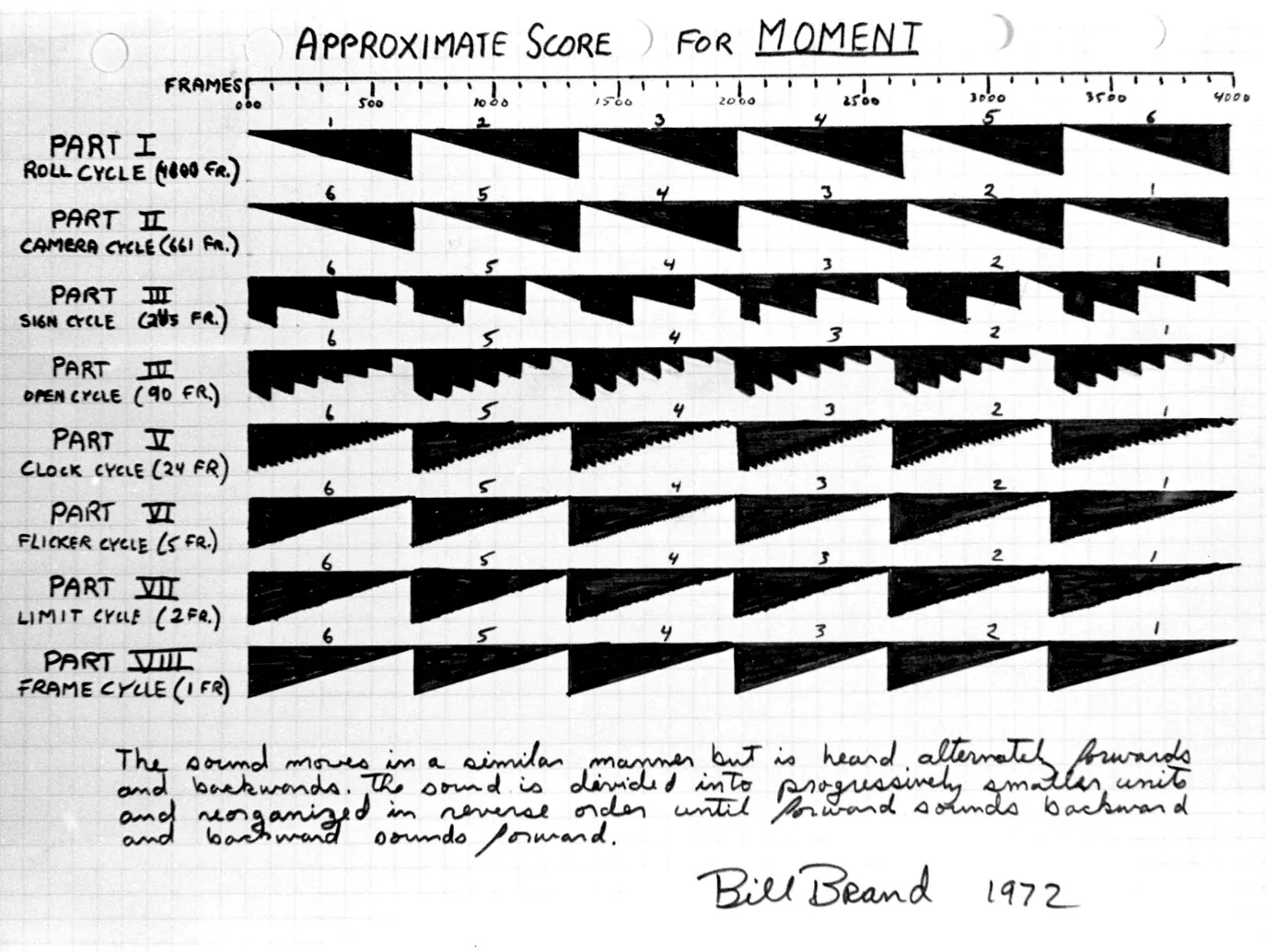
Somewhat less obvious is the case of Bill Brand’s film Moment (1972). In this film, the direct visual experience is enigmatic from the outset, and the viewer wishing to grasp certain aspects of the work would no doubt need several viewings, or even to take notes themselves until they could deduce the principle of construction behind the film. Fortunately, the artist pairs his film with visual instructions for use (Figure 15), making it more accessible. In this film by Bill Brand, one of the characteristics of experimental cinema appears in its purest form: works that oblige the viewer to abandon the “distracted” perceptual mode associated with commercial cinema in order to explore the modalities of an attentive perception, enriched by memory and intellect, in which the gaze can become as sensitive and affective as it is analytical and rational.
Cite this pageCórdoba, Pablo-Martín. “Analytical Function”. In Making Digital Images in the Light of Experimental Cinema — Anthropological and Political Resonances of Algorithms in Contemporary Art, Doctoral thesis in visual arts and photography, Université Paris 8 Vincennes-Saint-Denis, Doctoral School EDESTA (no. 159), research unit AIAC, 2026. https://www.pablomcordoba.com/thesis/analytical-function/