1.2.3
Autonomous Notations
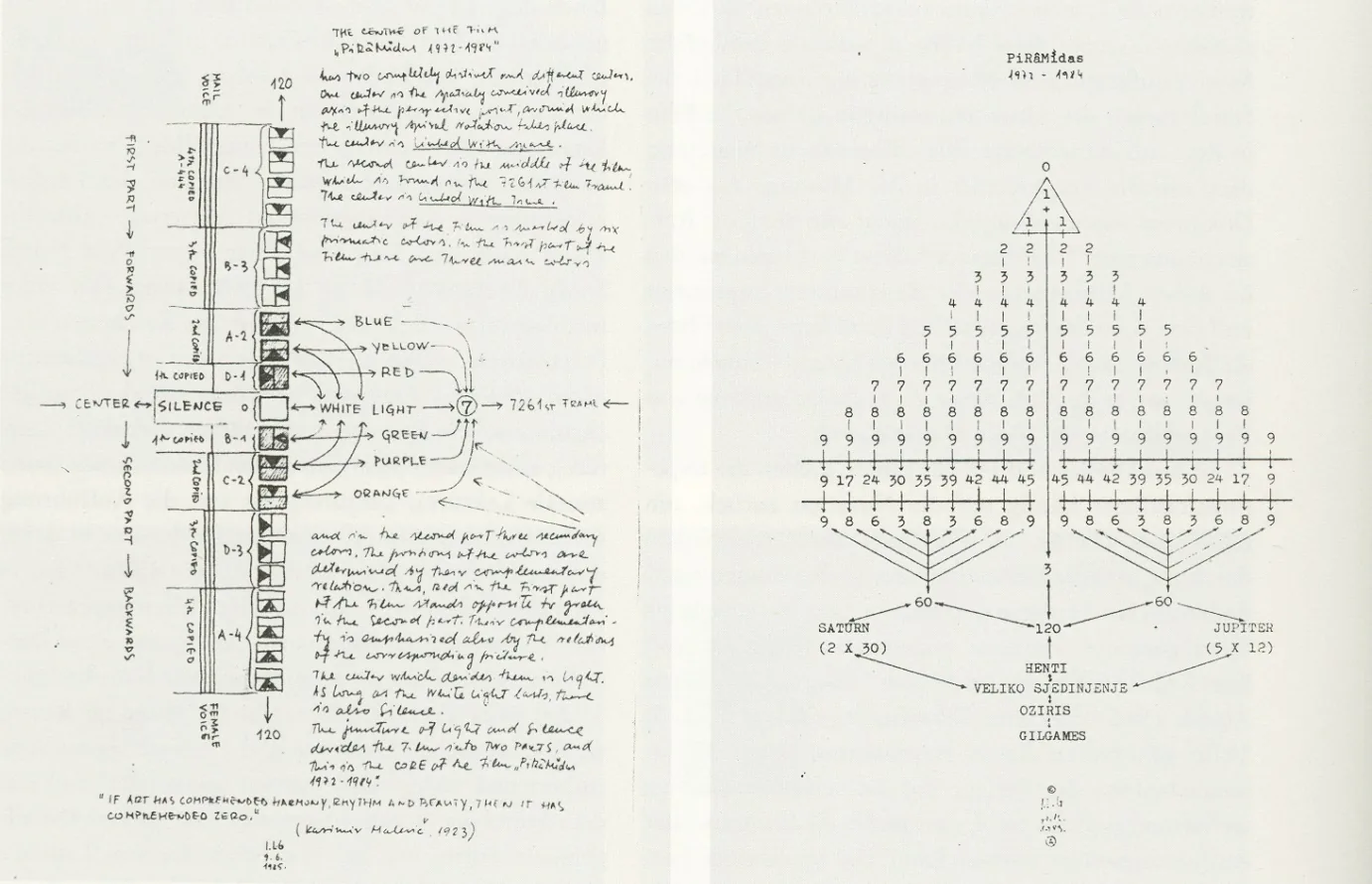
Some films maintain a particular relationship with their notations, one that goes beyond the operative role. Indeed, sometimes the center of gravity of the notation-film pair seems to shift from the film to the notation itself. In that case, the film is not built with the help of the notation; rather, the notation is elaborated, and the film follows from it. This is the case of the film PiRâMidas (1972-1984) by Ladislav Galeta. Here, the structure of the film is deduced from mathematical operations within a triangular and symmetrical geometry (right, Figure 12), whose roots refer to a form of mysticism with encyclopedic overtones1. The experience of the film seems incomplete, even difficult, without reference to the notation, which generates and explains the film.
Transposing into time the spatial symmetry of the original geometry, PiRâMidas consists of a tracking shot along a railway line, as if the camera were placed at the front of a train crossing an austere winter landscape, where bare trees stand, punctuated by the sporadic presence of low buildings. The image is rotated 90 degrees counterclockwise at intervals that grow progressively shorter until the middle of the film, where a colored flicker2 marks the end of the sequence, which is then reproduced in reverse, ensuring the symmetry of the 12-minute film. The structure of the film is described in “instructions for use3” (left, Figure 12) in English, which end with a sentence by Kazimir Malevich: Galeta’s film bears witness to a formalist approach that resonates with Suprematism. What is at stake would be the search for a beauty associated with a harmony of forms, whose epicenter seems to be the notation, which maintains an ambiguous relationship with the film, whose experience must be assessed in terms of time, and not only of space.
PiRâMidas takes to the extreme a formalism also present in Paul Sharits’s short film T,O,U,C,H,I,N,G (1972, figure 13), with which it maintains an evident dialogue. Yet, while in Sharits the generative principle of the notation lies in the rotation of a mandala – which gives the notation a certain depth and autonomy –, one could not say that the notation is more coherent than the film, for a good balance is struck: the film carries weight in itself. In T,O,U,C,H,I,N,G, we perceive what seems to be a heartbeat, introducing a rhythmicity that makes possible a flickering in which various portraits of the poet David Franks alternate, in positive and negative: either he seems to want to cut off his tongue with scissors, or his face is scratched by a female hand. The rhythm at which the images follow one another accelerates until the middle of the film, while the portraits of Franks are replaced by new still images, again introduced through flickering: explicit sexual images, surgery on a human eye, monochrome images of various hues (arising from the logic crystallized in the notation)… In a density of events that defies analysis, the sections of the film are delimited by the letters of the word touching, exploited in their plasticity without losing their semantic value (touching with the hand, touching with an instrument, touching oneself, being touched…). The notation, extremely rich, bears witness to the complexity of the film as well as to its symmetrical structure. Although it is partially deduced from a pre-existing structure (that of the mandala), it retains an operative function (as the working notes on the paper attest) as well as a marked pictorial resonance: Sharits’s notations, as we have already suggested, have pictorial value and have been exhibited in several museums and galleries.
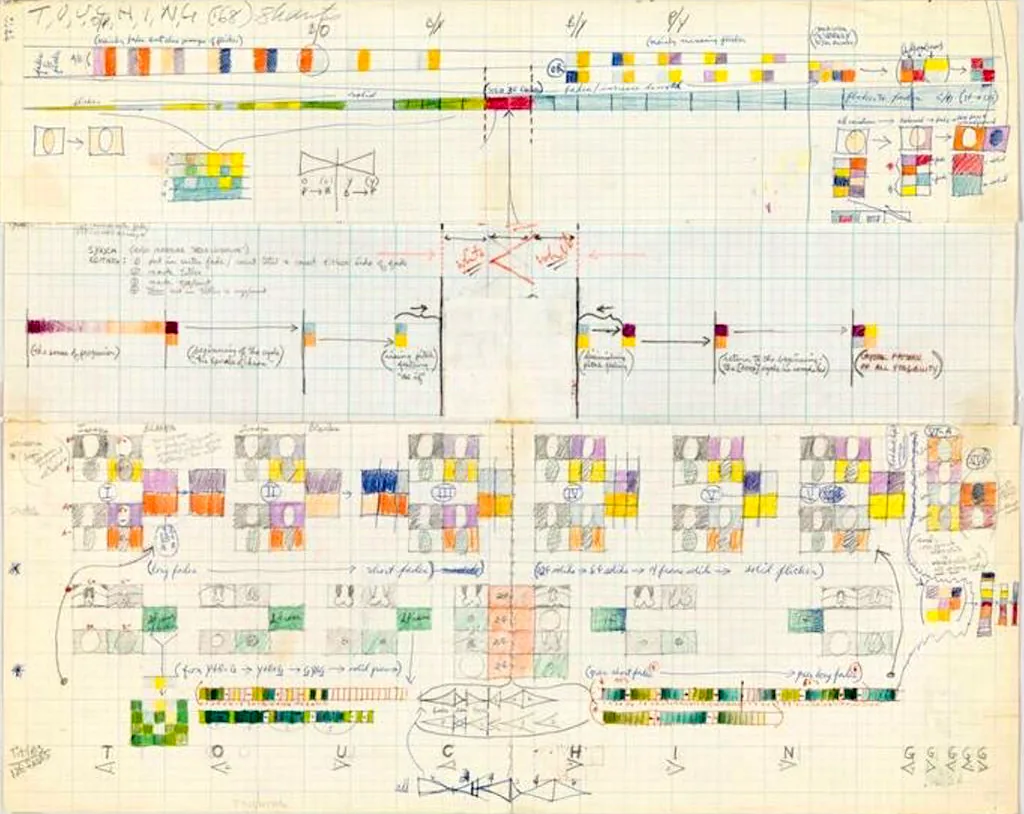
With its graphic and functional richness, the notation of T,O,U,C,H,I,N,G anticipates those of Rose Lowder – in which the operative function is also combined with a highly accomplished visual value – whose notations have been the subject of a recent publication. Indeed, the book Bouquets 11-20 : Notebooks by Rose Lowder, published in 2018 by VSW Press, presents the notations of ten of the artist’s films. The case of Sharits, whose notations become exhibition objects, and that of Lowder, whose notations are published, show that to the autonomy of the notation as the epicenter of coherence in the notation-film pair (Galeta), one must add a form of exhibition autonomy, based on the aesthetic value of the notation itself.
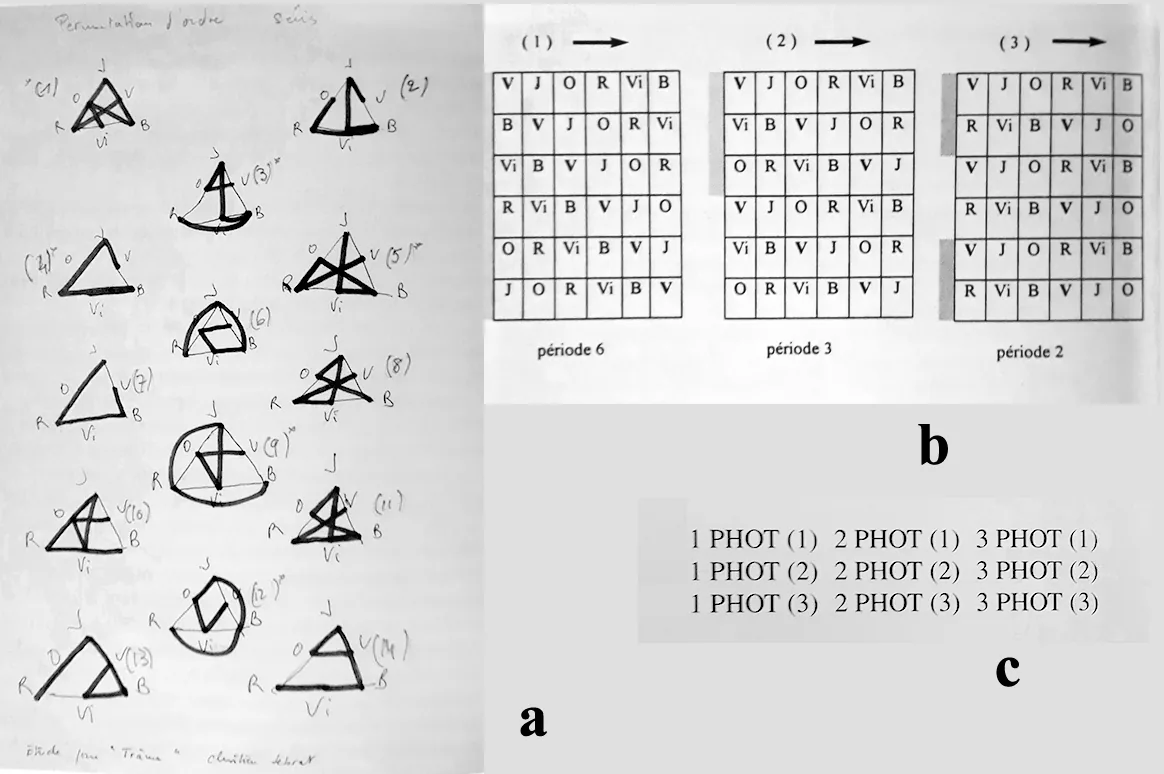
While it can be said that PiRâMidas as a film is generated by its notation, and that the notation of T,O,U,C,H,I,N,G originates in the rotation of a mandala, a form of autonomy can also be observed in the notations for Christian Lebrat’s film Trama (1980), which materialize a logical-deductive approach. In an almost scientific register, Lebrat studies the permutations of colors4 within the frame of the image, divided into six vertical bands of identical size. On the plane of the notation (which is also a space of calculation), the primary and secondary colors are used to fill matrices, from which the possible permutations are deduced, as well as the rhythms of change in speed. The visual result arising from the different combinations of parameters, within this system of great internal logic, is subjected – and this is crucial – to perceptual experience: it is the artist who “tests” the images and chooses which ones to keep, because they are associated with interesting perceptual effects5. To make it easier to visualize the “results,” the artist builds loops with the film reel. In the notation, we find geometric operators (Figure 14, a), matrices (Figure 14, b), and even vector variables (Figure 14, c). All of this ultimately serves the artist’s sensible choice, based on the visual renderings obtained by statistically exhausting the color combinations.
The film is dedicated to ancient civilizations, but also to Hermes Trismegistus, Lao Tzu, Albert Einstein and Wacław Spakowski.↩︎
By slowing down the image toward the middle of the film, one observes a succession of primary colors just before the halfway point, followed by secondary colors, all within a very short and imperceptible interval of time, a rapid progression indicated in the notation.↩︎
An expression borrowed from Yann Beauvais, in his 2008 article cited above.↩︎
Christian Lebrat, Entre les images: notes et réflexions sur mes films et le cinéma. Paris : Éditions Paris expérimental, 1997, p.74.↩︎
Within a given strategy, it is at the moment when the artist abandons themself to perception that the images are truly evaluated. In other words, it is during the artist’s sensible experience, faced with images in the process of formation, that their sensible value emerges. This process echoes what we will conceptualize as the analog virtual and the algorithmic virtual in chapter 3. Here, with his system of permutations, Lebrat generates the images as a computer would have done; yet, when it comes back to perceptual experience, the role of the artist — that of the human — cannot be taken over by the machine.↩︎
Cite this pageCórdoba, Pablo-Martín. “Autonomous Notations”. In Making Digital Images in the Light of Experimental Cinema — Anthropological and Political Resonances of Algorithms in Contemporary Art, Doctoral thesis in visual arts and photography, Université Paris 8 Vincennes-Saint-Denis, Doctoral School EDESTA (no. 159), research unit AIAC, 2026. https://www.pablomcordoba.com/thesis/autonomous-notations/