2.3.1
El túnel (2016)
In 2015, a work of exploring digital tools had led me to identify — and to choose — a system that made it possible to modify digital images at the scale of the pixel. This was the SDL library, widely used during the 2000s and 2010s in the creation of 2D video games, but already obsolete when I began using it. With this tool — and by extending, in a way, certain creative desires that had found expression earlier when working with film images — I wanted to create visual constructions by transferring forms between images, more precisely between images taken at different moments, of the same portion of a reality in motion.
The frame of the image would then not only be capable of preserving the trace of the past, but would also form a territory, a domain, where these traces could interact with one another, overlap, pile up. Through their accumulation, their amalgamation, their fusion, these traces would produce new forms. These, by virtue of their genesis — so I told myself — ought to be able to bear witness to reality in ways that escape perception, thanks to forms arising both from the movement of reality and from the functioning of the dispositif for capturing and processing images. At this stage, the reflection echoed the historical uses of image-capturing dispositifs for cognitive purposes — as in the experiments of Marey and Muybridge — but also, perhaps, more metaphysical uses, in the manner of the Bragaglia brothers.
A hypothesis put forward by Bergson was at work in the background. According to it, when human consciousness manages to broaden the reach of its memory through an effort of attention1, any perceived object (grasped by perception) can enter into resonance with the entities of the world to which it is connected: “We see that the progress of attention results in creating anew, not only the object perceived, but the ever wider systems with which it may be bound up2.” In this experiment with digital images, the idea was to muse somewhat playfully on this Bergsonian intuition. It was a matter of “playing” at producing an expansion of human attention like the one imagined by Bergson, but with the participation of the digital machine.
To this end, an assemblage of dispositifs was set up by trial and error, so as to ensure a circulation of the “captured” visual material. On the one hand, a remotely triggered camera captured new images of a simplified version of “reality in motion”: my body moving from right to left in front of a white wall. In parallel, a video projector, aligned with the camera, projected onto the wall (and onto myself), in alternation:
- a reference image, representing the completely white projection frame;
- each new shot;
- a “cumulative image,” built by progressively adding the difference between each newly captured image and the reference image.
The new captures were automatically sent from the camera to a computer, where a dedicated algorithm calculated the difference between each new image taken and the reference image, and then added this difference to the cumulative image.
From the computer, the images were transmitted to the video projector and projected back into the capture space. The camera, the computer running the algorithm and the video projector thus formed a closed circuit of images. This circulation was disrupted by the presence of a moving body, whose human forms were added to the cumulative image. In addition, a video camera, operating outside this closed circuit, filmed the unfolding of the action, giving the whole the form of a “video performance.”
What was I looking for with this uncomfortable experiment, mixing my body and its movements with the digital dispositif and its images? I imagined finding, in the cumulative image, amalgamated silhouettes of my body which, by fusing, would bring forth a new form bearing meaning. However, although this was a relatively simple assemblage of dispositifs, I was aware that unexpected phenomena could occur.
Indeed, during the performance, I could not help reflecting, through my expression and my gestures, a certain astonishment at the first images produced by the dispositif that had been set up. I had not anticipated the formation of what can be described as a telescoping of images, although, a posteriori, I was able to understand its origin: it results from the fact that the area captured by the camera is slightly larger than the one covered by the image projected by the video projector. On the other hand, I have not yet found a satisfactory explanation for the tendency of the images to drift toward an increasing saturation of colors, nor for the chromatic variations observed. For beyond the red that dominates from the beginning of the experiment, very dark blues, magenta and even yellow also appear (see figures). This is probably a feedback effect which, instead of dampening, diverges until it reaches maximum color saturation. This phenomenon may be linked to the camera’s automatic settings — exposure, white balance, etc.
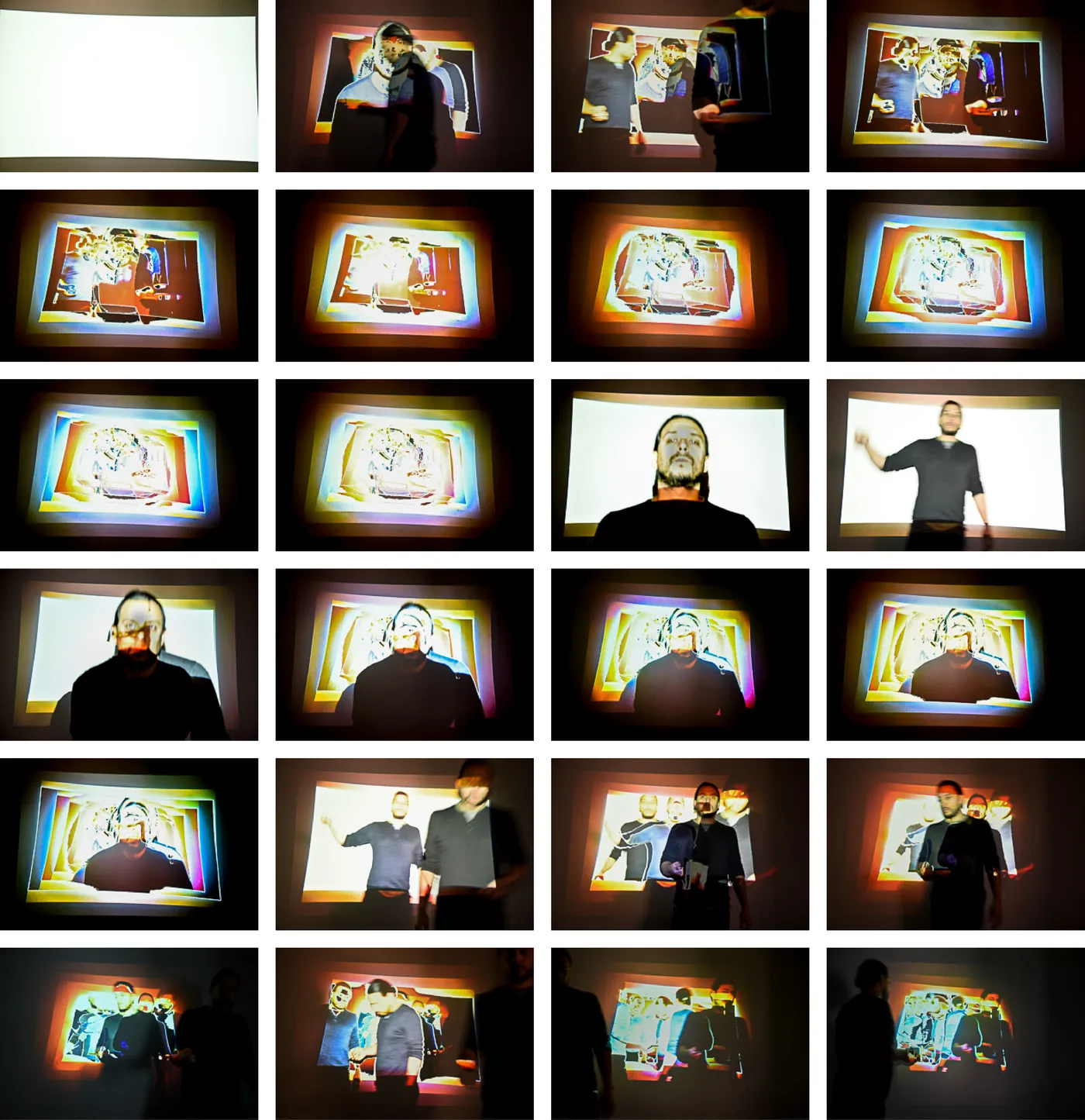
The initial project, which simply consisted in generating a new form from the superimposition of images of my body, was displaced – and enriched – in the very course of its making. Indeed, a “tunnel” seemed to be hollowing itself out in the image, as if the image refused to heap the traces of the past into the present; as if it demanded a more complex, deeper structure to represent the memory of bygone times… Moreover, the unexpected appearance of highly saturated colors drew the experiment away from the pseudo-scientific universe to which I was referring in the background, and whose coating of objectivity had until then seemed reassuring to me. These saturated images charged the atmosphere with an emotional content that compelled me to enter into a more subjective, more personal dynamic, one less easy to own.
The attention initially given to the mere generation of a visual form had to broaden, in order to apprehend complex forms that were materializing before my eyes. These images, born of a direct experience, seemed to want to “say” more. Through their material expression, denser than expected, they called for a surplus of meaning.
New keywords then appeared: passage, remembrance, human memory, machinic memory… In the formation of the image, I saw the dissolution of an individual – myself3 – into the expression of a machinic magma. The experiment took shape as a sensible reflection on the functioning of human memory, echoing machinic memory, and of course a tunnel necessarily refers to a passage, to a movement from one place to another. Today, faced with these images, I wonder about everything that, despite our incessant movements, keeps settling into a fixed form, in which we sometimes struggle to recognize ourselves.
The work was first titled El túnel de los recuerdos (The Tunnel of Memories), then, for the sake of openness, simply El túnel, in Spanish – without my being able to justify this choice otherwise than by an instinctive attachment to my mother tongue.
An effort whose nature, unfortunately, was not clearly specified by the philosopher.↩︎
Henri Bergson, Matière et mémoire, op. cit., p. 115↩︎
I have always found regrettable the interpretation of Peter Campus’s work proposed by – the otherwise brilliant – Rosalind Krauss, centered on a form of narcissism. Indeed, when artists stage themselves, it is often simply for lack of anyone else willing to take part in the experiment.↩︎
Cite this pageCórdoba, Pablo-Martín. “El túnel (2016)”. In Making Digital Images in the Light of Experimental Cinema — Anthropological and Political Resonances of Algorithms in Contemporary Art, Doctoral thesis in visual arts and photography, Université Paris 8 Vincennes-Saint-Denis, Doctoral School EDESTA (no. 159), research unit AIAC, 2026. https://www.pablomcordoba.com/thesis/el-tunel-2016/