1.3.1
Prefigurations
The paper notations studied do indeed prefigure several aspects of the mode of existence of algorithms and graphical interfaces, when these tools are mobilized in the creative processing of digital images.
Let us note first that some notations, as we have indicated, serve to determine — to “generate” — the characteristics of the frames on the celluloid film. This can be clearly seen in the notation for Christian Lebrat’s Trama (1980), the one for Bill Brand’s Moment (1972) and the one for Ladislav Galeta’s PiRâMidas (1972-1984). These notations thus herald, in certain respects, digital generative art, in which forms emerge from logical, mathematical or geometric principles, expressed through dedicated commands within algorithms1.
We have also identified an even more concrete role for paper notations: organizing and guiding the manual operations to be performed on celluloid, which we have called the operative function. Through it, paper notations prefigure what is known in the digital realm, following Harun Farocki, as operational images2. Whereas, by way of paper notations, filmmakers manipulate celluloid in an approach that retains a craft aspect, operational images set up the digital image as a kind of interface through which operations on the real are carried out by the machine, often (but not always) under the control of a human operator.
The principle of the loop, a fundamental structure in the functioning of algorithms3, also permeates the tradition of analog experimental cinema, despite the rigidity of the available apparatuses, in which the possibilities for handling time remain very limited. Indeed, analog cameras and projectors that allow image loops are rare and, when they exist, they are often handmade, built according to the needs and intentions of the artists4.
Regarding the structure of the image, we have observed that paper notations can organize various subdivisions of the spatiality of the image frame (Brand, Lebrat) and of the temporality of the film (Kubelka, Lowder and Brand again), as if it were a quest to reach the fundamental spatiotemporal components of the image, thus prefiguring the discretization of time and space (the pixel) that characterizes the digital medium.
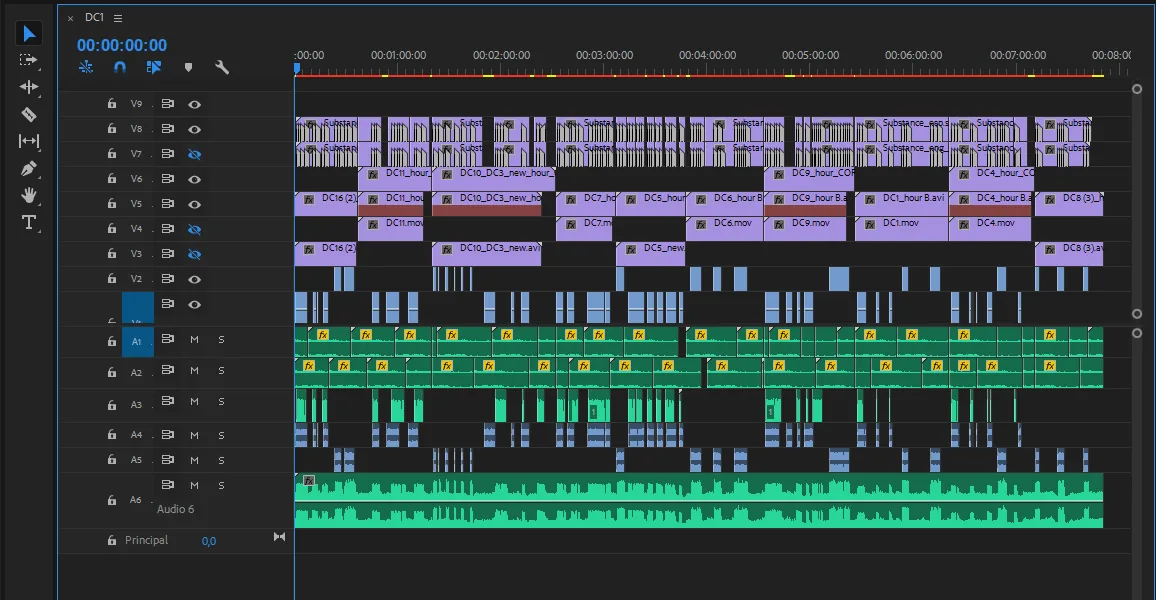
In general, it can be said that the notations associated with avant-garde films respond to a desire to arrange, within the temporality and spatiality of the film, distinct elements that can be combined in various ways. Editing is thus approached through the spatial organization of the available elements, according to a visual logic that is found in digital image-editing software. This can be clearly seen when comparing, for example, the notation of Paul Sharits’s T,O,U,C,H,I,N,G (Figure 13) with the appearance of the interface of a video-editing program (Figure 16): both organize sequences symbolized geometrically by horizontal bands, stacked on top of one another along a timeline, which follow one another and/or merge within the single visual and temporal register of the frame.
Finally, as already indicated, some paper notations can be apprehended as a transposition, onto the spatial plane, of a temporality with musical overtones, as Peter Kubelka’s approach attests. The notations associated with analog avant-garde films are thus brought into resonance with traditional musical scores5. Ultimately, it is a matter of transposing onto the register of image and/or sound graphic structures spatialized in two dimensions. This establishes a form of equivalence or analogy between the visual and sonic registers, prefiguring the process of “transcoding” made possible by the digital, when the same data structure is used to generate images and/or sounds6.
Several works among those grouped in the structurations category in the following chapter respond, in one way or another, to this type of dynamic.↩︎
It is in his video Eye/Machine (2001) that Farocki uses the notion of operational image for the first time.↩︎
With execution commands such as FOR/NEXT, WHILE, UNTIL, LOOP, etc. (the exact syntax depends on the programming language considered).↩︎
See in this regard the description of the loop projector developed by Christophe Goulard at the shared artists’ workshop L’Abominable, located in the suburbs of Paris: https://reevesmachine.com/16mm-film-looping-systems/↩︎
A preliminary version of the present analysis was presented in conjunction with a paper by Hélène Derieux on medieval notation systems of Gregorian chant, at the seminar of 9 February 2022 at the Sorbonne, as part of the inter-university and interdisciplinary conference “Le rythme au carrefour des arts.”↩︎
We will explore this possibility in the following chapter, in connection with the work Entwining of Lost Souls (2022) by the English artist Simon Le Boggit.↩︎
Cite this pageCórdoba, Pablo-Martín. “Prefigurations”. In Making Digital Images in the Light of Experimental Cinema — Anthropological and Political Resonances of Algorithms in Contemporary Art, Doctoral thesis in visual arts and photography, Université Paris 8 Vincennes-Saint-Denis, Doctoral School EDESTA (no. 159), research unit AIAC, 2026. https://www.pablomcordoba.com/thesis/prefigurations/