1.3.2
Transitional Elements
While paper notations prefigure digital functioning in several respects in the generation and editing of images, certain technical dispositifs established themselves as transitional stages between purely silver-based work and the use of algorithms. Such is the case of the optical printer, which consists of a camera aligned facing a projector — both analog — from which it receives images, one frame at a time. The optical printer was designed to create special effects and make copies in Hollywood in the 1920s, but it was only from the 1970s onward that it served the experiments of avant-garde filmmakers1. This dispositif can be considered an intermediate stage between editing on an analog editing table and the use of algorithms, especially from the 1980s onward, when programmable sequencers were added to optical printers2.
The analog video editing table, analyzed by Harun Farocki in his installation Interface (1995), is also an important element that thickens the technical evolution between celluloid film and the digital. In Interface, Farocki manipulates other people’s images: those that Paul Cozighian shot on 21 December 1989 in Bucharest, during the televised overthrow of Ceaușescu. Farocki focuses on the specificities of the technical assemblage, which determine certain characteristics of the relationship between the observer and the swarm of images — telescoped, time-shifted, coming from several sources —, images referring to the same event in different ways. Farocki himself compares the editing of celluloid film — associated with “physical” cuts in the support — with work on the electronic signal of video, which would involve only “imaginary” cuts in the flow of images. According to the artist, whereas in analog tactile contact with the image support remains possible — a mediating gesture of a “fine sensitivity” —, the switch to VHS video marks the loss of this sensitive gesture, which becomes an economic gesture, that of counting money3. In his video, Farocki expresses the nature of the technical transition under way, in which the appearance of new editing possibilities, combined with greater flexibility in the processing of images, goes hand in hand with a progressive detachment from the direct involvement of the artist’s body.
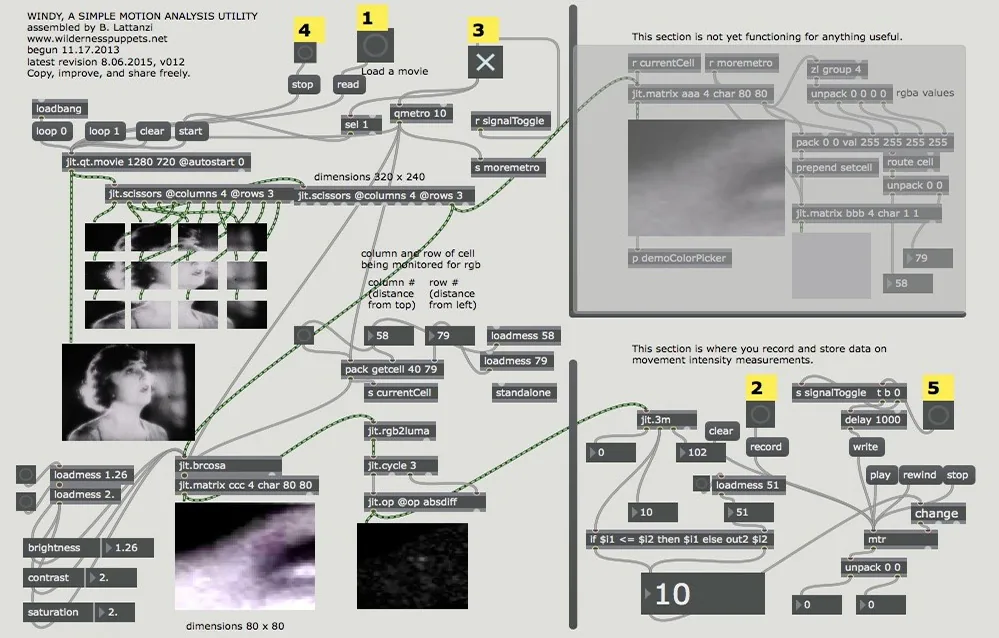
Moreover, visual coding systems associated with algorithms make perceptible, on the computer screen, the diagrammatic (and programmatic) aspect that links algorithms to the paper notations built by experimental filmmakers working with celluloid. Indeed, graphic systems for managing code, such as UML (“Unified Modeling Language”), as the artist Barbara Lattanzi points out4 (Figure 17), make it easier to grasp the “flow of operations” and visually reveal the temporal/conditional structure hidden behind the lines of code.
The dispositifs mentioned make it possible to trace a transition between the processing of images on celluloid, assisted by paper notations, and digital work relying on algorithms and editing interfaces. While the operative function — carried out by hand by the artist on the silver-based support — is progressively exteriorized within the computer, the analytical function seems on the contrary to dissolve at the level of the algorithm (without the implementation of a visual coding system), since reading lines of code has only a very indirect link with the spatiotemporal plasticity of the images that will result from them.
In fact, generally speaking, the technical passage from analog to digital cannot be represented as a simple, linear and complete process of exteriorization, since code cannot “absorb” the various aspects at work in the manual handling of silver-based images. A far more complex situation emerges from exchanges with artists working digitally: paper notations — or subjective, non-algorithmic notations made on a digital support —, different from those we have seen, continue to be mobilized by artists working digitally, often associated — but not always — with what seems to be a broadening of the operative and analytical functions associated with paper notations in the analog context.
Clint Enns, A brief history of algorithmic editing, op. cit.↩︎
Ibid.↩︎
In chapter 4, we will indirectly qualify these remarks by Farocki, since VHS video as well as the digital are to be associated with the forms of materiality of their respective supports, in which specific agencies are expressed that must be taken into account. Moreover, this research will seek to grasp a form of salience of gesture even in the digital.↩︎
In e-mail exchanges during 2020.↩︎
Cite this pageCórdoba, Pablo-Martín. “Transitional Elements”. In Making Digital Images in the Light of Experimental Cinema — Anthropological and Political Resonances of Algorithms in Contemporary Art, Doctoral thesis in visual arts and photography, Université Paris 8 Vincennes-Saint-Denis, Doctoral School EDESTA (no. 159), research unit AIAC, 2026. https://www.pablomcordoba.com/thesis/transitional-elements/