2.2.2
Personified Code
The previous section gave us the opportunity to grasp how Rosa Menkman, in A Vernacular of File Formats (2010), deceives the computer by forcing it to read a digital image according to the wrong protocols, a gesture from which deformed images arise. The production of forms then responds to a malfunction of the system orchestrated by the artist. A leading figure of glitch art – a practice structured on the machine’s error – Menkman has developed another type of creative strategy within the digital, one that does not depend on disrupting the computer’s functioning. It manifests itself when the artist manages to inject a form of human narrativity into an increasingly elusive and hermetic technological system.
When the Mathematical Operation Comes to Life
In DCT:SYPHONING THE 64TH INTERVAL (2015-2017), Menkman recounts an initiatory journey during which a “DCT parent” (DCT senior) takes their “DCT child” (DCT junior) to perform its first “Syphoning,” that is, its first processing of data in a digital image. The wager is a risky one, for the protagonists of this plot, which aims to be very human, are in reality 3D matrices shaped like cubes representing DCT blocks, DCT being the acronym for Discrete Cosine Transform, a complex geometrico-mathematical procedure – and a rather abstract one at first sight – that is fundamental to image compression.
In a didactic register frequent in Menkman’s work, the beginning of the video explicitly presents the DCT operation:
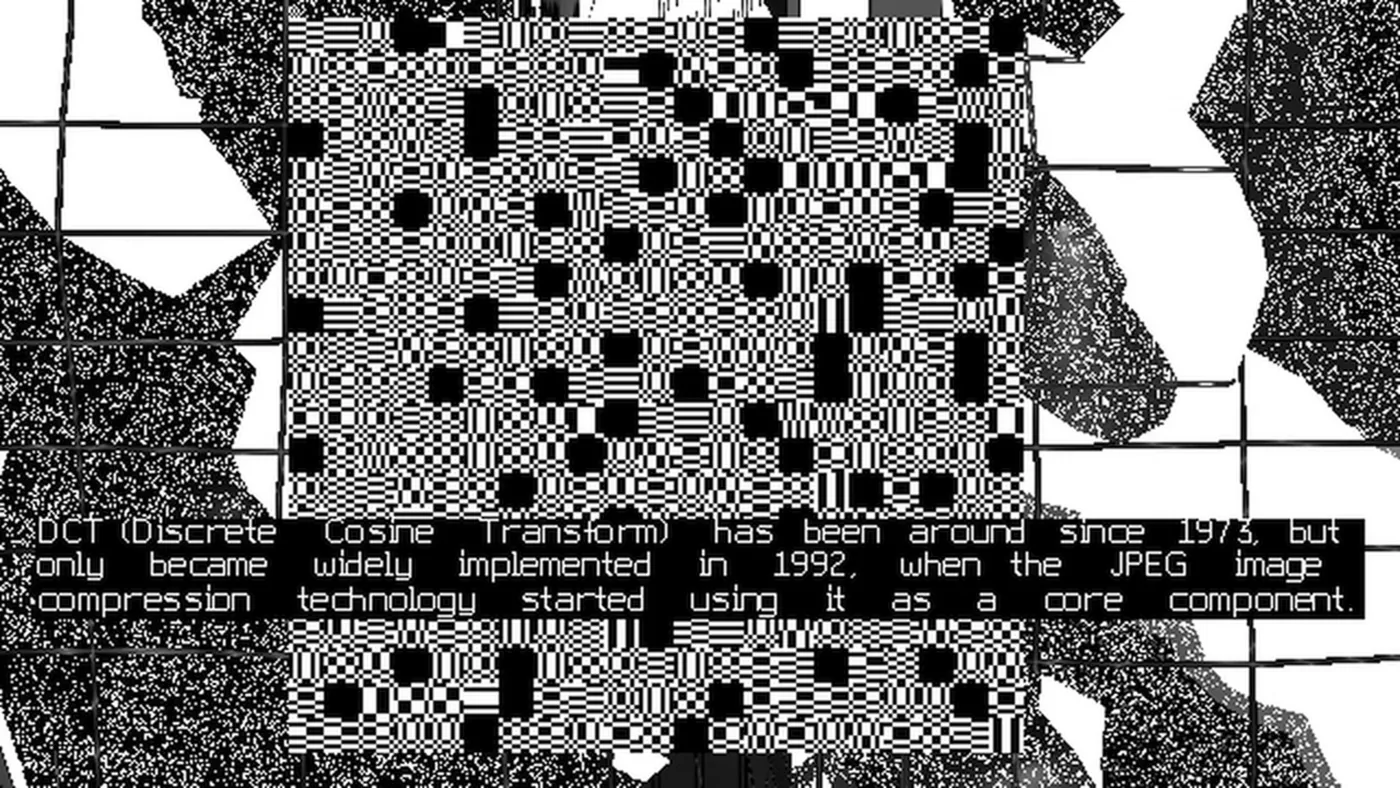
DCT (Discrete Cosine Transform) has been around since 1973, but only became widely implemented in 1992, when the JPEG image compression technology started using it as a core component1
Invented by the engineer and computer scientist Nasir Ahmed while he was working at Kansas State University, the DCT is indeed at the heart of the powerful image compression processes that led to the creation of the JPEG format for still images and MPEG for video. Without this invention, the gigantic flow of images circulating on the Internet today, like videoconferencing and streaming, would probably never have come into being.
From a technical point of view, the discrete cosine transform is carried out in several steps2:
- First, the image’s R,G,B color space is transformed into the Y,Cb,Cr system, based on luminance (Y), red chrominance (Cr) and blue chrominance (Cb).
- The image is then divided into blocks 8 pixels wide by 8 pixels high.
- Next, for each block, the values of each parameter (Y,Cb,Cr) are approximated by a linear combination of 64 predefined blocks, corresponding to the different frequencies.
- Finally, the image is transposed back into the R,G,B color space.
Since these predefined blocks, on the basis of which the image is approximated, are already known to the software, there is no need to rewrite them to cover the whole space of the image or its temporality (for video), which considerably reduces the amount of data associated with each image. Moreover, since the coefficients associated with the high-frequency blocks are generally very small, they can be eliminated outright. This compression method is therefore described as “destructive,” since it entails a loss of information compared with the uncompressed image (lossy compression). This loss, however, is almost imperceptible to the human eye, while the size of the image file is drastically reduced (by up to 80 or 90%, depending on the case).
The artist’s radical gesture lies in her capacity to transform these technical complexities related to the DCT into a resolutely human adventure. Without evacuating the technical aspect, Menkman wraps it in an emotional charge, in which technology enters into affective resonance with the spectator: the DCT child, now old enough, can at last learn from its DCT mother (or father) how to “compress” images.
The Digital Image, Scene of Adventure
At the beginning of the video, in the absence of the characters, the solitary spectator is led by the virtual camera across a space populated by flat structures with geometric patterns, collapsing along with kinds of flickering topographies. The image then appears as a dynamic assemblage of surfaces of varied natures, dominated by a strongly contrasted black and white. In this strange setting, geometric forms negotiate the available space with elements with irregular contours, reminiscent of the mineral world. At this moment, we have the impression of traveling through a succession of landscapes with permeable limits, mobile landscapes revealed by the camera as it flies over them. These forms offer a metaphorical vision of the inside of the digital image as one might imagine it: of great geometric complexity, resting on a support that is solid but not static, matter traversed by electrical flows.
Following this visual introduction, with our characters now present, we witness a first, failed attempt at compression in the face of the resistance of a three-dimensional tesse-react, an event that had been predicted to DCT senior by a sphere – the personification of wisdom. It is on a two-dimensional “rasterized” image, identified as “pixel art,” that DCT junior will at last be able to begin its first compression, which will lead it into an abyss of lines, themselves become animated textures, defining compartments of animated arabesques across the frame.
These images are accompanied by a dull noise, evoking an electrical interference of varying intensity, consistent with a visual sweep that carries us along with our characters toward a new universe. The latter symbolizes the next step in the compression process, or else simply indicates the passage into a new color space (Y,Cb,Cr), marked by the appearance on screen of subtle touches of red and blue. At this stage of the film, about three quarters of the way through, the space becomes increasingly anxiety-inducing. Opaque, animated surfaces progressively enclose our characters, who, as if suffocating, move with difficulty while temporality itself disintegrates. The entities within the image, including our characters, leave behind them traces that define forms as they move. Everything is then affected by a vibration in crescendo. Our characters are frightened, and DCT junior cries out: “this is madness!,” realizing that it is not ready for such an acceleration.
A vertiginous passage then takes place, as when Alice, in Wonderland, falls down the rabbit hole, or as in The Matrix when Neo takes the red pill, or again as in 2001: A Space Odyssey when the astronaut-hero Dr. David Bowman travels the end of his journey at the speed of light.
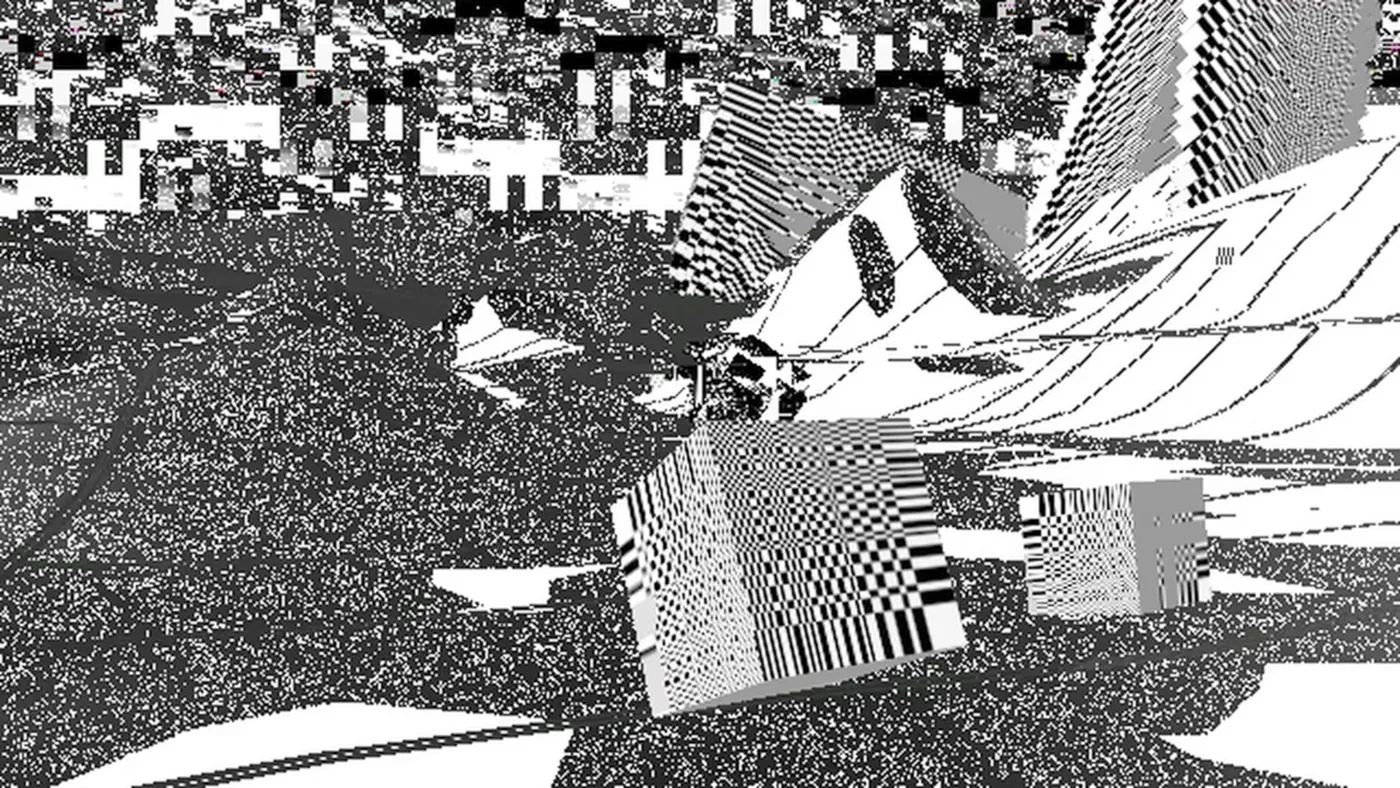
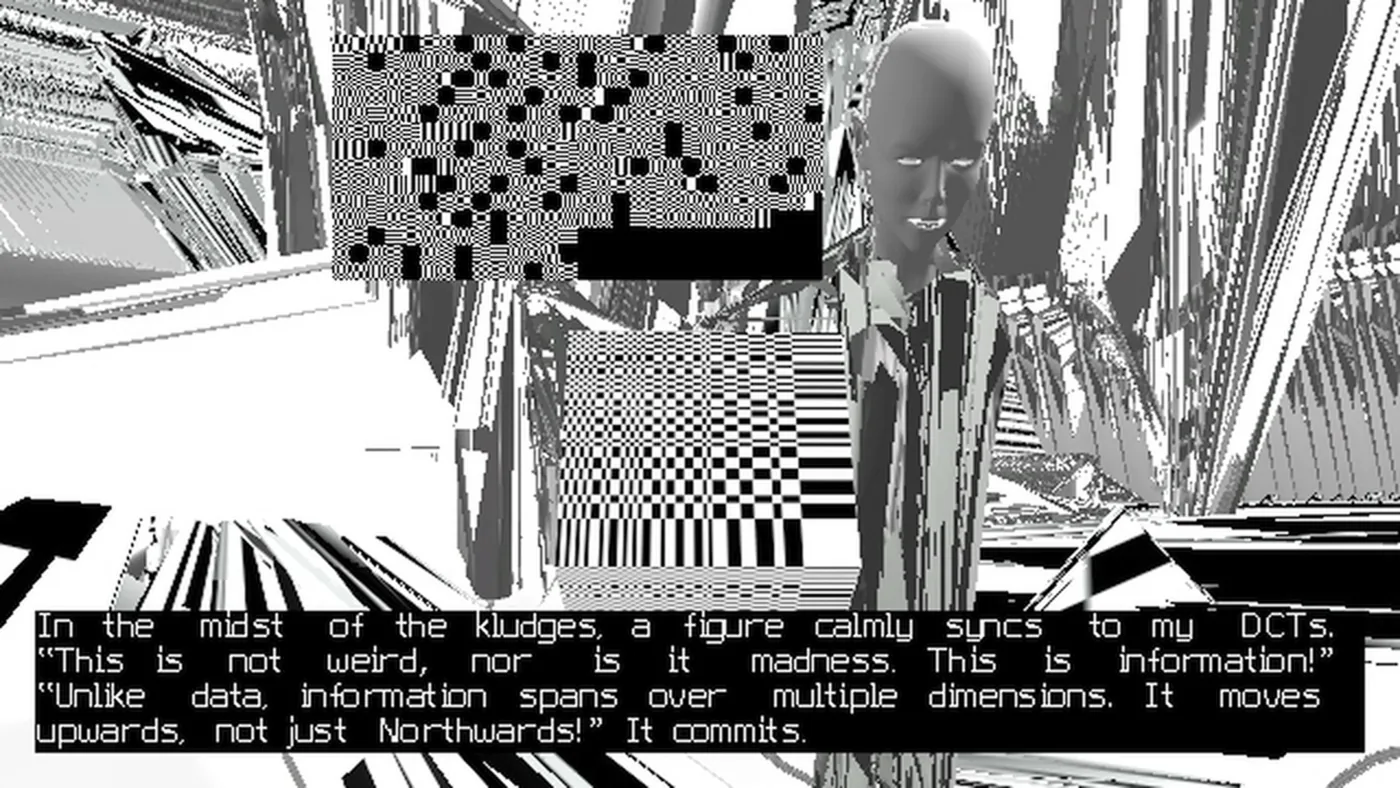
The atmosphere then becomes calmer, the landscape becomes more pixelated, and artifacts begin to appear in the image. We are probably within the already compressed image. A third character, in the form of a human mask, appears to reassure our heroes, explaining to them the difference between a “datum” that evolves on the plane and “information” that occupies the third dimension. At this moment an organic register discreetly emerges: green, animated, pixelated shrubs sway gently in a simulated wind. The short – but intense – epic, marked by incessant geometric transformations, draws to a close. We arrive at a landscape where a geometrized tree rises upward, leaving the frame, on a blue marbled base, surrounded by small black-and-white checkered dodecahedra that circle around it like birds.
Narration Reinvested
This narrative dimension that Menkman introduces into her representation of technics echoes what she had theorized about the cool glitch in 2010:
Cool glitches are the glitches that do not (only) focus on a static end product, but (also) on a process, a personal exploration or a narrative element (that often reflects critically on a medium)3.
It is important to emphasize that the narrative aspect is problematic in the tradition of experimental cinema, where narration, stemming from language, is perceived as the privileged vector of a power that legislates – and controls – on the basis of the intelligibility of words4. In Menkman’s case, moreover, this is not a form of prediscursive narrativity emerging from the material body of images, as we will see in Perconte. On the contrary, Menkman uses the narrative element in a resolutely traditional way5. This approach, outside the tradition of experimental cinema, seems justified in the context of the digital, a technology whose functioning is not only difficult to understand but quite simply impossible to perceive directly, since the electrical flows on which it is based take place outside the threshold of the space-time perceptible by humans. Moreover, as we will see6, the digital and the Internet have been marked by various equivocations and misunderstandings, intentional or not, which have muddied the tracks that might clarify the mode of existence of this technology, which has become a means of domination. In this context, recourse to narration, even in its classical form, makes it possible to render sensible territories hitherto inaccessible, related to technical aspects that are fundamental when it comes to apprehending the medium. This is how narration finds renewed value within the digital.
The Politicized Machine
Menkman makes no secret, in making this work, of the inspiration she found in Flatland, a geometric allegory written by Edwin Abbott Abbott in 1884. Flatland stages several levels of geometric hierarchy: first among the inhabitants of universes of differing complexity, and, within each universe, a formal man-woman hierarchy. Thus, in Lineland, a one-dimensional universe, men are lines while women are mere points, both of a lower rank than the inhabitants of Flatland, where women are lines while men take the form of polygons; and finally, the most important universe, Spaceland, where the spheres live. While Edwin Abbott Abbott’s fantasy novel criticized the highly hierarchical Victorian society of the nineteenth century, can we detect a critical dimension in DCT:SYPHONING THE 64TH INTERVAL?
We have already mentioned, in the previous section, Rosa Menkman’s capacity to bring the human and the machine together, creating points of tension. This characteristic trait of the artist’s creative process is manifest in several of her works, particularly in A Vernacular of File Formats (2010), where we evoked a form of heuristic of humanizing the machine. This strategy is pushed further in DCT:SYPHONING THE 64TH INTERVAL, where the specular human-machine structure of A Vernacular of File Formats merges into a single entity, the humanized technological element – the DCT characters – whose existential depth is built from a fictional series of events, a very human adventure that the technological element goes through. Menkman skillfully plays with specialized technical language and the jargon of “coders,” from which she pertinently weaves metaphors for “more human” aspects: the DCT child is ready to compress images when it reaches its 64th interval (the right age); the DCT mother “parses7” information (she analyzes, processes, understands); she strives to retain her observations in her “stack” (memory); and together, mother and son perform their first “syphon” (a metaphor for a bike ride, a fishing trip, etc.). The heuristic of humanizing the machine here allows the spectator to perceive, in a sensible way, a technical aspect (the discrete cosine transform, DCT) which, in its purely mathematical presentation, would probably not have aroused any emotion, or even captured their attention.
Through this strategy of personifying the machine, Menkman attempts to overturn an attitude that prevails today in the human sciences, in which technics is considered to stand in an insoluble relation of opposition to the human, which constitutes a genuine epistemological obstacle denounced by Gilbert Simondon:
The opposition drawn between culture and technics, between man and machine, is false and without foundation; it only covers up ignorance or resentment. It masks behind an easy humanism a reality rich in human efforts and natural forces, and which constitutes the world of technical objects, mediators between nature and man8.
Menkman’s staging of personified technics in digital images inscribes them within a reflection that is ultimately political, one that questions the capacity of technics to create hierarchies within – and between – human societies, a state of affairs that belongs to a fatalistic conception of the human’s bond with technics. Thus, as emerges from the artist’s work, it would not simply be a matter of containing the effects of a technology which, as it develops, alienates nature, including the human itself, a vision that predominates in Heidegger. On the contrary, echoing Simondon, Menkman seems to propose an epistemological reformulation, allowing the human to grasp the evolution of technics in order to direct it toward emancipation.
From the work’s synopsis9, interesting aspects of the artist’s approach emerge: it is a fiction in which compression tells its own story, as if it were endowed with a becoming. Radicalizing her gesture, the artist evokes a form of “ethnography of compression,” which raises the question of the “life” of the technical element, which would then lend itself to a “social” gaze, acting in a human environment.
Standardized Ruins
The synopsis also clarifies the moment of tension we mentioned in the video, when the characters – DCT parent and DCT child – are buffeted during a difficult passage, symbolizing the encounter with a more recent compression technology, a change that DCT junior struggles to keep up with. This moment highlights a more specific aspect of Menkman’s critique, which she addresses to the technological dynamic of innovation, in which new inventions replace old ones unquestionably, as if innovation could justify itself, as if it were self-evident. This “self-evidence,” however, appears increasingly out of step with the contemporary situation, notably as regards the state of humanity and the state of the planet. We also find this critique of innovation in the video The collapse of PAL (2010), in which the artist offers a requiem for the PAL technology made obsolete by the advent of the digital. In Menkman’s universe, obsolete technologies are imbued with a form of sublime solemnity, as if the artist perceived in them something akin to Benjaminian ruins10.
The critique of technological innovation proposed by Menkman is accompanied by the desire to unveil technology’s capacity to normalize the real, including the human11. The artist explores normalization through themes such as the standardization of the female face, or the aesthetic “improvements” offered by technological applications12. This bringing together of the technological element and the human element in Menkman’s work offers a ground of heightened visibility and understanding, from which a sensible position with regard to technological evolution can emerge.
Let us say, by way of recapitulation, that through DCT: SYPHONING THE 64TH INTERVAL, Menkman sets the digital image, as a technological element, in tension with the problematic aspect of its own evolution. As if to point the finger at a technics engaged in a headlong rush that hierarchizes, introduces differences, normalizes and discriminates between elements of the real that nonetheless stem from the same plane. As if to criticize a technics that compartmentalizes without offering points of connection, that homogenizes by eliminating differences.
However, the critique suggested by Menkman does not imply distancing oneself from technics – quite the contrary. The artist raises the problematic aspects of technical evolution while bringing technics closer to the human, by “injecting” the human – the poetic – into technics, and by injecting technics into the human. In DCT: SYPHONING THE 64TH INTERVAL, the artist achieves this by setting up an improbable but fertile narrative structure, which brings human experience closer to very abstract technical procedures.
This fundamental gesture of Menkman’s acts beyond the body of the image, at the level of what Manovich calls the cultural layer, a level where what matters is what the image means, what it is from a cultural point of view. The image may be photojournalistic, illustrate encyclopedias, or again be a work of art. It is rare, however, to see an image become the main character of a story, and rarer still to see a technical operation – operating behind the scenes – become personified and the hero of a fiction.
We will next examine another work which, like Menkman’s, operates beyond the images themselves in order to create, this time, a new level of image, resolutely plastic, in which complex collages are built through the spatio-temporal multiplication and assembling of pre-existing sequences.
Original English quote.↩︎
The DCT method is explained here in a very schematic way. For a more detailed description, see for example the following video on the Computerphile channel on YouTube https://www.youtube.com/watch?v=Q2aEzeMDHMA accessed 24 July 2024.↩︎
A reflection included in the work A Vernacular of File Formats (2010). Original English quote.↩︎
This observation is clearly formulated in the paragraphs that make up The Limits of Control, published in 1978 by William Burroughs, paragraphs that seem to have been written yesterday and with respect to the current situation in several Western countries. Website for a French translation: https://www.lapublication.fr/2020/04/30/les-limites-du-controle-par-william-s-burroughs/ accessed 21 October 2024.↩︎
The adventure lived by the DCT characters in this work by Menkman follows very classical narrative schemas, such as the Hero’s Journey described by Joseph Campbell.↩︎
In chapter 5.↩︎
A term that comes from the English to parse, the equivalent of analyser in French.↩︎
Gilbert Simondon, Du mode d’existence des objets techniques, op. cit., p.9.↩︎
Web link: https://beyondresolution.nyc3.digitaloceanspaces.com/DCT64thinterval.pdf accessed 26 July 2024.↩︎
We saw this expressed in A Vernacular of File Formats as well.↩︎
Thus, ironically, Menkman titled her 2011 solo exhibition at the Fabio Paris Art Gallery in Brescia, Italy, Order and progress.↩︎
The artist specifically studies, by diverting it, the Perfect365 software.↩︎
Cite this pageCórdoba, Pablo-Martín. “Personified Code”. In Making Digital Images in the Light of Experimental Cinema — Anthropological and Political Resonances of Algorithms in Contemporary Art, Doctoral thesis in visual arts and photography, Université Paris 8 Vincennes-Saint-Denis, Doctoral School EDESTA (no. 159), research unit AIAC, 2026. https://www.pablomcordoba.com/thesis/personified-code/