3.2.9
Programming Gestures, Animation Gestures
The gestural genesis reconstructed in the preceding paragraphs for calculation, over the course of which gesture is exteriorized into the machine first by mechanical means (Pascaline, Babbage’s machine), then by electromechanical ones (ENIAC, Manchester Mark I), unfolds in parallel with another gestural genesis, very close to the concerns of this research. This is the evolution of image animation dispositifs, from the seventeenth century with the magic lantern – made by Christiaan Huygens in 1659 – to the end of the nineteenth century with Émile Reynaud’s Théâtre optique (1888) and the Viviscope (1893), a technical lineage over the course of which a form of animation gesture was exteriorized into the machine, in a movement leading to the cinematograph invented by the Lumière brothers in 1895.
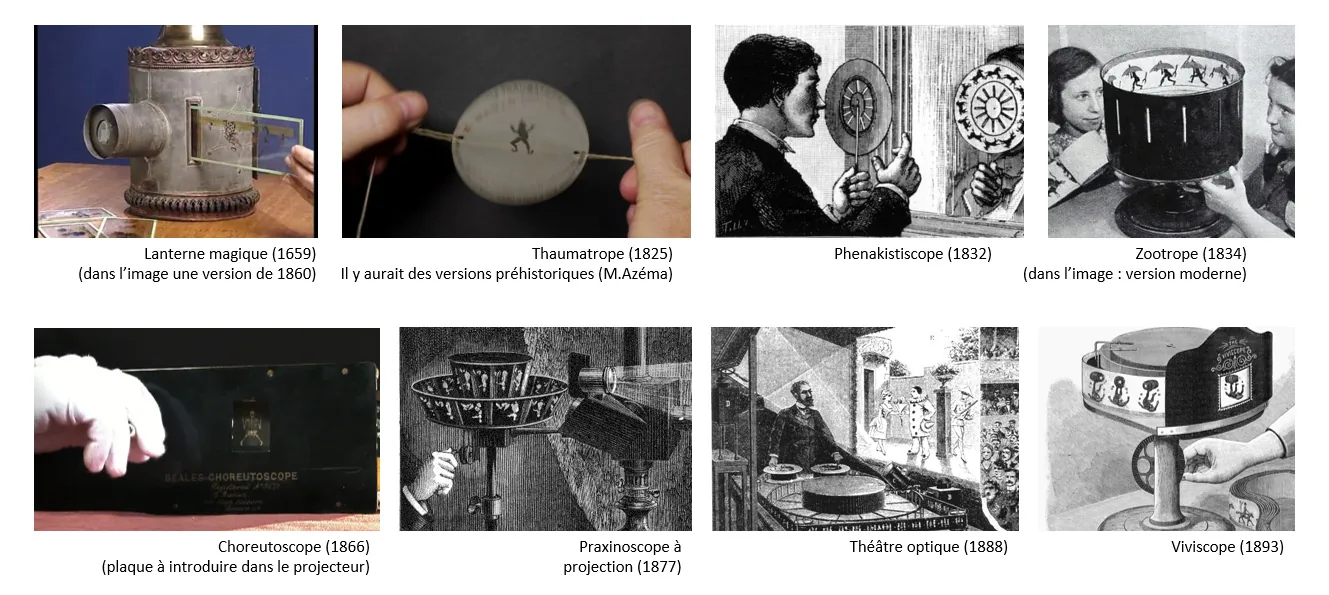
This is the exteriorization of two types of gestures: besides the gesture of activating the animation, the gesture of manually creating the images was also exteriorized. Indeed, whereas in artisanal dispositifs the images were painted individually, this intervention was transferred to the machine with the cinematograph. The latter implements photographic capture, producing indexical images entirely automatically.
In this passage, from artisanal animation dispositifs to the cinematographic dispositif, Lev Manovich1 observes a distancing of moving images from human gesture, a deviation of cinema from its original genesis: “A mechanical eye was coupled with a mechanical heart; photography met the motor.” Cinema, now founded on photographic capture, would come to be structured around a narrative vocation, relegating its artisanal origins to the art of animating images, considered “cinema’s bastard relative, its supplement, its shadow2.”
For Manovich, the advent of the digital signifies a movement by which cinema returns to its artisanal origins, with new technological possibilities (algorithms) that restore a relationship of plastic construction to images: they can be cut up, chromatically altered, recombined, etc. With the digital, the traditional mode of existence of cinema becomes one possibility among others: the flatness of the image may or may not be favored when one can build 3D spaces; recourse to captures of the real becomes an option in the face of a technology that, abandoning photographic indexicality – still according to Manovich –, achieves the feat of constructing its images ex nihilo.
These claims of Manovich’s (which date from the 1990s) deserve to be nuanced on two counts. On the one hand, traditional cinema, though certainly based on the capture of a scene taking place in reality, has never been as transparent as Manovich suggests. Despite the rigidity of celluloid compared to the increased plasticity of digital pixels, analog industrial cinema has been a site of multiple manipulations of the image, even though these were often concealed or disguised. On the other hand, the vision of the digital as a medium capable of doing without the real thanks to its capacity to simulate it completely has proven inaccurate. Today, faced with the failure of the realistic simulation of the living, we observe the flourishing of forms of indexicality in digital cinema as in video game creation, where various captures take part in the fabrication of images: 3D scans, photographs, video captures, and above all photogrammetry.
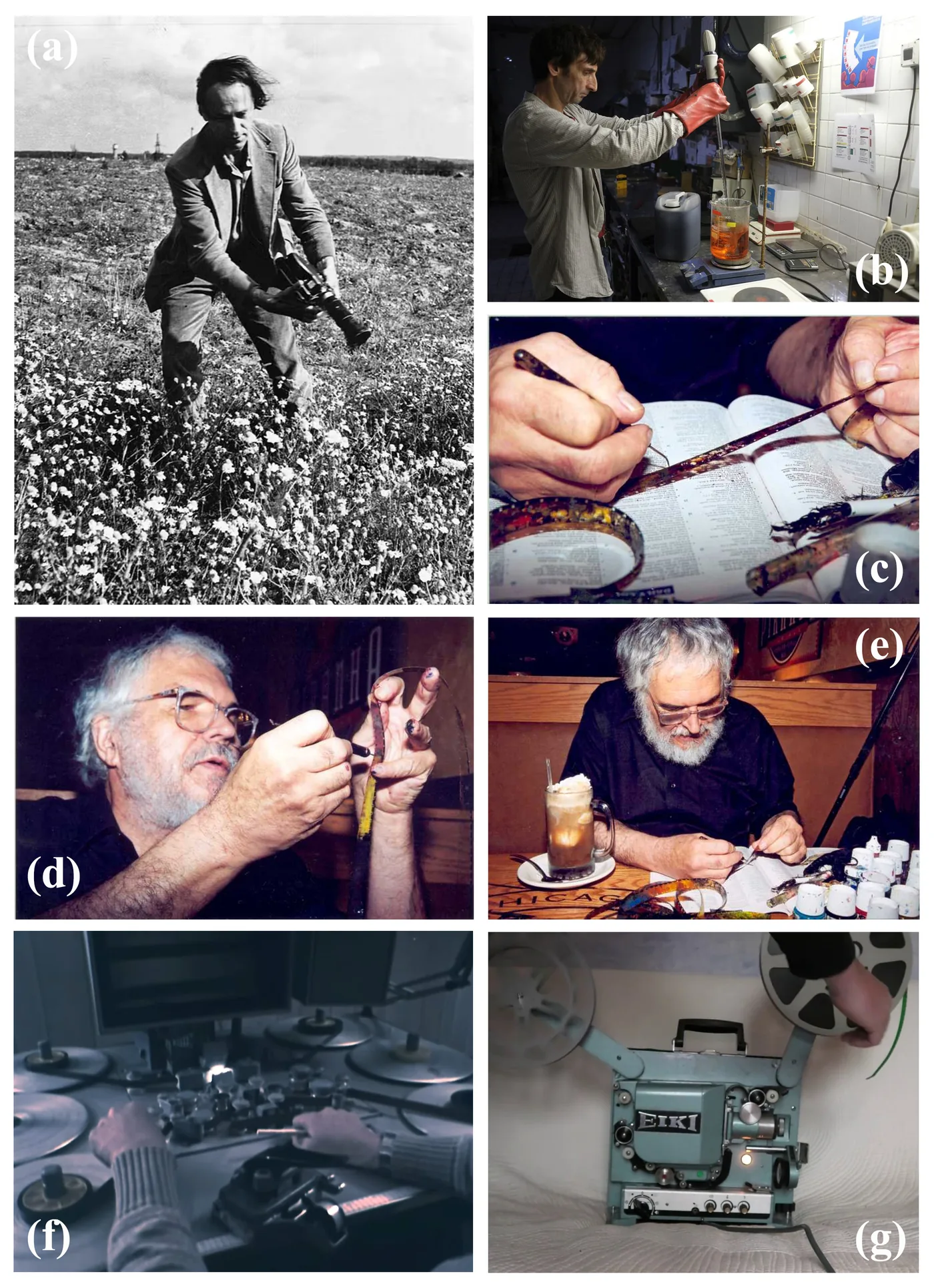
Another remark also deserves to be made. When Manovich sees, in the passage from the artisanal animation dispositifs of the nineteenth century to the cinematograph, an abandonment of the gesture of manually constructing images, he fails to recall that analog cinema also took shape in a tradition parallel to industrial cinema (and far less popular), one that managed to preserve the characteristics of an artisanal practice articulated with a rich theoretical reflection. This is analog experimental cinema – which guides this research on the digital –, a place where images were often constructed individually, manipulated, deformed, altered by creative intervention on the celluloid support, the scratchings of film carried out by Stan Brakhage being emblematic in this respect. Indeed, within experimental cinema, various explicit forms of gesture continued to exist, including during the developing, printing and editing of the film, operations often carried out by the artist-filmmaker himself.
These remarks in no way call into question the relevance and visionary character of this text by Manovich, which remains extremely interesting thirty years after it was written. It joins a felt sense at the heart of this research, according to which the practice of digital cinema extends traditional artistic making in several respects. Manovich maintains that with the digital, cinema reconnects with the artisanal animation of images and, radically and no doubt polemically, asserts that it becomes a subgenre of painting. This is debatable, but far more relevant than saying that the digital would belong to “language,” as if it were a new territory conquered by literature.
With the digital, Manovich asserts, video captures are no longer a final product, but the raw material for new manipulations. Thus, “while retaining visual realism unique to the photographic process, film obtains the plasticity that was previously only possible in painting or animation3.” It is as if, without paradox, the surplus of possibilities for automation introduced by the computer were combined with new territories open to manual intervention:
We usually think of computerization as automation, but here the result is the reverse: what was previously automatically recorded by a camera now has to be painted one frame at a time. But not just a dozen images, as in the 19th century, but thousands and thousands4.
Manovich thus sees a renewed link between painting and digital cinema, which algorithmically “paints” images one by one. This link, lost – according to the author – during the analog period of cinema, was still at work in the prehistory of cinema, with the dispositifs we have seen – thaumatrope, phenakistiscope, zoetrope, etc. – capable of producing the illusion of movement from still images painted by hand. Manovich very pertinently emphasizes that these pre-cinema dispositifs prefigure a fundamental function of algorithms: execution in a loop. These loops were indispensable in nineteenth-century dispositifs, since the illusion of continuous movement resulted from the repetitive chaining of the same gesture (a step in walking or running, a turn in dancing, etc.), within an animation that ultimately depended on very few images (2 for the thaumatrope, 12 for the phenakistiscope and the zoetrope).
In the twenty-first century, the memory capacities that the digital enjoys allow animations with a far greater number of images5; loops nevertheless remain essential within algorithms, ensuring the feasibility of procedures that must apply to thousands of images, or to all the pixels of a certain number of images, etc. This is achieved through the use of commands such as repeat, while, for/next, for each, with different syntaxes and characteristics depending on the programming language.
Another aspect present in certain pre-cinema dispositifs, as Manovich points out, prefigures a characteristic found in digital cinema. This time it is what the author calls “spatial montage,” through which images from different video sequences, or from the same sequence at distinct moments, can coexist on screen. This principle was already present, in embryonic form, in dispositifs such as the magic lantern – where several images coexisted on the glass plate – or in Robertson’s fantascope as early as 1799, where operators equipped with magic lanterns moved fragments of image within the frame.
The principle of the loop and that of spatial montage, at the heart of the experience offered by pre-cinematic dispositifs, reappear in the digital through a myriad of works, such as Flora petrinsularis (1993) by Jean-Louis Boissier or Little Movies (1994-) by Manovich himself.
Digital cinema, Manovich concludes, marks a return of cinema to its artisanal genesis, in what he proposes as a movement from Kino-Eye – the “cinema-eye,” in which Dziga Vertov saw a perceptual revolution arising from the mechanical observation of the real – to Kino-Brush, the cinema-brush, forged through the pictorial gesture. If, in traditional cinema, images follow one another by replacing one another, in digital cinema they coexist and are superimposed, whether visible or only potential in the technological dispositif. More fundamentally, the author points to a transformation: from traditional cinema, a cinema of perception, to digital cinema, which would be a cinema of memory.
Lev Manovich, «What is digital cinema? ». dans : DENSON, Shane and LEYDA, Julia (dir.), Post-cinema: Theorizing 21st-century film [en ligne]. Sussex : REFRAME Books, 2016, p. 20–50. disponible à l'adresse : http://reframe.sussex.ac.uk/post-cinema/2-2-manovich/.↩︎
Ibid.↩︎
Lev Manovich, « What is digital cinema ? », dans Post-cinema : Theorizing 21st-century film, op. cit.↩︎
Ibid.↩︎
Although the effects of video compression must be taken into account, without which none of our computers would be able to play a 2K video, for example; streaming would also be impossible.↩︎
Cite this pageCórdoba, Pablo-Martín. “Programming Gestures, Animation Gestures”. In Making Digital Images in the Light of Experimental Cinema — Anthropological and Political Resonances of Algorithms in Contemporary Art, Doctoral thesis in visual arts and photography, Université Paris 8 Vincennes-Saint-Denis, Doctoral School EDESTA (no. 159), research unit AIAC, 2026. https://www.pablomcordoba.com/thesis/programming-gestures-animation-gestures/