2.2.3
Hollywood in Tatters
The work of Gregg Biermann, an American experimental filmmaker, interests us for two main reasons. First, this artist has built most of his films1 through the implementation of algorithmic approaches: he uses digital tools, dedicated algorithms built by the artist but also editing software, to give form to montages that would be difficult to achieve with analog means2. Second, Biermann interests us because he belongs fully to the orbit of experimental cinema3, the tradition that serves as the basis for this research. Thus, by virtue of his experimental filiation and the nature of the tools the filmmaker mobilizes, Biermann’s work can be considered digital experimental cinema. More specifically, as we will see, Biermann’s work resonates with what was known in the analog context as structural film.
Biermann deploys a very legible protocol: he takes as his basis an emblematic sequence of Hollywood’s industrial cinema and diverts it by multiplying and altering the shots, which are then reassembled by computational means according to various strategies. Attention will be paid to three films representative of the artist’s approach: Happy Again (2006), Utopia Variations (2008) and Labyrinthine (2010).
Three Assembly Schemas
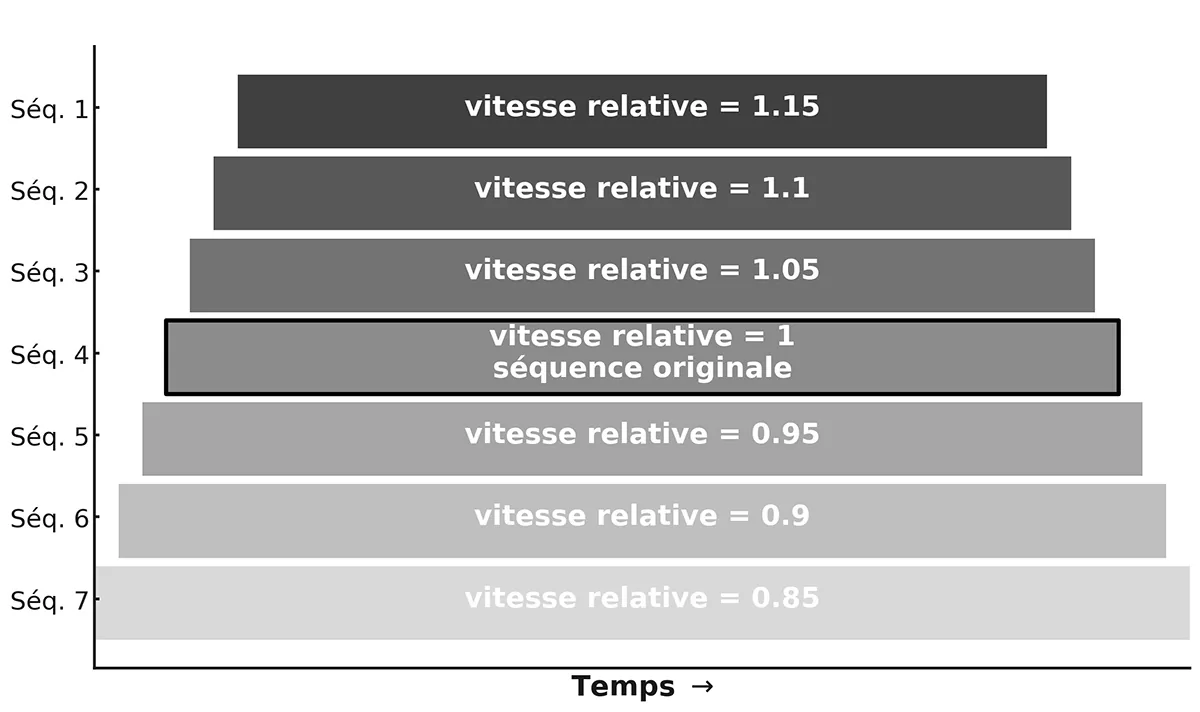
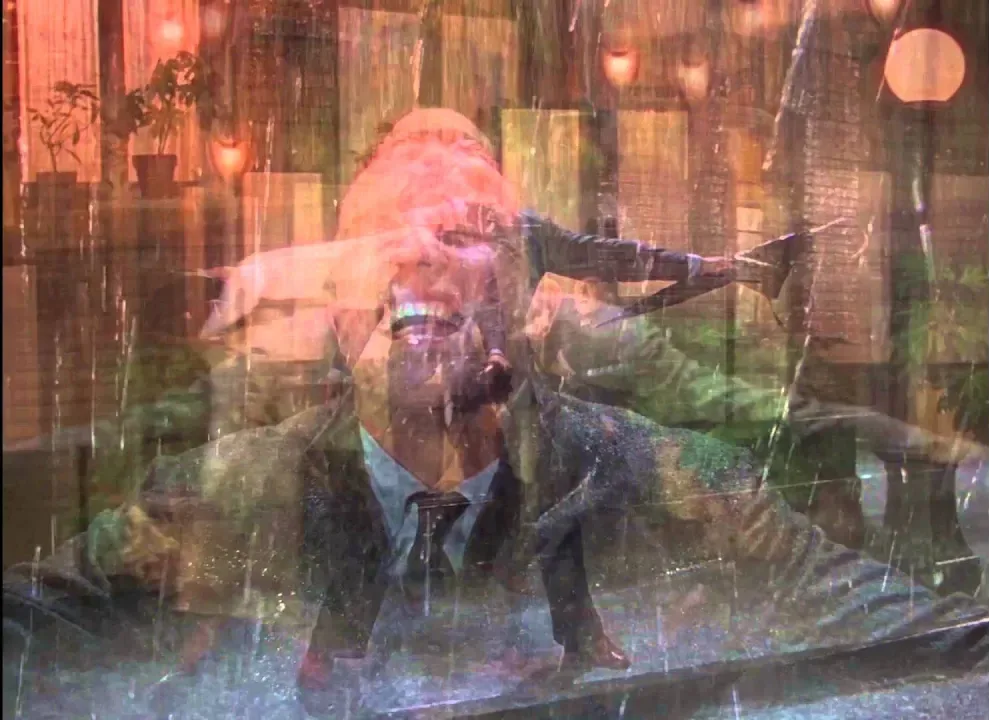
It is first of all the temporality of the medium that interests the artist. In 2006 he built a dedicated algorithm with which he decomposed the iconic sequence of the musical Singin’ in the Rain (1952) by Stanley Donen and Gene Kelly, in which the latter performs the famous title song while dancing on the sidewalk in heavy rain, wearing a hat and holding an umbrella sublimated into dance props. Biermann superimposes seven copies of the original sequence, which he variously speeds up or slows down. These stacked sequences are merged in semi-transparency, making each copy more or less visible in the frame. Thus, from the beginning of the film, we find Gene Kelly multiplied into seven diffuse silhouettes orchestrating a phantasmagorical choreography. The original melody, like the images, replicated and reassembled after being stretched or shortened in time, becomes a din, especially at the beginning and end of the film. Toward the middle of the work, the seven sequences draw closer together in time and the image recalls futurist representations, Gene Kelly’s body being surrounded by its own visual echoes, while the sound gains in legibility. The original melody, even when populated with echoes, becomes recognizable. At the exact midpoint of the film, the seven diverted sequences coincide perfectly and, for an instant, the image is equivalent to the original sequence. From there, the fragments begin to move apart from one another in time, and the film becomes increasingly ghostly again.
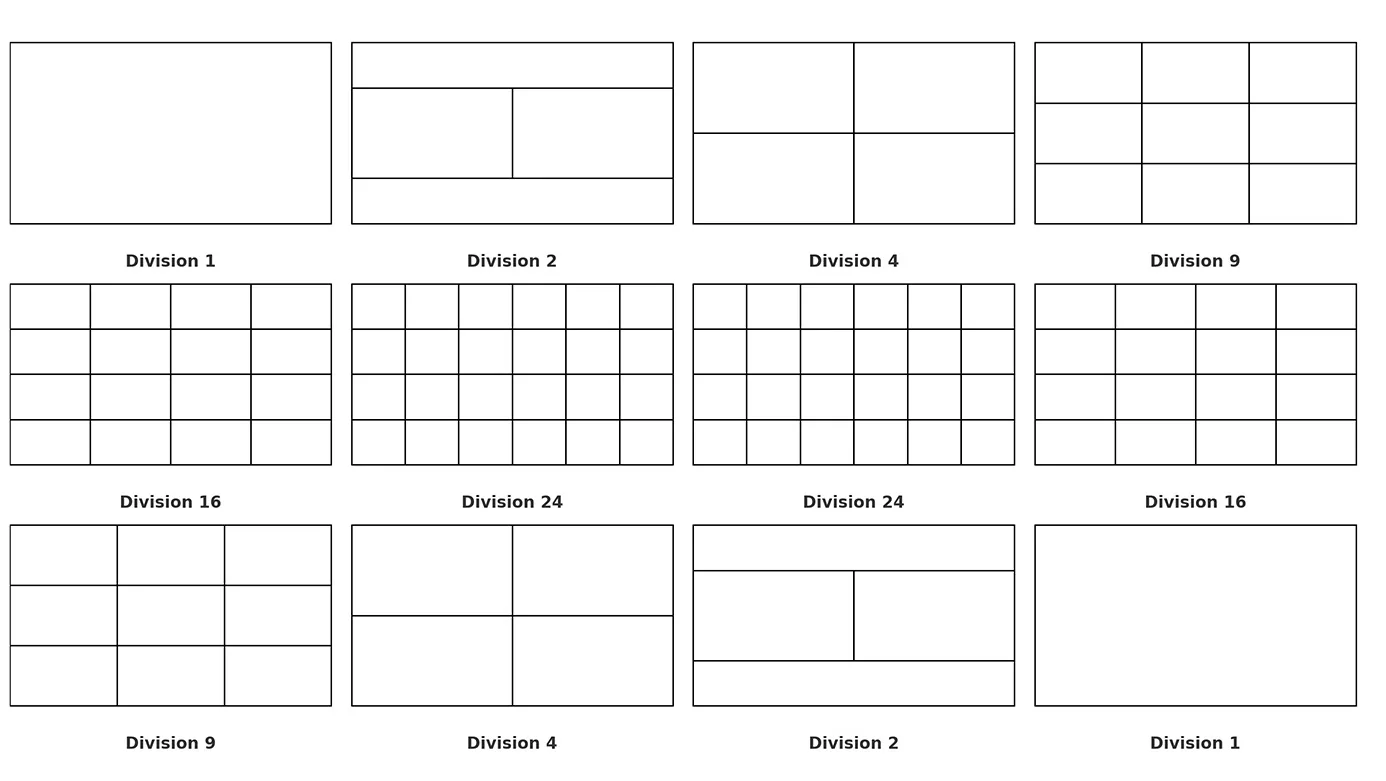
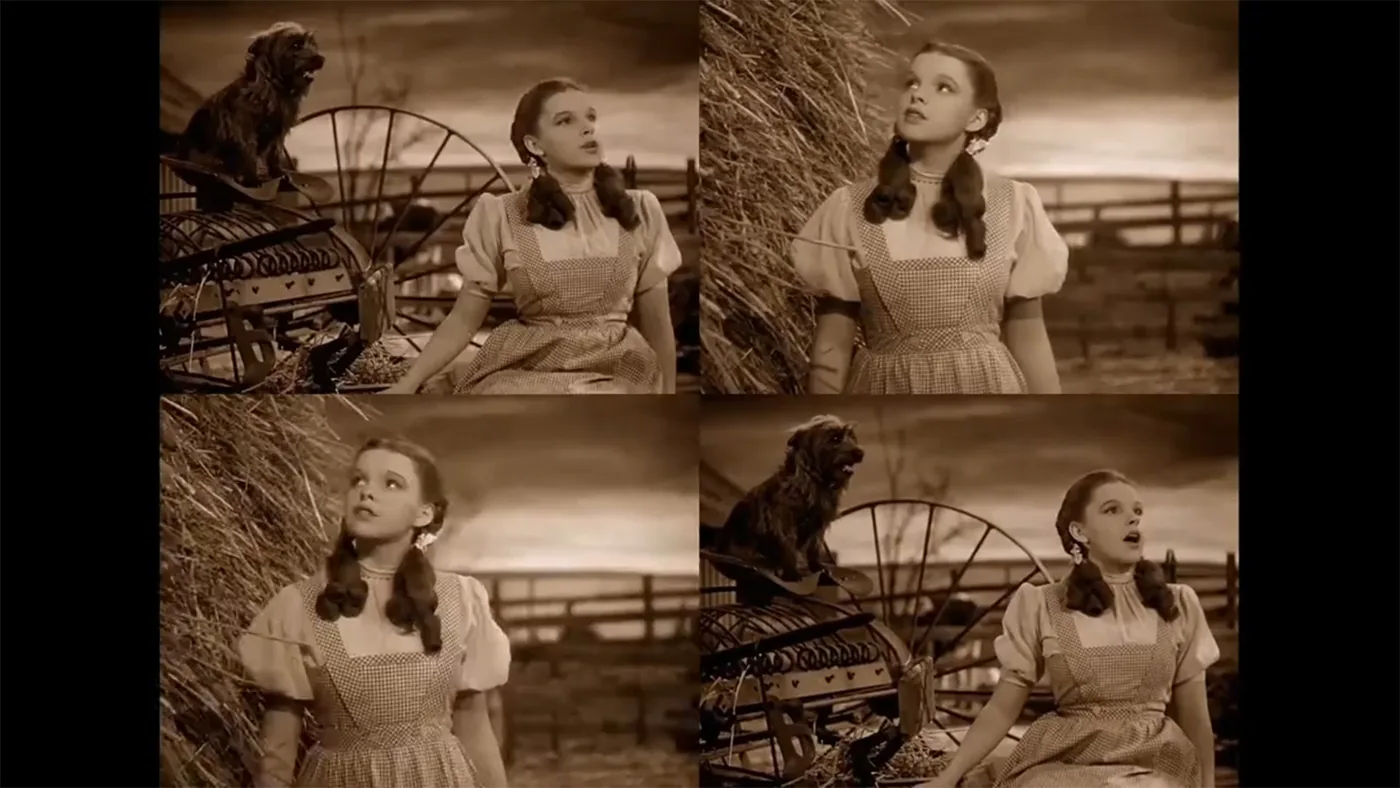
In Utopia Variations, Biermann tackles the iconic scene from Victor Fleming’s (1889-1949) film The Wizard of Oz (1939), in which the actress Judy Garland performs Over the Rainbow4 while moving through a dreamlike set. Manipulated by Biermann and his algorithms, the original sequence is first rendered split into two fragments that alternate across the whole frame: one that travels through time moving forward from the beginning, the other doing so from the end, in reverse. Then, fairly quickly, the screen is divided horizontally into two equal parts, where the two fragments of the sequence are placed right and left, regularly alternating their positions. A little later, each of the fragments is in turn divided in two, introducing a temporal offset. A complex choreography then emerges, in which four fragments of the original sequence, two moving forward in time and two moving backward, alternate their positions by rotation within a frame broken up into four parts. The procedure continues thereafter: 9 fragments of the original sequence on a screen divided into 9 equal parts (3x3), then divided into 16 (4x4). Toward the middle of Utopia Variations, we find the frame divided into 24 parts (6x4), in which 24 fragments of the original sequence5 exchange positions offset in time. Since each fragment keeps its own soundtrack, the film’s sound evolves from voices that alternate and follow one another as in a musical canon toward a veritable swarm of echoes in which the basic melody is transfigured. From the middle of the film, the process is reversed: the number of fragments of the original sequence present in the frame gradually decreases until the end of the film, where we find a situation identical to the initial one. Thus the film is structured – like Happy Again – according to a fairly strict principle of symmetry, which invests time as much as space. By its structure, Utopia Variations reminds us of Bill Brand’s film Moment (1972), in which a banal sequence shot taken at a gas station is “naturally6” divided in space into four vertical strips of equal width. The film is built from a succession of renderings of the original sequence, progressively subdivided in time, with the order of the cut pieces reversed. The cutting is carried out according to ever smaller subdivisions, down to the ultimate fragmentation of the original sequence, when the subdivisions reach the duration of a single frame, that is, 1/24 of a second. Thus, at the end of Brand’s film, the recomposition after reversing the order of the sub-parts is equivalent to rendering the original sequence backward. Utopia Variations deepens the complexity of Brand’s already very complex work, by tackling not only time but also the space of the frame, thanks to the vast possibilities for manipulating images offered by digital technologies.
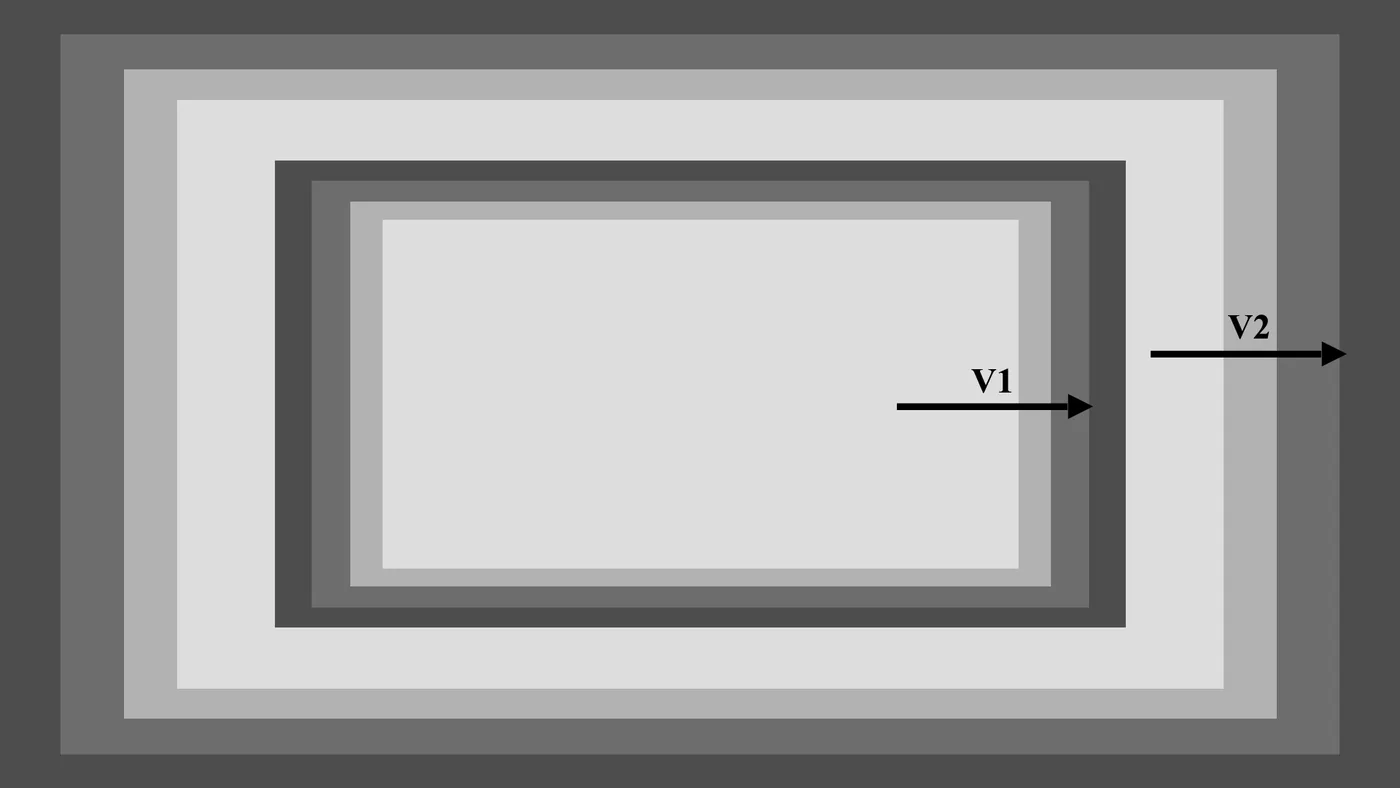
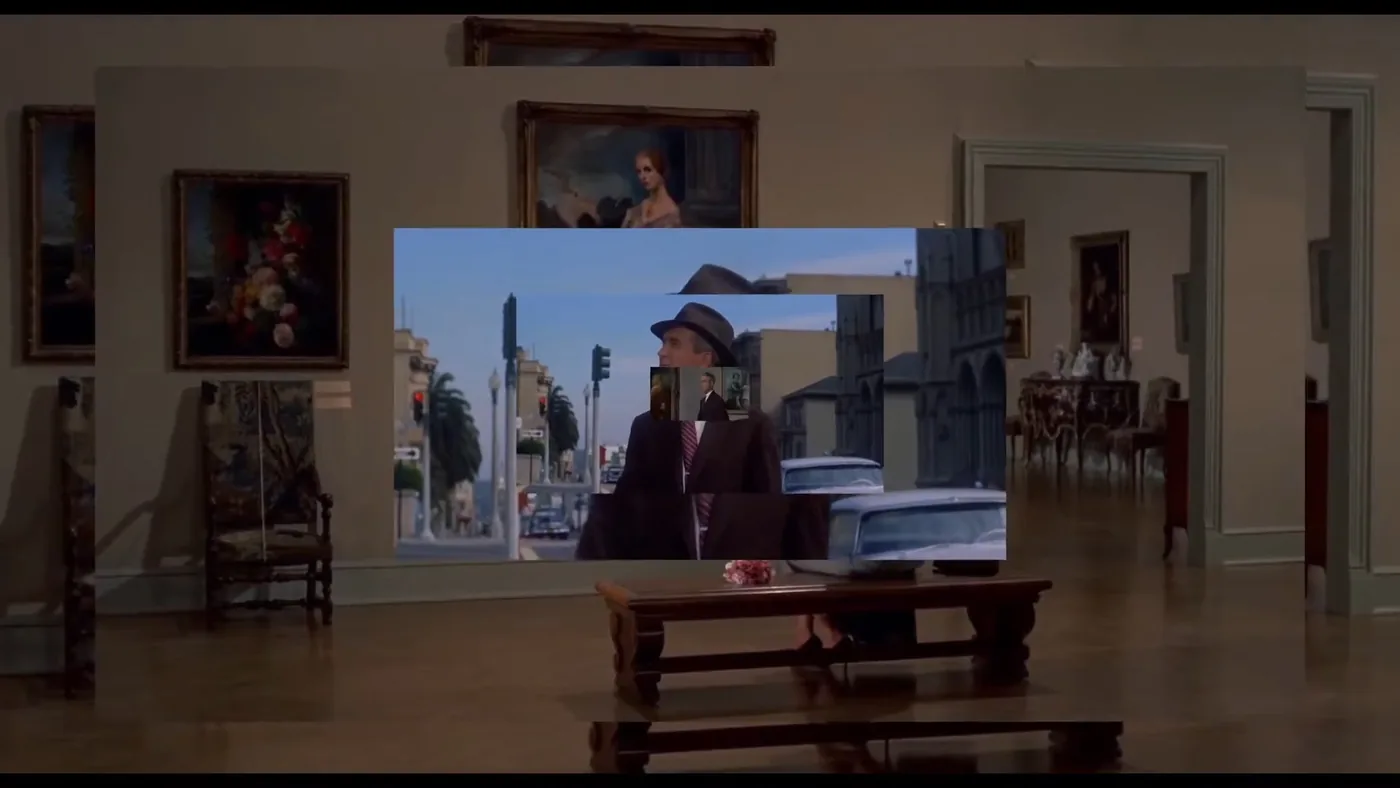
Biermann extends the algorithmic modulation of cinema’s space-time in his 2010 film Labyrinthine. This time, the artist uses as raw material a sequence from Alfred Hitchcock’s film Vertigo (1958). From it, Biermann extracts 40 shots and renders each of them replicated in four versions, offset in time, nested concentrically inside one another. Each set of 4 telescoped shots, corresponding to one shot of the original sequence, emerges from the center of the frame until it covers it entirely. As in the previous film, some of the shots run through the original sequence from the beginning and in the normal direction, while others do so from the end of the original sequence and in reverse. Each set of shots widens from the center of the frame at variable speeds, so that some images, once they have appeared, expand rapidly to cover the images that precede them, all of which contributes to a complex and changing dynamic of superimposed concentric shots in perpetual expansion. Depending on which shot of the original sequence is involved, the centrifugal movements introduced algorithmically by Biermann may combine with a very slow zoom in, which helps accentuate the tension with respect to the original sequence. When the latter, at times, results from the camera moving sideways (a lateral tracking shot), Biermann’s complex collage becomes slippery, with identical events repeating, offset in time and space.
Assembling Images, Disassembling Narratives
The complex nesting of these altered images, in constant expansion, cannot but completely deconstruct the original narrative line. We find James Stewart multiplied, stringing together mechanically repeated gestures and expressions, covered by (or covering) shots that show him moving through the street, or else images of the inside of a museum where a seated woman looks at a painting, or again a tracking shot in front of the classical façade of a hotel… At times, the visual elements taking part in the plot seem to lose their power of representation and gain in plasticity, when they are ejected by the algorithmic montage right out of the frame. Unlike Singin’ in the Rain and The Wizard of Oz, which, as founding films of the Hollywood entertainment industry, are often the objects of détournement within experimental cinema, Vertigo, Alfred Hitchcock’s film, benefits from a different gaze, a different kind of recognition of its artistic value. This perhaps explains why the complex détournement carried out by Biermann seems here to reinforce the film’s atmosphere, intensifying the atmosphere of mystery, which becomes increasingly anxiety-inducing, while reinforcing the sensation of vertigo, which proves despairing.
In Utopia Variations and Happy Again, Biermann manages to bring out what is artificial in the Hollywood image. Through blendings, changes of size and insistent repetitions, it is the industrial look of these images that comes to the surface of our gaze. The artificiality of Hollywood’s ready-to-consume storytelling is unveiled in its full extent. With it, what is foiled is the project of Hollywood cinema as a “show business, [which] comes to fulfill our desire for myths7,” associated with an anesthetizing effect8.
We saw a process of this order in The Pirate Cinema by the collective Disnovation.org, where the video streams “consumed” by users, intercepted by the work during P2P exchanges, followed one another in tatters, by means of “glitch” tears that seemed to constitute de facto datamoshing. Thus these images, stripped of their narrative component, echo one another solely on the basis of their formal aspect, which proves instrumental, predetermined. These two films by Biermann, like The Pirate Cinema, sketch a critique that is nonetheless not directed at the same actors. Indeed, while The Pirate Cinema addresses consumer imagery, certainly, but also and above all the techno-economic-military complex as the power controlling the digital ecosystem, Biermann’s films, still from within the digital, extend the critique of their analog elders: the industry of industrial cinema, of which Hollywood is the paradigm.
Machinic Structurations, Human Experiences
Biermann’s creative process, based on setting an organizing principle in motion, is to be set in tension with what we know as structural film. The latter, as mentioned earlier, was first understood by P. Adams Sitney as a form of experimental cinema “of structure in which the shape of the whole film is predetermined and simplified, and it is that shape which is the primal impression of the film9.” Biermann’s work differs from these proposals because the latter work, for the most part, from images shot by the artists themselves, images that are often “simple” from a formal point of view10, whereas Biermann systematically uses sequences taken from the great productions of Hollywood’s industrial cinema. Moreover, it is interesting to observe that, while for analog structural film the initial idea could materialize in the form of notations on paper11, Biermann’s creative process crystallizes his gesture, or at least part of it, within an algorithm. It is at the level of the algorithm that the manipulations to be carried out on the original sequence are defined, as is the way in which the resulting images will be assembled.
Biermann’s algorithmic approach also resonates with the work of Martin Arnold, an Austrian artist who radically restructures Hollywood scenes12, introducing into them repetitive and insistent back-and-forth effects on very short segments, thereby managing to build a broken-up temporality that is not devoid of a keen sense of humor, at the antipodes of the original Hollywood scenes. Indeed, both Biermann and Arnold take advantage of the possibilities of automatic editing to shape their convoluted assemblages of images, the former, as mentioned, through algorithms and software, the latter by means of an optical printer that he built himself, by hand. Despite this machinic component, Martin Arnold’s works, like Biermann’s, give off a human dimension resulting from the fact that the construction takes place with the sensible participation of the artist, who validates each step or makes changes until forms emerge that are pertinent in his eyes. In this sense, Biermann states:
The structure of these pieces are all based on global templates. Everything that occurs in these pieces is the result of my original compositional idea and its interaction with the original iconic sequence. Of course I am often not satisfied with the result of my very first idea so the finished work is usually the result of trying many variations until I arrive at the one that works13.
This experiential aspect ultimately marks a departure from structural film as understood by P. Adams Sitney, bringing Biermann’s work – like Arnold’s – closer to the conception defended by Malcolm Le Grice and Peter Gidal, which they call, as we have seen, structural-materialist film: a cinema in which the application of an intelligible principle, which guides the structuring of the image’s space-time, excludes neither the participation of the sensible through perception nor affective engagement with the image.
Human Montages, Machinic Montages
Thus a “human” sensible register persists in Biermann’s productions, even after the algorithmic intervention, for the latter is subject to jealous control on the artist’s part: despite the complexity of the assemblage, the result is a legible dynamic that combines discords and accords between the images, in a dance of forms in which vocal play, mirror effects and echoes of bodies multiplied within the frame intertwine. By contrast, in Pirate Cinema, as we saw – in the part on Destructurations – the machinic montage does not produce a succession of images naturally graspable by the spectator’s sensibility; the weight of the work lies above all in the dispositif and the associated reflection, a reflection that questions the invisibility of Internet flows and the role of images as consumer commodities.
In Biermann’s work, the initial proposal, materialized at the level of the algorithm – or of the editing software – introduces a strong formal conditioning, which is what will govern the transformation of the images thereafter. However, as noted earlier, the artist adjusts this initial proposal until the result is judged suitable.
Equidistant from the human and the machine, the experimental short films produced algorithmically by Biermann draw their raw material, like DCT: SYPHONING THE 64TH INTERVAL, considered earlier, from the cultural layer, in which images evolve on the basis of their symbolic value. Biermann does not exploit, as Menkman does, the tradition of narrative stratagems – such as the hero’s journey – but focuses specifically on the industrial imagery emanating from Hollywood, visual information that he uses to build his films. He does so not, as Menkman does, by setting up a narrative structure, but by establishing a new level of image, a digital collage, located just above the images he mobilizes.
On this new, fundamentally plastic level, Biermann shapes his works by multiplying the base images and reassembling their space-time. It is still a gesture that operates outside the images themselves, but one that does not extend, so to speak, the discursive “suprastructure” around the images – as Menkman does. On the contrary, Biermann builds a plastic suprastructure, in which the base images are algorithmically arranged in space and time, thus producing his experimental films.
We will now examine a third work that also stems from a gesture situated outside the images. This gesture, however, acts neither on the domain of narrative practices – as with Menkman – nor on the plasticity of industrial images – as with Biermann. Here it is an intervention based on producing a new form of interconnection between images already networked, images that are part of big data, that exponentially growing mass of data made possible by the Internet.
A corpus of 20 films made from 2002 to 2023, most of them from sequences taken from Hollywood’s industrial films.↩︎
In an interview for the VIP - VIDEOCHANNEL INTERVIEW PROJECT, for The New Museum of Networked Art, Biermann states: “Since I am looking to make work that would have been very difficult or impossible to do in earlier periods I do keep up to date with developments in hardware and software.” Website of the interview: https://vip.nmartproject.net/biermann-gregg/ accessed 9 September 2024.↩︎
Biermann is co-vice-president of The Film-Makers’ Cooperative, an association for the preservation and distribution of experimental films based in New York, founded in 1961 by Jonas Mekas, Shirley Clarke, Ken and Flo Jacobs, Andy Warhol and Jack Smith.↩︎
A ballad written in 1939 for the film by Harold Arlen and Yip Harburg.↩︎
An emblematic figure, since in the traditional cinematic dispositif film has 24 frames per second.↩︎
The sequence shot is filmed through an advertising billboard with rotating slats, which divide the image vertically into four parts.↩︎
Patrick Nardin, Effacer, défaire, dérégler, op. cit., p. 187.↩︎
Ibid.↩︎
P. Adams Sitney forges the category of structural film as an evolution toward complexity from what he understands as lyrical film, whose emblematic figure is Maya Deren. Experimental filmmakers such as Michael Snow, George Landow, Hollis Frampton, Paul Sharits, Tony Conrad, Ernie Gehr and Joyce Wieland are identified by P. Adams Sitney as practitioners of structural film. See in this regard P. Adams Sitney, Le cinéma visionnaire, op. cit., p. 329.↩︎
Like the interior corridor filmed by Ernie Gehr in his famous film Serene Velocity (1970), or the loft filmed by Michael Snow in Wavelength (1967).↩︎
Documents we studied in chapter 1.↩︎
See for example Martin Arnold’s Pièce touchée (1989), which diverts a sequence from Joseph M. Newman’s film The Human Jungle (1954), and Passage à l’acte (1993), which does the same with a sequence from Robert Mulligan’s film To Kill a Mockingbird (1962).↩︎
During exchanges with the artist in December 2020. Original English quote.↩︎
Cite this pageCórdoba, Pablo-Martín. “Hollywood in Tatters”. In Making Digital Images in the Light of Experimental Cinema — Anthropological and Political Resonances of Algorithms in Contemporary Art, Doctoral thesis in visual arts and photography, Université Paris 8 Vincennes-Saint-Denis, Doctoral School EDESTA (no. 159), research unit AIAC, 2026. https://www.pablomcordoba.com/thesis/hollywood-in-tatters/