2.1.2
Feinting the Machine
A Vernacular of File Formats (2010) is an artistic adaptation of a booklet that Rosa Menkman, a Dutch artist, had originally designed to accompany a course on databending. Originally subtitled A guide to Databend Compression Design1, the booklet presents, over some twenty pages, multiple ways of diverting an initial uncompressed image (the original image in RAW format). This by intervening on different file formats2 while modifying the compression settings. These image file formats structure data in a specific way and, in the case of compressed images, according to a particular compression method. When the machine “reads” the digital image, the parameters in the file header guide the reading of the data block so that the image is rendered normally. The databending strategy consists in supplying the computer with a diverted reading protocol, thereby causing a deformation of the image when it is rendered with data thus disorganized.
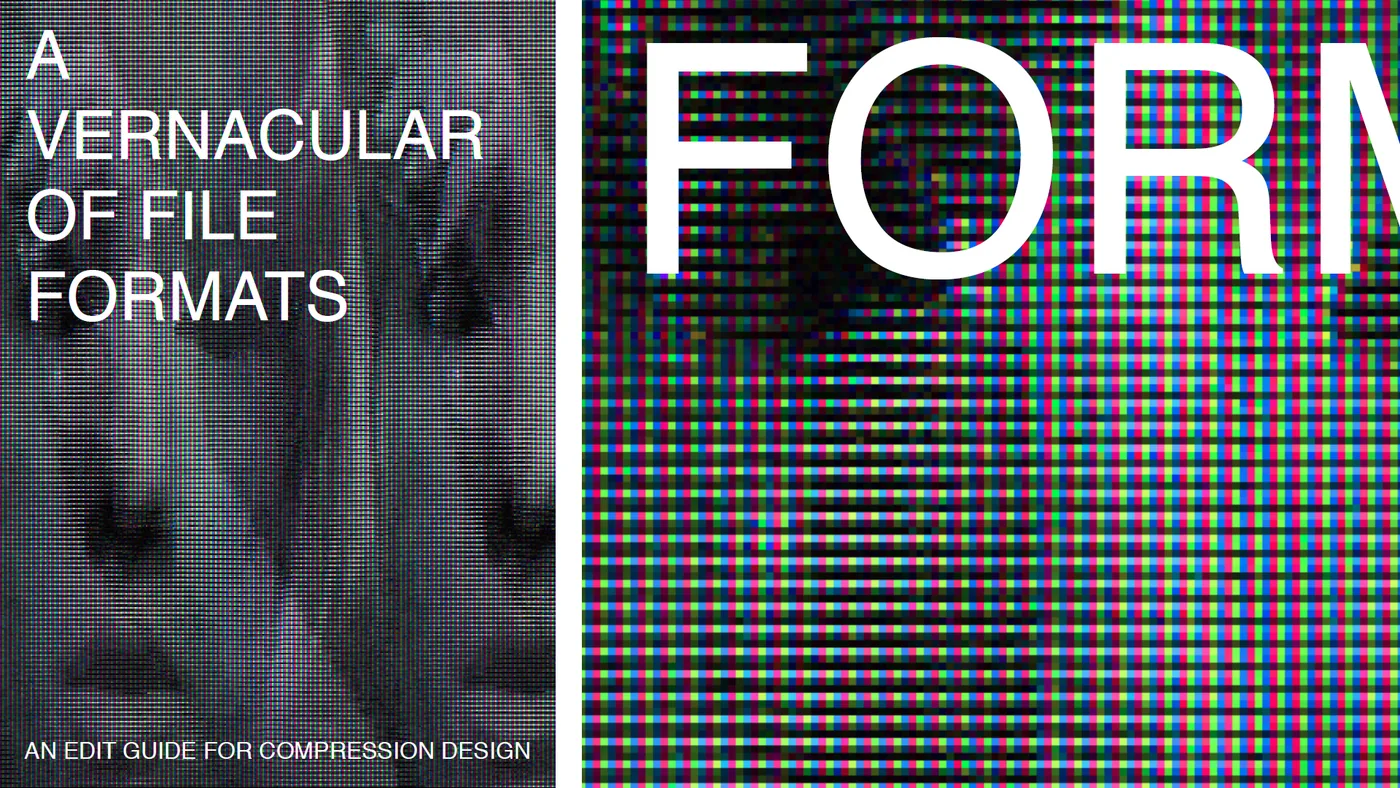
On the front cover, an apparently monochrome image catches the eye. Yet, on closer inspection, one sees how each dot is in fact the result of combining, in equal parts, three dots colored according to the primary colors of additive synthesis: RGB (Red, Green, Blue), the operating principle of our LCD screens. Strictly speaking, the computer does not “see” colors: it is colored filters that produce three differentiated flows of current when the image is captured. This signal is then “recolored” upon rendering thanks to miniature physical filters present at the output (the screen). Inside capture and rendering dispositifs, only variable intensities of electric current are processed, distributed over three channels, one for each color. The cover image of Menkman’s booklet underlines the concrete material reality of the rendering dispositif as a sine qua non condition on which the work is structured, while announcing the generative principle of these images arising from “non-standard” interactions with the machine: as when one looks very closely at a screen dispositif designed to be seen from afar.
Toward an Aesthetics of Glitch Art
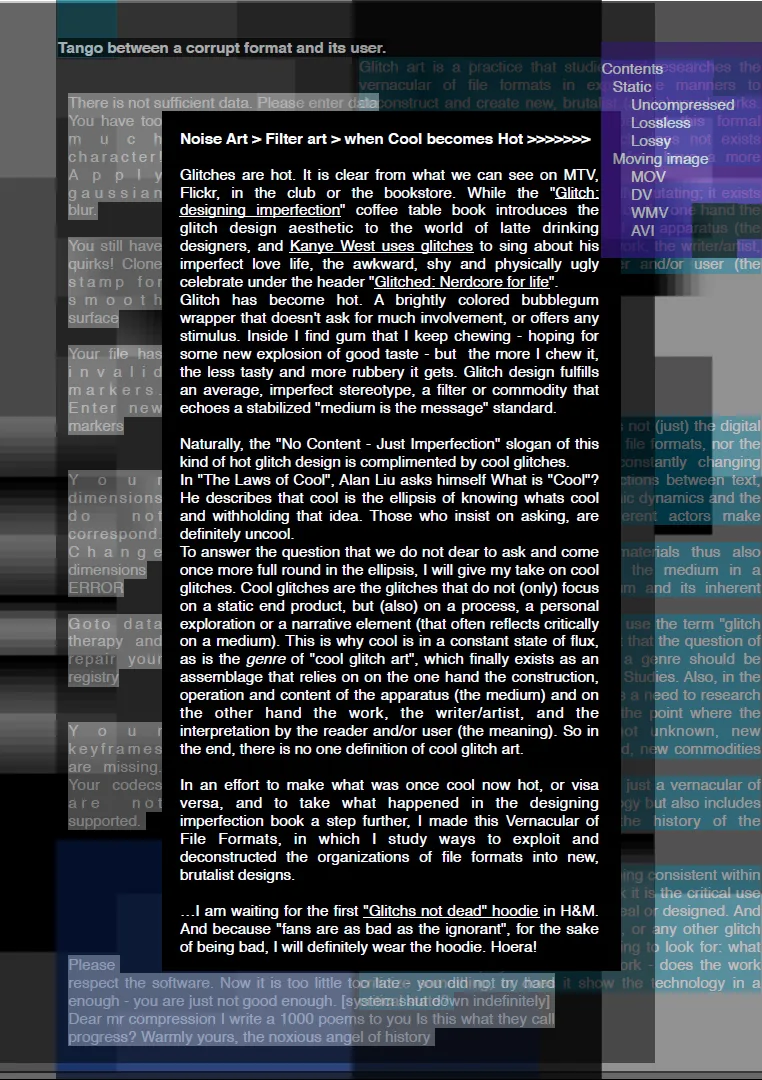
The logic of malfunction continues to express itself on the second page, which accompanies the introductory image with discourse, in blocks of text laid out mechanically, sometimes illegible. At the very top left, the work’s subtitle stands out: “a tango between a corrupt file and its user.” In the center we find a main block of text – white on a black background – drawing up an ironic assessment of the glitch ten years after its birth. The glitch, according to Menkman, had become ubiquitous by 2010, that is, “hot,” viral before its time, affected by a form of conformism. The artist criticizes this trivialization while advocating a “cool” glitch, one that is not limited to the superficiality of an easy visual effect, but that is capable of questioning the process, of embarking on a personal quest of the artist’s or, at the very least, that can offer a narrative element3. The “cool glitch,” according to Rosa Menkman, must be capable of bringing forth a reflection on the medium itself, and must be able to contribute to a constantly evolving critique.
The terminology used by Menkman echoes that of Marshall McLuhan, who distinguishes between hot and cool media. For McLuhan, print, radio and cinema are hot media because, in his view, they stimulate the senses by conveying a large quantity of data. By contrast, speech, the telephone and television are cool media, since they provide less information, obliging the listener to fill in the rest themselves4. Hot media tend to encourage passivity, whereas cool media invite active participation, in which the listener must make an effort of interpretation, mobilizing their knowledge, their memory and their mental models. Despite the criticisms leveled at this typology of hot and cool media5, it seems to correspond to Menkman’s desire to make the glitch more “cool,” in opposition to a superficial approach in which one is content to passively receive surprising imagery. The “hot” stage of the glitch must be transcended by an approach that makes the phenomenon resonate with procedural, experiential or narrative dimensions, thereby prompting critical reflection in the spectator.
Ruins of Pixels, between the Poetic and the Scientific
On the left of the central block, still on the second page of the work, six small blocks on a gray background house error messages and suggested fixes, oscillating between the poetic and the humorous. On the right of the page, toward the top, another block of text – this time on a purple background – presents a sort of simplified table of contents, indicating the formats explored in the two main sections: still images and moving images. Toward the right of the page, in the background, other texts on a cyan background set out truncated sentences on glitch art, remarks taken from an interview Menkman gave to the magazine Dinca.org6. In this interview, the artist refers to the glitch as a “primal data-scream” of the machine. Finally, at the very bottom of the page, there appears a fictional dialogue with multiple interlocutors. The system first addresses the user, human, always imperfect: it demands respect, then shuts down and disappears. The user, for their part, recalls having written 1,000 poems to “mister compression” and wonders: is this what they call progress? Finally, it is the angel of history who closes the dialogue7. By thus bringing her glitches close to Benjaminian ruins, Menkman makes her work resonate with the fine discretization of space, as found in Paul Klee. Through this procedure, Menkman manages to inscribe her work within a discursive and artistic continuity, pertinently linking the artistic tradition with the analog world and the digital universe.
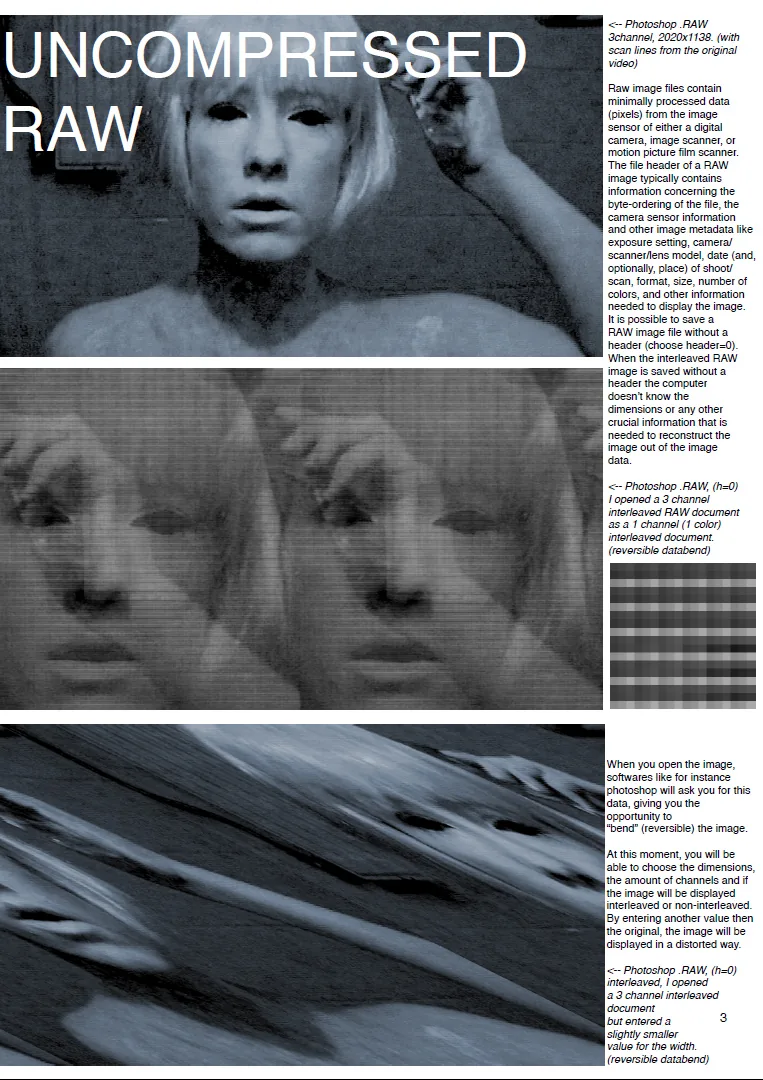
The introduction is followed by some sixty images, presented as the results of a scientific study. These images, as mentioned above, come from altering the header of a file containing an original image, reread by the computer with intentionally erroneous settings. The raw image – in RAW format – shows the artist combing her hair facing the camera, as if in front of a mirror. Her eyes remain invisible, evoking a hollow statue, in the image of the compressed digital “medium” she explores. Indeed, compressing the image amounts to hollowing out the raw digital image of its matter, through a codified approximation of the color values of the pixels. This original photo is followed by the results of the various manipulations, each attempt being carefully captioned.
Some images are accompanied by enlargements revealing the intimate texture of the image obtained. The manipulations concern different parameters that define an image format: resolution, width, height, number of channels, as well as the parameters specific to compression codecs. Each new parameter is briefly explained in the caption, underlining the didactic character of the work. For each manipulation, whether in color or monochrome, the artist specifies whether it is a reversible or irreversible transformation. In the first case, as with certain transformations in the material world, it is possible to return to the initial state, since the data are simply read in an altered way, without having been modified. Irreversible transformations, on the other hand, modify the very substance of the original image, which is lost and replaced by the new, diverted version.
Machine, Mirror of the Human
With these alterations, Menkman amplifies the symbolic scope of the initial image: in it we find the human figure deformed to the point of disappearing or, at times, doubled, referring powerfully to the imaginary of the body and to that of the psychological world. These transformations put to the test the indexical dimension of the original image, which sometimes turns into total abstraction. The whole forms a complex work, in which the human seems to somatize a disturbed technological environment. Through this work, and more broadly through her practice, Menkman reminds us that the evolution of image technologies is not simply the fruit of an autonomous advance of scientific and technical research. On the contrary, the configuration of our capture and rendering dispositifs is shaped by forces of power, an abstract power that the artist seeks to reveal and to confront.
I consider A vernacular of file formats as a starting point of my research into compression algorithms, which has become a main theme within an ongoing research-based artistic practice. I often presented my finding of this exploration as a rendered iteration presented in print. But in essence, A vernacular of file formats was never a static work. Rather, it was an ever evolving catalogue that illustrates the fact that every compression algorithm comes with its own bias, ingrained as normally invisible, yet definitely not unimportant organization of data, that can be brought to the surface of the image through the disturbing of the data file, or, in a colloquial term, by glitching the file8.
Menkman identified in the plastic expression of machine errors a fundamental problem that she continues to explore, extending the experiments of glitch pioneers such as Ant Scott and Iman Moradi, who were little interested in the underlying complexity to which Menkman was sensitive. By describing the glitch as the machine’s “primal data-scream9,” she envisages the machine not only as a living being, but sometimes even as a human being. This vision echoes the fact that the terms used to describe the gestures inherent in digital creation are often the same as those used to describe interactions between humans. Thus, when Menkman places herself in front of the mirror in the starting image of A Vernacular of File Formats, one can see in it a metaphor of the human facing the machine, the latter playing the role of a mirror of the human being. The human then tries to take hold of the machine by deciphering it, while the machine becomes the theater in which the most fundamental questions about human nature are played out, beginning with the most burning of them: the material inscription of the soul. This did not escape Bruno Latour, who asserts: “a little digital makes one believe in the virtual, a lot of digital redirects the mind toward materiality10.”
It is surprising to note the intensity of the symbolic radiance that Menkman sets off with a gesture of destructuration that is nonetheless simple. The détournement of the reading protocol of digital images produces a rich work, in which a hollow figure, an allegory of image compression, dominates a territory of torn images, veritable ruins of pixels. Through these Benjaminian ruins, the digital, become a mirror of the human, reveals itself in its headlong race toward progress. Echoing the Angel of History dear to Paul Klee, it seems to take its place within the tradition of art.
This rich “vision” of the digital and its images responds to an intervention that takes place outside the image itself, since it consists above all in thwarting the reading protocol of the image-rendering dispositif. We will now consider a work that intervenes inside the image itself, by overturning its structure. The result is an experience that lays bare the digital image in its operational function and its military genealogy, while disrupting the passive role of the spectator.
See the work’s page on the artist’s website: https://beyondresolution.info/A-Vernacular-of-File-Formats accessed 16 December 2022.↩︎
The artist explores the following digital image formats: .bmp, .gif, .png, .tga, .tiff, .psd, .jpg and .jp2.↩︎
We will study this last aspect of the artist’s “toolbox” in more detail, in the paragraphs devoted to structurations, through the prism of the video DCT:SYPHONING THE 64TH INTERVAL (2015-2017).↩︎
Marshall McLuhan, Pour comprendre les média: les prolongements technologiques de l’homme. Paris : Mame-du Seuil, 1968, p.42↩︎
See on this subject Fabien Granjon, «Pour une critique des approches « média-techniques »: Théorie-Écologie-Archéologie des médias, médiologie et question de la technique ». Variations [en ligne]. September 2022, n° 25.↩︎
Interview available on the artist’s website: https://rosa-menkman.blogspot.com/2010/07/interview-7-questions-on-dinca.html, accessed 18 September 2024.↩︎
Text of the dialogue: “Please respect this software. At this moment it is a bit too late – you did not try hard enough – you are not good enough. [the system shuts down indefinitely]. Dear Mr. compression, I wrote you 1000 poems. Is this what they call progress? Yours truly, the noxious angel of history.↩︎
Statement originally in English, made by the artist in the video It takes more than the past to understand and build the archive (2021), a video accompanying the archive of her own work that Menkman produced for the Stedelijk Museum Amsterdam. Web link: https://vimeo.com/455224171 accessed 18 September 2024.↩︎
In an interview for the digital art archive dinca.org. A version of the interview remains available on the artist’s blog: https://rosa-menkman.blogspot.com/2010/07/interview-7-questions-on-dinca.html accessed 8 October 2022.↩︎
Bruno Latour here twists Francis Bacon’s famous sentence: ”It is true, that a little philosophy inclineth man’s mind to atheism; but depth in philosophy bringeth men’s minds about to religion,” during a lecture at the Bibliothèque nationale de France on 19 November 2014. Web link: https://youtu.be/f3lsSJp8dbI?si=CAKD4KLf4Qzvzq3-&t=2768, accessed 26 July 2024.↩︎
Cite this pageCórdoba, Pablo-Martín. “Feinting the Machine”. In Making Digital Images in the Light of Experimental Cinema — Anthropological and Political Resonances of Algorithms in Contemporary Art, Doctoral thesis in visual arts and photography, Université Paris 8 Vincennes-Saint-Denis, Doctoral School EDESTA (no. 159), research unit AIAC, 2026. https://www.pablomcordoba.com/thesis/feinting-the-machine/