3.2.3
The Gesture of Counting, Exteriorized
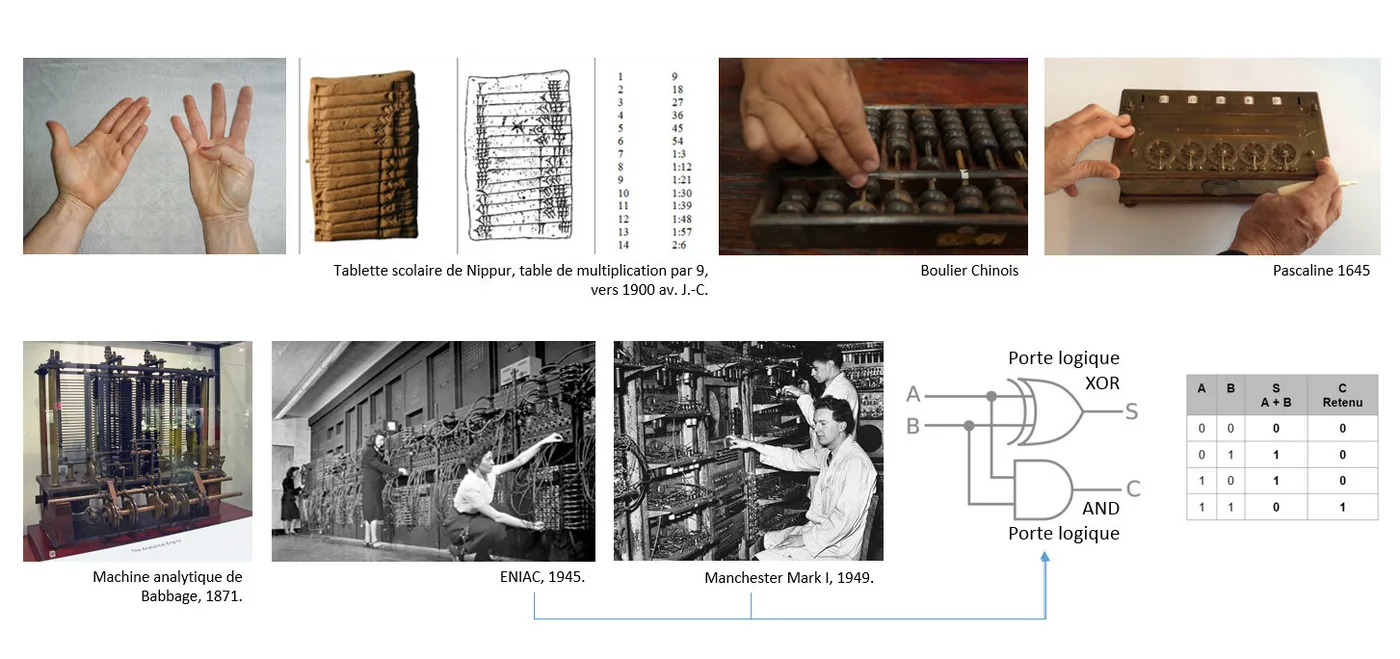
Other artifacts punctuate the process by which calculation is progressively exteriorized into technics. In the Mesopotamian abacus (such as the Nippur tablet) and much later in the Roman abacus, the manual gesture already involves the conditional configuration of matter, in the placing and moving of pebbles or beads on incised tablets. This gesture is extended, and becomes more complex, in dispositifs such as the Pascaline (1642), or later the Comptometer (1887), where manual intervention is relayed by a system of gears, levers and springs: the body remains present, but it gradually delegates the mechanical aspect of its gesture to a machinic configuration.
This movement of exteriorization of the calculating gesture extends to far more sophisticated machines, such as Charles Babbage’s Analytical Engine (1837) – designed, but never built at the time beyond the prototype – conceived to be driven by a steam engine. The machine was to be programmed through the use of punched cards, inspired by Jacquard looms. Ada Lovelace, Babbage’s assistant, was the daughter of the poet Lord Byron and of Anne Isabella Milbanke1, an English aristocrat passionate about mathematics, whom Byron called “the princess of parallelograms2.” Their daughter Ada – the first person to have written a computer program – is said to have said:
The Analytical Engine weaves algebraical patterns just as the Jacquard-loom weaves flowers and leaves3.
The human manual gesture, the one that once calculated by directly modulating matter, is now completely delegated to a machine that can be apprehended as calculating matter. This matter remains coded, just as in Mesopotamia, where it was understood that three pebbles signified three head of cattle. Ada Lovelace’s words bear witness to the salience of a form of affinity that has always haunted calculation, between code and matter modulated by gesture.
With the ENIAC (1945), memory (modulated matter) becomes electronic. The machine is programmed by manual rewiring, calling upon the hands and bodies of its programmers – in this case, six women mathematicians whose names are all too often forgotten: Marlyn Meltzer, Ruth Teitelbaum, Frances Spence, Kathleen Antonelli, Jean Jennings Bartik and Betty Holberton4. At this particular moment in the genesis of computers, the conception of the algorithm appears closely linked to gestures that call upon the whole body, a body that kneads the machine’s circuit as circuit bending would do much later (by other means and in another logic), revealing the genetic link that ties coding to gesture, more precisely to the gesture of setting down (poser), problematized by Michel Guérin5 and to which we will return.
The Manchester Mark I, one of the first computers in the modern sense to be built, extended the “technical” lineage of the machine in 1949, preceded only by the Z3 built by Konrad Zuse in 1941. The Manchester Mark I is structured on the basis of the Von Neumann architecture, the scheme at the basis of our contemporary processors: data and algorithmic instructions are stored in the same memory; the processing unit is composed of an arithmetic logic unit (ALU) and a control unit; a “bus” (a shared line carrying several types of signals) makes the data available and handles the processing of instructions, one by one. In the Manchester Mark I, the result of operations is translated into binary states, stored in the form of luminous dots in cathode-ray tubes. From then on, carrying out a calculation no longer involves any movement visible to humans: everything plays out in electrical flows and states.
See Lovelace’s biography in the Encyclopædia Britannica. URL: https://www.britannica.com/biography/Ada-Lovelace, accessed June 16, 2025.↩︎
Joan Baum, The calculating passion of Ada Byron. Hamden, Conn : Archon Books, 1986, p. 14.↩︎
Ibid., p. 71.↩︎
See in this sense the page devoted to the history of these pioneering women on the website ada-online.org. URL: http://www.ada-online.org/frada/spipb0a3.html?article102, accessed June 16, 2025. In Breaking the Internet (2015-2016), a work that will be considered in chapter 5, Lauren Huret mobilizes the history of these women.↩︎
In Michel Guérin, La troisième main: des techniques matérielles aux technologies intellectuelles. Arles : Actes Sud, 2021.↩︎
Cite this pageCórdoba, Pablo-Martín. “The Gesture of Counting, Exteriorized”. In Making Digital Images in the Light of Experimental Cinema — Anthropological and Political Resonances of Algorithms in Contemporary Art, Doctoral thesis in visual arts and photography, Université Paris 8 Vincennes-Saint-Denis, Doctoral School EDESTA (no. 159), research unit AIAC, 2026. https://www.pablomcordoba.com/thesis/the-gesture-of-counting-exteriorized/