2.3.9
Assemblages, Perspectives
It would be entirely possible to approach the works we have just considered, drawn from my personal work, through the strategies problematized earlier — destructurations and structurations — on the basis of works produced by other artists. This is not at all surprising: those works were chosen for their proximity to the personal work, on the basis of impressions and questions that arose in the course of practice.
One could indeed mention destructuring gestures manifested in La Flamme, where a digital image is torn to shreds by algorithmic means; in Gare Paris-Saint-Lazare, 10 avril 2017, 12h03-12h07, which destructures the temporality of the moving image to transform it gradually into a still image; in Paysage d’hiver, in which the rigid representation of a real landscape is algorithmically altered. In this last work, the destructuring of the image of the real landscape is directly followed by the structuring of a new, imaginary landscape, with an uncertain, subjective topography, capable of supporting not only flows of forms but also temporal flows.
For its part, structuring action1 can also be invoked with regard to the personal work. In Gare Paris-Saint-Lazare, 10 avril 2017, 12h03-12h07, it is very legible, for we see a concrete structure taking shape, which materializes the hollow of the architecture by subjecting it to a certain “pressure,” at least a visual one. In Postdigital flipbook, it is not a matter of structuring a fixity out of a movement, but of the opposite process, in which an animation is shaped out of still images. In L’inter-code, structuring action is materialized within a generic algorithm, designed to build video collages out of basic sequences. Substance, for its part, deploys a narrative structure, associated with a “virtual” journey, which articulates, on the visual register, urban infrastructures — the data centers — strategically hidden from view and intentionally disarticulated on the discursive plane.
In fact, as mentioned before, the categories defined — destructurations, structurations — are neither rigid nor self-sufficient: they seek to characterize strategies, attitudes, gestures, on the basis of their predominance within the creative processes addressed. Indeed, all the works mobilized lend themselves to being reinterpreted, more finely, according to structuring and destructuring moments, which may manifest themselves in succession during the creative processes. These processes must be integrated into the reflection, preserving their spatial and temporal development, for the thickness of each work is built on the experiential plane.
Between Destructurations and Structurations
Without seeking to attribute any originality whatsoever to the personal work, it proves well suited to grasping a third type of strategy, which cannot be fully characterized either as destructurations or as structurations, although in certain respects it presents itself as a hybridization of these categories.
Through its revelatory potential, this third type of strategy may echo what happens in the face of the expressions of technological errors — without it being possible to say that one has occurred — at the moment when the functionality of technics is bracketed and — in Simondon’s words — the functioning of the system is revealed, forcing the technological element to take part in a dynamic that has been described as hyperfunctional2.
Likewise, and just as with structuring strategies, these works are built thanks to elements that emerge, but the point is to indicate a form of emergence associated specifically with a bringing into relation, an articulation, of different elements.
The aim is to reflect more closely on the moments when the creative process proceeds through an unusual linking of technical elements — but sometimes also discursive and/or symbolic ones — unforeseen in their “normal” mode of functioning. This set of atypical connections is triggered — set in motion — and provokes a displacement that produces unpredictable forms, which — in happy cases — become re-anchored in an “elsewhere” when the process reaches safe harbor.
Assemblages: A General Framework
The notion of assemblage (agencement), theorized by Deleuze and Guattari, proves interesting in this respect. Indeed, it seeks to describe the effect of the interconnection of different elements, of a multiplicity, within a whole that may be led to evolve. Mobilizing this notion pushes us to deepen our understanding of the creative processes concerned. In particular, it obliges us to broaden the domain in which strategies and/or gestures unfold, so as to include, besides the material domain, the symbolic aspect3 and the discursive.
Since this is a term at once fundamental and very general in the highly convoluted conceptual universe of Guattari and Deleuze, a definition of assemblage may seem abstract at first sight in a context as restricted as ours4:
We may draw some general conclusions on the nature of assemblages from this. Along a first, horizontal, axis, an assemblage comprises two segments, one of content, the other of expression. On the one hand it is a machinic assemblage of bodies, of actions and passions, an intermingling of bodies reacting to one another; on the other hand it is a collective assemblage of enunciation, of acts and statements, of incorporeal transformations attributed to bodies. Then, along an oriented vertical axis, the assemblage has on the one hand territorial or reterritorialized sides, which stabilize it, and on the other cutting edges of deterritorialization, which carry it away5.
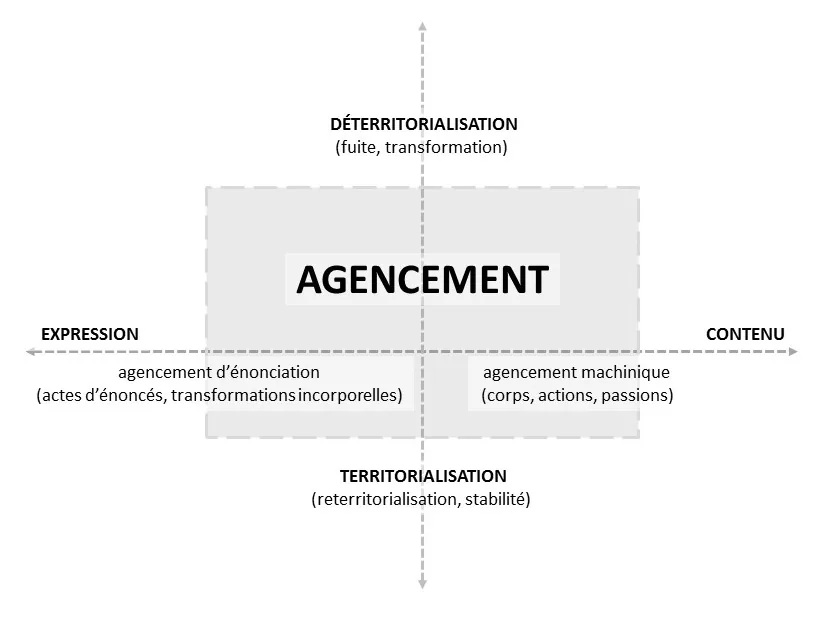
Deleuze and Guattari briefly illustrate their proposal by indicating concretely what would constitute a “feudal assemblage.” On the plane of content of the feudal assemblage — a machinic assemblage of bodies — we find “the body of the earth and the social body, the bodies of the overlord, the vassal and the serf, the body of the knight and that of the horse, the new relation they enter into with the stirrup, the weapons and the tools that ensure the symbioses of bodies6,” while, on the plane of expression, there unfolds “the legal regime of heraldry, the set of incorporeal transformations, notably oaths with their variables, the oath of obedience, but also the oath of love, etc7.” Feudal territorialization would be placed on the lower part of the vertical axis, and what tends to happen with the knight, his mount and his statements during the Crusades is to be considered on the axis of deterritorialization8.
Assemblages: Material Functioning
In the generic definition of assemblage, we find a family resemblance with other proposals, such as that of the dispositif — according to Michel Foucault and, later, Giorgio Agamben — and that of the apparatus (appareil) proposed by Jean-Louis Déotte. These notions seek to characterize complex entities within which heterogeneous elements are articulated: discursive, material, organic, social, institutional and technological.
Why call on the notion of assemblage, and not on these neighboring notions? Well, the whole that Foucault calls dispositif, reworked by Agamben, seems above all intended to describe the alienating action of power; it could not, then, describe what happens that is positive, so to speak, in artistic creation. It is precisely out of a form of dissatisfaction with the notion of dispositif9, limited when it comes to “accounting for the power of appearance and of creation10,” that Déotte envisages his conception of the apparatus, which he opposes, in its effects, to the dispositif. One and the same element may behave as a dispositif, in a closed logic, but also, under certain conditions, as an apparatus, triggering the emergence of the new.
However, Déotte’s thought — in which the notion of apparatus is central — conceives of the digital, in resonance with Jean-François Lyotard, as the technological turning point through which the whole of reality becomes intelligible: the immaterials, materials arising from language — by means of a rapprochement between computer code and human language that seems problematic — exclude from analysis the agency of a matter that has become intelligible without remainder11. This perspective appears diametrically opposed to the felt sense that guides this research, which seeks to apprehend code not as a “language” but on the basis of gestures, and which could not admit the existence of anything that might abstract itself from a material support, or dispense with the agency of matter.
The same could be said of the dialectic of Flusser’s player, according to which the artist — the photographer — plays against his means of production. When the logic of the latter prevails, there will be no creation. Conversely, when the artist manages to make his apparatus function outside its program, there may be what Flusser conceives of as informative images, carrying a surplus of information12. Flusser’s logic interests us, but with strong limits, for in it the instances of representation are conceived exclusively as stemming from processes of coding and recoding, which still seem to exclude any expression of material agencies.
And it is precisely with respect to this point that the Deleuzo-Guattarian assemblage proves interesting, for the logic of functioning of its fundamental stock is thoroughly physical, material, even geological.
Assemblages — and these are words that touch our research at its heart — function “on the basis of modes of semiotization that make signs work ‘right on’ things, bodies and flows of every kind”13 14. The intimate nature of assemblages directly echoes that of the domain in which — all — the artistic practices that interest us unfold.
Deterritorializations: A Prepolitical Horizon
This research could not take on the project of determining the general relevance and potential of applying the notion of assemblage, as understood by Deleuze and Guattari, to the entire field of art, all the more so since the notion very quickly connects to other notions — lines of flight, body without organs, etc. — within a complex thought. On the basis of specialized reflections, such as those of Anne Sauvagnargues, such a perspective can be envisaged15.
We have simply identified in the notion of assemblage a fertile conceptual framework for describing — within creative processes concerned with digital images — certain moments when, out of an unexpected articulation of elements, a displacement, a drift occurs, during which the system leaves the ground — material, plastic, conceptual, symbolic, functional, discursive — that underlies it, so as to stabilize itself again on new soil16. In this sense, the notions of deterritorialization and reterritorialization, already associated with the notion of assemblage, seem promising for enriching the reflection.
Also associated with the notion of assemblage, there is a prepolitical horizon17 that seeks to weigh, in each displacement of the system, the evolution of the conditions of alienation and emancipation. This can be read, for example, in the opposition Guattari draws between equipment and assemblages. Indeed, while the functions of equipment “systematically rely on general categories that tend to seize collective processes in order to reterritorialize them onto the formations of power18,” those of assemblage “strive to connect semantic flows directly to the abstract machines carried by the deterritorialization of flows19.”
The attention paid to the conditions that favor or hinder the expressions of full freedom resonates with the attitudes, gestures and felt experiences that underlie the artistic approaches considered.
Disconnecting and Reconnecting: Deterritorializing
Rather than a structuration, which triggers phenomena of emergence constituting a surplus of structure, or a destructuration, which produces forms out of the partial dismantling of a preexisting system, the point is therefore to pin down a movement resulting from the interconnection of elements already present — a gesture at the origin of an unexpected and surprising change of logic, while remaining strategically provoked.
The process of deterritorialization of assemblages makes it possible to place within a framework of intelligibility what happens, for example, in El túnel, when a camera, a video projector and an algorithm are articulated to form a closed circuit of images, altered by a human presence; or what happens when a semantic segmentation neural network is plugged into the materiality of clouds in Sky Semantics; or again, what emerges when a facial recognition AI is pointed head-on at big data in Postdigital flipbook, with the aim not of surveillance but of creating an animation within a framework that echoes the playful.
On a more plastic plane, the point is to pin down the negotiation at work between the still image and the moving image, brought into relation in Gare Paris-Saint-Lazare, 10 avril 2017, 12h03–12h07; to reflect more closely on what takes place when visual reminiscences of an Amazonian people (the Taulipang, today Taurepang) are set in dialogue with images of modern machines and instruments of vision, as in L’inter-code; finally, it would be a matter of further problematizing what takes place in Substance, when a very elderly person is compelled to think about digital data centers, moved by an affective impulse — an aspect of which these installations, and perhaps technics in general, have been strategically deprived, in order to distance them from the human experiential plane20.
The Identity of the Parts. Departures, Arrivals.
We can further specify the characteristics of the notion of assemblage, which offers itself as an alternative both to holistic thought and to reductionist thought21. The former proceeds by synthesis, seeing in certain systems properties that exceed those of the parts, while the latter is based on analysis and tends to explain the properties of wholes on the basis of those of the parts. Assemblages, however, are made up of parts whose nature does not depend on their interconnection with the other parts of the whole — as would follow from a holistic approach in which the parts mutually constitute one another —, this whole having properties that are not reducible to those of the parts22 — as would have been the case in a reductionist logic. This is due to the fact that the processes of deterritorialization and reterritorialization, which destabilize and restabilize the identity of the assemblage, proceed through active syntheses that constantly reconfigure its components. It is thanks to the idea of the “exteriority of relations” that this somewhat hybrid nature of assemblages can be understood: relations that are exterior to the terms forming part of the assemblage, and that can change without this implying a change in the nature of the parts23.
Although each of the strategies treated in this central corpus — structurations, destructurations, assemblages — has been considered on the basis of dedicated sets of works, it is important to acknowledge that there is a form of simplification associated with this methodological choice, which responds to the need to make the reflection possible. Indeed, as mentioned before, the creative processes considered can be apprehended more finely, associated with “moments” that are structuring, destructuring, or that function through assemblages.
Entering the World
We will conclude this part, devoted mainly to personal projects, by saying that the works addressed, although presented in the chronological order of their creation, can in turn be re-sequenced — just like the destructurations and the structurations — so as to outline a domain of action located at the edge of the place where the digital image is situated, defining an inside and an outside of it, and calling for a more precise problematization of its material mode of existence, which will be the business of chapter 4.
Indeed, the personal works can be articulated so that they trace a path which, at its beginning, scrutinizes the digital image from the outside, at a considerable distance — one that appears irreducible — in Substance; while Postdigital flipbook assembles images, inventories them, links them from their position within big data. El túnel, closer to the image, builds a closed circuit within which the image is produced and circulates24, while Sky Semantics, for its part, remains just outside the image, adding flashes of lightning to it by means of a deranged AI. L’Inter-code already places itself between images, which, of diverse natures, collide with one another and with text-images within a frame that has become disputed territory. Paysage d’hiver still assembles images, but these, worked on further, are the object of an algorithm that operates inside a new image, composed out of the spatio-temporal echoes of the basic images. With Gare Paris-Saint-Lazare, 10 avril 2017, 12h03–12h07, we are now definitively inside the digital image, with an algorithm that ceaselessly calls its regime of movement into question, producing traces that seek to express aspects of social functioning, while revealing the operational mode of existence of a digital image that watches. Finally, La flamme works directly at the level of the fiber of the digital image, expressing itself through manipulations at the level of the columns of pixels, within a still image that is unraveled, only to be rewoven by a contrary movement that manages to animate it.
Let us say, in summary, that the works belonging to the three strategies identified, which we have tried to characterize, produce, transform and/or articulate images acting at different places of a digital image, which thus sees the contours of its material conditioning take shape, calling for its physical mode of existence to be specified. Destructurations, structurations and assemblages, through a movement that begins outside the image, penetrate inside its body to reach the lower layers. Traversed by these gestures, the digital image reveals its stratified structure: beneath the sensible level — where the image deploys its visual plasticity — lies the symbolic level, code, where variables, functions and commands follow one another, which should be apprehended on the basis of their material and gestural genesis25. These works make the digital image react on the basis of its materiality, of its true physical substrate, which projects forms of agency onto the upper layers of the image — and beyond it.
Without wishing to halt this movement from the outside of the image toward its most intimate magmatic fibers, these works lead us to consider a level even deeper than this last physical level, one that will have to be assumed as metaphysical. These artistic approaches, understood as micro-universes in which possible stories of the human in its relation to technics are replayed, can be set in resonance with various theoretico-poetic proposals, providing a hypothetical vision of the nature of this level “beyond the physical” in which the whole of reality finds its first root.
Stemming, let us stress once again, from the fact that the digital benefits from an increased structuring potential, thanks to the possibility of finely — and conditionally — parameterizing the movement of matter and energy, in space and in time, as never before.↩︎
This notion is suggested in the introduction to the book The Art of the Accident (1998), which gathers interviews with leading thinkers concerning the link between the human and technics. It would be a hyperfunctional mode of existence of technics, which goes beyond the opposition between functional and dysfunctional. See Andreas Broeckmann and Frances Bretell (dir.), The art of the accident: Art + architecture + media technology ; DEAF 1998. Rotterdam : NAI Publ., V2 Organisatie, 1998, p. 3. The technological means thus mobilized abandon their function — local, targeted, self-interested — to take on a state of more general functionality, which touches on fundamental aspects.↩︎
This only in the knowledge that this research feels the symbolic, ultimately, as a particular mode of existence of matter.↩︎
Creative processes mobilizing digital images by means of algorithms and interfaces.↩︎
Gilles Deleuze, Mille plateaux, op. cit., p. 112.↩︎
Gilles Deleuze, Mille plateaux, op. cit., p. 112.↩︎
Ibid., p. 113.↩︎
Ibid.↩︎
Denis Skopin, «La notion d’appareil chez Jean-Louis Déotte et le dispositif foucaldien ». Appareil [en ligne]. December 2020, n° 22.↩︎
Ibid.↩︎
On this subject, see Jean-Louis Déotte, « Les Immatériaux de Lyotard (1985) », in Appareil, op. cit.↩︎
On this subject, see Vilém Flusser, Pour une philosophie de la photographie, op. cit., and also Marc Lenot, Jouer contre les appareils, op. cit.↩︎
Ibid.↩︎
No intention, on our part, of reducing the work of art to a “mode of semiotization.” This may nevertheless describe the processes at work during the act of creation, in which a surplus of meaning emanates from the transformation of matter.↩︎
On this subject, see Anne Sauvagnargues, Deleuze et l’art. Paris : Presses universitaires de France, 2005, and Anne Sauvagnargues Suzanne Verderber Eugene W. Holland et al., Artmachines: Deleuze, Guattari, Simondon. Edinburgh : Edinburgh university press, 2016.↩︎
The reflection will gradually be led to reassess these movements of deterritorialization and reterritorialization, which are to be grasped less as a journey toward an “elsewhere” than as a restructuring of the local ground under the aegis of the artistic gesture.↩︎
Within the framework of this research, the prepolitical is to be understood as a reflection whose object is not the possible systems of organization of society (capitalism, communism, liberal democracy, social democracy, etc.), nor the strategies aimed at establishing or preserving them, but rather an attention paid to the conditions of emancipation and alienation that affect the human individually and collectively.↩︎
Félix Guattari, Lignes de fuite: pour un autre monde de possibles. Nouvelle éd. La Tour-d’Aigues : Éditions de l’Aube, 2021, p. 137.↩︎
Ibid.↩︎
This last statement can be problematized on the basis of Friedrich Kittler’s reflection.↩︎
Manuel DeLanda, «Agencements versus totalités: ». Multitudes [en ligne]. January 2010, vol. n° 39, n° 4, p. 137–144.↩︎
Ibid.↩︎
Ibid.↩︎
While intervening, at the same time, within an algorithm that lies at a deeper level than the plane of visibility of the image.↩︎
We will develop this point further in chapter 3.↩︎
Cite this pageCórdoba, Pablo-Martín. “Assemblages, Perspectives”. In Making Digital Images in the Light of Experimental Cinema — Anthropological and Political Resonances of Algorithms in Contemporary Art, Doctoral thesis in visual arts and photography, Université Paris 8 Vincennes-Saint-Denis, Doctoral School EDESTA (no. 159), research unit AIAC, 2026. https://www.pablomcordoba.com/thesis/assemblages-perspectives/