2.1.1
Introduction
In the arts, the tendency to stray from the beaten path is nothing new. It expressed itself clearly in the Renaissance, through the stylistic evolution that tended to deconstruct the classical Renaissance, a deconstruction in which Vasari saw a license within the rule, a form of grace exceeding measure. By these means, the Mannerists marked a departure from the classical giants – Leonardo, Michelangelo and Raphael – and their “perfect manner.” Before Jacopo Pontormo’s pala in the Capponi Chapel (c. 1526), this becomes obvious: the Mannerists accentuate the expression of faces, saturate the color palette, make compositions more complex…
l0.5
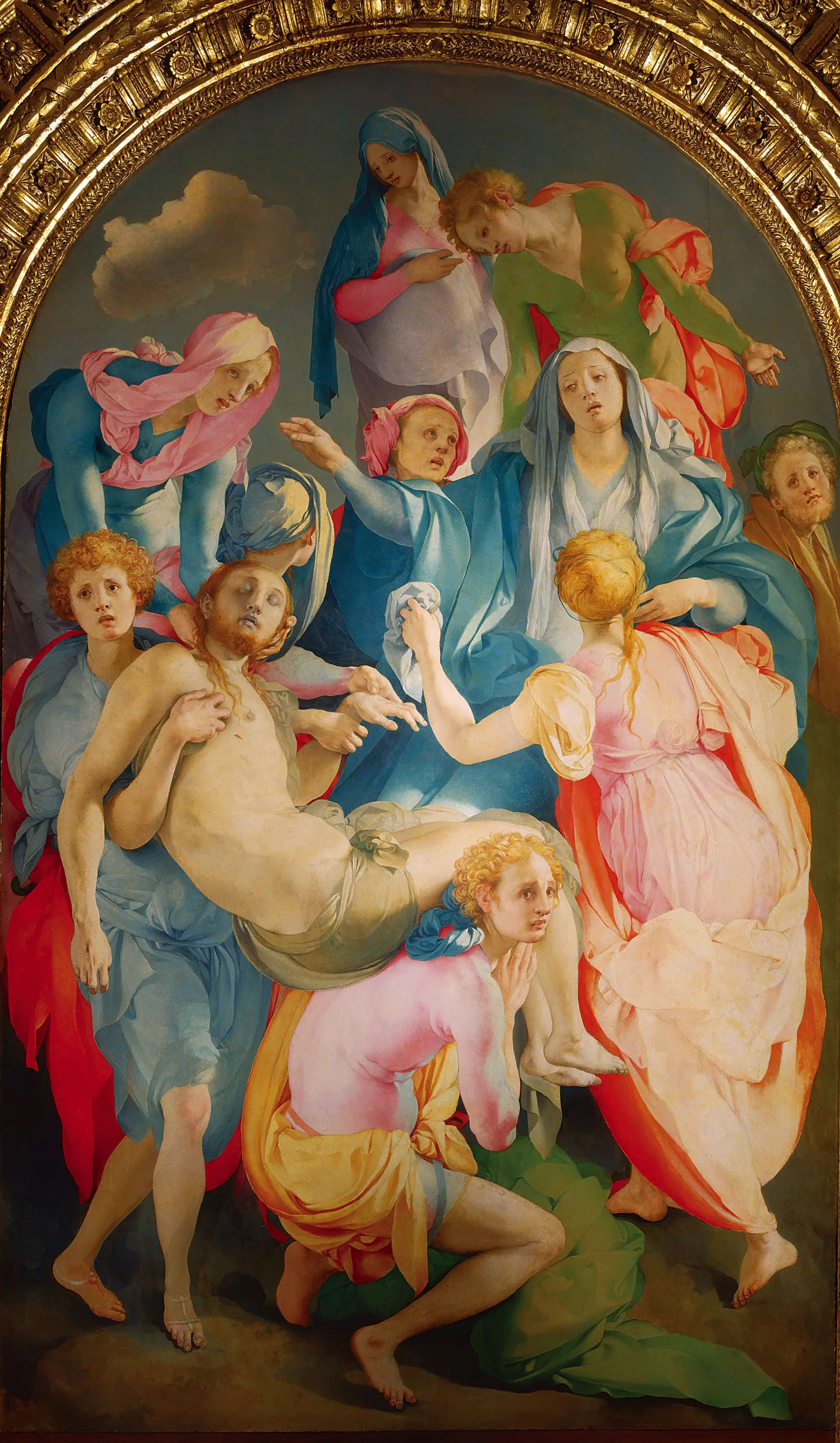
It is at the level of the representation of the human body that Mannerist destructuration manifests itself most forcefully: these artists “hypertrophy muscles, stretch extremities, devise contortions that exceed the capacities of bodies,” they accentuate the expression of faces and show bodies without fear of their nudity. Mannerism ended up discomfiting the power in place, namely a Catholic Church for which the image had become a weapon in its open war against the Protestant Reformation. Thus, in a dynamic that would lead to the Baroque style, Daniele da Volterra – a fervent admirer of Michelangelo, no less – was compelled to cover with drapery the private parts of the figures depicted in the Last Judgment (1541) just after the master’s death in 1564.
In Greek Antiquity, speculatively, one can imagine that such a destructuring tendency drove Praxiteles when he undertook, against tradition, to represent his famous goddess nude – the Aphrodite of Knidos (c. 340 BCE) – thereby shocking his contemporaries1. Pliny the Elder recounts that the sculptor also produced a clothed version of the goddess, preferred by the inhabitants of the island of Kos – the first to make their choice – because it was judged more modest and severe2. The inhabitants of Knidos, having no other option, received the nude version of the goddess. And yet it is precisely this one that became an object of universal veneration.
The manifestation of a deflection from an established tradition can be traced back to ancient Egypt – an artistic tradition that was nonetheless extremely rigid. Admittedly, it belongs to the context of the major political and religious upheavals of the Amarna period (c. 1348-1332 BCE), when Amenhotep IV – who became Akhenaten – turned his back on the clergy of Amun-Ra, choosing the figure of Aten as the expression of the divine. Under the rays of Aten, the solar disk, the representation of the human body became warmer, more expressive, displaying tenderness and sensuality, in a register that was duly described, a posteriori, as mannerist3.
As the common denominator of these distant stories lies a body whose concrete materiality seems artificially concealed by the power in place, a power in which the political, the military and the mystical are articulated. In this context, a form of artistic gesture manifests itself that destructures representation by liberating it, a gesture of resistance that attacks the structures established by authority in order to deconstruct them, while engendering new forms.
Perspective Destructured
Much closer to us, but still belonging to the craft-based arts, the revolution triggered by Cézanne has been interpreted as the result of a break with central perspective, a system that had structured representation since the end of the Middle Ages, and that can be understood as an apparatus4, that is, in Jean-Louis Déotte’s scheme of thought, as a technical element that precedes the act of creation and imprints its mark on the dynamics of representation liable to manifest themselves. The establishment of an apparatus, like its destructuration, institutes an act that transcends – intentionally or not – the sphere of art, and that can lead to new paradigms, ushering in a new era for sensibility5.
It would nevertheless be inaccurate to see in these gestures of deconstruction a fully calculated action, carried out by an artist consciously opposing tradition. Sometimes this movement responds to the most contingent factors. For example, regarding Cézanne, Merleau-Ponty recounts:
As he grew older, he [Cézanne] wondered whether the novelty of his painting did not come from a disorder of his eyes, whether his whole life had not been founded on an accident of his body6.
Stan Brakhage, a leading American experimental filmmaker who will be discussed in the following paragraphs, also takes part in a critique of perspective, crystallized in his book Métaphores et vision (1963). Like Cézanne, Brakhage also suffered from vision problems, especially during his childhood and up to his preadolescence, a physical condition that the artist does not consider insignificant when he reflects introspectively on his work7.
Following Cézanne – the “father” of the avant-garde painters according to Picasso8 – the pictorial experiments of the -isms deployed, each in its own way, various strategies for destructuring the classical system of representation, which had been in progressive decline since the appearance of photography, and was then definitively shaken by the world wars of the first half of the twentieth century. The Cubist decomposition of space, the one based on temporal fragmentation among the Futurists, as well as the various forms of abstraction, extended the Impressionist coup that rose up against traditional academic figuration.
The postwar period saw Pollock complete the deconstruction of pictorial academicism, to the great satisfaction of Greenbergian logic, which claimed to establish a new norm for art, whose sole aim would be to seek the specificity of each discipline. Yet Pollock’s gesture worked at a deeper level, managing to reactivate connections with ancestral, ritualistic modes of existence.
The Technical Image
With the apparatus-based arts, beginning with photography, the tendency to oppose pre-established structures takes on a more concrete form, while the conditionings of the system materialize further within the very means of creation employed. It is now a matter of highly technical dispositifs – cameras, projectors, printing equipment – associated with methods that, while making new dynamics of representation possible, reinforce the hold of pre-existing constraints. These apparatuses of capture and restitution institute a new – and thick – layer of mediation within the processes of image creation.
It has not escaped artists, nor certain theorists, that the new dispositifs for producing images – designed by an industry closely tied to commercial, scientific and/or military logics – often turn out to be out of step with their artistic use. Thinkers such as Vilém Flusser problematized photographic cameras as dispositifs bearing inherent conditionings, consistent with the multiple interests of the industrial sector that designed them. For Flusser, these apparatuses merely unfold their pre-established “program” when they are used unreflectively.
With the cinematographic dispositif and television, the instances of power that structure the technical means of creation become clearer. Cameras, movie theaters, sets, production and distribution circuits: everything seems to respond to the needs of a nascent culture industry, Hollywood constituting in the West the climax of this enterprise, which aims at product placement and, at a more fundamental level, at the conquest of consciousness with a view to its integration into consumer society. It is in the universe of experimental cinema that the will to break with the techno-economic-cultural system of domination flourishes in particular, by strategically disrupting the functioning of the means of artistic production, a process in the course of which forms are produced.
Moreover, the twentieth century, with Surrealism – inspired by Freudian psychoanalysis – brought to light the limits of the conscious and rational human apparatus, bearer of multiple conditionings that hinder the expression of a full freedom, which would flow from the liberation of the unconscious and of dreams. Thus, when Un chien andalou came out in 1929, its co-director Luis Buñuel declared: “During the elaboration of the plot, every rational, aesthetic or technical idea was rejected as irrelevant. In the end, the film is resolutely anti-plastic, anti-artistic, if one keeps to traditional canons9.”
Thus, the proliferation of the apparatus-based arts at the beginning of the twentieth century was accompanied, in parallel, by the discovery of the human unconscious and its pre-established structures, movements followed by theories that revealed the conditionings inherent in technical dispositifs for producing images10, at a time when the question of the machinic unconscious was beginning to be raised, notably with Félix Guattari11. From these reflections emerges not only the machinic aspect of the human unconscious, but also a conception of the unconscious as a transversal, non-anthropocentric function, liable to affect the technical level as well.
From then on, the occurrence of unforeseen technological phenomena, the manifestation of forces hidden within machines, became more legible. With the machinic unconscious, Guattari sought to propose a more open alternative – affective, ecological, technological, material, energetic… – to the reductive model of the unconscious proposed by Lacan, founded exclusively on the symbolic plane. Echoing such a perspective, but within a narrower framework, this research approaches the functioning of the digital not from the angle of the symbolic, but in terms of the way the medium mobilizes matter and energy. It is thanks to the attention paid to the concrete functioning of the medium that the digital works we are going to consider manage to reveal the conditionings inherent in it.
The awareness of hidden, sometimes unconscious structures, now to be situated between the human and the machine, makes intelligible a quest already at work since the dawn of time, one that passes through the destructuration of the technical elements – as well as the normative aspects – linked to the production of the sensible. Twentieth-century art would focus at length on destructuring the immense universe of analog apparatuses, henceforth central to the production of still and moving images, in parallel with the emergence of the culture industry.
Analog Destructurations
In Effacer, défaire, dérégler… (2015), Patrick Nardin builds a cartography of the Pratiques de la défaillance entre peinture, vidéo, cinéma [practices of failure between painting, video, cinema] – the book’s subtitle. This work amply suffices to gauge the richness of the analog antecedents of the practices that will be considered here as destructurations within the digital.
Far from exhausting the artistic corpus of this book, and the conceptual framework that emerges from it, let us say that among the works discussed are, under the aegis of distancing, Bill Viola’s offbeat use of the zoom in Chott el-Djerid (1979), Emilie Frances’s plays on variations of focus – in Nombrils du monde (1998) – and a filming through a pane of glass – concrete but above all dialectical – covered with sugar, in which Isabelle Froment collapses several sets of opposites12. These are practices that “exploit hypercontemporary machinery in an untimely way13.”
Next comes the gesture of erasing, which makes visible the action of absences and losses. Absence of movement in the cinematographic dispositif – Chieko Shiomi, Disappearing music for face (1966) – loss of the integrity of celluloid film, which produces forms when it is burned – Jun’ichi Okuyama, No perforations (1971) – or progressively soiled by the very functioning of the cinematographic projection dispositif in Nam June Paik’s famous Zen for Film (1964). These projects are based on the destruction or absence of the image, while producing forms otherwise. This also concerns the effects of the natural soiling that affects old celluloid – Peter Delpeut, Lyrisch Nitraat (1991). Also addressed is the interaction between the chance traces that alter the physical medium locally or globally – burns, scratches – and the figurative data pre-inscribed on the film, as Bill Morrison does in Decasia (2000).
As the temporal equivalent of spatial absence, it is then the turn of interruptions, which span films built through the off-program use of capture dispositifs – 8mm and 16mm cameras, including the iconic 16mm Bolex – with films edited in the camera at the same time as they are shot – Akira Mizuyoshi, Jun Miyazaki – or by means of accelerations and slowdowns that blur the movement of the referent, as in Yo Ota’s Speed Trap (2004). This path leads to the universe of one of the main figures of radical cinemas, the Austrian Peter Kubelka, who returns to the matrix of the film medium when it reaches its degree zero – white, black, white noise and silence – in Arnulf Rainer (1960). This through an approach that, by deconstructing industrial cinema, constitutes a genuine “thinking of the cinematographic act14,” by an artist for whom cinema, like sculpture, is foreign to movement.
From the territory of experimental practices thus explored follows a conception of art at the antipodes of Jacques Rancière’s vision, which sees in his aesthetic regime the predominance of the literary strategy over the other media. On the contrary, it is a matter of an artistic making in which, as the author points out, drawing close to the experimental filmmaker Stan Brakhage15, a surplus of consciousness is produced outside of language:
One of the aims of Brakhage’s cinema is precisely the search for a knowledge foreign to language, which would be founded on a visual, nonverbal consciousness. There would then be a disjunction of the visible and the sayable, moving toward the unsayable or the inexpressible. The discursive injunction effectively fades behind the act. Another apprehension of the world takes shape, which makes the image a sensible experience opening onto an “optical consciousness,” in Stan Brakhage’s phrase, relying on perception16.
Like Brakhage, and in dialogue with Godard – the Godard of Histoire(s) du cinéma – the point is to denounce a cinema that merely supplies stories, preceded by the literary apparatus, to the detriment of any hic et nunc experience that reactualizes the creative process.
Extending Brakhage’s scratchings, and through the introduction of a layer of mechanical mediation, there then appear approaches that thwart narrative rhetoric by re-editing sequences. This is the case of Bruce Conner, who, through a concatenation of found footage, unmasks the Hollywood industry as it is structured around sex and violence – A Movie (1958) – or again of Keith Sanborn, who makes the propaganda of the US Army “stutter” – in Operation Double-Trouble (2013) – simply by repeating the sequences a second time, thereby revealing the fragility of the discursive dispositif put in place. The exploration of temporal détournements continues with Douglas Gordon and his Star Trek, predictable incident in unfamiliar surroundings (1995), in which, through a simple slow-motion effect, the artist overturns the narrative, transforming the amiable Captain James T. Kirk – the hero of Star Trek – into a voracious satyr. These works stage sequences designed for communicational projects, which do not survive the interruption, the diversion of their temporal development, brought about by simple but effective gestures of re-editing17.
This reasoned journey ends with famous gestures that derange the electronic image: Wolf Vostell’s dé-collages and Nam June Paik’s prepared televisions. Through these approaches, the television image becomes a surface, answerable to an aesthetic gaze18.
Through the prism of the works, Effacer, défaire, dérégler… presents a universe of practices founded on détournements and failures, most of them induced. They bear witness to the thickness, variety and coherence, within the analog arts, of “gestures that act in negative19.” These produce forms by affecting pre-established structures, whether dispositifs, media, operations or methods. More generally, these gestures suspend the very foundations that underpin the standardized production of images, at the heart of a culture industry governed by a market logic with alienating effects.
When compared to the gestures considered in Effacer, défaire, dérégler…, the digital deconstructions considered in the following pages seem devoid of the craft dimension, which is much more difficult to grasp in a digital environment20. Yet this research aims to pin down what remains of gesture within the digital, where a large part of gesturality has been schematized and machinized, while another part, of a nature that will need to be specified21, still falls within the human’s purview. Taking circuit bending into account, as an intermediate rung between human gesturality and the schematized gesturality of the machine, thus proves necessary.
Toward the Digital
At this stage, it is appropriate to introduce circuit bending, an analog – even craft-based – practice that sheds light on the intimate functioning of computers. When, in the 1970s and 1980s, Texas Instruments launched its series of educational electronic devices – the Speak & Spell, the Speak & Maths, the Speak & Read – the firm did not imagine the artistic potential that might be revealed by these toys, should they fall into the hands of an adult like Reed Ghazala, an experimental musician in search of new sounds and thoroughly self-taught. After buying them cheaply in secondhand shops or flea markets, Ghazala opened up the toys, leaving their electronic circuits exposed. Then, with the help of wires that he manipulated, Ghazala short-circuited the internal nerves of these machines in varied and intuitive ways, without any formal knowledge of electronics. When an interesting effect manifested itself, the connection was located and kept for later use. In the most fruitful cases, components foreign to the circuit were added – switches, buttons, potentiometers, knobs, sensors… – in order to control the “off-program” effect found22.
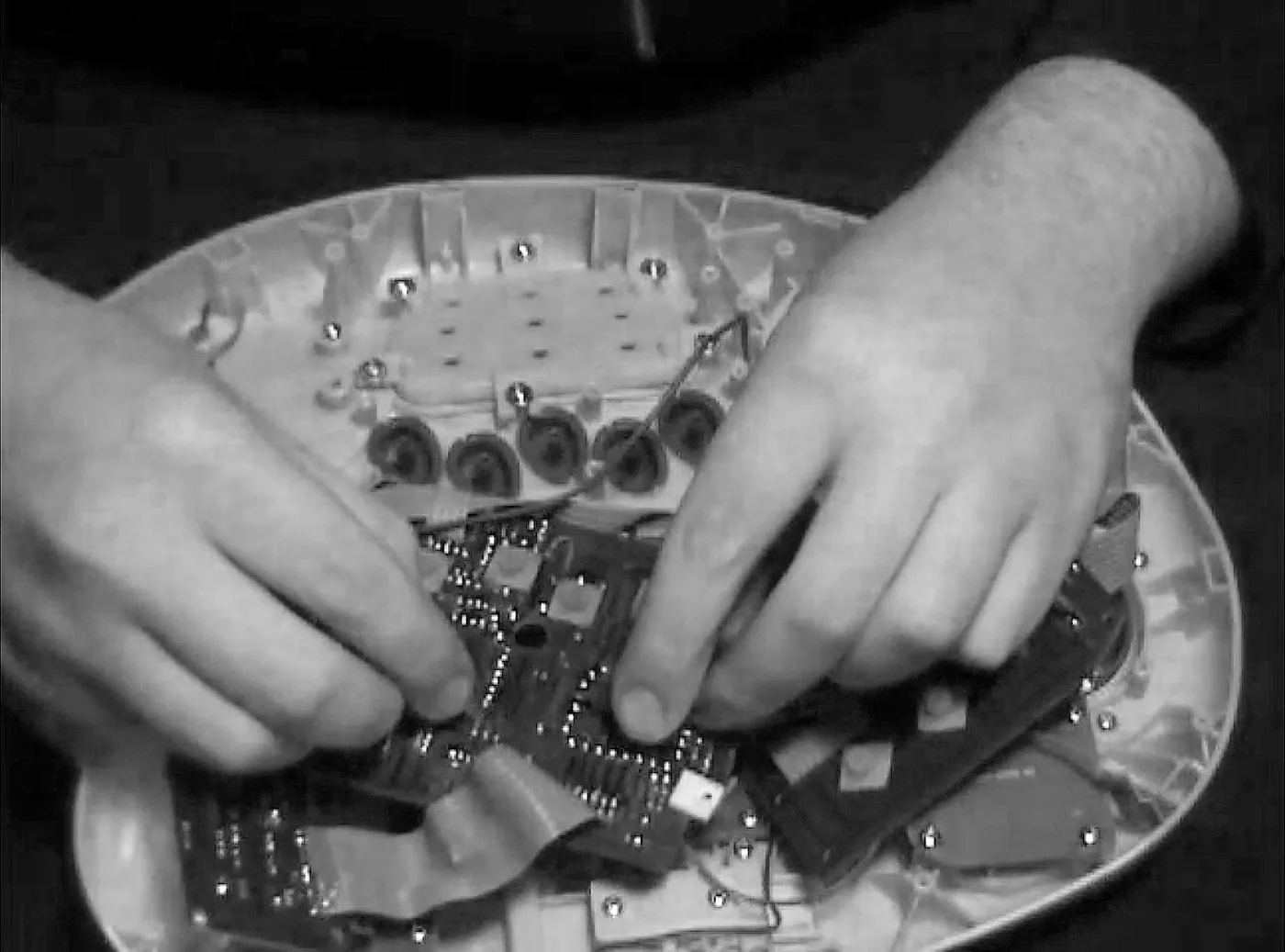
Since 1978, Ghazala has thus given shape to his series of Incantor instruments23, which so far comprises eight instruments made by repurposing “Speak &”-type toys produced by Texas Instruments.
Circuit bending runs counter to the black box logic increasingly favored by the electronics industry, by making possible an exploration of the technical object outside its design logic, while contesting the strategy of planned obsolescence. Indeed, circuit bending brings to light an additional potential use for products otherwise destined to be thrown away and replaced. This practice is deeply rooted in a DIY – Do It Yourself – philosophy of the most radical kind, for it is not only a matter of making with the tools one has at home, but also of creating outside any theoretical framework24. It is a matter of finding one’s own logic in the face of the technological dispositif, on the basis of experience and by trusting chance, a process which, in Ghazala’s words, is not without recalling the avant-gardes’ practices of deconstructing the pictorial dispositif:
If Pollock were to design electronics he would be a circuit bender, I mean the wires fall upon the circuit like the paint upon Pollock canvas you could say, and what happens happens and if I like it I stick with it if I don’t I move on or add more wires or whatever it might25.
We will see later, with Jodi.org, how, like Ghazala’s wires, the elements of computer code can acquire a graphic, even pictorial, value26.
Far less immediate than Pollock’s gesture, circuit bending is of particular interest within a research project that aims to problematize what is gestural in the use of algorithms27. For this purpose, it is useful to approach algorithms on the basis of a broadened definition, both in time – with regard to their genealogy – and in space – by considering interfaces as a particular shaping of algorithms. Circuit bending thus establishes itself as a bridge between the universe of analog electronics and that of algorithms, the latter being interpretable as a form of circuit bending – a highly sophisticated one, admittedly, but very real. The computer itself can be understood as a machine whose interest lies precisely in its capacity to offer very broad possibilities of “circuit bending,” based on a circuit designed to be finely modifiable: a circuit of remarkable plasticity.
The digital works that will be discussed below appear as the extension of the craft-based – painting, sculpture – and analog – cinema, video – experiments mentioned above, which produce forms by deranging pre-established structures: whether through the détournement of construction methods – such as central perspective – détournements carried out when capturing images, the destructuration of narrative strategies or again the undermining of the materiality of media… However, transposing these experiments into the digital domain requires dwelling on two fundamental aspects.
First of all, let us recall the privileged aim of this research concerning the characterization of the new layer of mediation materialized in the computing machine: the algorithm and code. The choice is made to depart from any conception of code that seeks to describe its functioning in symbolic terms, with a rapprochement with human language as its horizon. Indeed, as the practice of circuit bending suggests, code is better apprehended as a very large and varied set of human gestures made available, after having been schematized and “machinized.” These machinic gestures – modulable, parameterizable – designed to be chained together in extremely complex and varied – almost infinite – ways within algorithms, can also be disconnected – as will be the case with Jodi.org – and then reconnected differently, or even diverted, giving rise to strategies that destructure the algorithm in a quest for forms.
Furthermore, it is worth recalling the totalizing tendency of the digital and its effects, which define a new context for art. Indeed, if cinema and television managed to concentrate a significant share of the culture and entertainment industry, the digital also hosts, in addition to a new modality of social communication (social networks), extracultural activities: management, logistics, administration, scientific research, surveillance, military activities… This close link between the artistic medium and a large part of contemporary human activities makes possible fruitful articulations between the works and societal, economic and political dimensions, henceforth materialized within the digital.
Thus, the works we will explore forcefully offer reflections on the concrete mode of existence of digital images, but also on their “fantasized” mode of existence, as conveyed by certain misleading discourses. They also question the bond established between the user and technological means, and, from a more general perspective, the role of the image within the dynamics of social control and manipulation.
Taken together, these works present themselves as a destructuring path, which begins with the periphery of the digital image and progressively addresses various internal aspects, from its overall structure to its graphic texture. By thus crossing the image’s plane of visibility, this path leads on to gestures that destructure the non-visible, underlying levels: that of code, that of the medium, and, finally, the electrical flows themselves, the basic active principle of the digital image.
Alain Schnapp (dir.), Histoire de l’art Flammarion. Préhistoire et antiquité: Des origines de l’humanité au monde classique. Paris : Flammarion, 2011, p. 405.↩︎
Pline l’Ancien Jacques André Agnès Rouveret et al., Histoire naturelle. Paris : les Belles lettres, 1981, livre XXXVI, Ch. 4, paragraphe 9.↩︎
See, for example, Georges Bénédite, «Sur une tête de princesse de la famille d’Akhounaten ». Monuments et mémoires de la Fondation Eugène Piot [en ligne]. 1924, vol. 27, n° 2, p. 113–118.↩︎
See in this sense Jean-Louis Déotte, L’ époque de l’appareil perspectif: Brunelleschi, Machiavel, Descartes. Paris : L’Harmattan, 2001.↩︎
See on this subject Jean-Louis Déotte, «Le milieu des appareils ». Appareil [en ligne]. December 2007, n° 1.↩︎
Maurice Merleau-Ponty, Le doute de Cézanne: et autres textes. Paris : Gallimard, 2023, p. 16.↩︎
See in this sense the debate between Stan Brakhage and Malcolm Le Grice in Boulder, Colorado, in 1978. Malcolm Le Grice, Experimental cinema in the digital age, op. cit., p. 106.↩︎
Picasso is said to have called Cézanne “the father of us all.” See Christian Zervos, « Conversation avec Picasso », dans Cahiers d’art, numéro spécial (1935): p. 173-178.↩︎
P. Adams Sitney, Le cinéma visionnaire: l’Avant-garde américaine, 1943-2000. Paris : Éd. Paris expérimental, 2002, p. 21.↩︎
A reflection that can be traced back at least to Walter Benjamin and Theodor W. Adorno, followed, much later, by V. Flusser, J.-L. Déotte and P.-D. Huyghe, among many others.↩︎
Félix Guattari, L’Inconscient machinique: essais de schizo-analyse. Paris : Recherches, 1979.↩︎
Surface/window, covered/uncovered body, free/submissive woman…↩︎
Patrick Nardin, Effacer, défaire, dérégler: Pratiques de la défaillance entre peinture, vidéo, cinéma. Paris : L’Harmattan, 2015, p. 87.↩︎
Patrick Nardin, Effacer, Défaire, Dérégler, op. cit., p. 179.↩︎
Brakhage himself having made several films with his hands – scratching, collage, coloring – directly on the celluloid, combined or not with filmed figurative images.↩︎
Patrick Nardin, Effacer, Défaire, Dérégler, op. cit., p. 183.↩︎
Patrick Nardin, Effacer, Défaire, Dérégler, op. cit., p. 220.↩︎
Ibid., p. 233.↩︎
Ibid. p.278.↩︎
We will see with Adorno that craft can be weighed – beyond the presence or absence of machines – against “the preponderance of a free disposition of means by consciousness.” In Theodor W. Adorno, Théorie esthétique. Paris : Klincksieck, 2011, p. 295.↩︎
This aspect will be discussed in chapter 3.↩︎
Garnet Hertz and Jussi Parikka, «Zombie Media: Circuit Bending Media Archaeology into an Art Method ». Leonardo [en ligne]. October 2012, vol. 45, n° 5, p. 424–430.↩︎
Images of these works are available on the artist’s website: http://www.anti-theory.com/soundart/instruments/gallery/ accessed 18 October 2024.↩︎
On his website, Ghazala moreover presents his approach as anti-academic, linked to his personal experience, which is visible from the website’s very URL: http://www.anti-theory.com/, accessed 18 October 2024.↩︎
Original English quote. Sentence taken from the interview with Reed Ghazala conducted in 2010 by VBS, made available on the YouTube channel Motherboard. Web link: https://www.youtube.com/watch?v=KHDL9iGxDPM accessed 18 October 2024.↩︎
We had seen, moreover, paper notations associated with certain experimental films that could, they too, offer their aesthetic value to the gaze.↩︎
An aspect that will be explored in depth in chapter 3.↩︎
Cite this pageCórdoba, Pablo-Martín. “Introduction”. In Making Digital Images in the Light of Experimental Cinema — Anthropological and Political Resonances of Algorithms in Contemporary Art, Doctoral thesis in visual arts and photography, Université Paris 8 Vincennes-Saint-Denis, Doctoral School EDESTA (no. 159), research unit AIAC, 2026. https://www.pablomcordoba.com/thesis/destructurations-introduction/