3.2.2
Between Symbol, Instrument, Tool... and Gesture
In 1739, a strange object was found in Hertfordshire, a region north of London, in the United Kingdom. Made of bronze and small enough to hold in one hand, the object has twelve regular pentagonal faces – a dodecahedron – pierced in the center by circular holes whose diameter varies from one face to another. At its vertices are small spheres – or knobs – twenty in number.
Since then, other dodecahedrons of this type have been discovered in Europe. About a hundred in all, distributed mainly in France, Germany and England, but some have also been found in Hungary and as far as eastern Italy. The function of these objects has remained unknown – or nearly so, as we will see – to this day. Widespread, probably for personal use, these objects nevertheless appear in no document, account or image of the period that has come down to us.
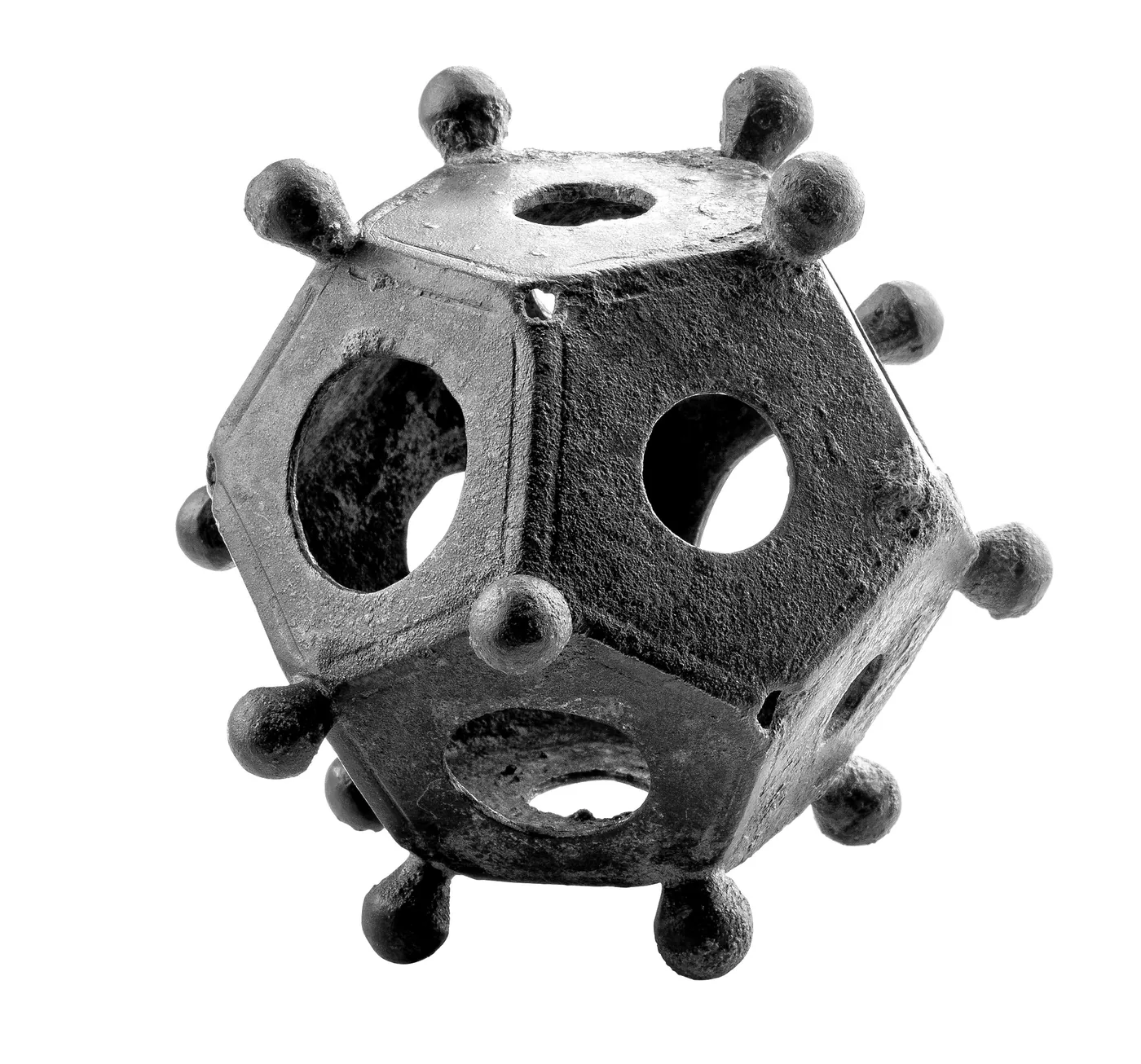
Enigmatic, these objects have aroused the interest and curiosity of archaeologists and lovers of mysteries, and more than 15 hypotheses concerning the use of the Gallo-Roman dodecahedron have been proposed. Some have seen in it an object of symbolic use, an accessory indicating its owner’s wealth. Others see it rather as a toy for children, or else a gaming die, a possible candlestick, a percussion tool, or even the head of a scepter. Some have suggested a ritual use, in which the dodecahedron would have served as an instrument of divination or clairvoyance. Approached experimentally, more serious and better-informed hypotheses have claimed that the object could have been used to measure distances visually1, as contemporary coincidence rangefinders do. This hypothesis is unlikely – an anonymous user hastened to point out on Wikipedia – arguing that, apart from decorative lines, no mathematical sign or graduated scale appears on the surface of the dodecahedron…
G.M.C. Wagemans defends one of the most sophisticated and most respected hypotheses, which he has tested experimentally and theorized mathematically. According to him, the Gallo-Roman dodecahedron would be an instrument of astronomical measurement. It would have made it possible to measure the angle of the sun at its zenith in autumn, in order to determine the optimal moment for sowing winter cereals (barley, wheat)2.
Thus, the most rigorous hypotheses see in the Gallo-Roman dodecahedron a measuring tool taking part in a mathematical calculation, a material echo – symbolic and gestural – of what we would today call algorithms.
The book by the artist and philosopher David Link, Archaeology of Algorithmic Artefacts3, honors the image of the Gallo-Roman dodecahedron on its cover. In this book, Link emphasizes the need for a discipline that seeks to approach algorithmic artifacts through an experiential and material approach, considering that the theoretical approach, both in the design and in the understanding of algorithms, remains insufficient. Although Link does not deal directly with the Gallo-Roman dodecahedron, the object resonates with his subject of study: algorithms. These – or more precisely the machines that execute them, that is, computers – proceed from a genealogy that situates them as instruments of fabrication, intimately linked to gesture: not only that of the abacus, which calculates, but also that of construction, like the one expressed in looms, the direct ancestors of computers.
Thus, despite the salience and virality of the hypotheses – some very simple and intuitive, others more learned – put forward regarding the use of the enigmatic Gallo-Roman dodecahedron, one of the possibilities that has most struck minds on the web, proven by practice but not demonstrated theoretically, suggests that it was in fact a knitting spool. Indeed, on discovering the Gallo-Roman dodecahedron, the Amigurumi expert – “Japanese art of knitting or crocheting animals and anthropomorphic creatures” – Amy Gaines understood that the object could be used to knit what is known as Viking knit: metal wires (sometimes gold) interlaced in complex patterns, used as jewelry. Gaines puts her hypothesis to the test in a video that caught the attention of enthusiasts of the enigma and convinced some of them.
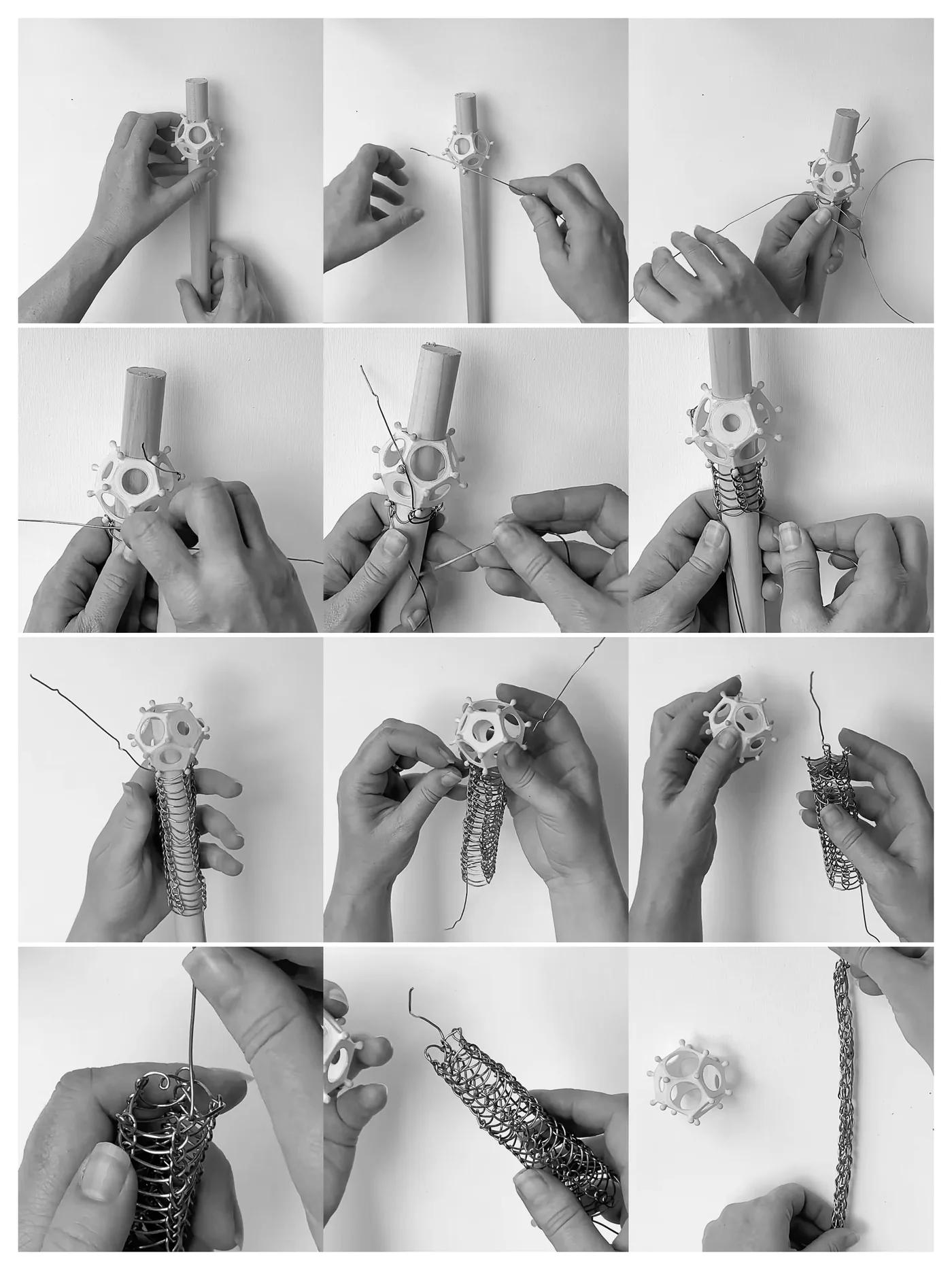
If Amy Gaines is right, this would mean that the form of the Gallo-Roman dodecahedron, which very quickly points to a symbolic use, is in reality a tool for the manual fabrication of woven work. In this sense, it is remarkable that it has been possible to demonstrate that the object could function as an ancient theodolite, measuring distances through the participation of the visual, and, even more so, that this same knitting spool has been verified as capable of serving as a system of astronomical measurement… The reverse is just as surprising: that a complex dispositif for spatio-temporal measurement could also serve as a craft tool for making the woven work in use at the time.
The Gallo-Roman dodecahedron points to a form of fundamental affinity between gesture, measurement, calculation and symbol. As such, it seems to confirm the relevance – suggested in various ways throughout these paragraphs, for the human as much as for the machine – of a continuity (of a passage) from the materiality of gesture toward symbolic functioning.
Amelia Carolina Sparavigna, A Roman Dodecahedron for measuring distance [en ligne]. 29 April 2012. [consulté le 15 June 2025].↩︎
G. M. C. Wagemans, «Was de Romeinse pentagon-dodecaeder een astronomisch meetinstrument voor het bepalen van de zaaidatum? ». Oudheidkundige Mededelingen uit het Rijksmuseum van Oudheden te Leiden. Rijksmuseum van Oudheden, 1997, vol. 77, p. 159–172.↩︎
David Link, Archaeology of algorithmic artefacts. First edition. Minneapolis : Univocal Publishing, 2016.↩︎
Cite this pageCórdoba, Pablo-Martín. “Between Symbol, Instrument, Tool... and Gesture”. In Making Digital Images in the Light of Experimental Cinema — Anthropological and Political Resonances of Algorithms in Contemporary Art, Doctoral thesis in visual arts and photography, Université Paris 8 Vincennes-Saint-Denis, Doctoral School EDESTA (no. 159), research unit AIAC, 2026. https://www.pablomcordoba.com/thesis/between-symbol-instrument-tool-and-gesture/