2.3.6
Postdigital flipbook (2019)
At the origin of Postdigital Flipbook, I should mention the discovery of two algorithmic tools that I had learned to handle in 2019. On the one hand, an AI neural network capable of taking any image as input and, if that image contains a human face, returning a set of 68 points outlining the features of the detected face. On the other hand, I had discovered an algorithm that made it possible to program and launch a large number of Google searches in order to extract their results automatically, notably image searches based on keywords.
These two tools had deeply impressed me. I had not imagined that a computer could — already — detect the presence of a human face in an image, and still less that a piece of software could manage to outline its features precisely, even though it was “seeing” that face for the first time1. I understood that I held in my hands the tool that was going to be — or already was — used for facial recognition. I was also astonished to find that it was possible, free of charge and without advanced computer skills, to literally “sweep” the Web2 and extract images hosted in the four corners of the world.
With such technological “power” in my hands — which I could mobilize despite my limited means — and aware of the titanic size of big data, I told myself that for any given image containing a human face, there must surely exist somewhere on the Internet another image, with another face, whose features would be very close. This second image would have another, structurally very close to it, and so on. By running these “neighboring” images one after the other, it should be possible to make something resembling an animation.
After very long hours of coding and debugging3, spent for the most part trying, by trial and error, to adapt huge chunks of code found on the Internet, an algorithmic system was created that made it possible to search for, find, interpret and link images of faces scattered across the four corners of cyberspace. This system essentially articulated three algorithms:
- The scraper, which, starting from a list of keywords, went looking for images on the Internet, saving the addresses of those containing faces.
- The algorithm integrating the neural network, which, for each image containing a face, provided 68 pairs of coordinates (I, J), pinpointing the eyes, the mouth — with the detail of the lips —, the nose and the lower contour of the face.
- An algorithm which, through long calculations, managed, for each new image, to find the closest images in the immense database.
The system had to be made more complex to take into account the fact that each image did not have, strictly speaking, a single neighboring image, but potentially six: one to the right, one to the left, one upward, one downward, one forward and one backward. The images, linked to one another by proximity, thus formed “spaces of faces.” And one must indeed say spaces, in the plural, for it could be observed, for example, that faces of a certain shape, bearing a particular expression, tended to link up more among themselves, forming a specific space.
After periods of scraping and calculation that could last entire days, the algorithmic assemblage produced, as its final result, a database indicating, for each image, its neighboring images. This database did not contain a single animation, but a vast set of potential animations, depending on the space of faces favored and the path chosen within that space. At the end of a long exploration, one itinerary was selected among the almost infinite possibilities, finally providing the succession of images to be mobilized in constructing the film.
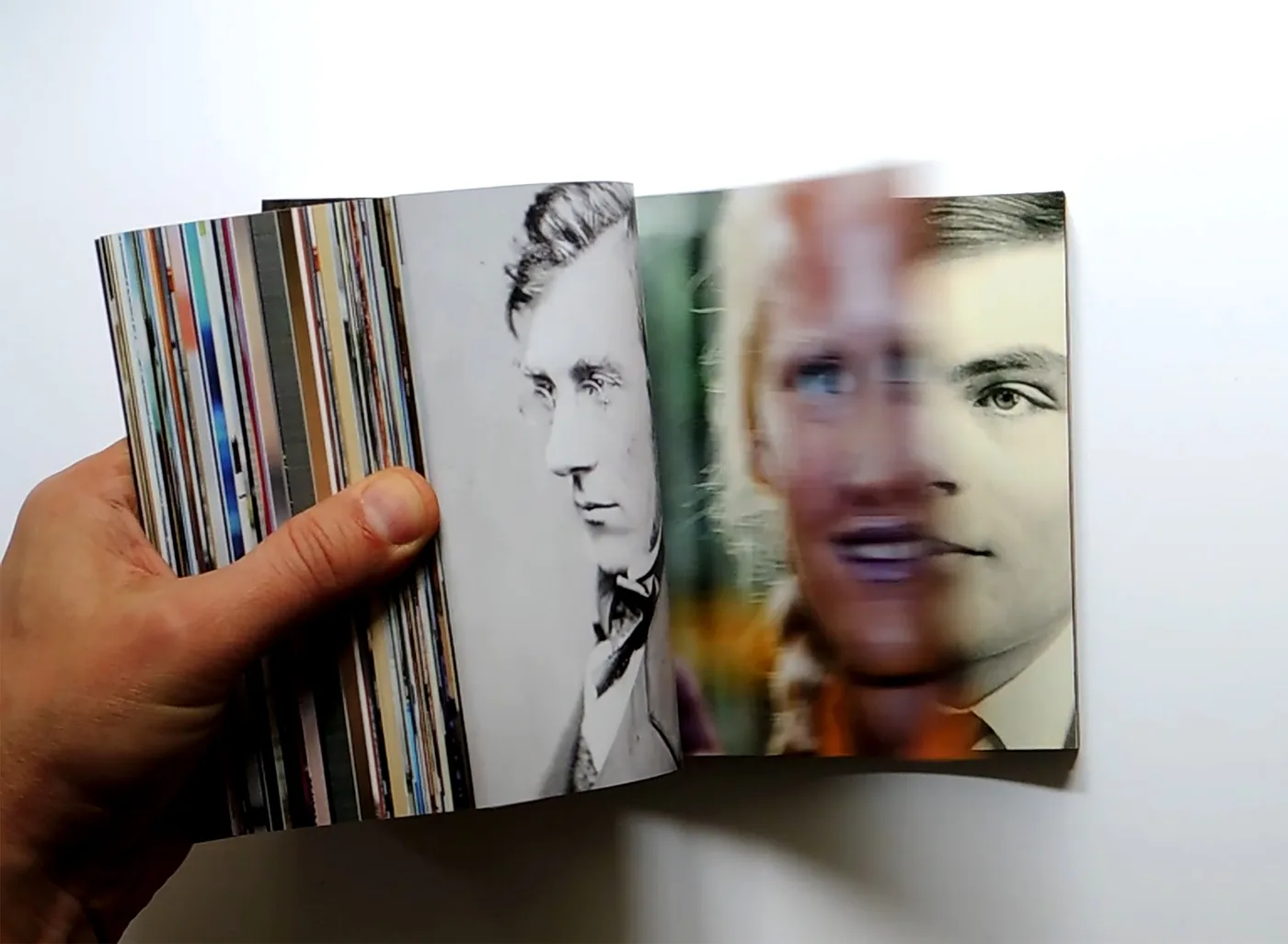
The very great diversity of images showing faces surprised me from the outset: I saw “real” photographic portraits scrolling by — including a few Harcourts —, interspersed with pixelated selfies, screenshots of posts on social networks (Facebook, Instagram, Twitter, TikTok…), “pro” portraits from image banks bearing their watermarks — Shutterstock, Alamy, Depositphotos, Getty Images, etc. —, images of participants in TV shows, shots of celebrities in gowns attending ceremonies, with sponsors’ logos in the background; close-ups of male and female singers, photos from yearbooks, athletes in action, corporate images, advertisements, vinyl or CD sleeves, book and magazine covers, memes with text, images extracted from films or music videos, very old black-and-white or sepia photographs, drawn portraits, faces engraved on metal coins, printed on T-shirts or integrated into tattoos…
Far more “flashy” than expected, the animation unfolds a hyper-fast catalog of the uses of facial imagery, with a strong presence of images with a commercial purpose. By setting all these types of images in tension — in dialogue or in collision —, celebrities and anonymous people intermingling at high frequency, the animation has the potential to “capture” the spectator in a state of permanent astonishment.
Moreover, a “medial” reflection emerged: just like the traditional cinematographic dispositif, and before it the historical animation dispositifs — from the thaumatrope4 to the praxinoscope, by way of the phenakistiscope — not forgetting the electronic video image, most of the systems humanity has devised to produce the illusion of movement rely on a rapid succession of still images. The digital image does not escape this logic, with video streams defined by an fps (frames per second), implemented by a machine — the computer — that expresses itself through a sequence of fixed states. Postdigital Flipbook seems to underline this common denominator of technical animation dispositifs, in a reflection that favors continuity between old and new media, in resonance with the spirit of media archaeology.
All the image-animation dispositifs used by humanity act on the basis of their specific material conditioning5, and Postdigital Flipbook could not have done otherwise. This material anchoring expressed itself forcefully during the creative process, in which, on the one hand, enormous amounts of computing and “data scraping” time were necessary, while the IPs (network addresses) of the images found indicated locations scattered across the globe6, bringing to light the concrete geographical deployment of the Internet.
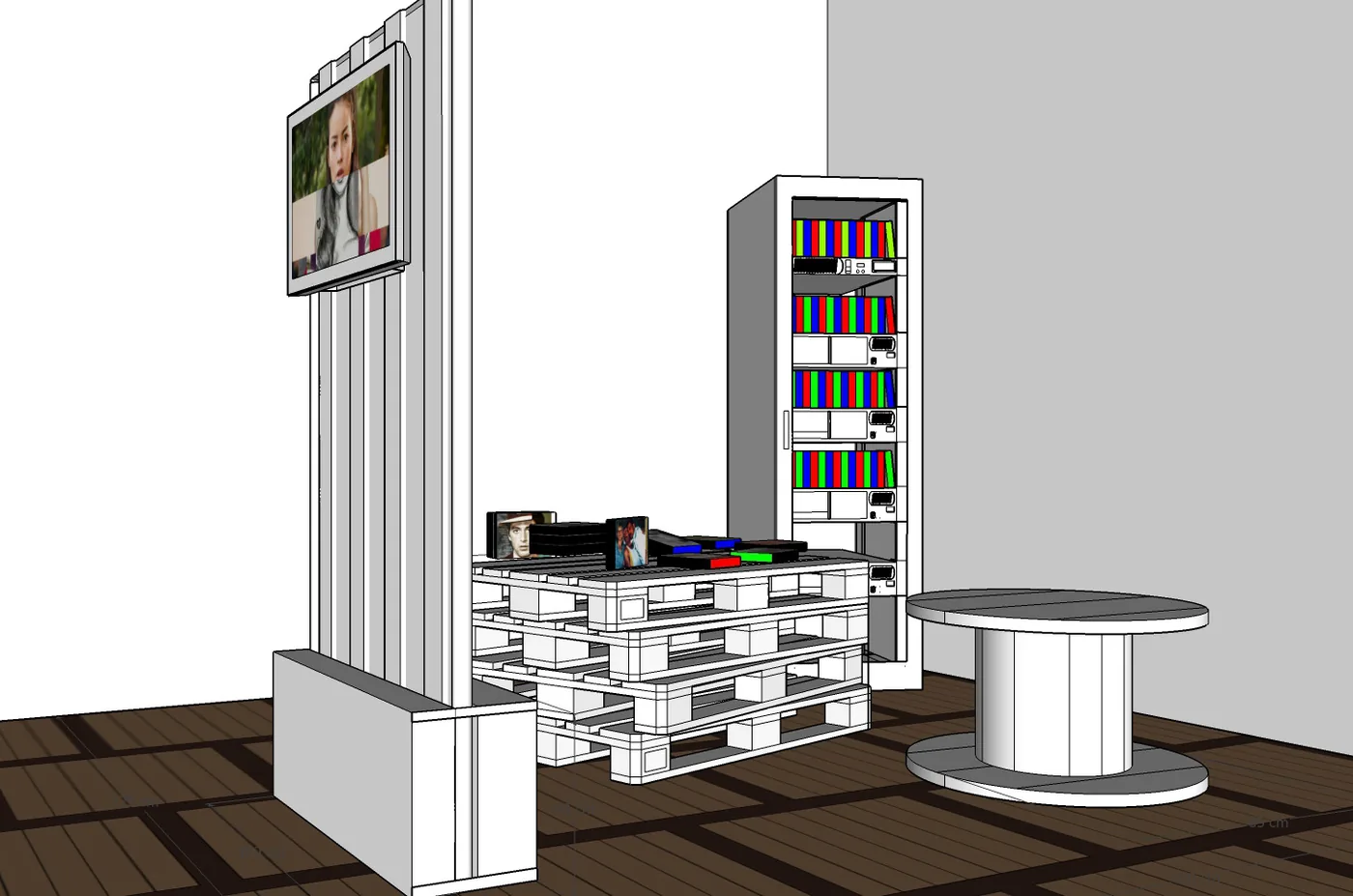
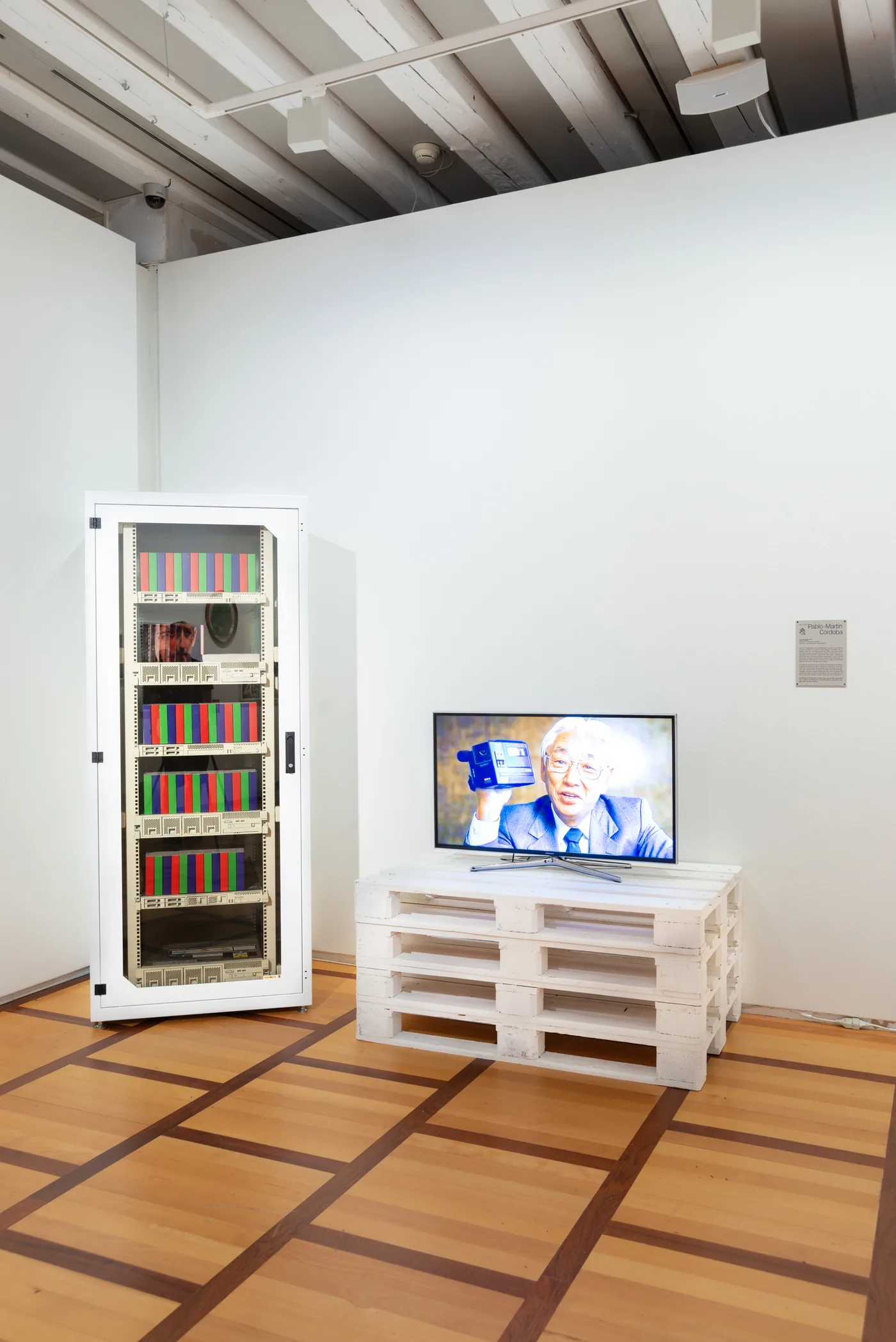
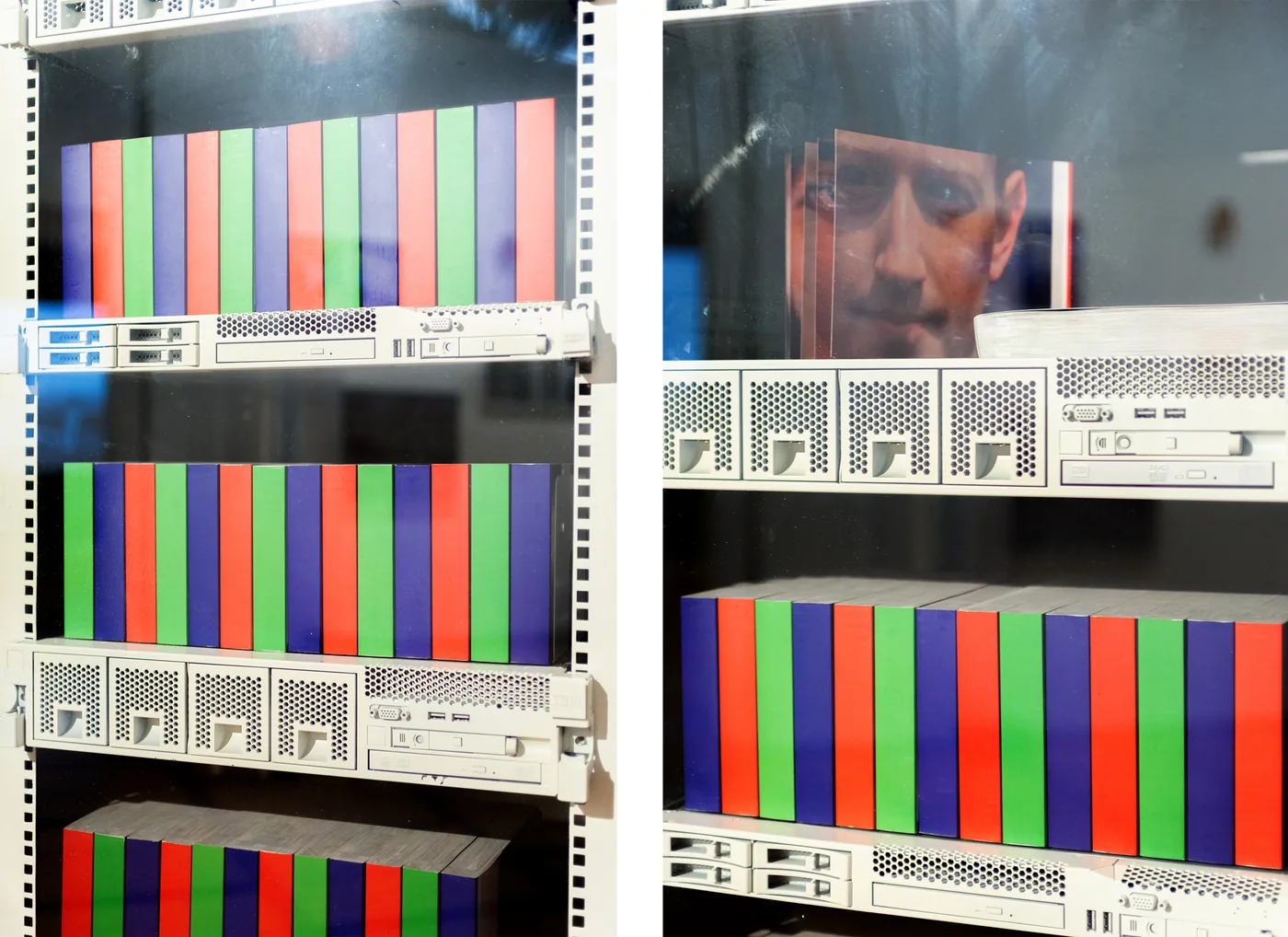
I tried to express this form of materiality by transposing it into the “heaviness” of paper, through the creation of about a hundred physical flipbooks — each weighing about 1 kg. Some of these flipbooks were to be stored in a server cabinet, while the rest of the copies were to be placed on an improvised table near the cabinet, made of a cable reel laid horizontally, the whole helping to structure an installation version of the film. This version was exhibited at the Musée de l’Élysée in Lausanne in 2020, on the occasion of the exhibition Regeneration4. The flipbooks were designed to be made available to the public; however, it was necessary to deal, until the very last moment, with the very material contingencies of reality. Indeed, because of the restrictions related to Covid-19, and in order to minimize the risk of transmitting the virus, the curators — Pauline Martin and Lydia Dorner — decided to keep the flipbooks out of the public’s reach, inside the server cabinet.
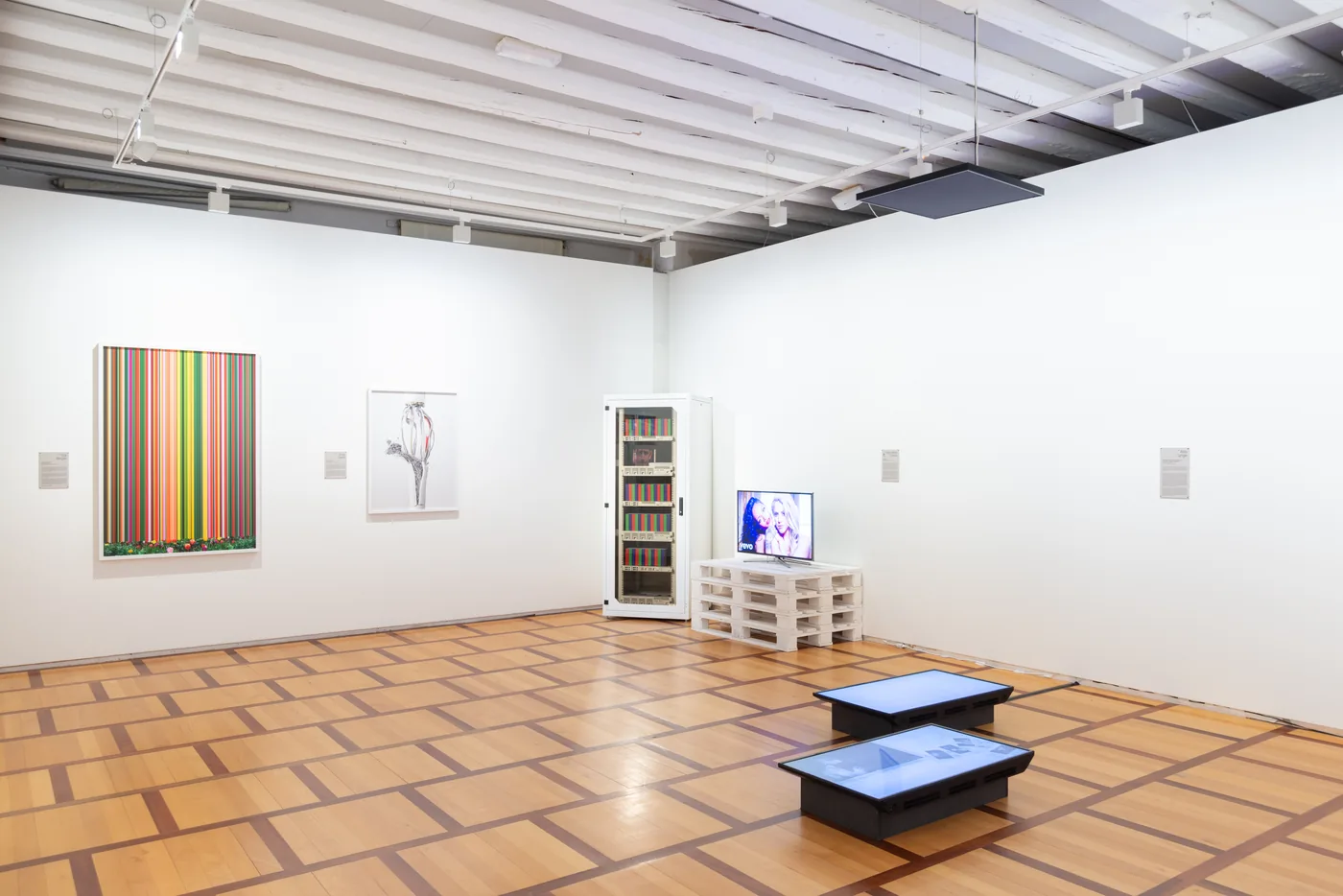
Postdigital flipbook bears witness to a worrying state of affairs, whose consequences we are only just beginning to perceive. Indeed, a large part of our data — including personal data — as well as all our “virtual” traces are de facto available to anyone who might wish to consult them, making new modes of appropriation possible. The point here was to mobilize other people’s data within an artistic project, but the undertaking clearly shows that, with very similar means, it would be just as possible to set up a facial recognition system. Such systems already exist, and not only in China7.
Moreover, the web giants have taken advantage of this situation in their exclusively economic interest. Indeed, thanks to the mass of data freely accessible on the web, and because of a legal vacuum, many digital players have trained their generative neural networks, now capable of producing images (drawings or photographs) and texts of every kind, in an attempt to storm what remained human in the management of the sensible. The sensible, to put it with Adorno and Horkheimer, already belonged to the culture industry; with generative AI, what is now at stake is its automation.
Postdigital flipbook, at first sight, seems to reflect this industrial mode of existence of images, offering an “easy” dazzlement, closer to entertainment than to contemplation — an appetizer that mobilizes vision more than the gaze. Except that, once the spectator is “hooked,” very concrete possibilities for broadening the experience open up: by simply wondering how the work was constructed, a reflection emerges that reveals a deeply problematic aspect of the contemporary mode of existence of the digital.
We now understand how this kind of technological feat works, based on the deep training of neural networks — deep learning.↩︎
It was nevertheless necessary to run the algorithm for a considerable time in order to extract the images mobilized by the project.↩︎
Sometimes difficult moments, during which I understood Brian Eno when he declares, in an interview: “I work with computers all the time and I can’t stand it. I feel I’m dying when I use them.” Web link to the interview: https://desmusiquespourguerir.com/brian-eno-strategies-obliques-pour-creativite-illimitee/.↩︎
The so-called Eyzies thaumatrope, discovered in 1864 at Laugerie-Basse in the Dordogne, dates from the Paleolithic.↩︎
But also of the material conditioning of the human, at the basis of processes such as persistence of vision, thanks to which our visual perception participates in creating the illusion of movement.↩︎
Admittedly, with certain highly privileged zones, such as the United States, and others almost absent, such as sub-Saharan Africa.↩︎
We will address this aspect in connection with the work of Benjamin Gaulon in chapter 5.↩︎
Cite this pageCórdoba, Pablo-Martín. “Postdigital flipbook (2019)”. In Making Digital Images in the Light of Experimental Cinema — Anthropological and Political Resonances of Algorithms in Contemporary Art, Doctoral thesis in visual arts and photography, Université Paris 8 Vincennes-Saint-Denis, Doctoral School EDESTA (no. 159), research unit AIAC, 2026. https://www.pablomcordoba.com/thesis/postdigital-flipbook-2019/