2.1.4
Magmatic Overflows
Takeshi Murata made his short film Monster Movie (2005) by reusing sequences taken from Caveman (1981), an American B-movie comedy. Originally, these sequences show prehistoric men who, while exploring a cave, inadvertently free an enormous yeti imprisoned in a block of ice. Once freed, the monster seems intent on hunting down its unwitting liberators, forcing them to flee through the hostile, icy environment of the cave.
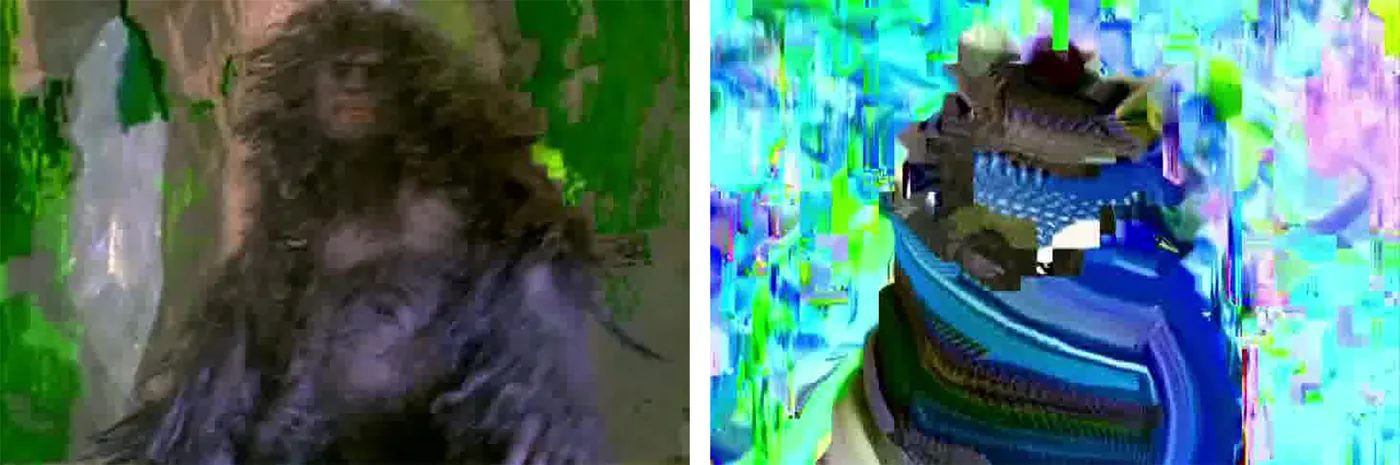
From the very first sequence of Monster Movie, Murata establishes the strategy that will guide the whole short film, which lasts 4 minutes and 10 seconds. He first presents, without any alteration, a sequence taken directly from Caveman for a few seconds. This sequence is then repeated several times, each iteration being progressively deformed by datamoshing. This treatment alters the consistency of the image, which finds itself plastically overflowed. This is done in complicity with the soundtrack, a jerky drum and bass jazz with an atypical time signature, which introduces an effect that is at once stabilizing and anxiety-inducing.
Datamoshing Sublimated
At the beginning of the film, one scene is striking: we see the monster’s head emerge from a pond. Over its successive (re)presentations, this sequence is progressively altered, as the intensity of the datamoshing increases: the image becomes pixelated and slippery, like a plasma in perpetual motion. Raw matter seems to gush centrifugally from the center of the image. The impression of witnessing a chemical reaction out of control, affected by a greenish flame, becomes compelling. At around 1 min 10 s, Murata introduces another register of datamoshing in response to a new action in the original image: the yeti, already out of the water, now advances toward the camera, its disproportionate arms waving in the air. This undulating movement is suspended by a succession of still – frozen – images that the creature’s abrupt gestures tear apart before they freeze again cyclically. In the first part of the video, one notices a certain coherence between the nature of the original image – the yeti emerging from the water – and the manipulated image, pierced in its middle by a magma of pixels. Here, by contrast, Murata plays with an image that shatters, just as the yeti shatters the ice that had enclosed it in the frozen cave (at 1 min 12 s).
The capacity of these images, even deformed, to retain features of the original sequences complicates any interpretation of Monster Movie in terms of abstraction. The surge of the video file’s “data,” provoked by the intervention on the compression system, multiplies the semantic radiance of the image. The figurative regime is thus not annihilated, but surpassed: despite the intensity of the deformations induced by datamoshing, elements of the original image persist in the mind (the dynamics of movements, tonalities), thanks to the systematic repetition of the sequences, but also to the coherence established between the initial referential scope of the images (actions, characters, movements) and the type of deformations to which they are subjected.
While datamoshing is often approached in an undifferentiated, even superficial way, Murata reveals in this technique a versatile image-generation tool, capable of providing different renderings, which the artist modulates pertinently so as to make the images overflow plastically and semantically, in harmony with their original referent.
On the Plasticity of the Glitch
Toward the middle of the film, a new sequence, insistently repeated, shows the yeti wobbling, trying to stabilize its posture. This movement, through repetition, through deformation, is once again transposed onto the magmatic register of the image manipulated by datamoshing, with a central figure that oscillates around itself before a vertiginous background, which liquefies alternately in the vertical and horizontal directions. In the act that follows, a new overflow upends the image: the yeti’s movement from left to right, characterized above all by the swinging of its very long arms, is progressively diverted to become a sort of plasmatic projection ejected toward the right of the frame. Since this is a sequence in which the camera follows the movement of the monster, which has become an incandescent body through the effect of datamoshing, the movement visible in the image comes mainly from the background of the original image, which is progressively stratified into horizontal layers of highly saturated colors.
Composed of scraps of pixelated images, arising from a break in coherence within the compression algorithm, Monster Movie may seem arbitrary at first. Yet, on immersing oneself in it, one discovers the depth of a work that offers a glimpse of the possibility of an aesthetics of the glitch, beyond surface effects. At odds with the frequent interpretation of glitch art, which quickly abandons the domain of the image to explore, on the basis of the glitch, more global societal aspects, Monster Movie bears witness to datamoshing first and foremost as a tool of plastic expression. If this experimental short film has become iconic of the artistic use of datamoshing, if it has been widely cited, and if it is part of the collections of major museums in the United States and elsewhere1, it is perhaps because the intense disfiguration of the image – the aspect that certainly strikes one first – powerful, radical, explosive, highlights a form of plastic coherence that responds to the sensible use of datamoshing quite simply as an artistic tool, whose effects are set in dialogue with the raw material of the work, the figurative image and its pertinently chosen content.
Dionysian Pixels
In Monster Movie, everything happens as if the artist, having isolated key moments in the progress of the yeti from the film Caveman, through repetition and deformation, managed to carry out an orchestrated overflowing of the original sequences, metamorphosed into a kind of frenzied dance of pixels, a symbolic expression of this monster turned experimental film. For despite Murata’s algorithmic intervention, which consists in disorienting the compression codec, the image of Monster Movie always remains within the profusion of its own dancing debris, as if the artist’s gesture consisted above all in “releasing the unpredictable power2” that resides at the heart of the digital image, “compressed” by nature.
In an interview for The Creators Project, Murata explains that his intervention tries to “overload these loops so they start to break apart, it was just pixelized, but it is something that would then have this kind of organic form3.” Henceforth, the “clean” digital image would suffer from a lack of organicity: too geometric, it must be jostled so that it can return to its origins, to its natural form4. Murata’s work thus establishes itself as if in response to the need to “de-artificialize” the digital image.
This return to origins stems from a gesture that must cross multiple layers of mediation, but which, by passing through a derangement of the intimate dynamics of the compressed image, frees it from its superficial artificiality and projects it both beyond and into the heart of itself. Monster Movie transforms the visual flow – and, behind it, the electrical flow – into a form of dance, considered the “first of all the arts and the only natural one5.” The image freed by Murata nevertheless gives itself over to a dance that obeys neither norm nor proportion; on the contrary, it celebrates the loss of control, as in a ritual dance, under the sign of Dionysus.
It is through a controlled use of datamoshing, a technique that deranges the functioning of compression codecs, that Murata makes the digital image resonate with its magmatic, fluid and electrical nature. This gesture affects the data structure of the compressed image, which can no longer be rendered – decompressed – without the appearance of the characteristic tears. This effect still manifests itself within the image’s register of visibility, as in Sniper, with the difference that Murata here tears the image at a finer scale.
However, behind the visible surface of our stratified digital images, the symbolic – yet always active – layer of code is at work, a domain that the duo Jodi favors exclusively as a territory of action. Their approach, which will be examined in the following paragraphs, consists in a generalized and varied destructuration of code, which, in abandoning functionality, offers itself to the gaze on the basis of its graphic value.
Monster Movie is part of the collections of the Smithsonian American Art Museum, the San Francisco Museum of Modern Art, and the Taka Ishii Gallery in Japan, among others.↩︎
In his article Michel Guérin, «Qu’est-ce qu’un médium artistique ?: Intention et condition ». Appareil [en ligne]. June 2016, n° 17, Michel Guérin, while constructing a remarkable image of both the medium and artistic intention, quotes René Passeron, the latter evoking the artist’s inability to fully control the evolution of their work, indicating that the artist places themselves ”in the power of the work, in order to release its unpredictable power,” René Passeron, La naissance d’Icare: éléments de poïétique générale. Marly-le-Roi : Ae2cq éd, 1996.↩︎
The interview, in English, says: ”after doing straight-hand animation I started to try to overload these loops so they start to break apart, it was just pixelized, but it is something that would then have this kind of organic form”. Link to the interview https://www.youtube.com/watch?v=D0wALLf75jU accessed 29 November 2022↩︎
In Adorno we find a conception of art as a process capable of restoring, within a reality too standardized (homogenized, normalized) by technics, a form of original organicity, more closely linked to Nature. See in this sense Theodor W. Adorno, Théorie esthétique, op. cit., p.187.↩︎
Michel Guérin, «Le geste de penser ». Appareil [en ligne]. April 2011, n° 8.↩︎
Cite this pageCórdoba, Pablo-Martín. “Magmatic Overflows”. In Making Digital Images in the Light of Experimental Cinema — Anthropological and Political Resonances of Algorithms in Contemporary Art, Doctoral thesis in visual arts and photography, Université Paris 8 Vincennes-Saint-Denis, Doctoral School EDESTA (no. 159), research unit AIAC, 2026. https://www.pablomcordoba.com/thesis/magmatic-overflows/