3.6.2
The Unfolding of Gesture in the "Space" of the Digital Creative Process
Most of the works making up the personal work (with the exception of Substance and Sky Semantics) involve from the outset an aspect of assemblage that touches the algorithmic core. Indeed, in the construction of the works, a tool designed for the creation of 2D video games – the SDL library implemented in C++ – was used to process and manage images from video and photographic captures. This is a matter of assemblage because it involves an unexpected connection between two instances (the SDL library on the one hand, photographic and video captures on the other) that were not designed to work together.
From there, within each project, the gestures and their effects1 unfold in distinct ways.
In El túnel, the engine of the work is established at the moment when material devices are assembled, establishing a non-standard connection (to be grasped in the protocol zone) between projector, camera and algorithm, devices pushed to the limits of their usual operating range. This also constitutes a loop of circulation for the images, which likewise escapes the range of use of these devices. From this gesture, a visual form is progressively structured within the image2, through the accumulation – controlled by the algorithm – of captured images of a human body in motion, the latter positioning itself as an element of the creative process, joining the material assemblage of devices from the analog periphery.
La flamme, as has been said, is constructed through an initial and progressive cutting-up of a still image, to be grasped as a destructuration operating at both the algorithmic and the plastic level. In its final version, the work proposes a structuration from a dynamic multiplicity (an abstract moving image) toward a final fixed (figurative) form, a dynamic that occurs in the analog periphery. The manifestation of a clear gesture was felt during the creative process of the work, when the order of succession of the images – as supplied by the algorithm during their construction – was reversed, a gesture (of destructuration) that took place between the images, outside the algorithm.
L’inter-code is based on a system that is structured algorithmically, in the form of a program capable of creating video collages from multiple sources. These, in the context of the work, are of a very diverse nature: captured images of members of an Amazonian people (the Taulipang, today Taurepang), images showing text, photographs and 3D models of the vision apparatuses exhibited at the Musée des arts et métiers in Paris. The unexpected linking of these different elements is a gesture located outside the algorithm, in the analog periphery.
In Gare Paris-Saint-Lazare, 10 avril 2017, 12h03-12h07, there is a protocol-based aspect, which periodically institutes the capture of still images from the moving image, in order to superimpose them onto it. This implies an assemblage between the still image and the moving image, whose balance between movement and fixity establishes the dynamics of the work. At the level of the analog periphery (the forms we see with our eyes), a structuration takes place, of a “collective” form that takes shape in the hollows of the architecture.
Paysage d’hiver destructures the representation of a real landscape, while algorithmically structuring a new, imaginary landscape, made sensible by the work. The progressive structuration of the image was here conceived within the algorithm, and then validated afterwards on the sensible plane3.
In Postdigital flipbook, there is a clear algorithmic assemblage, which articulates the facial recognition algorithm, the scraper that scans the web, and a third algorithm that links the images according to their proximity. This third algorithm makes possible a form of structuration initially conceived from the sensible (bringing together still images capable of generating an animation effect) within a protocol-based logic.
The animation that constitutes Substance was created using a graphical interface that makes it possible to perform visual movements within 3D models of Paris, by dynamically adjusting the parameters of the virtual camera (vertical and horizontal angles, zoom, etc.). The algorithm here takes the form of an interface4. The articulation of a reflection conceived for an elderly person with very recent data centers is to be grasped as a form of assemblage on the discursive plane, which belongs to the analog periphery, where a visual path revealing the location of the data centers is also structured. This path stems from a protocol-based logic: each data center is associated with an emblematic spot in the city of Paris, and their locations are visually linked by the movement of the virtual camera.
Finally, Sky Semantics finds its impetus in the diverted articulation of a semantic recognition neural network – designed to segment urban images according to the objects detected – with images of clouds, the two being brought together within the algorithm. However, in what can be apprehended as a destructuration of the latter, the work took on consistency at the moment when the precision threshold of the neural network was relaxed. The whole contributes to producing a sensible assemblage in which a dialectic between two different temporalities, one human and the other machinic, is expressed.
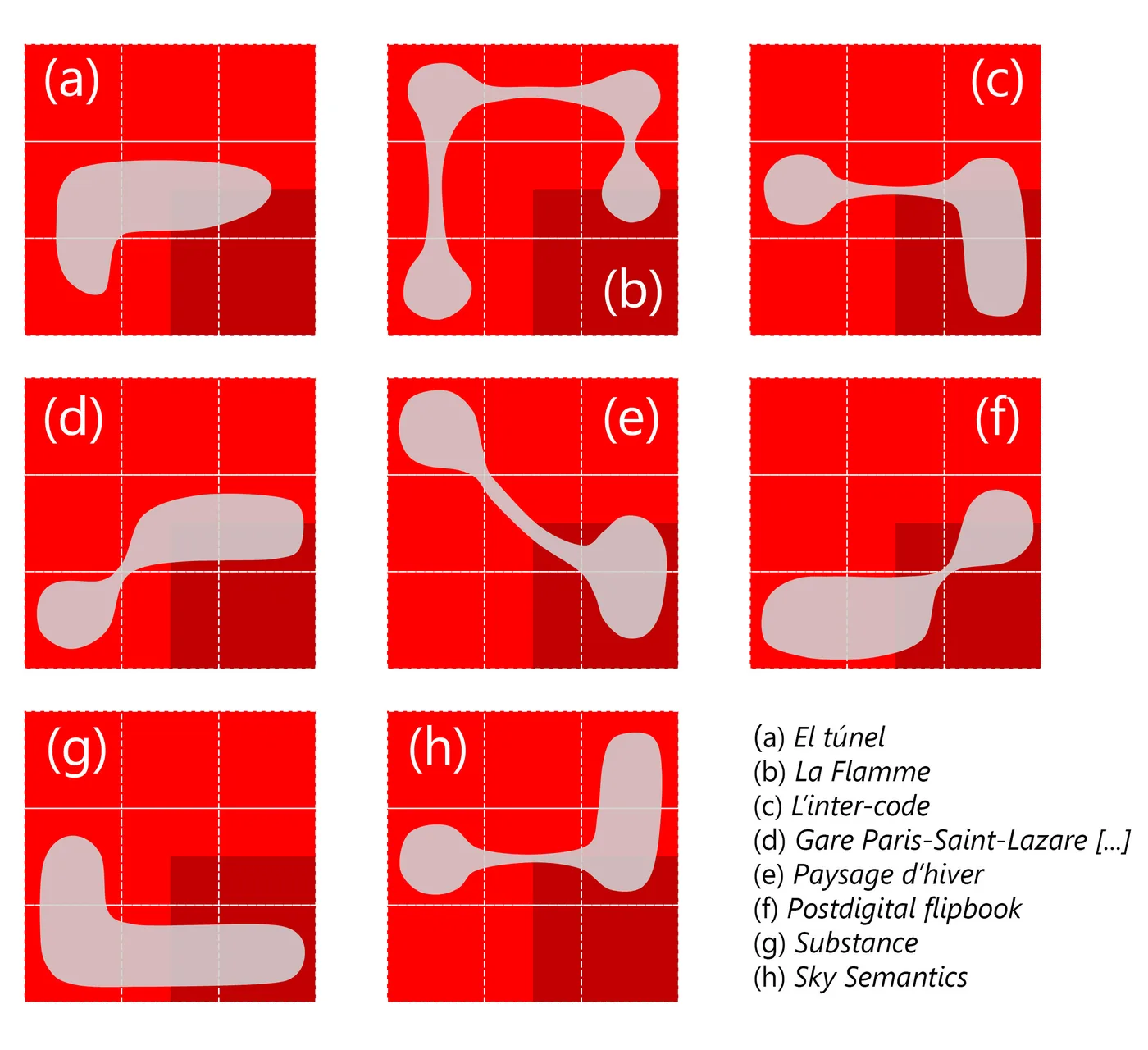
The proposed diagrams can be apprehended as an attempt to clarify the nature of the artistic gestures we are seeking to problematize. They do so by specifying – for each project making up the personal work – their spatial unfolding within a territory defined by the strategies (structurations, destructurations and assemblages) and the levels (algorithmic core, protocol zone, analog periphery) under consideration. These diagrams aim to describe the anatomy of each of these gestures, without it always having been possible to separate them from their effects, which raises the question of the boundary of artistic gestures: where do they begin, where do they end? Moreover, since the territory – thus defined – offered to gesture is also a space in which different forms of uncertainty (analog virtual, algorithmic virtual) are distributed, the proposed diagrams also make it possible to grasp the way in which each project activates these uncertainties – these forms of the virtual – inherent in the digital medium, which are bound to be actualized in different contexts within each work.
There is no clear boundary between gesture and its effects.↩︎
The image that reaches us, the visual signal that reaches our eyes, is always an analog signal, even when the system emitting the image, such as a computer, operates digitally.↩︎
Whereas, in Gare Paris-Saint-Lazare, 10 avril 2017, 12h03-12h07 and El túnel, the structuration of the image was imagined on the sensible plane, and then transposed into the algorithm, through adjustment.↩︎
In the context of this research, graphical user interfaces (GUIs) are to be understood as a particular form-giving of algorithms.↩︎
Cite this pageCórdoba, Pablo-Martín. “The Unfolding of Gesture in the "Space" of the Digital Creative Process”. In Making Digital Images in the Light of Experimental Cinema — Anthropological and Political Resonances of Algorithms in Contemporary Art, Doctoral thesis in visual arts and photography, Université Paris 8 Vincennes-Saint-Denis, Doctoral School EDESTA (no. 159), research unit AIAC, 2026. https://www.pablomcordoba.com/thesis/the-unfolding-of-gesture-in-the-space-of-the-digital-creative-process/