2.2.5
Exhausting the Image
In 1975, Georges Perec attempted to “exhaust” a place in Paris1, observing that, while the main elements of the place2 had already been inventoried, there remained a universe of events and objects that escaped the ordinary gaze, elements making up “that which is generally not taken note of3.” The author then sets out to describe meticulously, over three consecutive days, the microcosm he has chosen, which turns out to be teeming with details: he individualizes the buses and cars as they pass, he observes the subtle changes of the light, he takes note of the multitude of signage symbols distributed across the urban space, he captures the colors that dominate the scene as time goes by, as well as the actions of the most diverse characters, whom he observes and describes… In doing so, Perec manages first of all to point out the instrumental functioning of our capacity for attention, impoverished by the needs of everyday action. Despite the intensity of his commitment, his attempt to exhaust the place Saint-Sulpice obviously remains unaccomplished, as the artist himself acknowledges: he can only record the objects and events within his reach, located or taking place in his immediate radius, and only during the hours when he is present, in a place that ultimately proves too dense and too vast. The conclusion is inescapable: the exhaustive exploration of the real proves humanly impossible.
Perec’s account echoes another project that preceded it, in which the writer Jorge Luis Borges explores the almost infinite extension of an imaginary place, his famous Library of Babel (1944)4. It is composed of interconnected hexagonal rooms, whose walls hold shelves of identical size, each housing an equal number of books, all of which have the same number of pages – 410 –, of lines per page – 40 – and of characters per line – 80. His imaginary library is vast enough to house every book imaginable in this format, resulting from all the possible combinations of letters from an alphabet of 25. The rest is well known: the library, although gigantic, is not infinite. It nevertheless becomes an inexhaustible source of fictions, which the author puts to good use.
In the lineage of these literary projects, visual artists have devised their own protocols for exhausting digital images. Weighed against the place in the real world studied by Perec and against Borges’s imaginary library, these images present themselves as an easily apprehensible system. Indeed, the digital image is formed by a matrix of pixels of identical size, arranged in a fixed number of rows and columns. Each pixel must take on three values (R, G, B, for red, green, blue), which can vary between 0 and 255 and define the three components of additive color synthesis. We may add that, in contrast with the “analog” continuity of the real scrutinized by Perec, but just like Borges’s library, the digital image is made up of discrete elements in space – the coordinates of the pixels – and also with respect to the color of each pixel – positive integer values. Given the relative simplicity of the principle of its constitution, it is hardly surprising that the digital image is sometimes perceived as a closed system, too predetermined when it comes to inscribing an artistic gesture in it.
The works Every Icon (1997) by the American artist John F. Simon and, conceptually very close, Every Possible Photograph (2013) by Jeffrey Thompson are of particular interest to us because they articulate the sensible and the quantifiable, offering a glimpse of the extent of the domain of possibles associated with the digital image.
(Almost) Infinite Images
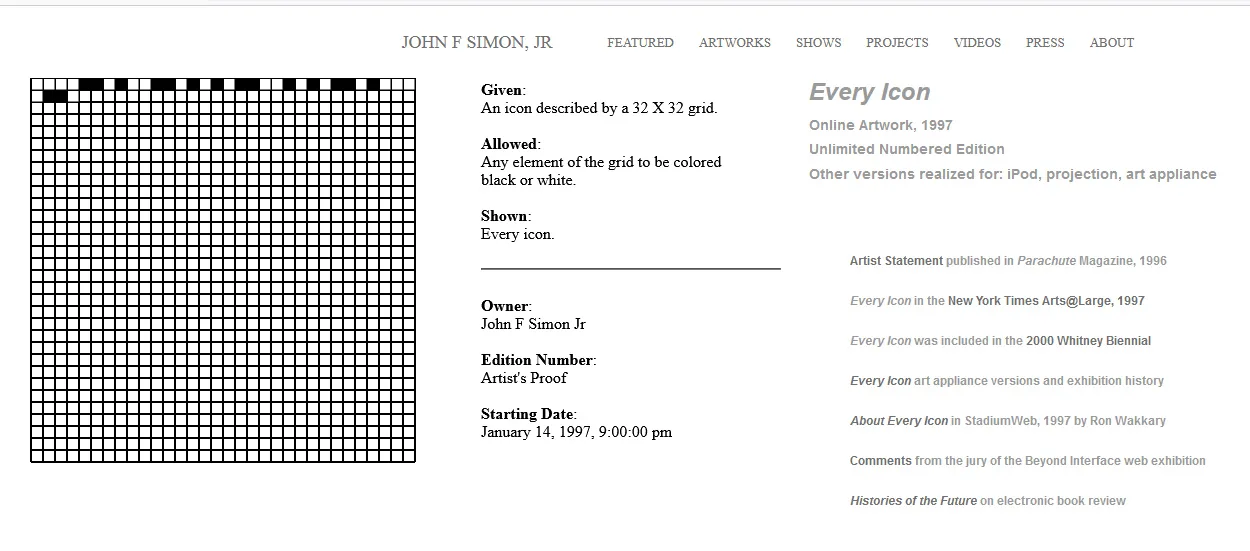
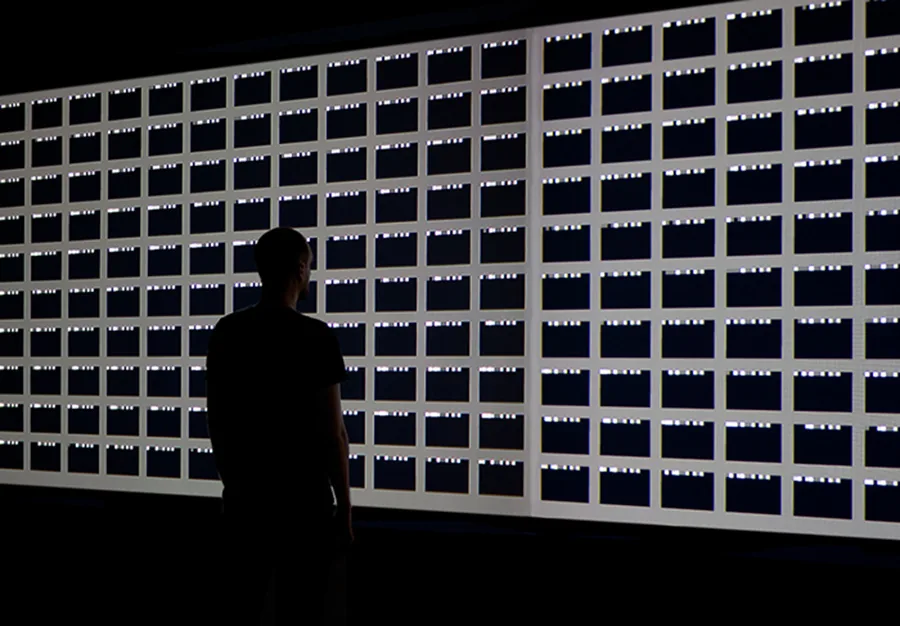
In Every Icon, John F. Simon proposes a matrix of 32 by 32 squares, defining a total of 1,024 monochrome “pixels.” The artist devises a JavaScript code whose project – a titanic one, as we shall see – is to render, one by one, every possible combination of black and white pixels, that is, the totality of the monochrome “icons” possible in this context. The work, originally presented online, was “started” on 14 January 1997 at 9 a.m., and today, almost 30 years later, only the graphic possibilities of the top row of pixels have been exhausted. Indeed, while calculating and displaying all the possible combinations for the 32 pixels of the first row, at a speed of 100 icons per second, takes 16 months, it would take 5.85 billion years to generate and display all the possible variations of black and white pixels in the first two rows combined and, a fortiori, it would take “several hundred trillion years5” to reach the 1.8x10^308 possible combinations for the 32 by 32 pixel grid.
Following a very similar logic, Jeffrey Thompson attempts to exhaust digital photography. To do so, just as in Every Icon, Thompson adopts a simplified model. He takes as his basis a matrix of 16 by 8 pixels, with a palette reduced to 8 gray values. His starting point is not the void of the blank image, but an adapted version of the first photograph ever taken, Nicéphore Niépce’s famous Point de vue du Gras (1827). The artist maintains that, with a computer running 24 hours a day, his project would need a number of years far exceeding the age of the universe in order to calculate all the images possible in this context, however reduced it may be6.
In light of these projects, which demonstrate the inexhaustible character of these images despite their very low resolution, we can only acknowledge the immensity of the possibles offered by digital images in their usual conditioning. Take, for example, a 2K image, standard today, with 1,920 pixels horizontally by 1,080 pixels vertically, each of which can take one value among the 16,777,216 possible shades of color: there is no machine capable of calculating the total number of possible 2K images, expressed in abbreviated form as 16,777,2162,073,600, nor any support long enough to write out the result. In truth, the overwhelming majority of possible digital images, despite the volume and speed with which our image-devouring civilization produces images, will never be materialized.
The Temporality of Meaning
As can be found in the texts associated with these projects, both John F. Simon and Jeffrey Thompson raise the question of the reception and meaning of the images generated by their “image machines.” If the calculation speeds up, Simon points out, the time devoted to displaying each image will be too short for the image to be perceived. For his part, Thompson anticipates that, among the multitude of meaningless images generated, there will be figurative images with no correlate in the real world, images representing fictional situations7. Simon also raises the question of the temporal variability of the meaning of the generated images. Indeed, apart from the images that can be likened to noise, some of the generated images will show representations or symbols that have no meaning today. Nothing, however, prevents these images from acquiring meaning in the future: perhaps they will have one for humans of the future.
Beyond the symbolic regime of these images generated by machinic means, these two projects interest us above all for their capacity to address, in a particular way, the temporality and materiality of the creation of digital images and of their reception, within a framework of finitude8: the finitude of a human temporality far too limited, incapable of bearing witness to the evolution of these projects; the finitude of computing capacities, quite simply incapable of carrying through a calculation bearing on very simple images; the finitude, finally, of the universe of possibles of digital images – except that this universe merges with the infinite when compared with our possibilities of production and reception. Indeed, these works underline the fact that, while digital images form a finite set from a theoretical point of view, they constitute a domain so vast that it turns out to be infinite in practice and on the sensible plane.
The End of the Image?
When one considers the context in which Every Icon was created, an interesting aspect comes to light. In the 1980s and 1990s, emerging postmodernism was calling into question the possibilities of images, presenting them as limited and obsolete, and subordinated to “language.” In an interview with The New York Times, John F. Simon states:
There was a lot of discussion in the late ’80s, when postmodernism was emerging, that we had reached the end of the image […] And I wanted to show that even in a simple 32-by-32 space, the possibilities of the image were vast9.
From then on, Every Icon can be conceived as a critique, as an almost political stance taken by the artist against the postmodernist conception, founded on principles of rupture: the – simultaneous – collapse of metanarratives such as Christianity, the Enlightenment, Capitalism and Communism10, but also the end of the material experience of the world, as Déotte points out in his exegesis of Lyotard’s ideas:
we pass from materials to Immaterials. The former are given, as matter is; the latter are produced by the mind that calculates; they are artifacts that offer no resistance to the knowledge that is their matrix […] From the moment matter is no longer a given, experience is no longer a value, any more than labor, will and emancipation11.
At the same time as it proclaimed the obsolescence of images – an obsolescence extendable to the sensible, to experience – postmodernism seemed to advocate a new, infinite and immaterial substance, that of language – the “mind that calculates” – an inexhaustible universe of possibles in which matter is deproblematized. A doctrine curiously well suited to the spread of an unbridled neoliberalism after the fall of the Berlin Wall. This connivance between postmodern discourse and capitalist structures has not escaped criticism12.
Against postmodern conceptions and their bold extrapolations, and taking the digital image as a metaphor, the works of Simon and Thompson succeed in underlining the inexhaustibility of the image’s domain of possibles. If the image is inexhaustible, it is because the speed of calculation is not infinite, but also, and above all, because the possibilities of sensible reception are likewise inscribed in a human temporality that proves vastly insufficient. This results from the fact that the human as much as the machine must answer to a resistance, which is none other than that of matter itself. In this, Every Icon and Every Possible Photograph resonate with the articulation of matter and time as it follows from Bergson’s formula:
If I want to prepare a glass of sugar water, do what I may, I must wait until the sugar melts […] the time I have to wait is no longer that mathematical time which would apply equally well along the entire history of the material world […]. It coincides with my impatience, that is to say, with a certain portion of my own duration, which cannot be lengthened or shortened at will. […] The universe endures. The more deeply we fathom the nature of time, the better we shall understand that duration means invention, the creation of forms, the continual elaboration of the absolutely new13.
There is an irreducible time, just as there is matter whose availability is not unlimited: this acknowledgment of finitude does not imply the absence of creation. On the contrary, creation is the name of the evolution of this system of time and matter, in a process that has been under way since, so to speak, the big bang. At this point, faced with this vision of a teeming creative evolution, the temptation to appeal to some form of transcendence that would simplify the problem is strong. The emergence of forms in a domain as material as that of the digital image encourages us to resist the siren song of transcendental simplifications and to envisage the project of living existence within a framework of immanence.
The Image, Between Time and Matter
What do these projects show, if not approaches that bear witness to a heightened awareness of the material temporality of images? These works resonate with the conception of images that emerges from the thought of Bergson, for whom matter is image, and the image is matter:
Matter, for us, is an aggregate of “images.” And by “image” we mean a certain existence which is more than what the idealist calls a representation, but less than what the realist calls a thing — an existence placed halfway between the “thing” and the “representation”14.
Hence, for Bergson, the movement of matter is also the movement of images:
[…] the truth is that the movements of matter are very clear as images, and that there is no need to look in movement for anything other than what we see in it15.
Thus the image-matter is to be conceived on the basis of its energetic, electrical fluidity, in harmony with the conception of the hypermaterial as proposed by Bernard Stiegler16:
Hypermaterial is a term that attempts to think what has wrongly been called the immaterial (notably by André Gorz). We must rid ourselves of the idea that cognitive and cultural technologies are immaterial: the immaterial does not exist. Matter, having become flow, is less and less solid; it is not for all that immaterial, and on the contrary, more and more equipment is needed to transform it. […] To speak of hypermaterials and of hypermateriality is to recall that what is at stake today is the mastery of matter-energy in its slightest states and at every scale, not the supposed immateriality of information. What is proper to a technology of the mind, which is to produce effects on a mind, is obviously not its “immateriality” […]17.
In tune with new conceptions of matter, these works profoundly undermine the validity of any hypothesis that would seek to problematize the digital image as a dematerialized entity. An anachronistic discourse that nevertheless persists today in the institutional framework of art, where digital works, increasingly present in collections, are still problematized on the basis of old paradigms. These paradigms reduce the possibilities that certain digital works offer of linking technology, the human and the environment in which they coexist. Thus, when John F. Simon offers realizations of his work Every Icon in the form of NFTs, the Centre Pompidou acquires some of them to enrich its new NFT collection, thereby becoming one of the first major institutions in the world to include NFTs in its ambitions and practices for the conservation of works of art. Yet, in an article presenting the acquisition, we read that the project is part of “a genealogy of the dematerialization of the work of art18,” and this in full awareness of the physical needs of NFT tokens19, and without being able to ignore the very material problems relating to the conservation of digital works20. Everything happens as if the apprehension of the material aspects of the digital – which it is our aim here to grasp through art – were coming up against the survival of old paradigms within institutions and aesthetic traditions.
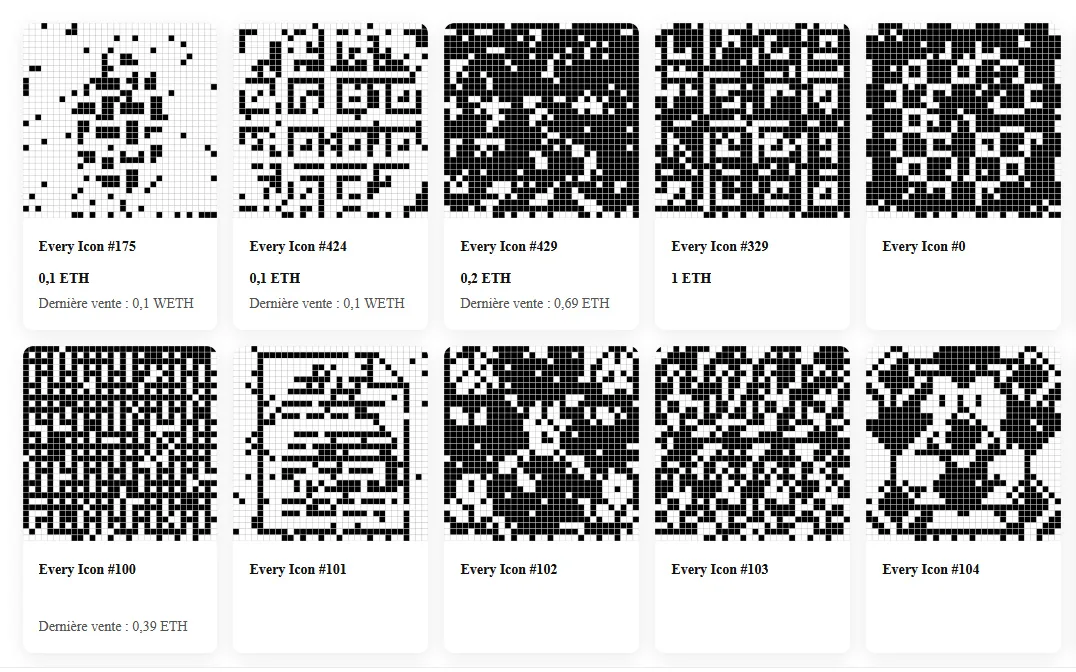
The works we have just discussed are veritable image-generating machines with an eternal vocation; they function by materializing visual forms otherwise condemned to remain at the stage of the “possible21.” These works offer the gaze unprecedented visual configurations, never represented before, thereby enlarging the concrete territory of existence of digital images. This is a passage from the “possible” to the real, which manages to make sensible the extension of the quantifiable evoked here, thanks to a gesture that approaches the digital image on the basis of its duration and its material anchoring in the world. The images thus produced are, admittedly, most often exhausted in the register of abstraction, of texture effects or, at times, of mere manifestations of noise. The weight of these works lies less in their direct formal rendering than in the reflection they make possible, starting from a simple protocol, on the immeasurable extension of the universe of possible forms linked to the digital image.
What follows concerns a work that still operates at the scale of the pixel, but in which the figurative radiance of the image comes into play. Within the image, fine textures evolve subtly, giving rise to forms of delicate plasticity, a manifestation of the action of the algorithm on an image into which it integrates naturally.
Georges Perec, Tentative d’épuisement d’un lieu parisien. Paris : Bourgois, 2008.↩︎
Such as the town hall, the tax office, the police station… The author had chosen the place Saint-Sulpice in Paris as the site of his experiment.↩︎
Georges Perec, Tentative d’épuisement d’un lieu parisien, op. cit.↩︎
In Jorge Luis Borges, Fictions. Nouvelle éd. augmentée. Paris : Gallimard, 2005.↩︎
As the artist states in an interview with The New York Times of 17 April 1997, transcribed on the artist’s website. Web link: http://numeral.com/articles/041797mirapaul/ accessed 2 September 2024.↩︎
According to the artist, his work would need 46,138,562,195,008,110,600,774,753,760,087,749,172,181,189,607,929,628,058,548,517,099,604,563,033,706,075 years to calculate and display all the possible images, whereas the age of the universe is only 13,770,000,000 years. See in this regard the synopsis of the work on the artist’s website. Web link: https://www.jeffreythompson.org/projects/every-possible-photograph.php accessed 2 September 2024.↩︎
There would also be graphic equivalents (monochrome, simplified) of all the paintings of the Renaissance, including those that have been lost, monochrome diagrams of every plant in the vegetable kingdom, simplified but exact representations of the moment of our birth and of our death, and so on. Just as in his fiction, Borges speculates that in the library of Babel, owing to its systematic and almost infinite nature, one could find “the minutely detailed history of the future, the autobiographies of the archangels, the faithful catalog of the Library, thousands and thousands of false catalogs, the demonstration of the falseness of those catalogs, the demonstration of the falseness of the true catalog, the gnostic gospel of Basilides, the commentary on that gospel, the commentary on the commentary on that gospel, the true story of your death, the translation of every book into every language, the interpolations of every book into all books.”↩︎
Taking finitude into account is rare in the literature related to the arts. In Stiegler, however, it is central. In the form of retentional finitude, it explains the need for, and the existence of, supports of inscription, and proves extremely promising, indeed absolutely necessary, for apprehending creative processes that mobilize digital means.↩︎
Interview op. cit. with the artist in The New York Times of 17 April 1997, transcribed on the artist’s website. Web link: http://numeral.com/articles/041797mirapaul/ accessed 2 September 2024.↩︎
Jean-François Lyotard, La condition postmoderne: rapport sur le savoir. Nachdr. Paris : Éd. de Minuit, 2005.↩︎
Jean-Louis Déotte, «Les Immatériaux de Lyotard (1985) : Un programme figural ». Appareil [en ligne]. December 2012, n° 10.↩︎
See for example Fredric Jameson, Le postmodernisme ou La logique culturelle du capitalisme tardif. Paris : Beaux arts de Paris, 2011.↩︎
Henri Bergson, L’évolution créatrice. 12e éd. Paris : PUF, 2013, p. 10.↩︎
Henri Bergson, Matière et mémoire: essai sur la relation du corps à l’esprit. 93 éd. Paris : PUF, 1982. Foreword to the 7th edition.↩︎
Ibid., p. 19.↩︎
This notion will be central when it comes to defining, in chapter 4, the concrete mode of existence of the digital image.↩︎
Definition of Hypermatière. Vocabulary of the Ars Industrialis association. Website: https://arsindustrialis.org/hypermati%C3%A8re accessed 3 September 2024.↩︎
Article Le Centre Pompidou passe à l’heure NFT, 10 February 2023, online magazine of the Centre Pompidou. Website: https://www.centrepompidou.fr/fr/magazine/article/le-centre-pompidou-passe-a-lheure-nft accessed 3 September 2024.↩︎
Which require a distributed infrastructure, the blockchain, to ensure their authenticity, and which are “mined” through energy-hungry calculations requiring very powerful machines.↩︎
See in this regard Alexandre Michaan, «Conservation et matérialité des œuvres numériques ». CeROArt [en ligne]. December 2018 .↩︎
We will eventually inscribe these images in what we will call the algorithmic virtual in chapter 3.↩︎
Cite this pageCórdoba, Pablo-Martín. “Exhausting the Image”. In Making Digital Images in the Light of Experimental Cinema — Anthropological and Political Resonances of Algorithms in Contemporary Art, Doctoral thesis in visual arts and photography, Université Paris 8 Vincennes-Saint-Denis, Doctoral School EDESTA (no. 159), research unit AIAC, 2026. https://www.pablomcordoba.com/thesis/exhausting-the-image/