2.2.6
Algorithm, Between Sculpture and Weaving
Before turning to algorithms, Jean-Michel Rolland was a painter and a musician. In the artist’s eyes, however, these disciplines demanded “too much investment to be pursued simultaneously in a satisfactory way1.” His discovery of the technical image, notably video, allowed Rolland, from 2010 onward, to bring painting and music into dialogue within a single medium. The artist then embarked on a long phase of experimentation, mainly using Processing as his working tool. From this process emerged two pieces that are of particular interest to us, the videos Upside-Down I (2022) and Traces:Ski (2023).
Matter as Active Principle
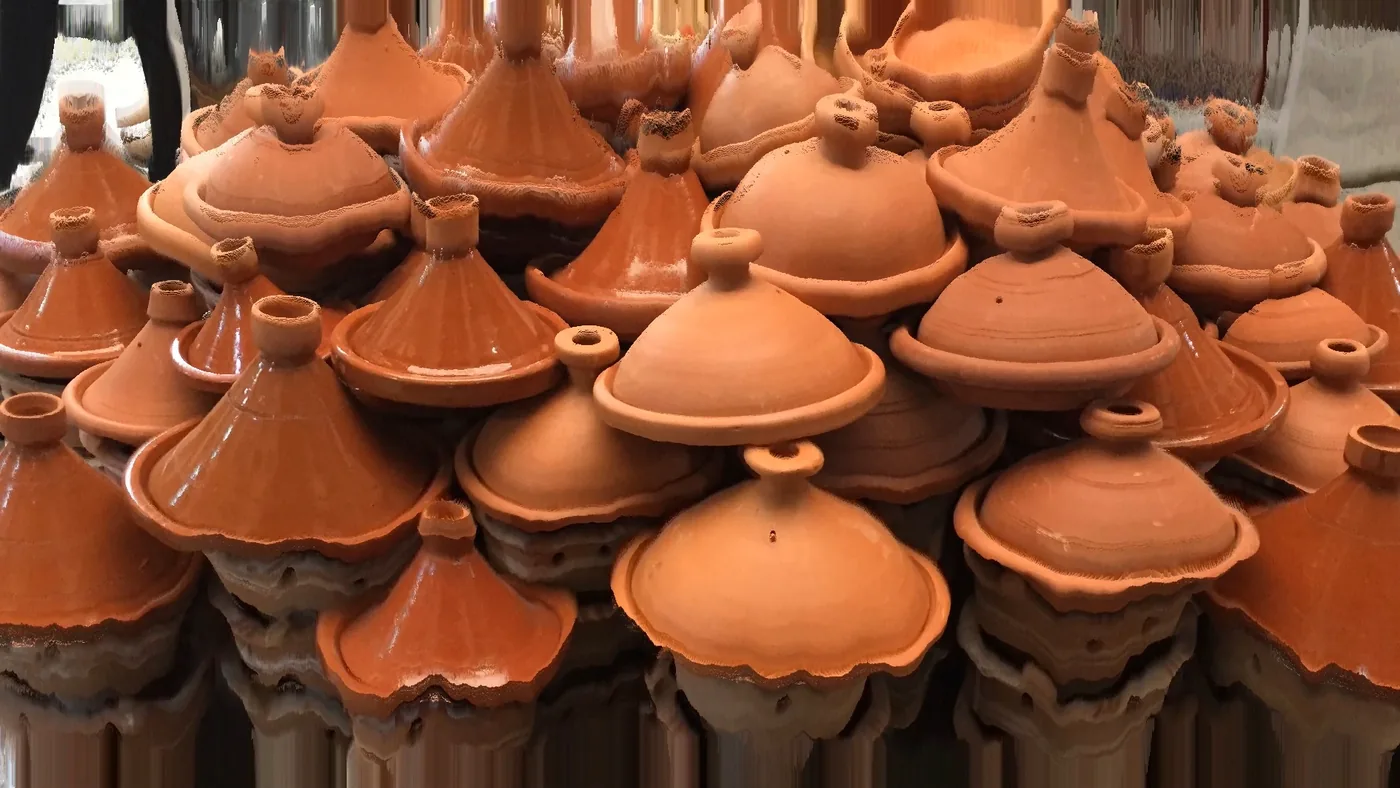
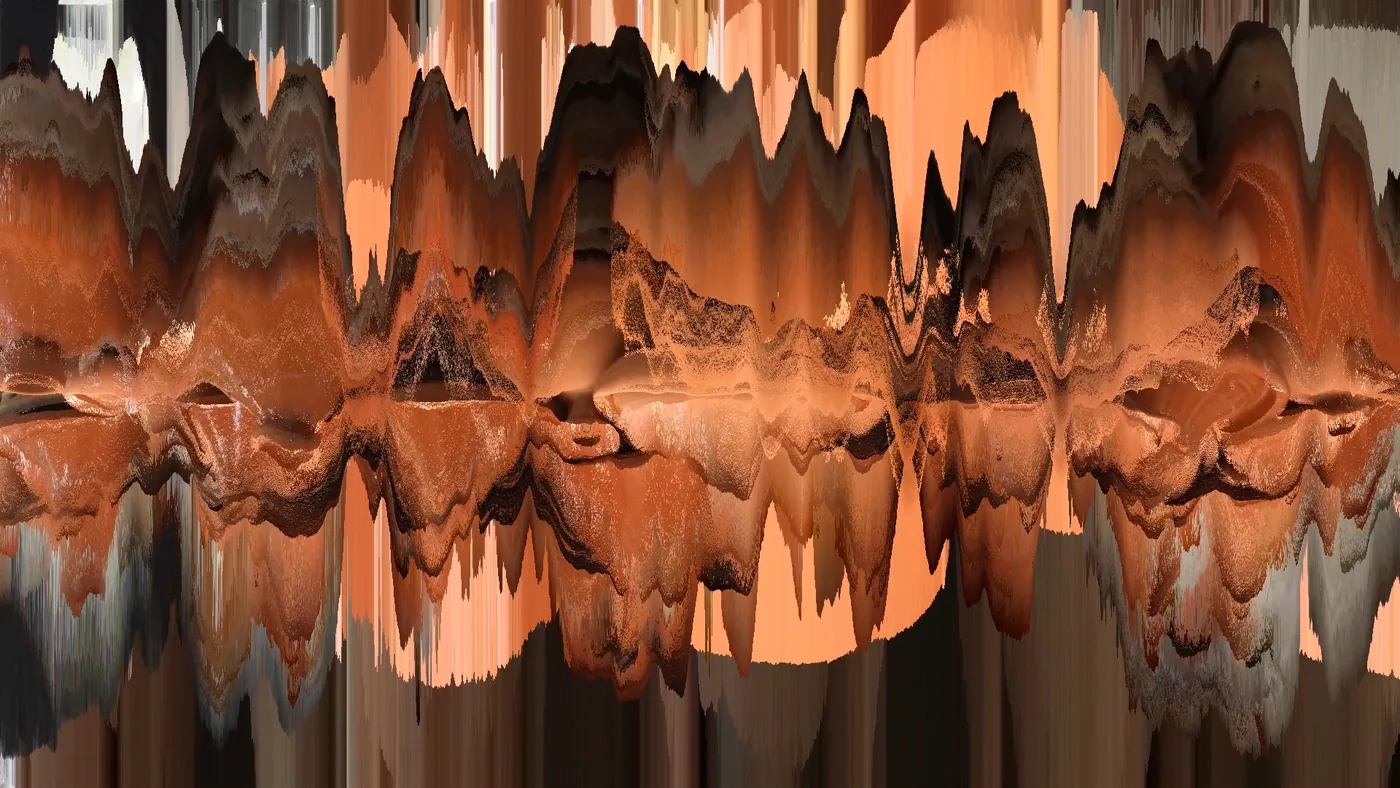
In Upside-Down I, a still image showing a stack of tajine dishes2 is animated algorithmically, at the finest scale. While the pixels in the lower part of the frame slowly begin to rise, at different speeds depending on their hue, those in the upper part make the opposite movement downward. Thus, at the beginning of the video, the very slow displacement of the pixels deforms the objects present in the image. The tajine dishes at the bottom of the image seem to crumble, while those at the top seem to collapse under an invisible weight. The 2m32s video finally reaches its end when the still image reappears, flipped vertically, hence the title of the work (Upside-Down I), a nod, according to the artist, to Marcel Duchamp’s famous “urinal.” While a parallel can be drawn between the technical image – notably photography – and the ready-made3, the algorithmic intervention at work in Upside-Down I appears rather as a transformation of matter. This brings the algorithmic video close to the gesture of the sculptor who negotiates forms with clay.
Although the choice of the base image is apt, the interest of the video lies in the transition between the initial state (the original image) and the final state (the flipped image), particularly toward the middle of the work. At that moment, the moving pixels, too dispersed to form a recognizable image, border on abstraction. This abstraction is, however, interrupted by the gradual emergence of a new figurative dimension, evoking a desert landscape with constantly shifting sand dunes. Everything happens as if, during their metamorphosis driven by the algorithm, the forms were losing their consistency, precipitating a return to the original matter, which asserts its primacy as the repository of latent structures.
The vision that emerges from this work, born of an experimental algorithmic approach, opens a reflection on a notion that is central when it comes to articulating matter and form: hylomorphism. An ancient paradigm forged by Aristotle, hylomorphism can be understood as:
the imposition of a form on a matter with an asymmetrical distribution of qualities: the virtue (the virility) of the form (morphè) makes it the active principle, while matter, hylè, has as its main quality its passivity or malleability: it lends itself to any form that cares to set its seal and its mark upon it4
For centuries, hylomorphism has structured fundamental aspects of the human cosmovision, at least in the West, contributing to a Platonic attitude toward the world that has structured not only the metaphysical dimension but also, very concretely, the relationship between the human and the material world. For Gilbert Simondon, it is a notion to be overcome if one is to apprehend in depth the evolution of technics, its genealogy. Indeed, for the philosopher, hylomorphism fails because it contemplates forms and matters as if they were abstract5.
The primacy of form over matter stipulated by hylomorphism also runs up against the understanding of experimental creative processes and, more generally, against the making of art itself6. In this respect, it is interesting to consider the work of certain so-called “conceptual” artists, such as Sol LeWitt, who professed a certain disdain for the material conditioning of his works, whereas major issues arose when they were materialized in exhibitions. With Sol LeWitt, rather than an “Idea-work” that materializes self-evidently, there emerges the image of a collective creation, set in motion by the artist but extended by the teams responsible for giving it form, generally art students or emerging artists hired for each exhibition7. Finally, hylomorphism probably underlies the shortcomings of the first aesthetic theories of the digital, founded on the supposed immateriality of a language-as-Word (from which a sense of the divine emerges), wrongly associated with the entirely material functioning of computers.
Thus hylomorphic form-giving (mise en forme) – in which form imposes itself on a docile and neutral matter – must be reassessed in light of a more realistic taking-form (prise de forme)8, in which forms are negotiated with matter and cannot be defined outside the possibles of the raw material.
A better understanding on the artistic plane at this level, echoing the recently emerged new materialist conceptions, can contribute to a paradigm shift that is necessary today, in the words of Barbara Bolt:
By acknowledging the agency of matter, new materialism calls into question the anthropocentric narrative that has underpinned our view of humans in the world since the Enlightenment. In this view, humanity creates the world and the world is a reservoir of resources for human enterprise. The urgency of new materialist discourse lies in the ethical, ecological and political imperatives that are closing in on us, the consequences of this worldview9.
Upside-Down I seems to fit within this perspective, with the pottery whose form appears contingent and the image which, in its transformation, reveals matter as an active principle. The “agency” of clay and its resistance function here as a metaphor for the agency of electricity within the digital, to which the algorithm and computer materiality owe their form. The reversal of the formal aspect of the image, at the heart of the work, acts as a metaphor for the reversal of hylomorphism itself.
Pixel, Frame, Elementary Components
While Upside-Down I takes as its raw material a still digital image, from which the artist structures a movement, the image at the origin of Traces:Ski is already a moving image: from it, the artist will carve out stable traces. It is a filmed sequence of a professional skier during a high-speed slalom run. This base sequence, impressive but banal, is sublimated by the digital alchemy orchestrated by Rolland, during which the past positions of the pixels settle on the frame and subtly merge with the video. This generates traces, trails in which we recognize the constituent elements of the scene: the skier’s body, his poles, the various marker flags lining the slalom course… The artist had already explored the algorithmic construction of traces from a moving image. Indeed, in Traces:Birds (2018), the comings and goings of hundreds of birds from and toward an enormous crane on which they alight gradually build traces in the air which, in turn, define in the air a reticulated structure that seems to extend that of the crane. The image becomes more and more enigmatic, approaching the symbol, asemic writing.
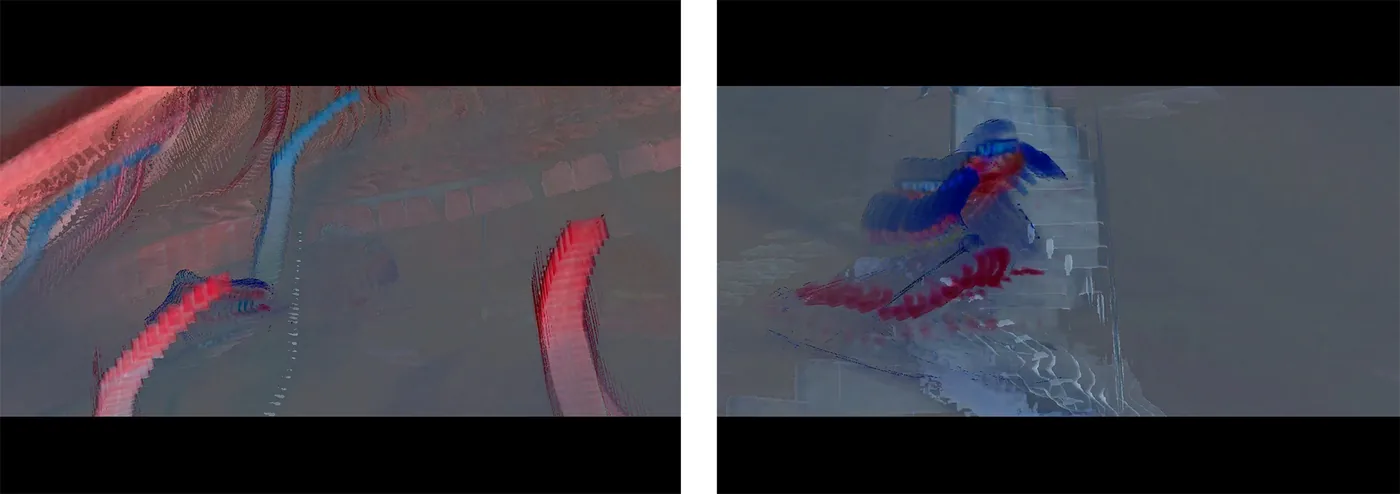
The functioning of Traces:Ski is, however, more complex, since both the subject of the image – the slalom skier – and the camera (which follows the skier’s body) are in constant movement. This produces different types of ephemeral, almost organic traces, which gradually combine and overlap like the strokes of a brush. These traces nevertheless appear as a succession of strokes without continuity, revealing an important aspect of the temporal intimacy of the medium. Through this algorithmic procedure, which operates at the level of the individual images, the artist reveals the very nature of digital video, which, just like electronic video and the classical cinematographic dispositif, is made up of a succession of still images. These traces thus express the discontinuity inherent in digital video and, at moments, particularly when the body of the moving skier occupies the foreground, recall chronophotography, an image on the border between art and science to which the artist is sensitive10.
Image Reverberations
The fine and delicate deformations of the digital image, as they appear in Rolland’s works, are made possible by the artist’s use of the algorithm, organically linked to this type of image. The algorithm allows the artist to act directly on the constituent elements of the image: the pixel for the still image, the individual frames for the moving image. As a result, these images reflect a form of plasticity specific to digital technology, as we will discover, albeit in another register, in the work of Jacques Perconte. These artistic approaches exploit another characteristic that seems exclusive to the digital11. Indeed, thanks to digital intervention, hyper-fast and hyper-precise – at the level of the pixel – it becomes possible (and sometimes necessary) to create new images from pre-existing ones, images that stem from them but differ from them, resulting from various operations: chromatic modifications, displacements of pixels, blends, combinations, etc. It is as if, within the digital, the image could cohabit with multiple versions of itself: images with different temporalities in the case of a moving image, modified versions for a still image, all combining in diverse ways.
These images, memory-images, distorted reflections of the original image, can coexist thanks to the systematic organization of the digital image12: each pixel occupies a precise location (I,J), and must carry three values corresponding to the color components of additive synthesis. We have no term to designate these ghostly images, which appear as reverberations of other digital images. Some of these images exist only internally, never materialized on screen, invisible to the human eye.
The Multiple Nature of the Algorithm
In another vein, it is worth emphasizing that Rolland’s approach is bound up with a reflection on the mode of existence of the means he uses. The artist assigns distinct roles to his algorithmic tools, depending on how they are mobilized in each project. Thus, for the Traces series, Rolland says he makes a “utilitarian” use of algorithmic means, whereas in the Upside-Down series the algorithm is at the origin of a “gesture,” that is, in the artist’s eyes, a manipulation of the image at the scale of the pixel:
Sometimes I use it [the Processing coding software] only in a utilitarian way (as in the videos of the Traces series), but in the Upside-Down series it is the manipulation of pixels made possible by this software that constitutes the artistic gesture13
These considerations shed light on the possible roles of algorithms within the arts, discouraging any attempt to fix definitively the nature of the algorithm, its ontology. Indeed, as Rolland suggests, the algorithm can function differently within each project: either as a “mere” tool that makes it possible to carry out a task, or as the technological element that makes a “gesture” possible, or as part of a medium, or, finally, as a technical individual that manifests both its complexity and the density of its bond with the human, with whom it co-individuates – if we agree to place it close to a Simondonian logic, in which the human and technics, indefinable one without the other, co-evolve within a transductive relation.
Jean-Michel Rolland’s work animates the digital image from its finest scale, subjecting it to transformations which, while producing fluctuations of meaning, make the image vibrate according to its primary plasticity, which is none other than that of matter. In his works, the image appears as a support of traces, affected by the movement of physical forces, like any inorganic, mineral element. The algorithm, understood solely as a tool, then becomes the technical element enabling this manipulation of matter at a fine scale, evolving according to the artist’s parameter settings and experiments.
We will now turn to a work that still operates at the level of the pixel. This time, however, it is a work in which the algorithm also helps introduce an organic component into the image, within a more uncertain operational framework, but one which, starting from a form of simplicity, gives rise to plastic and eventful configurations of great complexity.
Document Upside-Down, written by the artist in connection with the series of the same name.↩︎
A photograph taken by the artist in Fez, Morocco. The tajine dishes, which fill the frame of the image, were displayed for sale at a market.↩︎
See for example Rosalind E. Krauss, L’originalité de l’avant-garde et autres mythes modernistes. Paris : Macula, 1993, p. 74.↩︎
Michel Guérin, « Qu’est-ce qu’un médium artistique ? », in Appareil, op. cit.↩︎
Ludovic Duhem, «Penser le numérique avec simondon ». NepH, Nouvelle revue de Philosophie [en ligne]. Paris, 2014. disponible à l'adresse : https://www.researchgate.net/publication/322288394_Penser_le_numerique_avec_Simondon_Thinking_the_digital_with_Simondon.↩︎
Including so-called conceptual art.↩︎
See, for example, the making-of interview for Sol LeWitt’s exhibition at the Centre Pompidou-Metz in 2012. Web link https://www.dailymotion.com/video/xpcfnc accessed 27 September 2023.↩︎
See on this subject Catherine Letondal Guillaume Giroud Sylvain Pauchet et al., «Une critique de l’hylémorphisme dans les théories du design d’interaction : Recherche de concepts dans la philosophie pour appréhender la forme et la matérialité: ». Sciences du Design [en ligne]. July 2024, vol. n° 19, n° 1, p. 162–179.↩︎
Estelle Barrett and Barbara Bolt, Carnal knowledge: Towards a ’new materialism’ through the arts. London New York : I.B. Tauris, 2013.↩︎
See in this regard the series that Rolland devotes to chronophotography, Jouons avec Muybridge (2022). Website: http://franetjim.free.fr/muybridge.html visited 27 September 2023.↩︎
At least with such intensity and in a way that seems natural to the medium.↩︎
An organization that is upended, as we have seen, by Samuel Bianchini in his installation Sniper (1999).↩︎
A reflective text on the Upside-Down series, sent during exchanges with the artist.↩︎
Cite this pageCórdoba, Pablo-Martín. “Algorithm, Between Sculpture and Weaving”. In Making Digital Images in the Light of Experimental Cinema — Anthropological and Political Resonances of Algorithms in Contemporary Art, Doctoral thesis in visual arts and photography, Université Paris 8 Vincennes-Saint-Denis, Doctoral School EDESTA (no. 159), research unit AIAC, 2026. https://www.pablomcordoba.com/thesis/algorithm-between-sculpture-and-weaving/