1.4.1
Meta-operations, Micro-operations
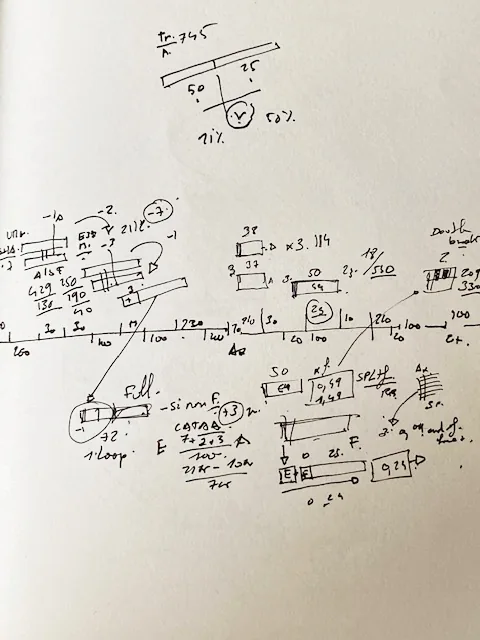
The filmmaker Jacques Perconte1, who excels in modulating digital images by altering their compression conditions, deserves to be mentioned at this point. Indeed, in order to organize the processing of the images — which can become very complex — the artist draws up genuine “compression scores” on paper (Figure 18), which aim to fine-tune over time this technical parameter, which takes on an unprecedented expressiveness in the artist’s hands. These notations by Perconte bear witness to the persistence of an operative function for paper notations in digital experimental cinema, except that, from now on, the operations no longer directly target the material conditioning of the images — as was the case with the celluloid support —, which has become the exclusive business of the machine, but act indirectly on digital images, by controlling processes of a higher order – such as the compression processes in Perconte’s work. This indirect route does not prevent the artist from modulating the microstructure of the image, its fine texture, in a way that was inconceivable before the digital age.
The operative function, identified in connection with paper notations in analog works, can also act directly at the fine scale in the digital, when the algorithm manipulates the structure of the pixels. This possibility is exploited in the film Amintire – Romani Memory #1 (2018) by the collective Brèches2. In this film, images of a birthday party in Romania are processed at the pixel level, with the aim of accentuating the digital imperfections (glitches) already contained in the base sequences. The method chosen to accentuate the defects of the image is inspired by a visual experiment called Jeu de la vie — in English Game of Life, which we will discuss in detail in the following chapter — in which the algorithm determines the state of each pixel over time according to its immediate surroundings3.
The work of the American artist Barbara Lattanzi also illustrates the new levels reached with the digital in the manipulation of images. This is not the “micro” level of pixels, but the “macro” level, where operations and general principles applicable to sets of images are found. In 2002, Lattanzi built not three films but three “film generators”: AMG Strain, HF Critical Mass and EG Serene. Each of these programs is capable of applying to any moving sequence operations similar to those that produced three emblematic films of the analog avant-garde: Strain Andromeda The (1992) by Anne McGuire; Critical Mass (1971) by Hollis Frampton and Serene Velocity (1970) by Ernie Gehr. In Strain Andromeda The, the American filmmaker diverts the science-fiction film The Andromeda Strain by reversing the order of all the filmed shots, showing how a new narrativity can emerge from this radical operation. In Critical Mass, for his part, Hollis Frampton upends a sequence showing a couple arguing: the forward movement of very short passages is jolted by sudden backward jumps, multiplying the drama and violence of the base sequence. Finally, in the film Serene Velocity — the quintessence of structural film — Ernie Gehr alternates in jerky fashion still images of a corridor4, images taken at different focal lengths, thus generating a form of permanent and increasing visual oscillation that puts our perceptual functioning to the test, while establishing maximal tension between representation and abstraction5. Lattanzi’s generators, which are works in themselves, crystallize the operations on images at the origin of these three films characteristic of avant-garde cinema, a gesture that would be impossible without the participation of algorithms.
The short films Happy Again (2006) and Utopia Variations (2008) by Gregg Biermann6 also derive from the application of rational principles to sets of images, but these are conceived by the artist and applied to “iconic sequences” taken from commercial cinema. Biermann uses paper diagrams to plan the “algorithmic transformations,” in which we see the algorithm multiply the image-editing possibilities that were found in the optical printer. Indeed, the intensity of the temporal editing recalls the films of Martin Arnold, made with the optical printer, but Biermann also brings the spatial component into play with, for example, in Utopia Variations, the screen progressively breaking up into mosaics. These mosaics with diverse temporalities synchronize exactly at the midpoint of the film, allowing the work to be seen as the result of a rational principle applied to the images, a principle transcribed fairly precisely by means of the algorithm. It would nonetheless be wrong to see in it an approach in which an “Idea” is transposed onto a passive (filmic) matter. On the contrary, as Biermann himself points out, the final parameterization of the algorithm that controls the evolution of the images results from an interactive process, in which the artist’s sensible impression of his work in progress predominates. In other words, it is still an experimental creative process.
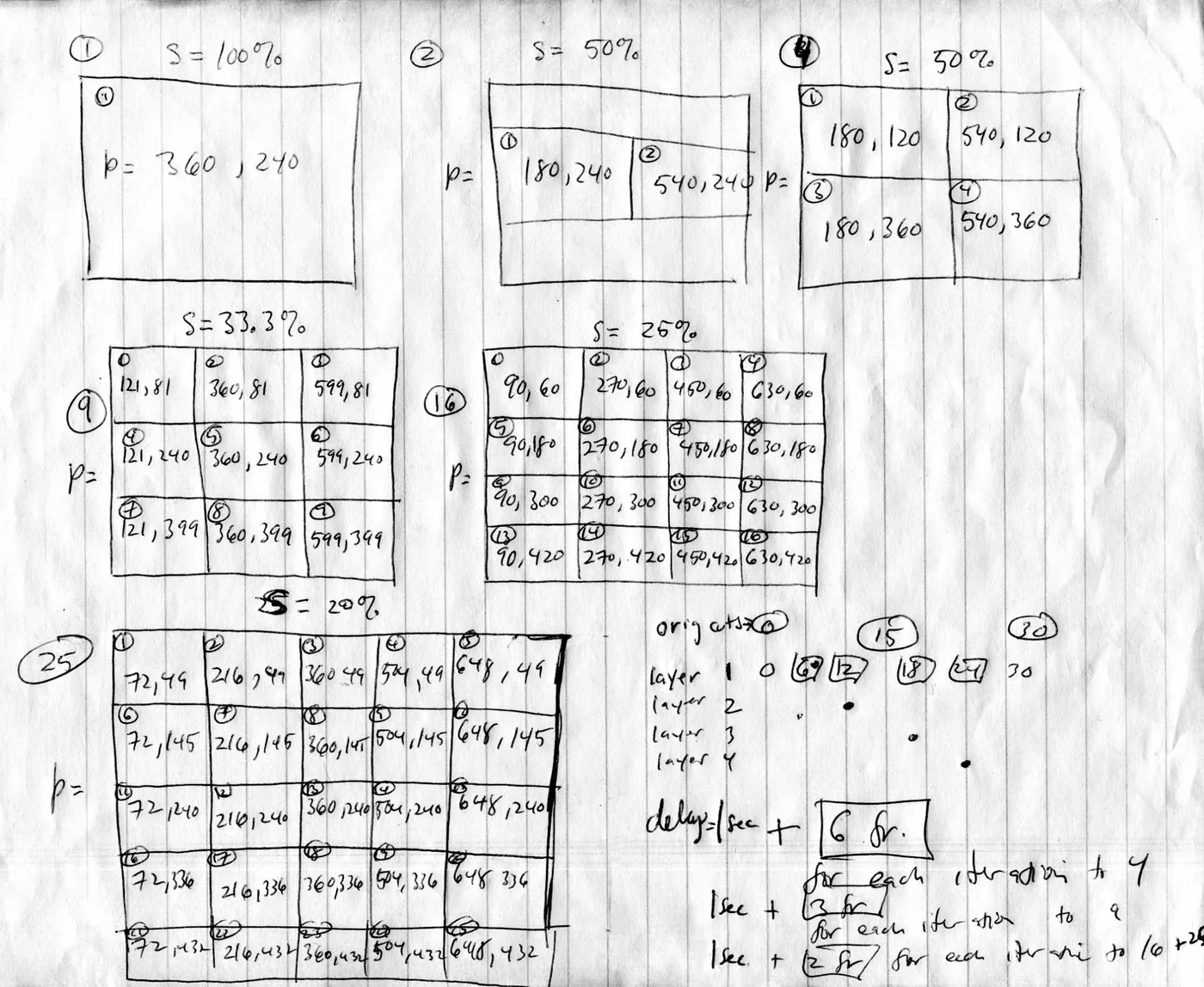
The work of Lattanzi and that of Biermann bear witness to a new level at which the operation of image editing can flourish, going beyond that of the individual image or the series of images to take over the entire space-time of complete sets of images, coming from a single sequence or from various sequences, as if they were “meta-operations.”
Thus, in sum, whereas the operative function associated with paper notations, as we grasped it in analog practices, was generally confined to the level of individual images — frames —, this function multiplies its power when it is “exteriorized” within algorithms, while broadening its scope: it now reaches the macro level of sets of images and the micro level of individual pixels. With the digital, we thus witness a bursting open of the domain of moving images, which abandon the atomism of the frame and the linear organization of the celluloid reel to become structured in networks of variable geometry, or in “circuits of images7,” which can now, thanks to algorithms, become the object of unprecedented operations of editing, manipulation and montage.
We will consider Perconte’s work in more detail in chapter 2, and we will also draw on it in chapter 4, since it will allow us to grasp the dual nature of the digital image, between flow and trace.↩︎
Some pieces by Jean-Michel Rolland, such as Upside-Down I (2022), which we will consider in the following chapter, also work on the fine structure of pixels by means of the algorithm.↩︎
See on this subject Jonathan Larcher and Leyokki, The instability of the digital archive: How to deal with pixels by hand [en ligne]. Amsterdam University Press, 2018.↩︎
A basement corridor in a building of the State University of New York, more precisely SUNY Binghamton, in the United States.↩︎
Scott MacDonald, A critical cinema: Interviews with independent filmmakers. Berkeley : University of California Press, 1988, p. 374.↩︎
We will consider Biermann’s work in greater depth in the following chapter.↩︎
An expression used by Christa Blümlinger to sum up the mode of existence of images in the electronic landscape, as attested by Harun Farocki’s installation Interface (1995), mentioned above. See on this subject Christa Blümlinger Pierre Rusch and Christophe Jouanlanne, Cinéma de seconde main: esthétique du remploi dans l’art du film et des nouveaux médias. Paris : Klincksieck, 2013, p. 319.↩︎
Cite this pageCórdoba, Pablo-Martín. “Meta-operations, Micro-operations”. In Making Digital Images in the Light of Experimental Cinema — Anthropological and Political Resonances of Algorithms in Contemporary Art, Doctoral thesis in visual arts and photography, Université Paris 8 Vincennes-Saint-Denis, Doctoral School EDESTA (no. 159), research unit AIAC, 2026. https://www.pablomcordoba.com/thesis/meta-operations-micro-operations/