5.5.2
Unveilings through Breakage
The articulations between the implementation of the technological element and its economic and social aspects tend to become invisible, because they are very indirect, they are structured according to long temporalities and they mobilize specialized knowledge.
Lauren Huret, in her video essay Breaking the Internet (2017), offers these articulations to the gaze, articulations that unveil mechanisms of domination through a pertinent bringing into play of the plasticity of images, backed by incisive and precise narrative elements1. Once again, and as we saw with Perconte, it is by emphasizing the materiality of the medium that, in Breaking the Internet, the sensible points of support emerge that are capable of making reflection possible. In Huret’s case, this is a radical, albeit figurative, gesture: “breaking” the Internet to discover what is hidden inside. This violent act first allows the artist to exploit the links with the tradition of textile machines as a necessary milestone in the development of computers. This breathes into the work a genealogical dimension that, in turn, opens the reflection onto social aspects, notably the subjection of the human factor when it comes to satisfying the needs of “technics.”
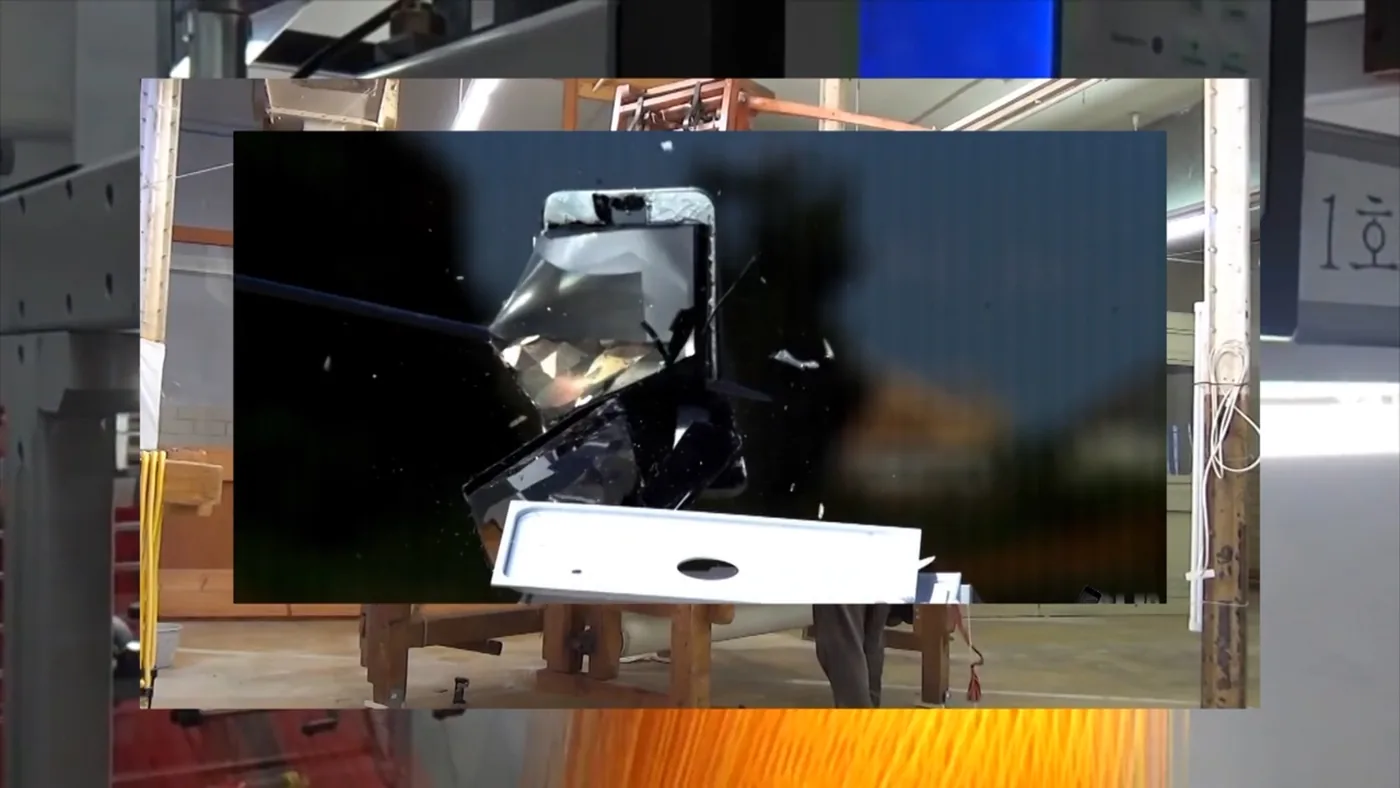
This multi-temporal reflection, from which the common denominators between different eras emerge, is expressed in the image by a concentric telescoping of shots of different sizes. Their nesting proposes, within the frame, centrifugal and centripetal paths for the gaze, which act like back-and-forth journeys in time, through forms and movements that are assembled in a relation of resemblance.
Thus there arise, carried by the voice-over, the tensions between human labor and that of machines during the “machine-breaking” revolt of the Luddites of 1811 in England, and those of the canuts (Lyon silk weavers) of 1831 and 1834 in France, while, on the level of the image, an iPhone is cut in two with saber strokes in slow motion. In these revolts, textile workers rose up and destroyed the then new weaving machines, which threatened to make their artisanal know-how obsolete and to make their source of income disappear. Without knowing it, Huret maintains in her video, Luddites and canuts were doing nothing other than destroying the first computers.
The historian of computers Michael S. Mahoney tends to support the approximation made here by Huret. Indeed, if for Mahoney (as already indicated in chapter 3 of this research) the computer results from the convergence of electromechanical engineering, computer science and software engineering, it is electromechanical engineering that structured the development of computers, and for this reason the historian prefers to refer to a technological history rather than a scientific history of computers2. The weaving machines3 that Huret favors as the ancestor of computers are to be associated with the first lineage (mechanical engineering, which became electrical engineering), the dominant tendency, which stretches from the Pascaline to the ENIAC, by way of Babbage’s Analytical Engine.
When we consider these insurgent artisans of the nineteenth century, who accused the machines of subjecting them to unfair competition4, we cannot but note a family resemblance between these revolts of yesteryear and the very recent tensions produced by the introduction of neural networks, which threaten, this time, not only certain artisanal trades but also jobs related to language and the visual arts.
The role of technics in the extension of logics of domination, notably patriarchal ones, is then developed in Huret’s work through a succession of shots showing the work of the “ladies of the telephone,” young women who set up the first telephone connections in real time at the beginning of the twentieth century5. In order to be hired, Huret recounts, these young women had to be single and available for an industry that needed soft, “immaterial” voices capable of organizing the routing of telephone exchanges, while their bodies were heavily solicited by the needs of rewiring. Voices without bodies, the “ladies of the telephone” are avenged much later, on the symbolic level, by the voiceless body of Kim Kardashian when she manages to “break the Internet” with images6, in a new transhistorical link that Huret “weaves” thanks to an approach we could liken to the universe of media archaeology. This field of research favors, just like Huret, a context of broadened definitions and temporalities, capable of bringing to light “novelties hidden in the old, as well as the subterranean presences of the old in the new7,” with attention paid to the materiality of apparatuses, which media archaeology “obstinately” questions8.
This work by Huret, the one by Meunier that we considered, and, to varying degrees, all the works we have examined, bear witness to a use of technics “outside” itself, in a gesture that, in structuring the work, enriches the real in which it is inscribed. The real sees its possibilities multiply and its hidden aspects revealed, becoming newly representable, by means of artistic strategies made intelligible by the theories of the apparatus. These theories offer multiple and concrete perspectives on what is only sketched by Heidegger9: the “ordering” unveiling (dévoilement commettant) of the real carried out by instrumental technics, which “challenges” (pro-voque) and enframes Nature and the human, can be suspended by art. From then on, technics mobilized by art contributes to a “pro-ductive” unveiling of the real, which is thereby enriched in extension and in nature.
Having been part of the exhibition Computer Grrrls at the Gaîté Lyrique in 2019, the work is available on the artist’s Vimeo account: https://vimeo.com/370897552, accessed December 1, 2024.↩︎
See in this regard Michael S. Mahoney, “The History of Computing in the History of Technology,” in IEEE Annals of the History of Computing, op. cit.↩︎
The reference to weaving, associated here with the work of Lauren Huret, had already emerged in the course of this research, as mentioned earlier, in connection with the work of Rose Lowder in chapter 1, and with the Gallo-Roman dodecahedron in chapter 3.↩︎
See on this subject: The declaration of the framework knitters [en ligne]. 1812. disponible à l'adresse : https://www.marxists.org/history/england/combination-laws/ned-ludd-1812.htm.↩︎
It is interesting to note that, if cinema can be apprehended metaphorically as a “timed drawing” (involving lines, so to speak, woven in time), the manual work of film editing in the early days of the medium was also entrusted to women, as Daphné Le Sergent reminds us. See on this subject Daphné Le Sergent, «Pré-médium ». Appareil [en ligne]. 2017, vol. 18 and Lilya Kaganovsky, «Film Editing as Women’s Work: Ėsfir’ Shub, Elizaveta Svilova, and the Culture of Soviet Montage ». Apparatus. Film, Media and Digital Cultures of Central and Eastern Europe [en ligne]. October 2018, vol. Media and Digital Cultures of Central and Eastern Europe, n° 6.↩︎
See for example: David Hershkovits, How Kim Kardashian broke the internet with her butt [en ligne]. The Guardian, 2014. [consulté le 1 December 2024]. disponible à l'adresse : https://www.theguardian.com/lifeandstyle/2014/dec/17/kim-kardashian-butt-break-the-internet-paper-magazine, accessed December 1, 2024.↩︎
Jussi Parikka, Qu’est-ce que l’archéologie des média ?, op. cit., back cover.↩︎
Ibid.↩︎
A form of pessimism predominates in Heidegger. Indeed, in an interview given by Heidegger to the magazine Der Spiegel, published after his death in 1976, the philosopher revises downward the role of art, which has become a mere intermediary awaiting the power of the divine: “Only a god can save us.” In: Martin Heidegger, «Nur noch ein Gott kann uns retten ». Der Spiegel. May 1976, n° 23, p. 193–219.↩︎
Cite this pageCórdoba, Pablo-Martín. “Unveilings through Breakage”. In Making Digital Images in the Light of Experimental Cinema — Anthropological and Political Resonances of Algorithms in Contemporary Art, Doctoral thesis in visual arts and photography, Université Paris 8 Vincennes-Saint-Denis, Doctoral School EDESTA (no. 159), research unit AIAC, 2026. https://www.pablomcordoba.com/thesis/unveilings-through-breakage/