2.1.6
Unmasking the Support
Although the illegal distribution and sharing of copyrighted content preceded the digital era and the deployment of the Internet, it was with the advent of the latter that “piracy” reached an unprecedented scale1. Despite new technologies enabling remote access to content, such as streaming, illegal file sharing has kept increasing year after year, and this in spite of the efforts of governments2 and private actors to stem this practice, which is facilitated by the complexity of the technological context. Every technical or legal advance aimed at countering illegal sharing is quickly followed by new piracy methods. Such is the case of P2P (peer-to-peer) sharing, a system in which thousands of computers connected to the Internet can simultaneously send and receive shared data, thus replacing the classic centralized structure in which several clients are connected to a single server. Indeed, the disconnection of a user belonging to a P2P network does not endanger the state of the system, whereas deactivating the central server was enough to shut down the old centralized piracy system completely. And if users manage to anonymize their web identification (IP) by using a VPN service, illegal sharing via P2P becomes even harder to combat. It is certainly difficult to obtain precise statistics on file transfers in these P2P architectures, but we know that their use continues to grow3, representing a significant share of overall Internet use, outside any condition of visibility.
A Machinic Montage
The Pirate Cinema, a work created in 2012 by the collective Disnovation.org, is a video installation materialized on three screens4. On these screens are projected the most widely shared P2P video streams of the moment, under the BitTorrent protocol. These are extremely short sequences, lasting a fraction of a second, because BitTorrent fragments video files into small pieces in order to optimize sharing. This fragmentation is carried out without regard to the temporal structure of the compression: the coherence of the video stream, ensured in a complete file by a succession of p-frames punctuated by i-frames, is thus lost in each fragment cut out by the P2P protocol. The direct playback of these fragments causes pixelations and distortions, particularly visible on each screen, especially at the junctions between video streams coming from various sources. Added to these distortions are interruptions due to discontinuities in data transmission.
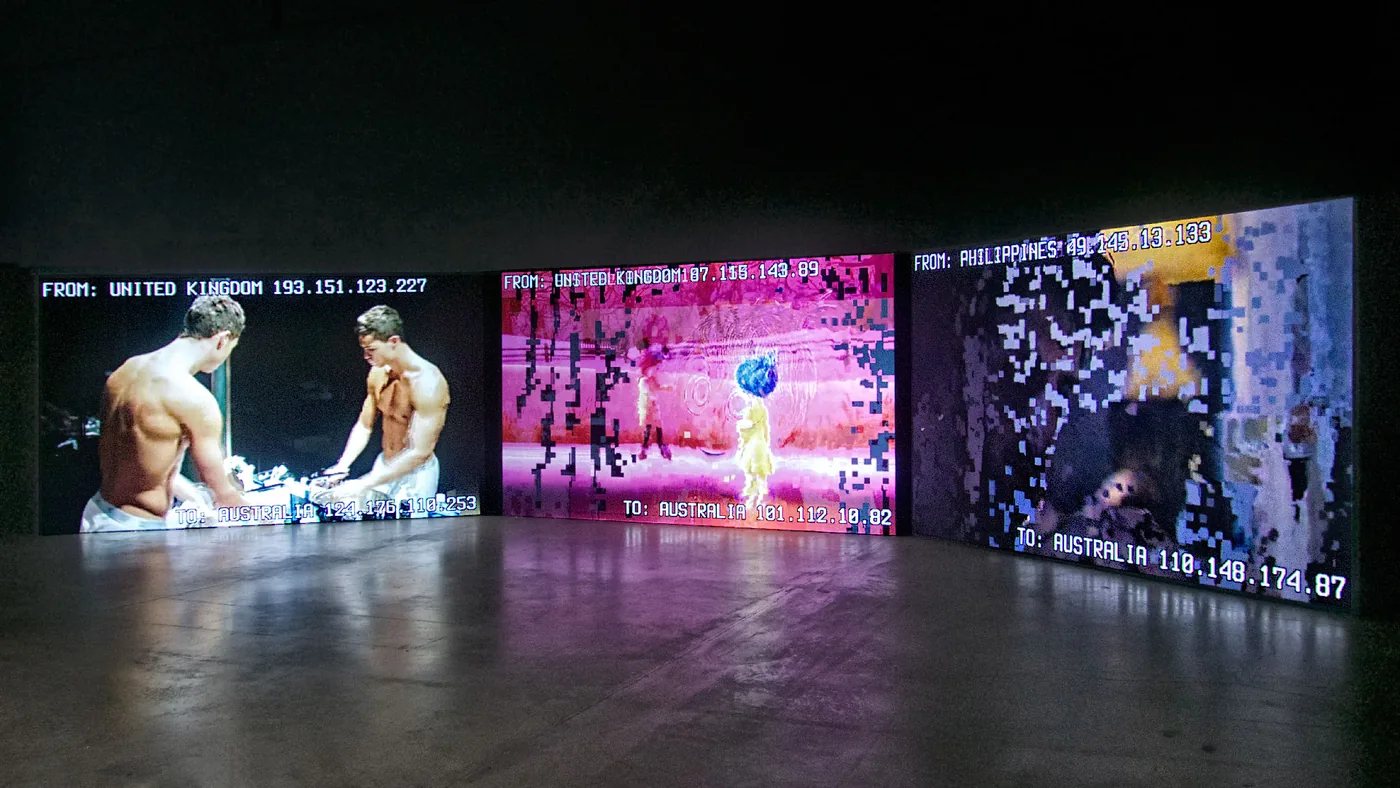
Thus, in The Pirate Cinema, the images appear affected by a de facto datamoshing, in a succession of short video sequences reminiscent of the mashup. However, the terms datamoshing and mashup are problematic in the context of this work. Admittedly, datamoshing causes a derangement of the compression structure inside the video file, with cuts disrupting the stability of the original file, a phenomenon that is indeed found within the installation. However, when we speak of datamoshing as an artistic practice5, these cuts are made consciously and in a controlled manner by the artist as part of their formal research. The resulting images are then kept (or rejected) according to their coherence with the work being created. As for the mashup, it designates a video composed of fragments of pre-existing digital videos, as was the case with found footage in analog. However, although the mashup can be created in real time, as in practices such as VJing – the visual counterpart of DJing – the composition is not left to chance or randomness, as in The Pirate Cinema. It relies on the intervention of an artist – the VJ – who can preview the available video sequences in real time and decide which ones to integrate into the composition6. Consequently, in the absence of any human guidance, the visual and sonic register that emerges from The Pirate Cinema refers more to a random and mechanical functioning of the algorithm than to the manifestation of a movement of human consciousness affecting the video stream – apprehended as a temporal object – during editing.
Making Visible
The central gesture of the work, the one that gives it its depth, does not involve a direct intervention on or between the images, but rather expresses a will to make evident the occult flows that underlie the technological system. These flows escape visibility in multiple ways: on the one hand, as objects of a practice hidden because it is prohibited by law (piracy); on the other, as internal elements of dispositifs strategically designed as “black boxes”; and finally, and more concretely, as physical phenomena escaping the spatiotemporal domain of human sensibility7. Disnovation.org’s intervention disrupts the usual functioning of the system and forces the direct playback of data flows initially intended for transmission8, and not for visualization.
These images offer to the gaze these otherwise hidden flows, but not only that: they also make visible the ultra-fast fragmentation operations that take place at the level of the support, in connection with the possibilities of random access to recorded data. A play of image counterpoints, inscribed in a machinic temporality, thus seems to emerge from the technological base to irrigate the three screens. The confrontation of visual registers takes place first within each screen, where torn and amalgamated images are superimposed, generating spontaneous datamoshing. Then, resonances, echoes and oppositions arise between the different images juxtaposed by the arrangement of the screens.
Since the video fragments correspond to the most widely shared content, the iconography reveals the state of visual consumption in mass culture. The register of violence and that of sex are algorithmically interwoven with excerpts from Pop music videos, creating a disruptive visual and sonic collage, without any real point of purchase for the spectator’s sensibility. This spontaneous, entirely mechanical montage partakes of a form of the sublime born of the annihilation of the original meaning of the images. These images nevertheless retain their plasticity, which offers itself to the spectator’s eyes without the attenuation of the narrative filter.
Fragmented Flows
The question of the visibility of the invisible – or of the “invisibilized” – occupies a central place in the work of the collective Disnovation.org. These artists exploit the restoration of the visibility of hidden flows for a purpose that is at once aesthetic and cognitive: the aim is to make perceptible phenomena that structure the substratum of digital technology. The stake is thus to make accessible, through the sensible, the intimate functioning of a support that generally remains the business of technical specialists. As Nicolas Maigret, a member of the collective Disnovation.org, emphasizes:
[the work] is also part of the tradition of experimental cinema that explores film material; here, it is not celluloid but the digital support, compressed and fragmented, with its slippages of the image that occur when data is missing. Beyond a mere artifact provoked from scratch, it is here a signifier of the medium, and of the contemporary film-video support9.
In the absence of a classical regime of representation, that of the Albertian “window-image,” made impossible by these images torn by the machine, the installation refers to the very functioning of the digital support, unveiled in its true face: that of the finitude of matter. This finitude is transmitted from the support to the image, which is forced to be compressed to reduce its size, thus adapting to the always limited capacity of the transmission support, and fragmented to occupy every available interstice on the storage support.
If the intention was to highlight a form of art that would exploit the specificities of the digital, The Pirate Cinema reveals one of the most striking characteristics of the “medium”: random access to memory, designated by the English acronym RAM. This type of structuring of data reading and storage favors a nonlinear functioning of images, breaking their original temporality. This constitutes a major difference between the analog support and the digital support10, one that, moreover, brings the latter closer to the functioning of human consciousness, in which memories are mobilized independently of their chronological order, responding to the needs of action, to internal flows of thought, or to unconscious mechanisms that make repressed images resurface untimely. To the human unconscious populated by images, the work of Disnovation.org offers a machinic correlate, which shows the P2P flows as if they were the expression of a form of technological unconscious. This notion, which can be traced back to Félix Guattari – who spoke of the machinic unconscious11 – was revisited by the geographer Nigel Thrift, who uses it to designate “the technical infrastructures, generally situated beyond the reach of our perceptions and our understanding, whose functioning conditions our capacities for orientation in space, time, sociality and action12.” If we are to believe Thrift, the bringing to light of digital flows as it appears in The Pirate Cinema goes beyond the aesthetic domain, for it makes sensible an important aspect of the active “behind the scenes” of perceptible reality, whose nature and characteristics have a considerable impact on the tangible world.
The Commodity-Image
This installation, on the border between home cinema and the surveillance system, ends up unveiling the hidden mechanisms of the audiovisual industry, through which the digital image is placed at the heart of consumer society. The direct playback of fragmented data (chunks) causes the narrativity inherent in the film, the series or the music video to shatter. Pornographic sequences, the violence of gangster fights, and action scenes lose their “narrative” efficacy, offering themselves to view, decoded, solely as image. What then remains of these collisions, just as after a car accident, are plastic pieces: scraps of shots, camera choices, poses, expressions, dominant colors, composition, framing. They reveal an invariant conditioning of images, whatever the genre (film, series, music video, pornography…). This collapse of illusory splendor, which does not survive the absence of storytelling, exposes the inherent poverty of our spectacle-images, contemporary commodities.
By exploiting the sensible potential of the specificities of the material support, the commodity-image – in transit – is rendered in all its precariousness. The occult fragility that affects images meets the more concrete fragility of the consumers of audiovisual content, victims both of the violence of advertising and of that of a power that surveils and punishes13, and that enjoys privileged access to the network. By making explicit the origin and destination of the exchanged flows, the installation makes tangible the planetary extension of the Internet’s infrastructure. This creates a dissonance with the perception of the Internet as an immaterial cloud, a metaphor that appears puerile and derisory through the prism of the installation. For in reality, what is at stake is not a topology but a genuine topography – that of our world – crisscrossed in all directions by “dataducts,” which, together with data storage centers, constitute the real face of the Internet.
It is thus by disrupting the balance between visible and invisible that Disnovation.org’s gesture here produces a strange manifestation of images prepared for the machine, giving rise to an installation that concretely stages the transmission and storage support of our contemporary commodity-images14. The reflection on the support of inscription, arising from the détournement of the BitTorrent protocol, restores its role at the epicenter of the digital and underlines its importance as a material entity whose structural features show through all of the upper layers.
From then on, 0s and 1s should no longer be perceived as mere symbols of a digital code, but rather in terms of their concrete material conditioning, as variations of a specific property on a minuscule portion of matter. These are, for example, magnetizations oriented in one direction or another on the metallic layer of a hard disk, or electrical charges present or absent in the cells of flash or SSD supports. In all cases, the support of inscription – fragmentable and fragmented – inscribes more or less lasting traces of the real, waiting to be exploited by those who wish to – and are able to.
Despite the technological sophistication that accompanies them, the fundamental mode of existence of these traces does not constitute a break with the universe of inscriptions created and archived by humanity: from engravings on stone to analog video, by way of writing on paper. Indeed, the real, material world always remains “analog.” It is in this continuity that we better understand the remarks of Brian Cantwell Smith, one of the rare philosophers to have looked into computers:
[…] digitality is not an intrinsic property of anything. Whether or not something is digital is a higher-order characterization of it: a characterization of a characterization. It is characterizations of objects, “takes” or cuts on objects, that are, or are not, digital – not objects per se15
Thus, although matter can be conditioned in its microstructure by varying one of its properties between two possible states, the reading of these states, which seeks to determine whether it is a 0 or a 1, remains an interpretation. Neither the traces nor the signal that passes through them – and reads them – are truly digital. On the contrary, like any entity of the physical world16, they are fundamentally continuous, analog.
In the computing machine, the fundamental base is made up of supports of inscription capable of dividing, recombining and controlling nanocurrents in an incredibly complex way. These nanocurrents, oriented by the microstructure of the support, are the material counterpart of programs, images, sounds, data. Although they can be interpreted as 0s and 1s, the current is always continuous. Thus, the truly active principle, the base of the digital, remains resolutely analog. This is precisely what the work discussed next forcefully “demonstrates.”
According to the association creativefuture.org, websites associated with illegal file sharing received 700 million visits per month in 2022 in the United States alone.↩︎
In 2009, France saw the introduction of the law for the protection of copyright on the Internet, known as Hadopi 1.↩︎
Vincent Mabillot, «La culture pirate et les usages du P2P ». Tracés. Revue de Sciences humaines [en ligne]. ENS Éditions, June 2014, n° 26, 26, p. 67–88.↩︎
Depending on the spatial layout of the exhibitions, either medium to large LCD screens or projections.↩︎
As was discussed with Takeshi Murata.↩︎
A system with multiple screens, analogous to the one used by DJs, who have two turntables side by side, with a dual listening system (dedicated headphones or headphones with a single earpiece), allowing them to listen simultaneously to the composition in progress and to assess the next track to integrate into the mix.↩︎
Indeed, the electronic flows that structure digital technologies do not benefit from the “social” visibility of other phenomena that also escape the human sensorium, such as the phenomena of subatomic physics and those taking place in deep space (black holes, strings, etc.), widely schematized – imaged – in discourses, topics of interest, and collective reflection.↩︎
These flows internal to the system, highly compressed flows, will generally produce, when rendered, “poor” images, such as those theorized by Hito Steyerl in her famous article: Hito Steyerl, «In defense of the poor image ». http://www.e-flux.com/ [en ligne]. 2009. disponible à l'adresse : http://www.e-flux.com/journal/in-defense-of-the-poor-image/.↩︎
Marie Lechner, Nicolas Maigret: «montrer le flux numérique à l’échelle mondiale» [en ligne]. Libération, [n.d.]. [consulté le 12 September 2022]. disponible à l'adresse : https://www.liberation.fr/cinema/2013/10/08/montrer-le-flux-numerique-a-l-echelle-mondiale_937985/.↩︎
Malcolm Le Grice analyzes the effect of random-access memory (RAM) as a specificity of digital experimental cinema, thus opening up new perspectives for experimentation. See on this subject Malcolm Le Grice, Experimental cinema in the digital age, op. cit., p.239-240.↩︎
See on this subject Félix Guattari, L’Inconscient machinique, op. cit.↩︎
According to Yves Citton in the definition he proposes for the technological unconscious, in Citton, Angles morts du numérique ubiquitaire. [s. l.] : Presses universitaires de Paris Nanterre, 2023, p.245-246.↩︎
The P2P sharing system exposes the location of users, especially those who have not taken the precaution of using a VPN, or virtual private network.↩︎
In this sense, it is not surprising that the installation was given a central place in the exhibition Le supermarché des images, curated by Péter Szendy at the Jeu de Paume in 2020.↩︎
Original English quote.↩︎
Without going into subatomic considerations, of course, where one finds energy quantized at the minimum value deduced from Planck’s constant.↩︎
Cite this pageCórdoba, Pablo-Martín. “Unmasking the Support”. In Making Digital Images in the Light of Experimental Cinema — Anthropological and Political Resonances of Algorithms in Contemporary Art, Doctoral thesis in visual arts and photography, Université Paris 8 Vincennes-Saint-Denis, Doctoral School EDESTA (no. 159), research unit AIAC, 2026. https://www.pablomcordoba.com/thesis/unmasking-the-support/