1.2.2
Operative Function
Since it allows no retakes, work with celluloid pushed avant-garde filmmakers to produce precise and detailed notations, betraying an operational aim. One of their main roles is to organize the operations to be carried out on the film stock, whether by hand, with the editing table, with the optical printer from the 1970s onward, or during shooting, in the case of filmmakers who edit their films directly as they shoot them (such as Rose Lowder).
This need for precision requires a surface whose spatial unit can be translated into a unit of time. As a result, the notations accompanying avant-garde films are often made on graph paper. The notation thus takes the form of a Cartesian diagram, with a horizontal spatial dimension that refers to time, while the vertical dimension takes into account the various elements to be synchronized.
Seen from this angle, notations appear intimately linked to the manipulation of matter, and it is therefore not surprising that some filmmakers revive manual crafts through them. This is the case of Martin Arnold’s 16-minute short film Pièce touchée (1989), which was built frame by frame using an optical printer, from an 18-second sequence taken from the Hollywood film The Human Jungle (1954). This “inflation” of the original sequence results from frenzied repetitions and very high-frequency back-and-forth movements, operations first inscribed on a score of more than 200 pages, in which the interweaving of frames recalls the structure of weaving.
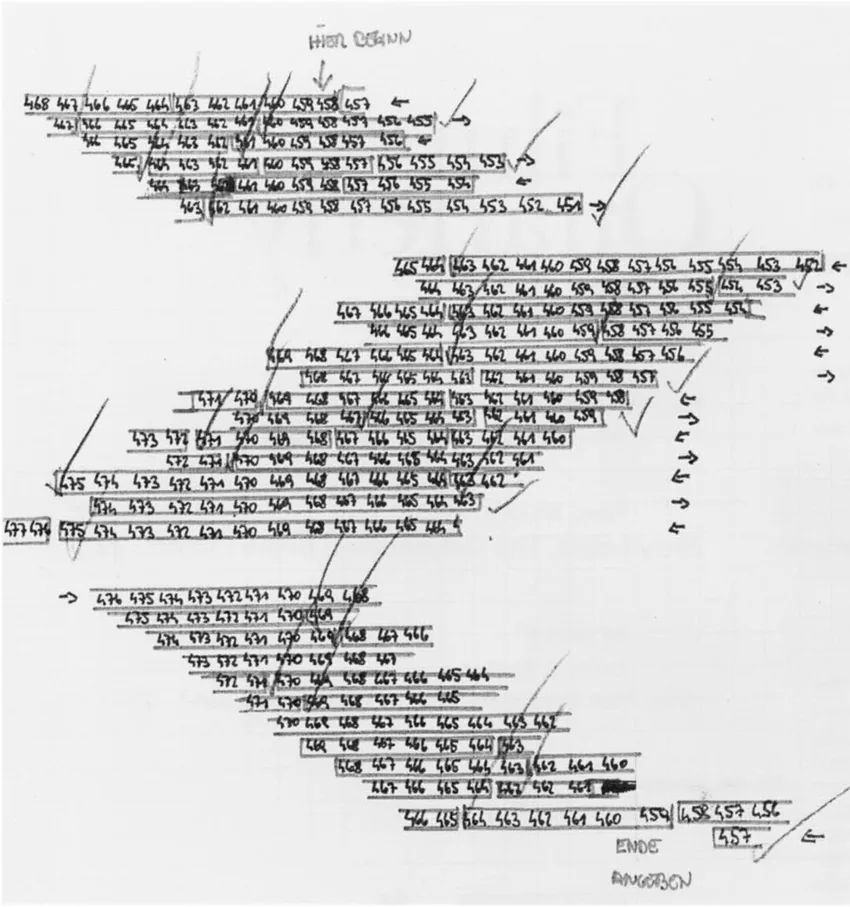
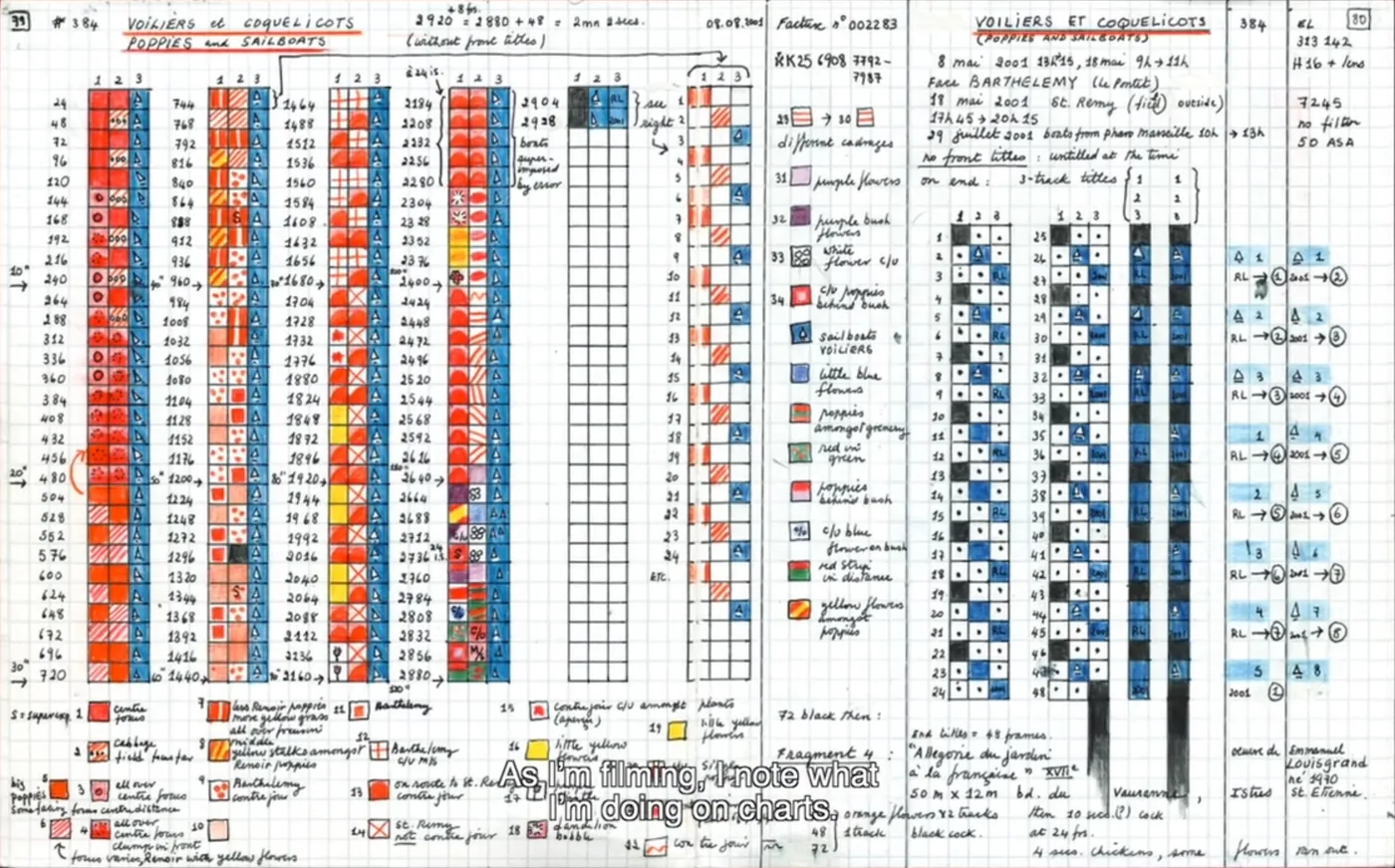
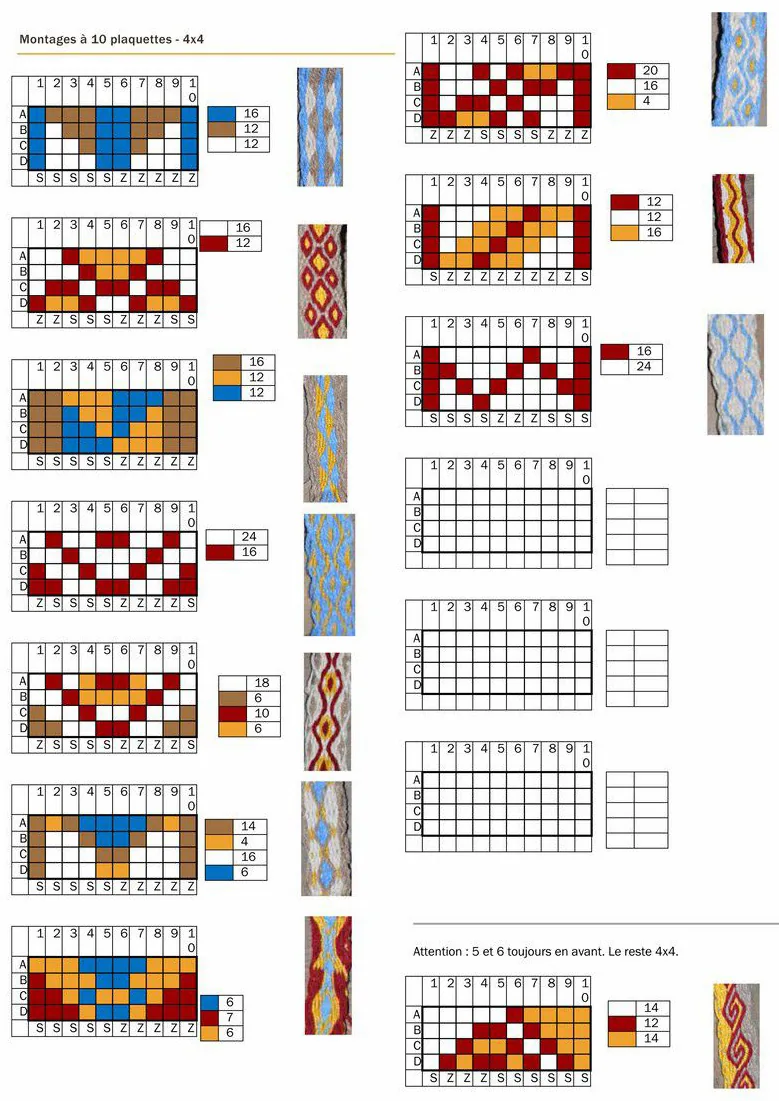
The reference to weaving1 is explicit in Rose Lowder, who says she “weaves her films2,” her weaving tool being her 16 mm Bolex camera. This camera makes it possible to capture individual frames while advancing (or rewinding) the film reel. The artist thus edits her films in the course of shooting. Unsurprisingly, the notations the artist draws up (Figure 10) recall the diagrams used to structure weaving (Figure 11). It should not be forgotten that the first punched cards, used to inscribe the programs of the first computers, were made on the model of those developed in 1801 for Jacquard looms, which is at the origin of the metaphor formulated by Ada Lovelace (1815-1852), author of the first computer code ever written: “The Analytical Engine weaves algebraical patterns just as the Jacquard-loom weaves flowers and leaves3.”
The activity of weaving appears as a recurring figure throughout this research. It will also come up in chapter 4, regarding the Gallo-Roman dodecahedron – a strange ancient artifact that lends itself to the symbolic as well as to the gesture that builds with matter – and in chapter 5, in connection with Lauren Huret’s work Breaking the Internet (2017), in which the artist stages the echoes that arise, at the level of social production, between the recent evolution of computers and that of weaving looms in the nineteenth century.↩︎
See in this regard: Entretien : Rose Lowder, Fondation Vincent van Gogh Arles, url: https://vimeo.com/443209111, accessed 2 September 2025.↩︎
Luigi Federico Menabrea and Ada Augusta Lovelace, «Sketch of the analytical engine invented by charles babbage ». Bibliothèque Universelle de Genève [en ligne]. October 1842, n° 82, p. 352–376. disponible à l'adresse : https://www.fourmilab.ch/babbage/sketch.html.↩︎
Cite this pageCórdoba, Pablo-Martín. “Operative Function”. In Making Digital Images in the Light of Experimental Cinema — Anthropological and Political Resonances of Algorithms in Contemporary Art, Doctoral thesis in visual arts and photography, Université Paris 8 Vincennes-Saint-Denis, Doctoral School EDESTA (no. 159), research unit AIAC, 2026. https://www.pablomcordoba.com/thesis/operative-function/