5.4.2
Dionysian Deliverances
The ideology of innovation, like the myth of immateriality, has undeniably contributed to the tentacular and unbridled deployment of digital technology. The latter has also taken advantage of the promise of easy and instantaneous communication, capable of ensuring unlimited connection between societies and individuals. The setting up of a cyberspace of global reach, fostering commerce and communication, attests incontestably to a concrete interconnection, thus demonstrating that digital technology has, in a way, kept its promise. Yet, despite the interest and power of these new electronic connectivities, voices have been raised to denounce an essential degradation of communication when it is mediated by the machine and takes place without direct human contact1.
In the field of artistic practices, the revolution of learning on the Internet has replaced physical environments for sharing materials and knowledge. This is flagrant in practices such as photography and experimental cinema, where the photo clubs and cooperatives that ensured a rich socialization in the analog age now see practitioners isolated at home behind their screens, with access to an enormous amount of information, but exploiting it in solitude. We thus observe that the evolution of learning on the Internet has favored “DIY2” at the expense of “DIWO3,” despite notable public and private efforts aimed at reversing this trend4.
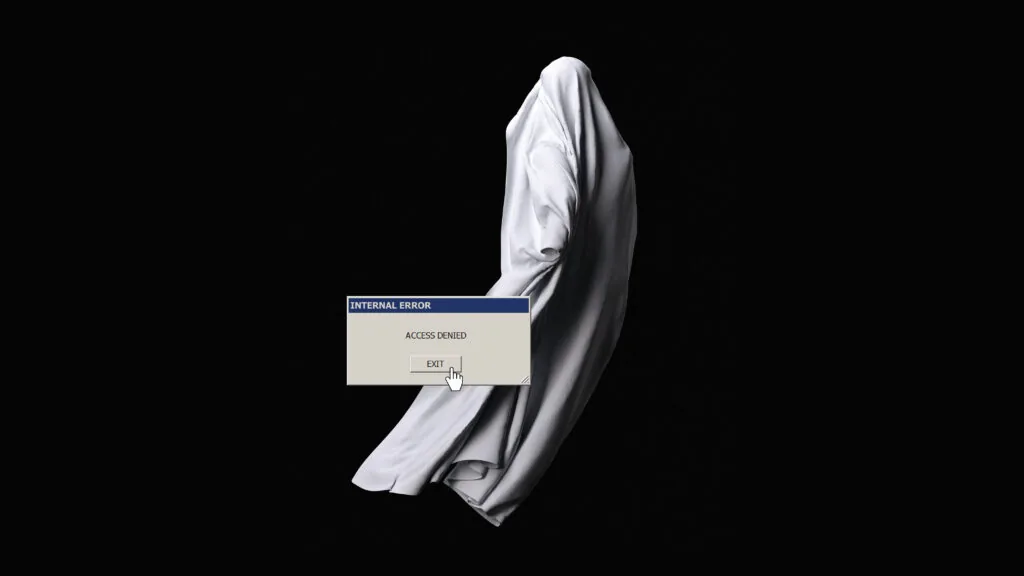
Elisabeth Caravella’s short film Howto (2014) problematizes this state of affairs with humor. The film is inspired by the video tutorials available online (notably on YouTube) that show step by step how to carry out a specific task in a dedicated piece of software, through a video image made from a screen capture of the “tutor” (here, a woman), accompanied by her voice-over commenting on the operations. The task here is the creation of a 3D text in a modeling software, except that, as the tutorial progresses, various malfunctions begin to appear, up to the progressive appearance of a character, with no visible body but wearing a sheet, who dances in the software’s construction space. The tutor first tries to get rid of this invasive presence, but the intentionally absurd design of her software hinders her task.
During the exhibition Computer Grrrls at the Gaîté Lyrique in 2019, the adaptation of the work as an immersive room amplifies the anxiety-inducing grip of the sheeted dancer, who now envelops the physical space offered to the spectator. The native grid of the room’s display dispositif nevertheless manages to offset the organicity of the choreography, signaling the survival, within the installation, of the dialectic that ensured the tension in the single-screen version of the video, in which the Cartesian aspect (the software’s 3D construction environment) and the dancer, a Dionysian personification of technical failure, coexist. Caravella had, however, probably already found the optimal conditioning of her work in its 2014 version Howto (Into the rift), in which the “real” converges with the “virtual” in a concrete way at the level of the VR headset5. No escape is then offered to the spectator, absorbed by the inescapable observation of the emergence of error from the very heart of the system. All that remains is for them to get used to this disruptive presence that invades the totality of their field of visibility, as if it were a veritable hallucination in solitude, despite the promises of sociability of digital technology. A hallucination inherent in the technical system, but, on the human side, arising here from an unsatisfied desire to speak with someone, as we discover from the artist’s reflections:
Even with the Internet, you end up alone, to the point of inventing ghosts for yourself. An enormous number of people share tutorials but, in the end, you are still alone in front of your screen while watching a person alone behind theirs. When you speak to everyone, and therefore to anyone, perhaps you are speaking to no one6.
As we see from one work to the next, the liberation of technics implies the liberation of the human themself, the “opening up” of their vital space and of their experiential framework. This seems natural when we consider the fundamental, not to say constitutive, character of the human’s bond with technics. It supports the Simondonian proposition, which sees the human and technics as two terms belonging to the same system, united by a “transductive” relation: different terms, certainly, but such that one cannot reflect on one while dispensing with the other7.
See the work of Sherry Turkle, specifically Sherry Turkle, Seuls ensemble: de plus en plus de technologies, de moins en moins de relations humaines. Paris : L’Échappée, 2015.↩︎
Do It Yourself.↩︎
Do It With Others.↩︎
This is the case, for example, of the network of FabLabs in France.↩︎
See: https://www.elisabethcaravella.com/howto-into-the-rift-(2014).html, accessed December 1, 2024.↩︎
Transcript of the artist’s interview in: Anna Hess, Elisabeth Caravella filme un logiciel hanté dans un "tutoriel cinématographique" [en ligne]. August 2015. disponible à l'adresse : https://elisabethcaravella.com/texts.html, accessed December 1, 2024.↩︎
The philosopher of technics Bernard Stiegler, as indicated in the last part of chapter 2, exploits and refines the description of this Simondonian notion, which we have seen at work within digital creative processes themselves. See for example Bernard Stiegler, La technique et le temps, op. cit., p. 321.↩︎
Cite this pageCórdoba, Pablo-Martín. “Dionysian Deliverances”. In Making Digital Images in the Light of Experimental Cinema — Anthropological and Political Resonances of Algorithms in Contemporary Art, Doctoral thesis in visual arts and photography, Université Paris 8 Vincennes-Saint-Denis, Doctoral School EDESTA (no. 159), research unit AIAC, 2026. https://www.pablomcordoba.com/thesis/dionysian-deliverances/