1.4.2
Branching Analytics
As we have seen, experimental filmmakers working with celluloid build paper notations not only to keep track of the operations carried out and to guide those to come, but also to better understand the plastic issues running through their films, whether under construction or already finished. Thus, Rose Lowder “weaves” her notations in order to better weave her films, and Bill Brand provides a diagram that makes legible the progressive and intricate temporal reversal that takes place in his film Moment.
In the digital context, notations seem to be associated with new analytical ambitions, since they now aim to analyze not a single film but a set of films, when coherent series are involved.
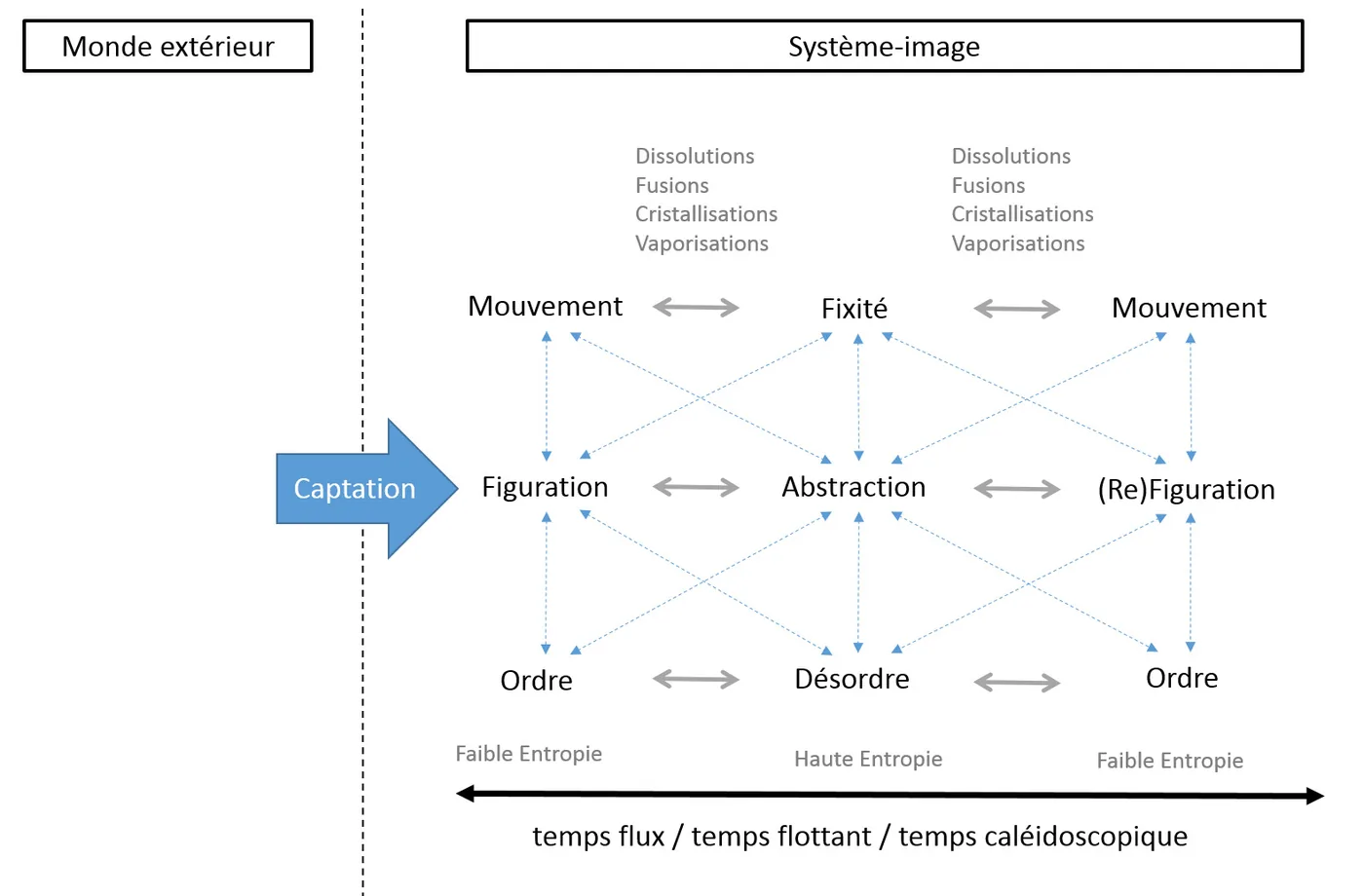
An example of this type of notation is a diagram drawn up to synthesize the dynamics at work in five pieces from my personal work: El túnel de los recuerdos (2016), La flamme (2016), Gare Paris-Saint-Lazare, 10 avril 2017, 12h03-12h07 (2017) and L’inter-code (2017), as well as the photographic series Rémanences1 (2017). In all these works, the images belong to a field of forces oscillating between fixity and movement, between figuration and abstraction, between order and entropy: the plastic matter of the digital image is revealed in a relation of equivalence2 with the living and inorganic matter of the real world.
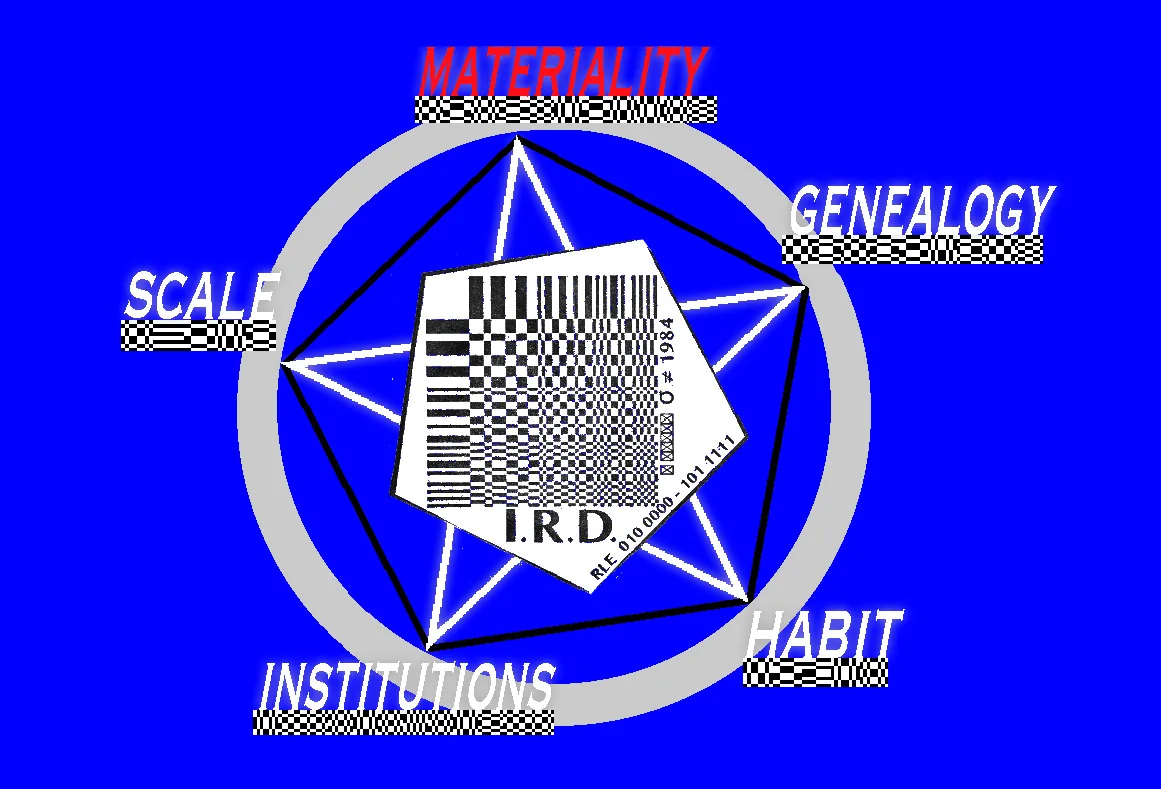
The analytical scope of human inscriptions sometimes answers to an attempt to systematize the whole of a plastic and conceptual corpus. Such is the case of the diagram in Figure 21, which offers itself as a graphic and analytical guide to the work of Rosa Menkman, whose plastic production is closely linked to theoretical considerations, in a rich questioning of images structured along five interconnected axes: Materiality, Genealogy vs. /his/tory, Habits, Institutional tactics and what could be rendered as The out-of-scale (of the sensible) as a form of violence.
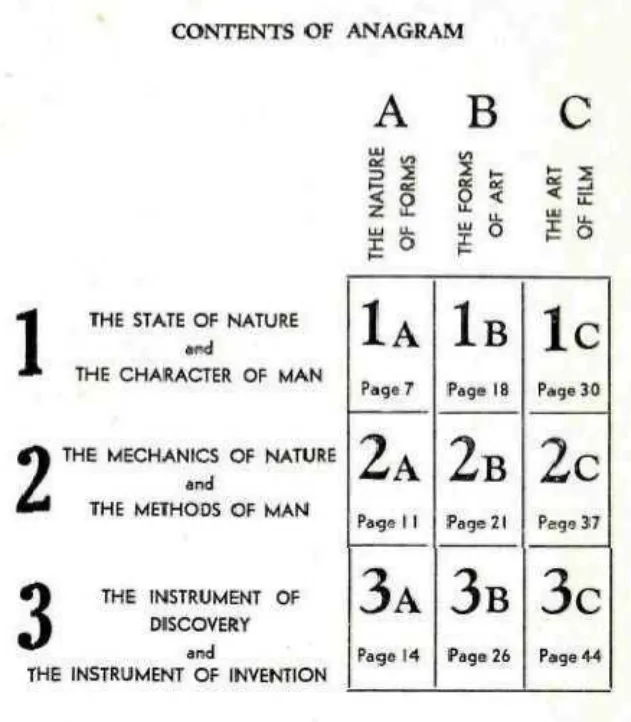
This is not to claim that this level of analysis was absent from the pre-digital landscape. One need only think of Maya Deren’s anagram3 (Figure 22), dating from 1946, as one of the most accomplished examples of a notation, built by the artist herself, that refers — albeit indirectly — to an artistic corpus traversed by axes of theoretical reflection, which the artist develops with remarkable depth4. It is simply suggested that, in the new technological context, notations, freed from their immediate operative role (which has become the business of the algorithm), can project themselves more easily toward considerations that go beyond the order of the individual work, giving more immediate access to a higher order of analysis.
This photographic series derives from the process at work in the video Gare Paris-Saint-Lazare, 10 avril 2017, 12h03-12h07, applied to other urban locations in France and Germany.↩︎
Over time, I had to move beyond this vision of my images as a metaphor for the materiality of the world, and accept that the digital image is itself matter. From this paradigm shift emerged the questions that motivated this research, which seeks to understand the genesis of this form of technological plasticity, and of the link established between it and the artist during the creative process.↩︎
Deren uses the notion of anagram — a word whose letters, once rearranged, produce another word — because she organizes her reflection along two axes: the first considering art, form and cinema; the second taking into account ontology, methods and invention. Several possible readings thus emerge from the essay, opening onto reflections oriented along distinct axes.↩︎
In Bill Nichols and Maya Deren (dir.), Maya Deren and the American avant-garde. Berkeley : University of California Press, 2001, p. 267.↩︎
Cite this pageCórdoba, Pablo-Martín. “Branching Analytics”. In Making Digital Images in the Light of Experimental Cinema — Anthropological and Political Resonances of Algorithms in Contemporary Art, Doctoral thesis in visual arts and photography, Université Paris 8 Vincennes-Saint-Denis, Doctoral School EDESTA (no. 159), research unit AIAC, 2026. https://www.pablomcordoba.com/thesis/branching-analytics/