5.2.1
Opening Up Cyberspace by a Throw of the Dice
We know that Marcel Duchamp could toss a coin in the air and, depending on the result (heads or tails), either leave for America or stay in Paris1. In doing so, the artist was “actively suspending the play of preferences2,” his own as much as those of others, and surrendered himself to chance, a phenomenon that lies at the heart of the playful and which constitutes, moreover, one of the main strategies for introducing uncertainty3 into digital technology4. The collective Disnovation.org5 mobilizes chance algorithmically in Predictive Art Bot (2015-), a work that manages to break down the partitions of cyberspace by randomly cutting up and recombining the news that circulates there. In Predictive Art Bot, an algorithm captures on the Internet the headings of trending topics belonging to multiple and varied fields of interest, and randomly chooses words from them, which are then combined in order to form new sentences, unexpected and sometimes disconcerting, in turn parodically offered as “ideas for art projects.” Presented as a website at the address predictiveartbot.com, the work runs in real time and injects its art project ideas into the project’s Twitter account, which is still active6.
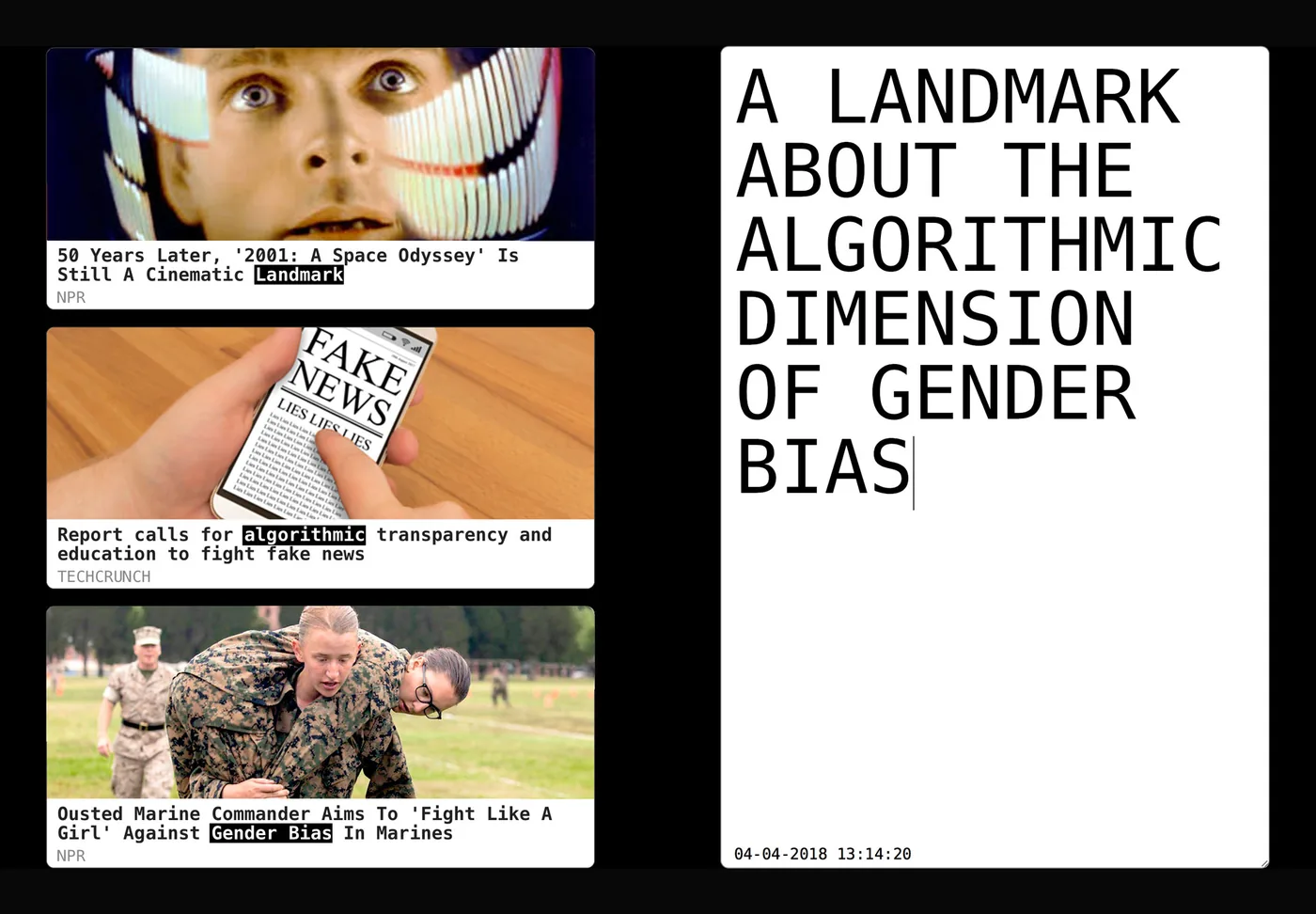
Predictive Art Bot manages to make sensible disturbing and invisible aspects of the implementation of the Internet, as much in the functioning of social networks as in that of search engines. These work in coordination in order to select, from the immense variety of content available on the web, only the information likely to reinforce the worldview of the Internet user sitting in front of the screen. This becomes possible through the application, for each user, of a filter built progressively according to the history of their interactions on social networks and of their searches on the web, a phenomenon called a “filter bubble7” (bulle de filtre8). The user thus finds themself at the heart of an informational bubble in which all the content they see tends to reinforce their opinions and political choices, to mobilize their fears and to resonate with their prejudices. In parallel, a complementary mechanism on social networks, “echo chambers,” fosters for each user virtual contact with individuals who share their opinions, thereby creating a veritable social segmentation. These mechanisms threaten our democracies today because they annihilate debate, help to harden biases and contribute to the development of extreme positions on the part of certain social groups9. In the face of such a context, Predictive Art Bot proposes a contrary movement: with a parodic touch and with complete lightness, the work orchestrates an algorithmic game that mobilizes chance in order to re-signify the news on the Internet, helping to restore the diversity of information on the screen.
André Breton, Les Pas perdus. Nouv. éd. rev. et corr. Paris : Gallimard, 1990, p. 121.↩︎
Sarah Troche, «Marcel Duchamp : Trois méthodes pour mettre le hasard en conserve: ». Cahiers philosophiques [en ligne]. October 2012, vol. n° 131, n° 4, p. 18–36.↩︎
Outside the framework of philosophy, we could not be concerned here with establishing differences between the unforeseen, chance, uncertainty, etc.; within the framework of an aesthetics of the sensible, it is enough for a phenomenon to be “humanly unpredictable” for it to interest us as a bearer of surprise, of astonishment, that is, of unexpected effects.↩︎
This involves the implementation, at the level of code, of “random” functions, capable indeed of introducing a certain level of chance, which is nevertheless not complete, into the behavior of the machine. The exploitation of noise and/or of data arising from human-machine interaction (mouse movement, various sensors, etc.) constitutes other means likely to inject “the unforeseen” into the digital.↩︎
An artistic research collective based in Paris, formed by Maria Roszkowska, Nicolas Maigret, Baruch Gottlieb and Jerome Saint-Clair https://disnovation.org, accessed December 1, 2024.↩︎
https://twitter.com/predartbot, now https://x.com/predartbot, accessed December 1, 2024.↩︎
https://www.cnil.fr/fr/definition/bulle-de-filtre, accessed December 1, 2024.↩︎
See in this regard Eli Pariser, The filter bubble: How the new personalized web is changing what we read and how we think. 2nd pr. London : Penguin Books, 2012.↩︎
The analysis of the Flat Earther community, for example, reveals how it functions as an echo chamber, see Carlos Diaz Ruiz and Tomas Nilsson, «Disinformation and Echo Chambers: How Disinformation Circulates on Social Media Through Identity-Driven Controversies ». Journal of Public Policy & Marketing [en ligne]. January 2023, vol. 42, n° 1, p. 18–35.↩︎
Cite this pageCórdoba, Pablo-Martín. “Opening Up Cyberspace by a Throw of the Dice”. In Making Digital Images in the Light of Experimental Cinema — Anthropological and Political Resonances of Algorithms in Contemporary Art, Doctoral thesis in visual arts and photography, Université Paris 8 Vincennes-Saint-Denis, Doctoral School EDESTA (no. 159), research unit AIAC, 2026. https://www.pablomcordoba.com/thesis/opening-up-cyberspace-by-a-throw-of-the-dice/