2.3.7
Substance (2021)
It was while reflecting on the work of Rosa Menkman that I found, so to speak, arguments tending to justify, in my own eyes, the use of a story, of a narrative — of a fiction. For in general I share, with a good number of experimental filmmakers — among them Malcolm Le Grice and Paul Sharits — a certain reluctance to use narrative elements, not because it would be a matter of preserving the purity of a “medium” in a Greenbergian logic — by avoiding any transfer from literature — but because I feel an apprehension about using a means directly legible by power1, which has made the narrative register one of its favorite tools. It is by exploiting our archaic “desire for stories” that the culture industries, articulated with commercial persuasion, have structured themselves: it is with this observation that Bernard Stiegler opens the first chapter of the third volume of La technique et le temps, entitled Le temps du cinéma2.
The modulation of the sensible, or at least of the non-intelligible, of the plastic, of the “uncodified” — or else of the codified, but in a far more uncertain and ambiguous way than human language in its “standard” use — seemed more fitting to me, although I know that this is above all a personal bias, which I do not seek to demonstrate or justify3. Yet the use of narrative in a work of art finds new justifications nowadays, as a strategy capable of bringing closer to the human technological elements that are increasingly opaque and abstract — as is the case with the DCT transform, the subject of Menkman’s video DCT:SYPHONING: The 1000000th (64th) interval (2015-2017), a work considered in the Structurations part — which, moreover, are the object of strategies of concealment — which is rather more the concern of Substance.
I was reassured, however, to observe that the narrative emerged gradually during the creative process, with the images, out of the images.
Substance concerns an elderly woman who, while moving from her house to a nursing home, had lost a film photograph, the only memento of her father, killed in action during the Second World War. This image, in its physicality, had something irreplaceable about it, impossible to restore with a digital image. The narrator in Substance regrets what we perhaps all regret: the fact that with the digital, the tangibility of the support of images has disappeared forever. The support is still material, to be sure, and it certainly possesses particular forms of agency that manifest themselves (and that this research seeks to grasp), but it is a materiality whose functioning escapes, temporally and spatially, the domain of human sensibility: the material modulation of the support of digital images, just like its reading, becomes, in the digital, the exclusive business of the machine4.
As a result, there can probably be nothing of the order of aura in a digital trace. I realized that I felt this after having “emptied,” somewhat mechanically, the SD card of my camera containing images taken at the birth of my first son. These images were going to be properly backed up, to be sure, in three copies, distributed across hard drives kept in different locations. But if the SD card was now empty, ready for a new shooting session, the original traces of these important images were lost forever — and I had been indifferent to it. Walter Benjamin had taken care to oppose the trace to the aura:
The trace is appearance of a nearness, however far removed the thing that left it behind may be. The aura is appearance of a distance, however close the thing that calls it forth. In the trace, we gain possession of the thing; in the aura, it takes possession of us5.
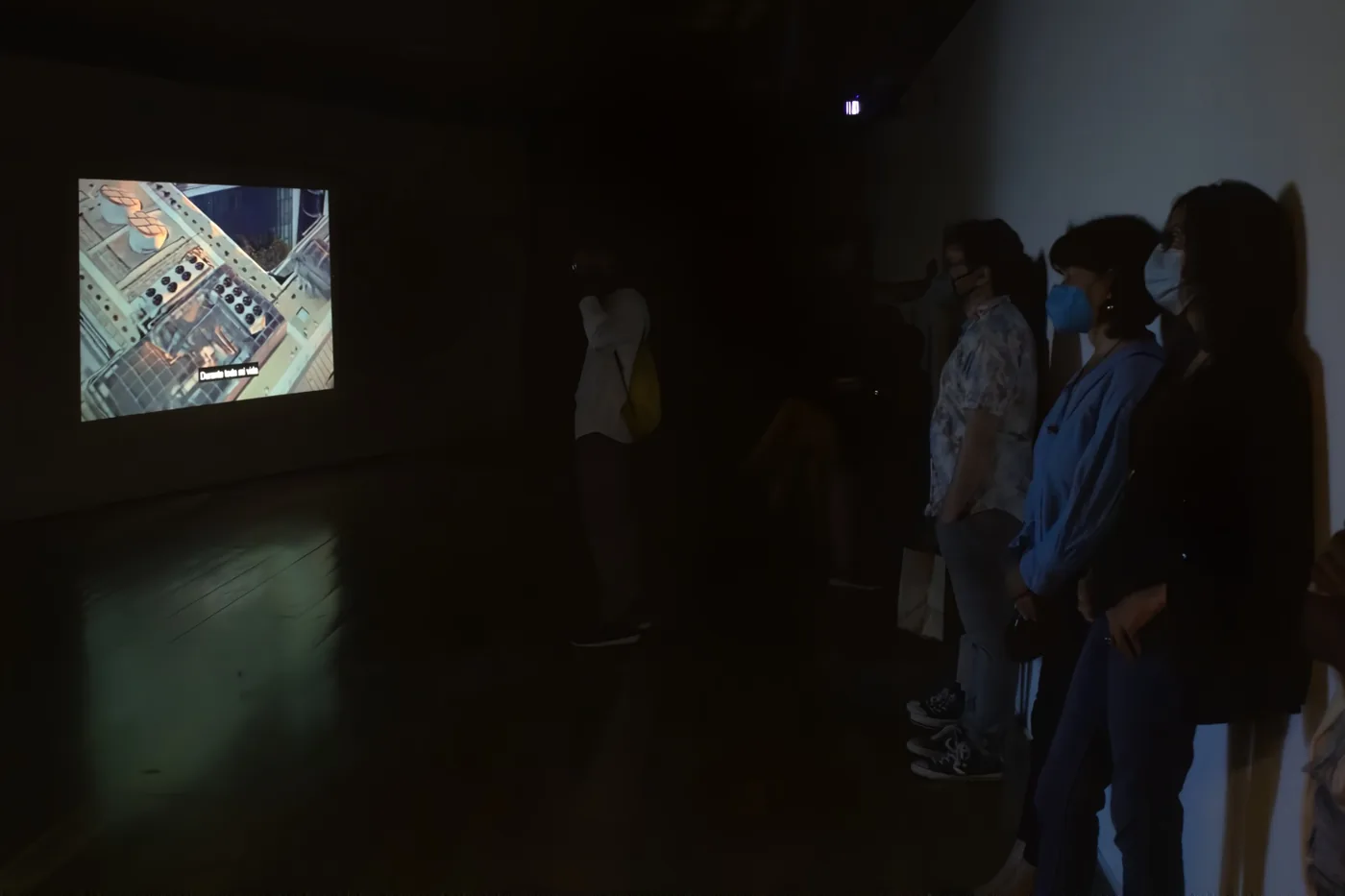
The narrator in Substance cannot let go of this “auratic” tactility that she associated with the film photograph, because it was the object that brought her closest to the body of her dead father. And although her children and grandchildren point out to her that several digital versions of this precious image exist, for the narrator this was obviously not equivalent. For while there is a definite materiality of the digital support — one that needs to be problematized — the affective dynamics linked to the support of images have been forever upended with the advent of the digital. In response, the video presents itself as a flyover, a quest to recover the “body” of this image, at once symbol and affective receptacle of the body of the lost father. Along the way, the aerial quest reveals the true face of digital storage in Paris, more absent than ever from discourse, at the very moment when the energy needs of the digital are exploding with the development of artificial intelligence. A paradoxical aspect, as the city forcefully embarks on its green transition.
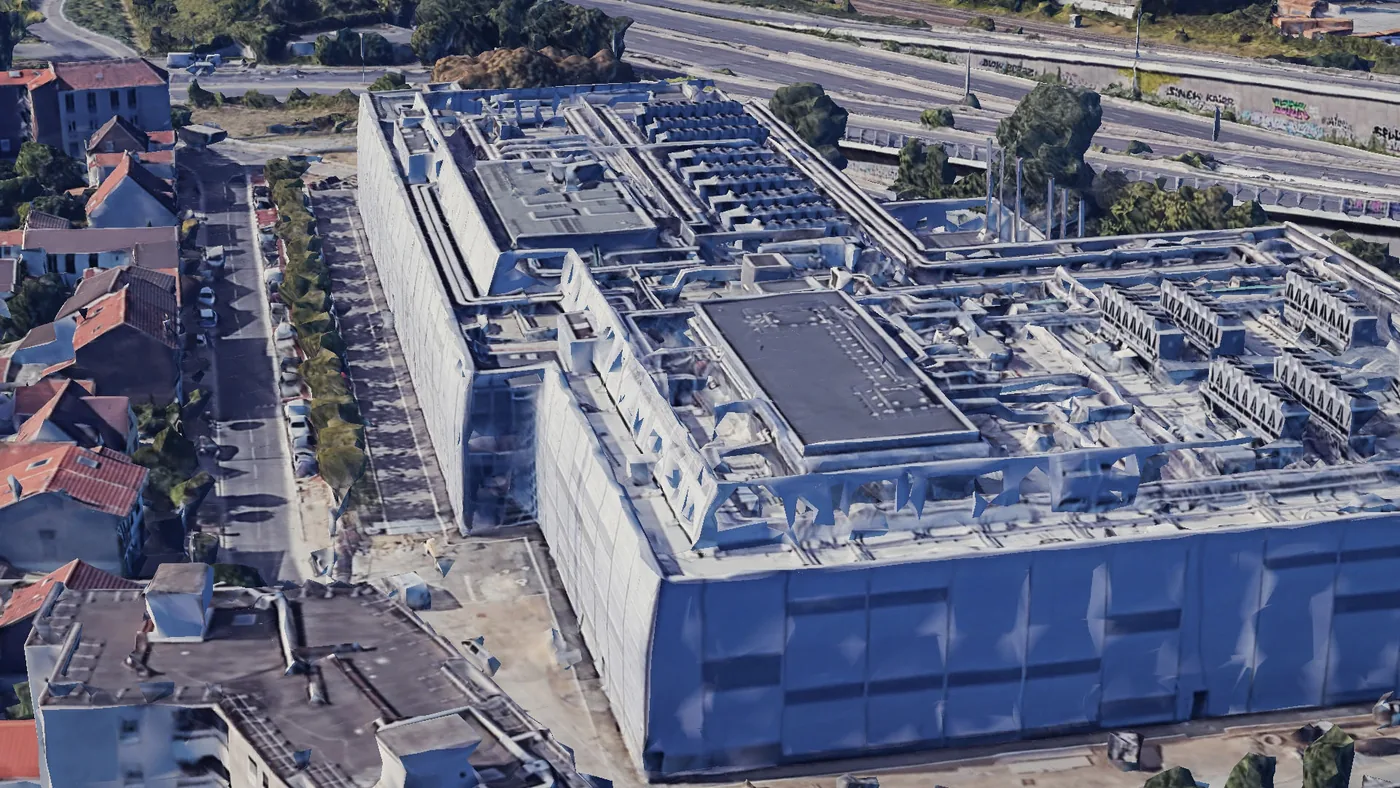
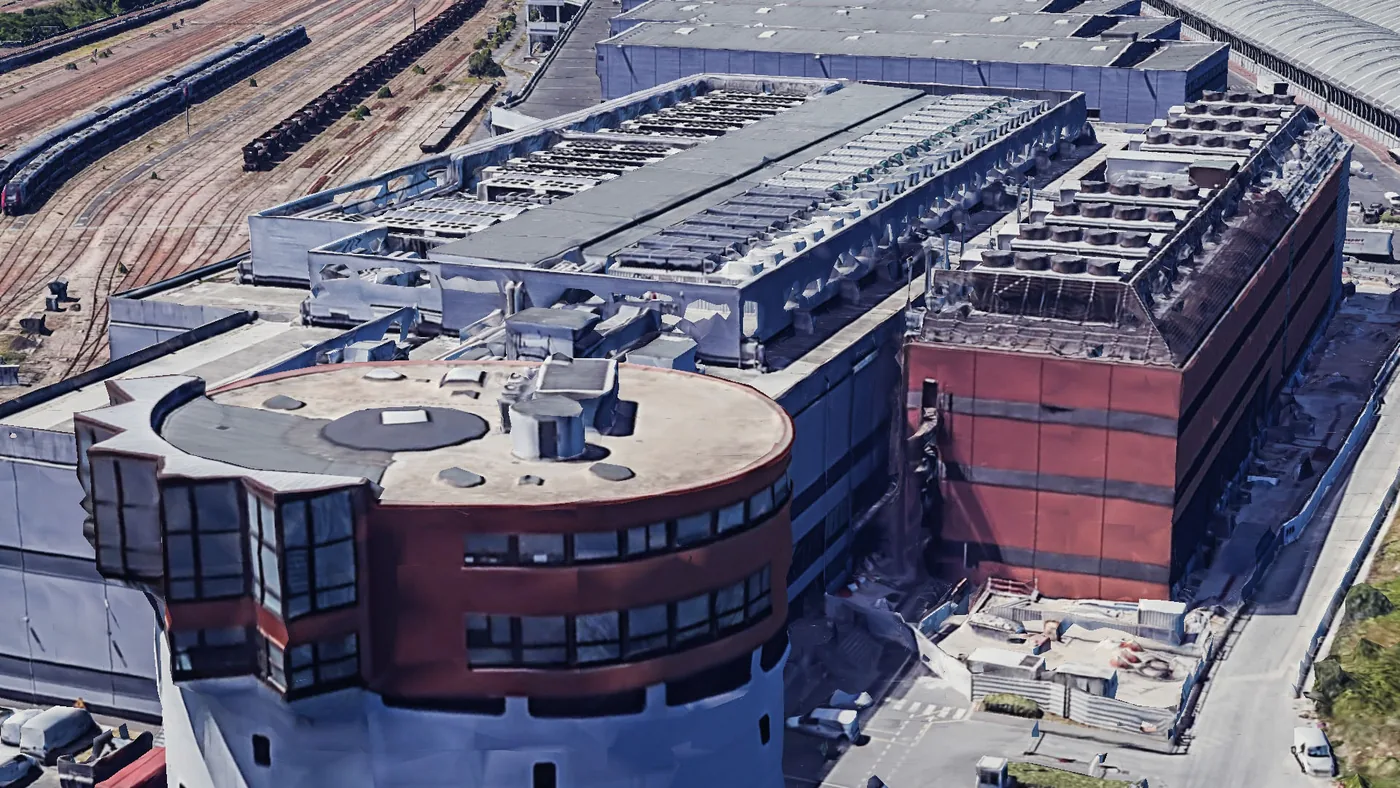
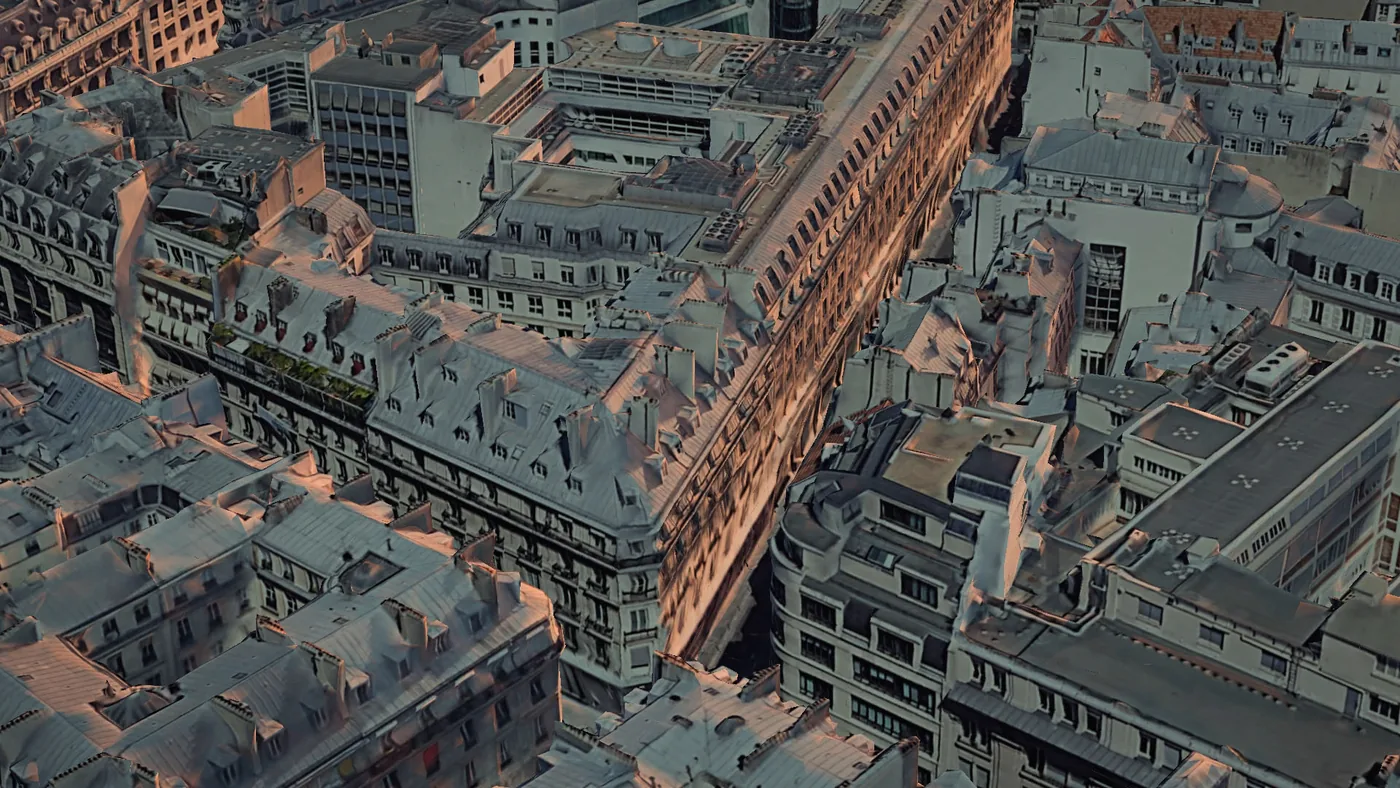
While the video, in 2021, could not show the largest data center in France, and one of the largest in Europe, Interxion’s PAR8 — aka Paris Digital Park — then under construction, Substance offers an aerial exploration of other colossal data centers, in Paris and the inner suburbs: the Telehouse 2 on boulevard Voltaire, owned by KDDI; the SFR NetCenter in Courbevoie; the OVHCloud at Porte de Clichy; the PA2/3 in Saint-Denis and the PA4 in Pantin, owned by Equinix; the PAR2 in Aubervilliers, the PAR5 in Saint-Denis, the PAR6 in Ivry-sur-Seine and the PAR7 in La Courneuve, all belonging to Digital Realty (formerly Interxion).
In Substance, the material deployment of the digital is set in perspective with the evocation of armed conflict — here the Second World War — which sealed the loss of the father for the narrator. A resonance is thus proposed with the military aspect that remains attached to the digital image, stemming from its genealogy6, but also with the geopolitical stakes concealed behind this hidden materiality, notably regarding sovereignty in data management. On this point, the attention paid within the video to the concrete conditioning of the digital brings a worrying aspect to light. Indeed — to cite just one example — the company Digital Realty, owner of the largest data centers in Paris, is in fact based in San Francisco, and its board of directors is composed exclusively of North American nationals. What is more, it should be noted that among the company’s five main shareholders, four are North American investment funds (BlackRock Advisors LLC, Cohen & Steers Capital Management, Inc., State Street Corporation and The Vanguard Group, Inc.)7. This situation appears hardly tenable in the face of current economic and political upheavals, especially since the beginning of Donald Trump’s second term in the United States, in January 2025.
While the overcoming of hylomorphism evoked by Gilbert Simondon would amount to revaluing the role of matter in relation to that of form, the video seeks less to problematize these convoluted Aristotelian principles than to set in tension, through a fictional narrative, the concrete mode of existence of digital images and their effects on our stories and our becomings, individual as well as collective.
This is truer than ever with artificial intelligence, through which control and surveillance can be automated.↩︎
On this subject, see Bernard Stiegler, La technique et le temps, op. cit., p. 601.↩︎
The ban on what the Nazis considered “degenerate art” in general, and notably, in experimental cinema, the ban on Hans Richter’s film Ghosts Before Breakfast (1928), bears witness to the fact that authoritarian powers may very well seek to silence non-linguistic expressions.↩︎
This was already the case for the non-digital electronic image, that is, analog video.↩︎
Walter Benjamin Jean Lacoste and Walter Benjamin, Paris, capitale du XIXe siècle: le livre des passages. 3e éd. Paris : Les Éd. du Cerf, 2002, p. 464.↩︎
We saw this in resonance with Samuel Bianchini’s installation Sniper.↩︎
Web link: https://www.marketscreener.com/quote/stock/DIGITAL-REALTY-TRUST-INC-12320/company, accessed March 31, 2025.↩︎
Cite this pageCórdoba, Pablo-Martín. “Substance (2021)”. In Making Digital Images in the Light of Experimental Cinema — Anthropological and Political Resonances of Algorithms in Contemporary Art, Doctoral thesis in visual arts and photography, Université Paris 8 Vincennes-Saint-Denis, Doctoral School EDESTA (no. 159), research unit AIAC, 2026. https://www.pablomcordoba.com/thesis/substance-2021/