3.8
The Life of the Work: From the Preindividual to the Transindividual
Summing up what has been discussed in this chapter, let us say that experimental artistic practices that modulate animated digital images, and that see meaning emerge from algorithmic manipulations of matter – in the successive interactions between artist and computer –, lead us to envisage these two entities, human and machine, as structured in turn on the basis of matter, experience and gesture.
This led us to sketch out a gestural genesis for both the human and the machine, by bringing into resonance notions and experimental results drawn from the philosophy of technics, paleoanthropology, developmental psychology, neuroscience, software studies and media archaeology.
Thus, on the human side, experience with the materiality of the world through gesture prefigures and determines, over the long time span of phylogenesis as well as over the shorter time span of ontogenesis, the symbolic functioning that makes mathematics and natural language possible.
As for the computer, the evolution from operative gesture toward forms of coding that seek to resemble natural human language, by way of formal logic, took place in a forced and over-artificialized manner (the history of the design of the COBOL language, which we discussed, is proof of this). Machinic symbolic functioning remains within an operative perimeter, with signifiers that are linked in a one-to-one manner and that point directly and unequivocally to the operation.
It is on this symbolic plane that the human communicates with the machine, but natural human language cannot be inscribed on this rigid plane — that of formal logic. Indeed, communication passes through the chaining of commands, the management of flows, the generation and management of more or less lasting traces (memories).
At a moment and in a place of the creative process that are always renewed, the artistic gesture manifests itself, which may be algorithmic when it involves an intuitive modification of the code or an unexpected change in the wider system that can be understood as the algorithm in the broad sense (for example, protocol-based aspects of the creative process). This gesture is a movement of the body, even if that movement is not perceptible, and it responds to an impulse of intuition that does not admit of a causal explanation (Flusser). It reveals the nature of the “medium” as well as the strategic means of control put in place by human intentionalities (Agamben). The artistic gesture invests temporality, outside the algorithmic core, as a wild discovery, a direct communication between matter and flesh (Ribault). When it takes the form of an algorithmic gesture, on the other hand, the artistic gesture expresses itself discontinuously, admitting pauses, latencies, echoing the specificities of the digital medium on which the gesture unfolds (like, in this respect, the gesture of setting down (poser) considered by Michel Guérin1).
Within each creative process, and in a singular way, human-machine interactions are also a movement from the unresolved toward the resolved, from incompatibility toward compatibility, from instability toward stability, but above all from the symbol toward gesture.
When the process reaches a safe harbor, the components of the creative process form a coherent system, for, during the process, each element takes part in the structuration of the others, in a mechanism that recalls what Simondon proposes as a transductive relation. In the course of the process, both the human and the machine progressively enter into resonance with the ancestral gestures they share as a common origin, as the plasticity of the work takes on consistency, as meaning emerges, and as the work is brought into resonance with the world in which it is inscribed2.
However, diagram B must be completed, for this movement of “return to gesture” that begins during the digital creative process cannot aim at a fusion – which is impossible – with the original, preindividual level. Indeed, the creative process, as a process of individuation, is a movement of increasing structuration, whereas the original level is radically homogeneous3.
Moreover, the ascending movements from matter and gesture toward the symbolic, which we have described for both the human and the machine over the long time span (outer parts of diagram B), can also be apprehended as processes of individuation, hence of increasing structuration.
Whether it is the movement from gesture toward the symbolic over the long time span4, or the reverse movement, from the symbolic toward gesture, during the creative process (the descending movement, in red, at the center of the “B” diagrams), the level of structuration always increases (Diagram B.1).
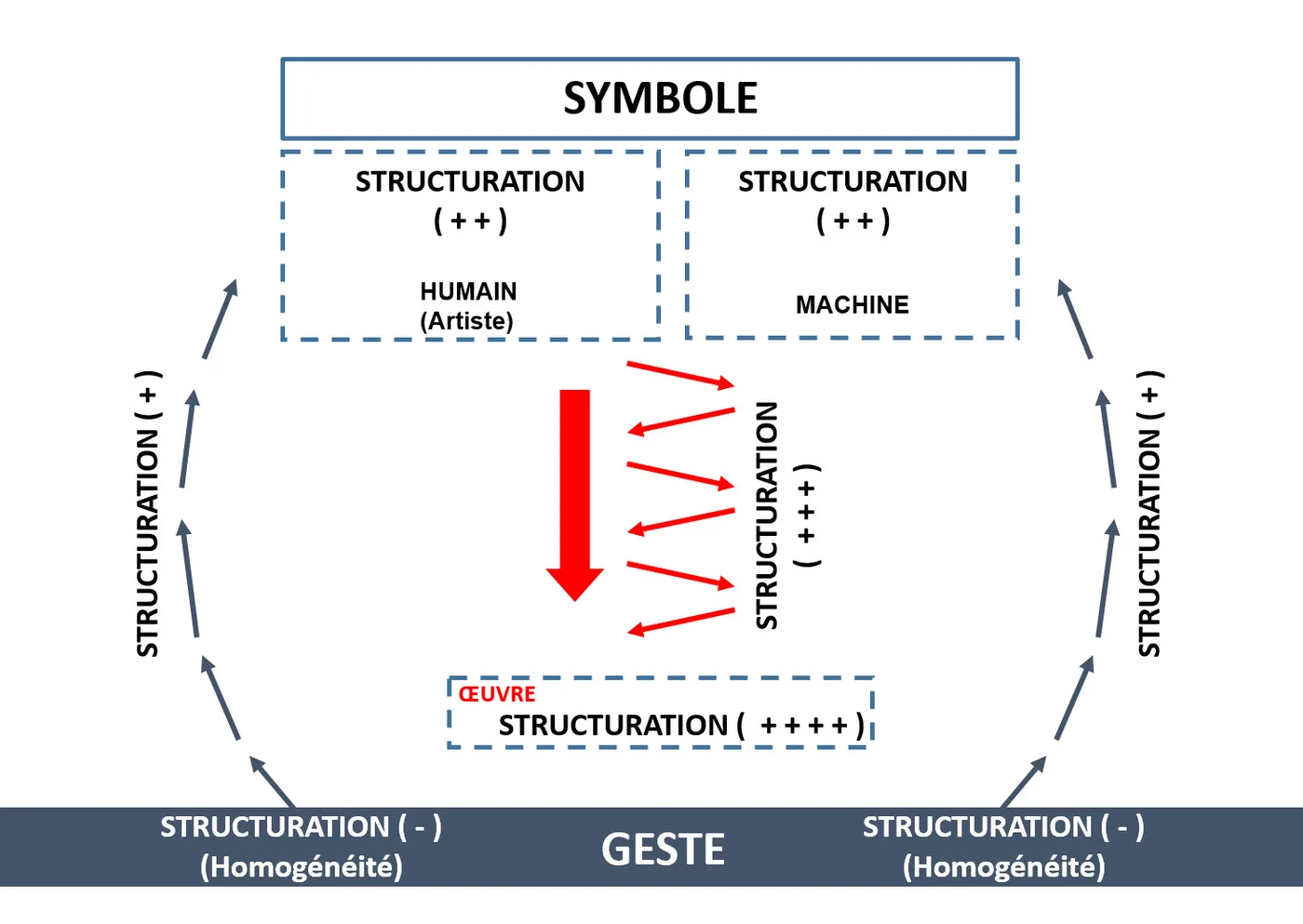
It should be added that, as already indicated, individuation as described by Simondon is a structuration (of “being”) from which the individual emerges through the formation of phases, an individual that always retains part of the preindividual.
We may think (this is our hypothesis) that this preindividual content diminishes during the individuation to which the human and the machine are subjected over the long term, but that it is amplified during the artistic creative process5 as all the instances of the process – artist, algorithm, images – progressively enter into resonance with the original ancestral gestures (Diagram B.2).
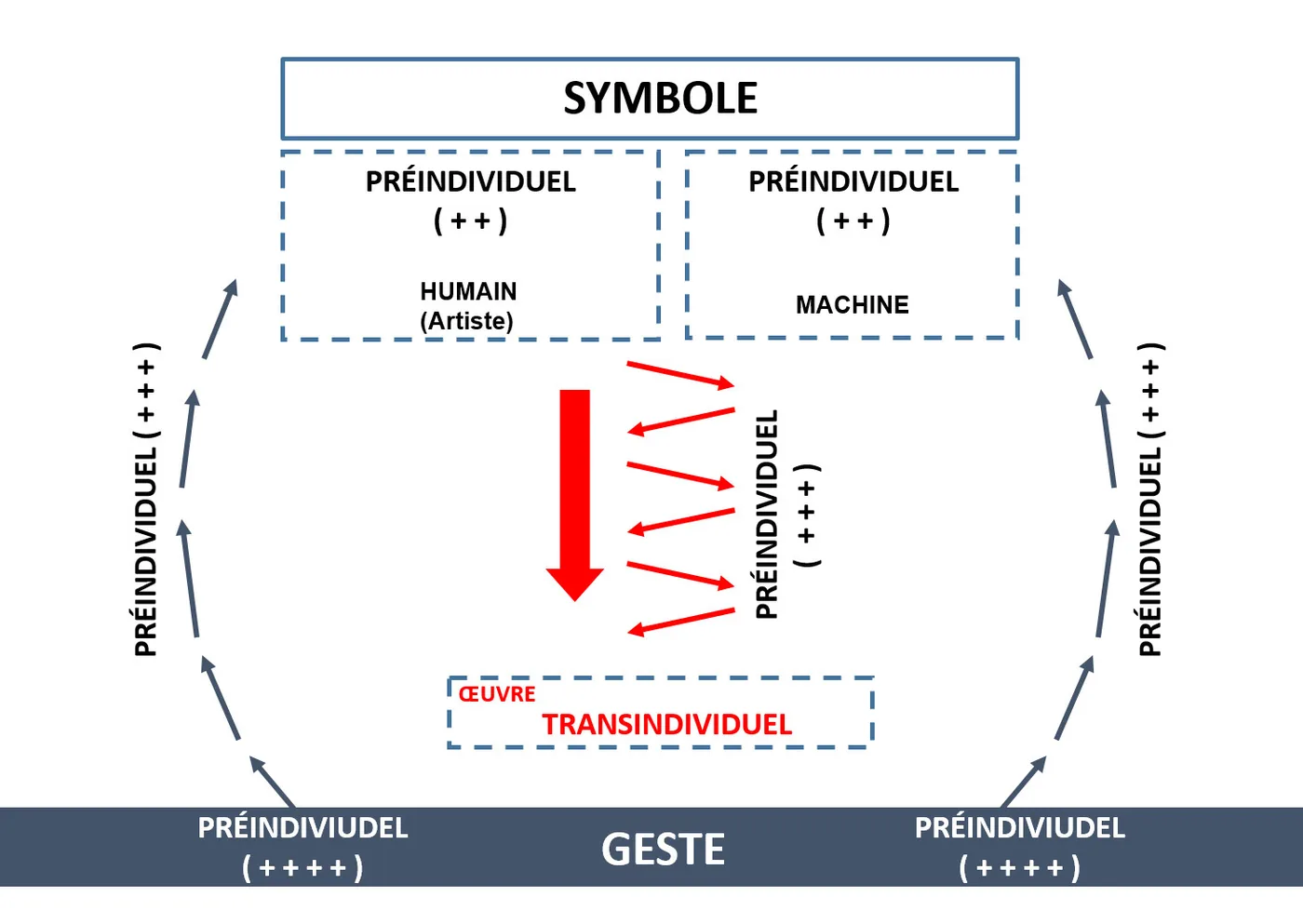
This preindividual content – revitalized and expanded – associated with a highly structured entity (the finished work), unable to resolve itself in a fusion with the original core (for the latter, homogeneous, belongs to an anterior order), continues its evolution outside the creative process, offering possibilities of collective individuation (transindividuation) at the moment of the work’s reception6. Bernard Stiegler evokes a process of this kind, which he designates as “noetic feeling”:
To feel noetically is to individuate the sensible and thereby to invent it, as an artist does, by co-individuating oneself, by hetero-affecting oneself with others, and thus initiating a circuit of collective individuation – what I call a circuit of transindividuation, hetero-affection being a transindividual production: to feel noetically is thus to make felt what constitutes a suprasensibility of the sensible7
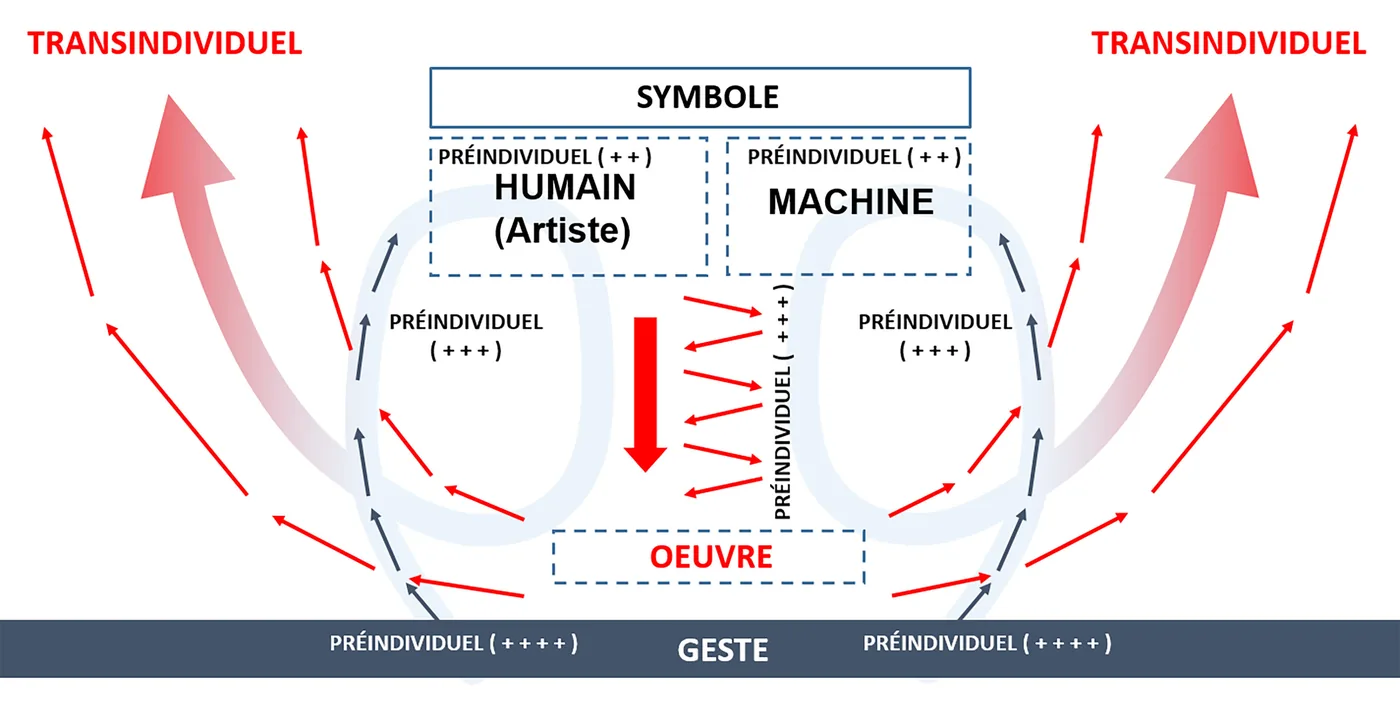
The creative process thus appears only as an instant in a much longer movement that goes far beyond the artist, a movement that traverses multiple temporalities and that presents itself as a breathing of being: a long original ascending exhalation – from gesture toward the symbol – over the long time span, which is followed by descending inhalations that call upon gesture over the short time span, descents during which the preindividual content expands and becomes transindividual, initiating anew an ascending movement toward the symbol (Diagram B.3), taking part in collective individuation (transindividuation) in what can be grasped as the life of the work outside the creative process.
See on this subject Michel Guérin, La troisième main, op. cit.↩︎
as we saw a few pages above, in diagram B.↩︎
Although, as an original metastable state, it is supersaturated with potential.↩︎
That of human phylogenesis, and of the concretization – or rather the individuation – of the computing machine.↩︎
This capacity of the artistic process to regenerate preindividual content is consistent with the function of art as Simondon sees it in his cosmogenesis, presented in a particular way in Du mode d’existence des objets techniques in 1958. Indeed, as one of the first transformations concerning the human, Simondon sees technics and the mystical (for the latter he uses the term religious thought) crystallize as fundamental phases, issuing directly from a “magical phase” (p. 216). While technics structures formal properties, the mystical is founded on properties of the ground. Art – designated by Simondon as aesthetic thought – thus appears not as a new phase, but as a function of convergence, capable of preserving a form of original reticulation, thanks to the concretization of “qualities of ground by means of technical structures” (p. 252).↩︎
Associated with this “transindividualizing” vocation of the work of art, we saw in chapter 2 (Immanences), again drawing on Simondon, a process of enrichment of the real itself, an effect particularly perceptible when this real has been artificially impoverished by a use of technics as a means of domination.↩︎
Bernard Stiegler, «Dans le cycle des images – cercle ou spirale ? Imagination, invention et transindividuation ». dans : BONTEMS, Vincent and DE RONDE, Christian (dir.), Gilbert Simondon ou l’invention du futur. Paris : Klincksieck, 2016, p. 271–289, p. 272↩︎
Cite this pageCórdoba, Pablo-Martín. “The Life of the Work: From the Preindividual to the Transindividual”. In Making Digital Images in the Light of Experimental Cinema — Anthropological and Political Resonances of Algorithms in Contemporary Art, Doctoral thesis in visual arts and photography, Université Paris 8 Vincennes-Saint-Denis, Doctoral School EDESTA (no. 159), research unit AIAC, 2026. https://www.pablomcordoba.com/thesis/the-life-of-the-work-from-the-preindividual-to-the-transindividual/