2.3.2
La flamme (2016)
This work mobilizes the same algorithmic tools as those used in El Túnel: the SDL library (which allows images to be processed at the scale of the pixel), combined with the C++ programming language, the whole organized within the Code::Blocks development environment. At the origin of the work lies the intention to “animate” a still digital image through the automated reorganization of its pixels. To this end, an algorithm was progressively developed, by trial and error, over the course of the creative experience, making it possible to modify the position of pixels in vertical slices. The still image chosen for this process represented a sculpted portrait: the monumental work Eros Bendato, made in 1999 by the Polish artist Igor Mitoraj (1944–2014) and installed on Rynek Główny square in Kraków1. In Eros Bendato, the enormous – hollow – bronze head of the mythological hero rests horizontally on a base. Bandages, above and below the nose, fail to hide the god’s eyes or his mouth. The god would thus be able to see, and to speak.
During the creative process, the algorithm was used to deform the image in very thin vertical shreds, on the order of a single column of pixels. These shreds are progressively displaced, at first very slightly in relation to their initial position. The width of the shreds, as well as the amplitude of their displacement — deltax and deltay in the algorithm — are determined semi-randomly, that is, by means of random variables constrained to evolve within a defined range of values. At each iteration, the algorithm sweeps the entire image, from left to right and from top to bottom; it selects columns of pixels and moves them, thereby generating a new image, which will in turn be transformed. Since the values of the variables controlling the thickness of the shreds and their displacement are progressively incremented, the result is an increasing deformation of the image. The images produced during the first iterations, when strung together, convey a simple “vibration” of the original image — a vibration that gradually turns into dislocation, into the dismemberment of the initial face, until the image becomes abstract, describing less a form than a texture, predominantly geometric, tending toward abstraction.
Once all the images had been constructed, and seeing the experiment sink at this stage into a form of “non-signification,” the choice was made to render the succession of images in an order reversed with respect to the temporality of their construction. The image now evolved toward the initial figurative image – showing the sculptural face of Eros – starting from an abstract beating of vertical blocks, thanks to a gesture that was, so to speak, radical. What is then at stake is a convergence of animated forms within the frame, a drawing together of the shreds of image until the final face is formed; it is a process of construction, of genesis. This sensation is reinforced by the sound, synchronized with the succession of images, which evokes hammer blows on metal, like those heard in a forge. These powerful but intermittent sound effects punctuate a background sound recalling a breath, a draft of air — effects that converge to express a form of broken breathing.
Between the initial abstraction, with its strong rhythmic component, and the final figuration tending toward a static crystallization, an intermediate phase is inserted: the shreds of image, as they approach the center of the frame without yet having formed the face, seem to vibrate, undulate, palpitate — like a flame. It is from this moment that the title of the work was born.
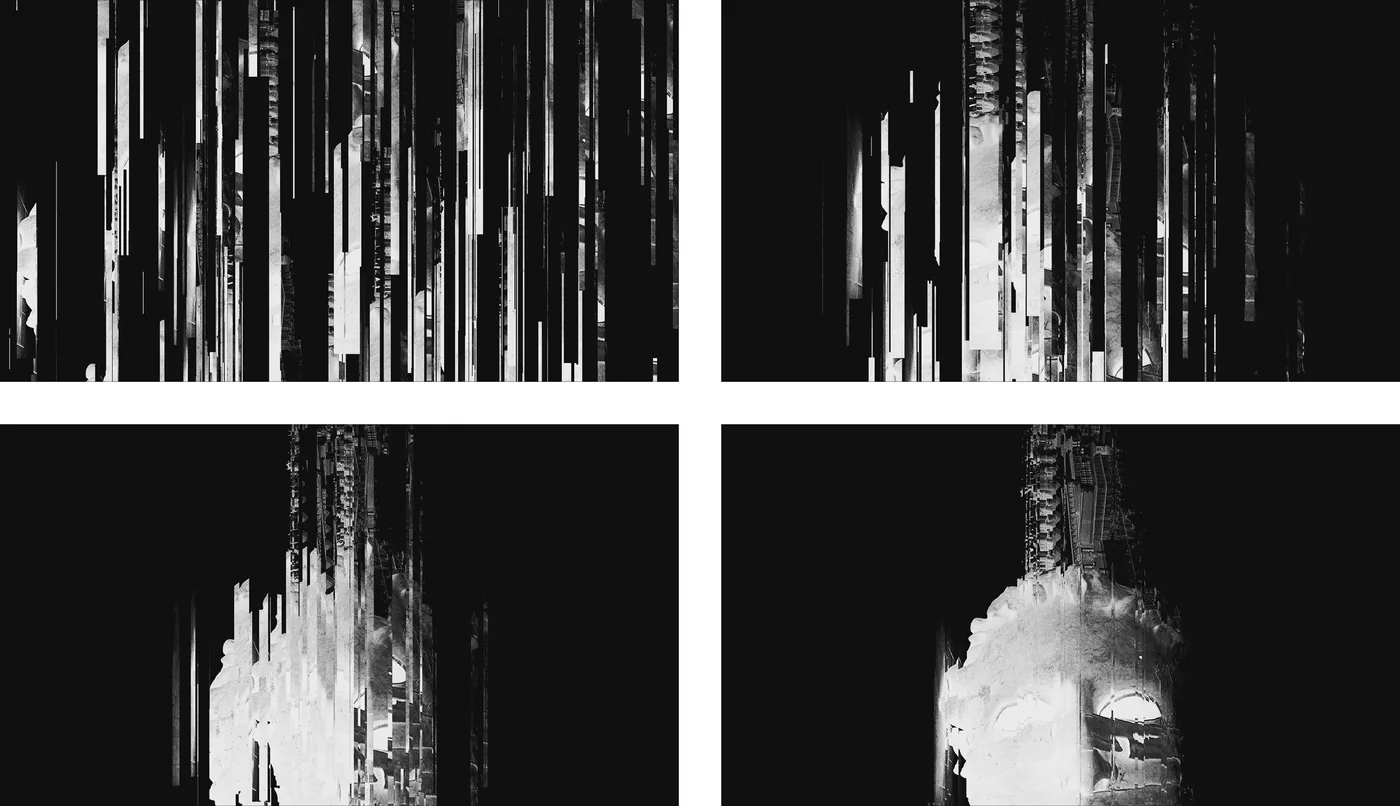
The evolution of the images in La flamme refers forcefully to the material world, to the physical interactions between bodies, to the chemical reactions between substances, to the changes in the state of aggregation of matter. More precisely, these images seem to evoke the limits of the inorganic world, where the boundaries with the living begin to take shape.
I saw in the work a representation of the passage from the inorganic to the living, a passage that requires an input of energy – like the energy introduced by hammer blows in a forge, or the energy transmitted by the heat of a flame. Whereas in El túnel what manifests itself is of the order of a dissolution, of a death, La flamme, on the contrary, evokes a birth. A mirror effect is also established with the spectator, who discovers a human face at the very moment this face begins to look: the bandage covering the god’s eyes, once it has fallen, marks the end of his blindness, but also that of the spectator.
I am aware that the meaning that seems to me to emanate from La flamme is subjective and personal. It results from what I feel before the work, but also from reminiscences of past readings, reactivated by contact with these images, and enriched by readings undertaken in the course of the research. I thus find again the distinction between the inorganic and the living, those fundamental categories on which Henri Bergson relies, notably in L’Évolution créatrice (1907). This book, which I had read well before the beginning of the research, undoubtedly left a deep mark on me – although, over time, I came to feel the need to detach myself from the notion of “élan vital,” so dear to Bergson, for it seemed to me too steeped in transcendence, whereas artistic practice was pushing me toward a form of immanence. Nevertheless, the distinction Bergson proposes between the inorganic and the living as a fundamental dividing line in the universe still seems relevant to me, as does his wish to rely on a “hard,” measurable parameter, such as entropy – a thermodynamic property capable of indicating, for any transformation, the “right path”: the one that increases a system’s capacities for action, that creates new gradients, when entropy decreases.
It is only on the plane of the living that the possibility of a reduction of entropy can be envisaged, while the inorganic world, for its part, tends toward its maximization – toward chaos. Although the notion of entropy may seem somewhat outdated today, it has remained, for me, an essential quantity: a tool that makes it possible to anchor reflection in the physical world and to prevent it from tipping over into an “all-metaphysical.” Even if it has largely disappeared from dominant academic discourse, the notion of entropy retains strongholds of topicality in the work of several major thinkers to whom I feel close. Gilbert Simondon, from the very introduction of his emblematic book Du mode d’existence des objets techniques (1958), evokes the notion of entropy – in its inverted version, negentropy – emphasizing that the machine can also contribute to its reduction, which seems to me to find particular expression in the field of apparatus-based arts. Likewise, Bernard Stiegler’s thought is traversed by this notion. In La technique et le temps (1994–2001), Stiegler indeed mobilizes not only entropy and negentropy, but also derived notions: anti-entropy, cultural entropy, retentional entropy…
If, in the past, I saw in the images arising from my work a metaphor for the materiality of the world, I now apprehend them as concrete expressions of a specific materiality: that of the digital. This allows us to consider the plastic dynamics at work in digital images on the basis of principles drawn from the physical sciences, and to mobilize the vocabulary associated with them, centered on the inorganic materiality of the world. Adopting this register, one could say that if the dissolution of the human figure at work in El túnel resembles a spontaneous process, the consolidation of forms in La flamme belongs to a non-spontaneous process, which requires a force and an energy in order to come about.
With regard to these algorithmically arising forms, the question of emergence2 arises – more generally – in a sense that seems to me relevant to the whole of my work, and perhaps valid for any experimental practice: with the emergence of plastic forms, an emergence of meaning also takes place. The elements that emerge in the image in El túnel – color saturation, the telescoping of forms – initiate a reflection on the mode of existence of human and machinic memory, on their confluences and their divergences, and on the possibilities and the role of the human in an environment saturated by technics. What stands out in the image in La flamme – an animated texture, a rhythm that expresses itself, the flame itself when it appears – seems to point toward the living as the summit of the organization of matter, but this is then a bottom-up organization of the living, which cannot disregard its inorganic origin, and in which the agency of matter is permanently at work.
La flamme expresses, rather than represents, this passage from inorganic matter to the living, characterizing it as a non-spontaneous process. It thus evokes, as we have suggested, a form of Bergsonian élan vital, understood as a force capable of structuring inorganic matter in order to engender the living.
Today, on the basis of the work but also against it, and after having observed what emerges from the Game of Life, I am considering another hypothesis3: one that envisages the passage from the inorganic to the living as a spontaneous transformation, occurring without the intervention of any external force, through the convergence of contingent factors. This passage, although statistically highly improbable, could come about naturally when certain conditions are met — just as, in the Game of Life, cellular automata form structures of extreme complexity from elementary configurations, evolving according to rules of astonishing simplicity.
In his essay Philosophy and Simulation: The Emergence of Synthetic Reason (2011), Manuel DeLanda tackles the phenomenon of emergence head-on. After a brief introduction tracing the history of the term emergence, the philosopher describes a series of processes of increasing complexity: from purely physical entities — such as the morphology of a convection cell inside certain thunderclouds — by way of “prebiotic soups” and bacterial ecosystems, up to insect intelligence. DeLanda thus seeks to think the arising of human memory, language and institutional organization as so many emergent processes. This ambitious project presents the genesis of the living as a spontaneous, contingent and fortuitous process, within a materialist vision of the world that “does justice to the creative powers of matter and energy4.”
Which I had the good fortune to visit in 2009. It is in fact a scan of a black-and-white film negative; the image is therefore chromatically inverted.↩︎
Which was discussed in connection with structurations.↩︎
I cannot manage to integrate this hypothesis into my consciousness in a lasting way, to the point where it would give rise to a feeling; it seems too dizzying to me.↩︎
Manuel De Landa, PHILOSOPHY AND SIMULATION: The emergence of synthetic reason. Place of publication not identified : BLOOMSBURY ACADEMIC, 2019, p. 6.↩︎
Cite this pageCórdoba, Pablo-Martín. “La flamme (2016)”. In Making Digital Images in the Light of Experimental Cinema — Anthropological and Political Resonances of Algorithms in Contemporary Art, Doctoral thesis in visual arts and photography, Université Paris 8 Vincennes-Saint-Denis, Doctoral School EDESTA (no. 159), research unit AIAC, 2026. https://www.pablomcordoba.com/thesis/la-flamme-2016/