5.4.1
Liberating the Flâneur
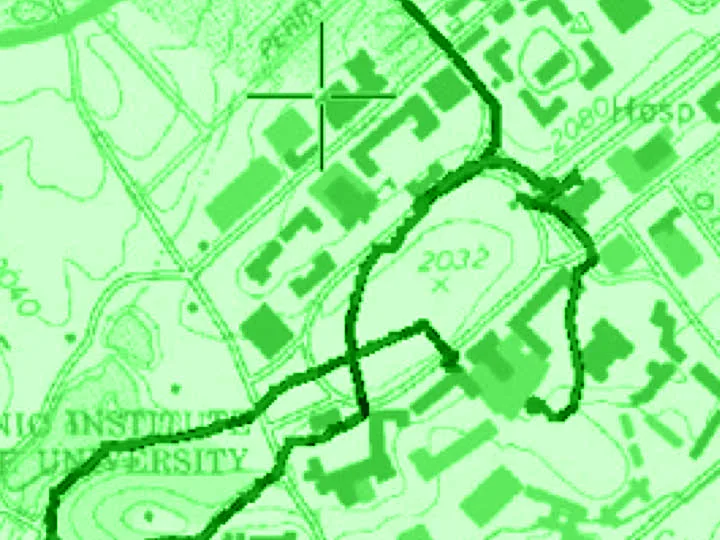
In Random GPS (2010), Gwenola Wagon and Stéphane Degoutin divert a GPS so that, instead of indicating to the driver the optimal route from their location to a destination, it offers them an experience of road wandering likely to accomplish an almost impossible mission: “getting lost” in our contemporary technosphere. During this motorized flânerie, with Benjaminian overtones, the user will see their route recalculated periodically and randomly. The false data of this unconventional journey transmitted by the “hacked” GPS will pollute the user’s behavioral profile1 so as to neutralize its predictive efficacy. The user of the deranged GPS then becomes an active spectator and the main protagonist of this ultimately interactive work. They experience an “art of loss” that resonates, as the reflection associated with the project indicates2, with the attempts at disorientation of Jack Kerouac, Charles Baudelaire and above all Guy Debord (who resorted to alcohol and hashish), or else with the experiments of André Breton, who “amplified wandering through the surrealist spirit3.” In Random GPS, the challenge consists in letting oneself be guided by the voice of the device as one obeys the voice that directs a process of hypnosis4.
The liberation of the human evoked in this project goes beyond the pleasures of an ephemeral flânerie. In truth, when these artists introduce a failure into the GPS device, they disrupt the process of surveillance through the analysis of users’ movement data. Indeed, individual profiling relies not only on the data that the user has “agreed” to share5, but also and above all on data collected without their knowledge, such as collateral data (residual data), which constitute what web actors call “behavioral surplus6.” Whether spelling mistakes, typing speed, color preferences (buttons, interfaces), speed and style of driving, among many others: mountains of “data exhaust,” which is in fact gold dust7, for it allows an extremely predictive profiling of each user. The exploitation of behavioral surplus plays a central role in an economic model that, as it becomes generalized, gives birth to a renewed form of capitalism that Shoshana Zuboff has named “surveillance capitalism8.” By taking behavioral surplus into account, the profile of each user could reveal their “inner demons9” so as to determine when and how they will feel vulnerable, thus making it possible to target the appropriate moment to present them with an advertisement for a specific product or service. From this project by Wagon and Degoutin emerges the temporal aspect of the alienating action of technics as implemented, which can operate as much through an impoverished planning of the future as through a malicious appropriation of the traces of past activity. The emancipatory project must, in return, ensure the openness of the future while preserving the traces of the past from an illegitimate, extractivist appropriation.
r0.5
When data is apprehended as a trace, the question of its management thus arises with greater force, with formulas that remain to be invented but which can only emerge from collective action. The institutional management of data as a material social asset reveals it as a technical object, an object that must in turn be grasped as a pharmakon, which can be mobilized within an alienating framework – as the GAFAM do – but which, managed on the basis of the general interest, opens promising perspectives for collective planning. In this sense, Marta Severo and Alberto Romele reflect on what they call “soft data”: data “available on the Internet, easily accessible and harvestable,” which may come from Facebook, Twitter or RSS feeds, among others, and which offer themselves to public services as an “original and rich source of information on the social phenomena taking place in a territory10.”
In this passage from data as poison to data as remedy, artists have their say, for their works make sensible problematic domains within which a positive potential for action would have to be discovered. In this sense, Random GPS tackles the fundamentally technical stakes of the expressions of the dispositif of alienation when it exploits human movement, unveiling its functioning. Yet this technical dispositif always presents itself backed by discursive elements, which would also have to be dismantled within an emancipatory quest.
A behavioral model that web service providers can build for each Internet user, on the basis of their personal data but also of their behavioral traces, in order to predict their behavior.↩︎
URL: https://d-w.fr/en/projects/random-gps/, accessed December 1, 2024.↩︎
Ibid.↩︎
As Wagon suggests in an interview. In Julie Beressi and Laurent Védrine, Géolocalisation, une théorie de la dérive [en ligne]. 27 January 2015. disponible à l'adresse : https://www.radiofrance.fr/franceculture/podcasts/sur-les-docks/geolocalisation-une-theorie-de-la-derive-4764533.↩︎
Such as browsing history on the Internet, interactions with posts on social networks, the identity of contacts, etc.↩︎
See in this regard the chapter ”La découverte du surplus comportemental” (in English: ”The Discovery of Behavioral Surplus”) in Shoshana Zuboff, L’âge du capitalisme de surveillance, op. cit.↩︎
Shoshana Zuboff, L’âge du capitalisme de surveillance, op. cit., p. 101.↩︎
Shoshana Zuboff, L’âge du capitalisme de surveillance, op. cit↩︎
See in this regard the documentary The Big Data Robbery. URL: https://www.imdb.com/title/tt13641514, accessed December 1, 2024.↩︎
See on this subject Marta Severo and Alberto Romele, «Soft data. Essai d’une nouvelle définition des données pour les études territoriales ». dans : Traces numériques et territoires [en ligne]. [s. l.] : Les Presses des Mines, 2015, p. 63–87. disponible à l'adresse : https://shs.cairn.info/traces-numeriques-et-territoires--9782356712271-page-63?lang=fr.↩︎
Cite this pageCórdoba, Pablo-Martín. “Liberating the Flâneur”. In Making Digital Images in the Light of Experimental Cinema — Anthropological and Political Resonances of Algorithms in Contemporary Art, Doctoral thesis in visual arts and photography, Université Paris 8 Vincennes-Saint-Denis, Doctoral School EDESTA (no. 159), research unit AIAC, 2026. https://www.pablomcordoba.com/thesis/liberating-the-flaneur/