2.3.3
L'inter-code (2017)
The work that would lead to the making of L’inter-code was already under way in 2016, and concerned the construction of a generic algorithm for creating video collages from several sources1. At that time, I was finishing reading an essay by Vilém Flusser that had struck me: Pour une philosophie de la photographie, written in 19832. In this essay, Flusser sketches a genealogy of human evolution structured by its means of representation. At the origins, the philosopher imagines a prehistoric “magical age,” during which humanity, lacking writing, sought to come into contact with the forces of the universe through archaic images3. With the appearance of writing, the latter established itself as the privileged instance of representation of reality, relegating the original images to the background. Much later, when scientific development renders written texts hermetic, according to Flusser, images — now technical, with photography — “counterattack” and regain their hegemony among the means of representing reality. Yet, for Flusser, the technical image is not capable of representing reality, for it constitutes a mere recoding of linear writing. In reality, according to him, even archaic images were already a matter of code: they signified the forces of nature, the mystical. Writing then appeared in order to recode these first images. In their turn, technical images, when they emerged, would merely have carried out a new recoding — this time of written texts.
Flusser sees in the dizzying evolution of the entities of representation (archaic images -> writing -> technical images) a superimposition of layers of coding and recoding of reality, which culminates with technical images, now hallucinatory, and marks the completion of humans’ detachment from the world they inhabit.
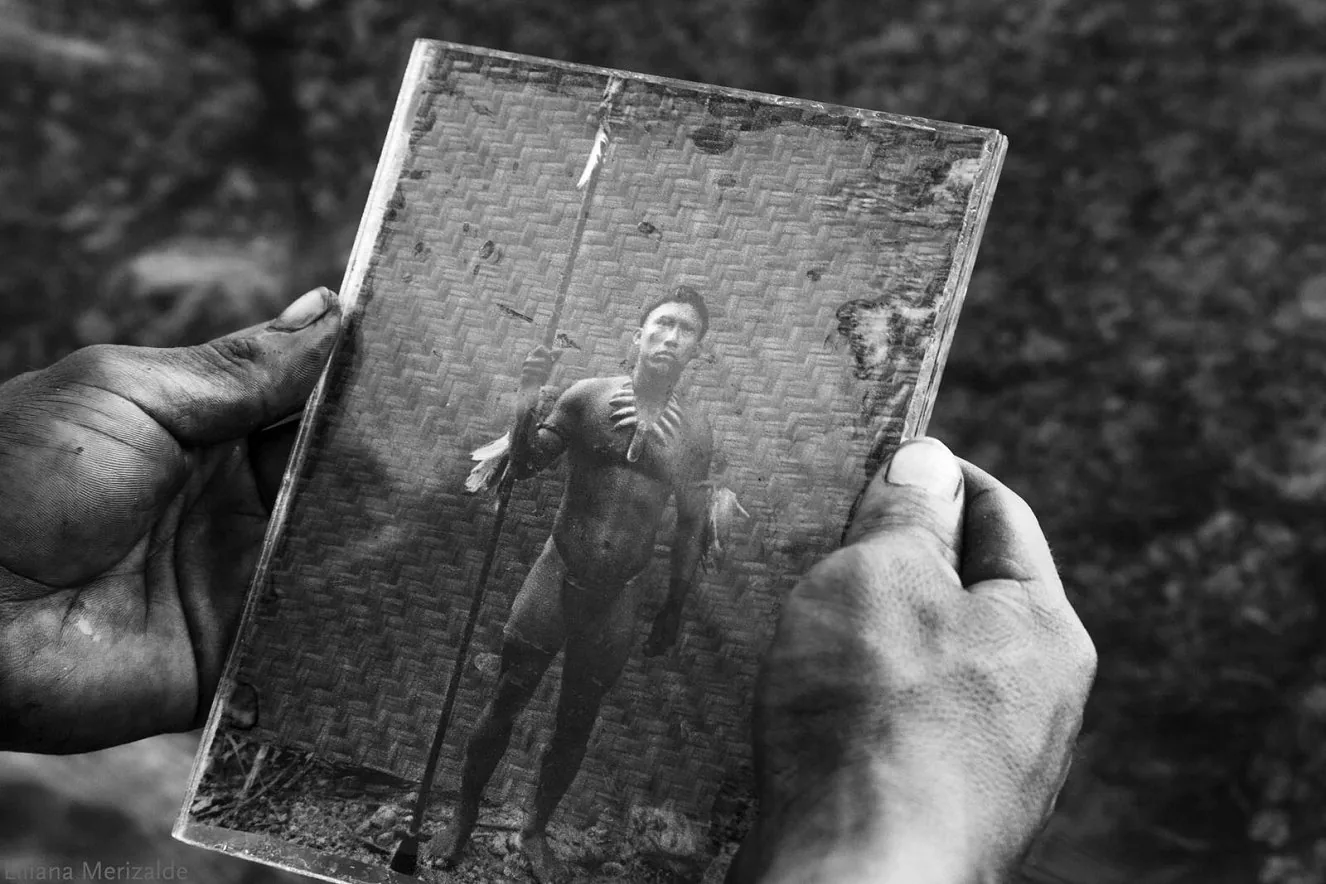
In Flusser’s vision, contemporary humanity, surrounded by technical images, appears disoriented in comparison with archaic humans and their cave art4. As if, by dint of over-investing the plane of representation, humanity had lost all contact with the world. I found a reflection of this kind at work in the film Embrace of the Serpent, made in 2015 by the Colombian director Ciro Guerra. In this film, two narratives mirror each other across time, staging two Western explorers — Theodor Koch-Grünberg in 1909 and Richard Evans Schultes in 1940 — in their interaction with the same local guide, Karamakate, young in 1909 and already old in 1940, a native inhabitant of the Amazonian regions. In this fiction inspired by historical figures, the Indigenous people call the white men chullachaqui, a word designating ghosts reduced to the image of themselves, frozen in an “all-symbolic” that prevents them from dreaming5. Humans who have become image, like the silhouettes these Indigenous people saw in the photographic prints displayed by the explorers. In this film, the capture dispositifs — the medium-format analog cameras brought by the Westerners — play a central role.
Immersed in this atmosphere, I went to the Musée des Arts et Métiers in Paris, equipped — in my turn — with my camera, determined to photograph historical optical dispositifs. I was also interested in the uses of viewing instruments as measuring tools, such as theodolites and photogrammetry dispositifs — and methods. I was able to take numerous shots — some of which would make it possible to build photogrammetric models — of various emblematic dispositifs kept in the museum6.
Toward the end of my visit to the museum, I was struck by the presence of Foucault’s pendulum. This imposing instrument, which demonstrates through its functioning the rotational movement of the Earth — and therefore its subordinate position in the hierarchy of the universe — was installed at the heart of the Romanesque chapel attached to the museum, lit by the light passing through the stained-glass windows, at the center of a space structured by the ribbed vaults of an ambulatory heralding the Gothic. This triumphal — brutal — unnuanced staging, like a coup de grâce dealt by science to religious feeling, aroused a strange feeling in me.
With all the visual material gathered at the museum, I wished to materialize, within a video, the dialectic between images and words that had so fascinated me in Flusser: this struggle between images and words, both of which he conceives as visual symbols. I did not know, at the time, that the very making of the video would lead me to qualify the Flusserian proposition, which turned out, in the end, to be too symbolic, without any real material anchoring — an anchoring that I would precisely find again in the final video, where colored forms emerge, replace one another, crack, melt and restructure themselves in a dynamic that seems to me to refer insistently to the material genesis — and destruction — of symbols, to their pre-symbolic existence, to the primacy of their objecthood over their interchangeable role within the code.
At the end of the phase of shooting and building the photogrammetric models, I had at my disposal a small library of heterogeneous video sequences, which would constitute the raw material of the final video:
- Sequences built from the photographs taken at the CNAM, placed in succession by means of long, highly plastic transitions, in which each still image deforms, cracks, and progressively takes on the appearance of the next.
- Sequences made up of blocks of text following one another according to the same type of transitions. These texts seem to dissolve and re-emerge transformed, out of a colored magma.
- Sequences derived from the 3D models of the CNAM’s optical dispositifs, built by photogrammetry from the still images. These sequences result from the movements of the virtual camera inside the 3D modeling software.
- Archival images found on the web, showing members of an Amazonian people (the Taulipang, today Taurepang), in Brazil, carrying out various activities. These images were captured in 1911 by the German explorer Theodor Koch-Grünberg, a historical figure staged by Ciro Guerra in his film.
The confrontation of these images would be structured by the algorithm, which would extract, from the various base sequences, video fragments intended to be superimposed on one another within the frame. The algorithm assigned to each fragment, semi-randomly, a position as well as a rather saturated dominant color (red, green, blue, white, black or gray). The system also provided for synchronization with sounds, triggered by the appearance of each block. A great number of “runs” were needed in order to harvest a few interesting sequences, which were then edited in a traditional way. Although it consisted in the temporal organization of sequences generated by an algorithm, the final edit remained, in this project, a human affair.
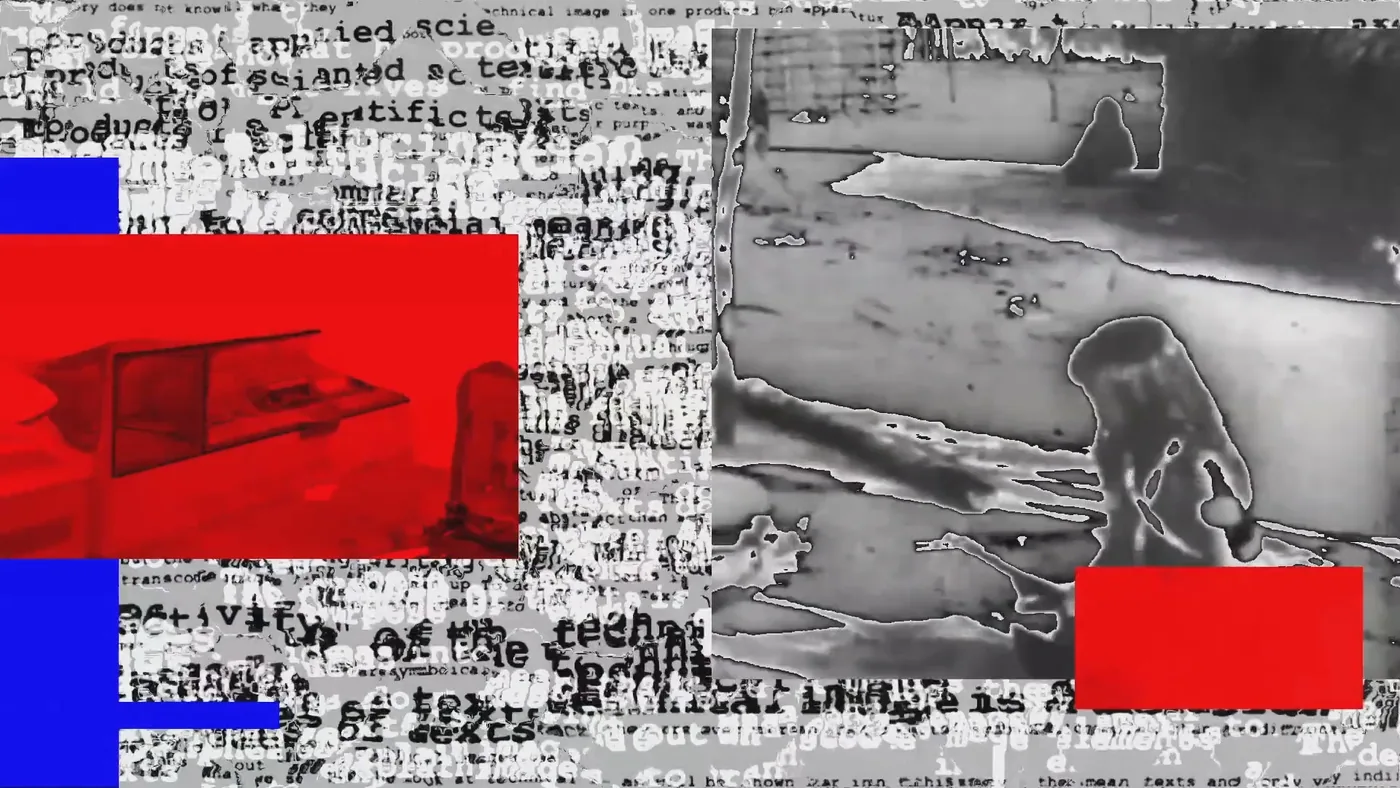
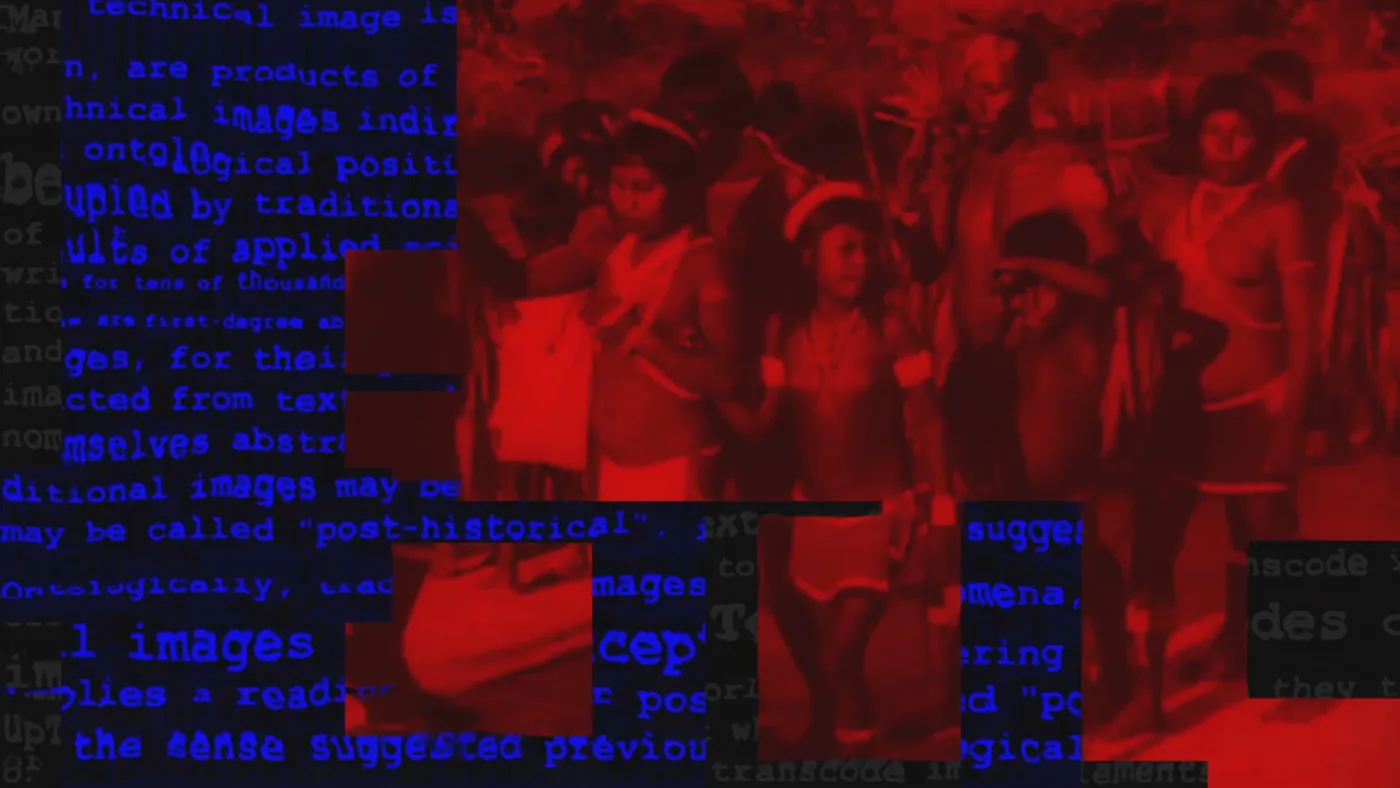
In the final version of L’inter-code, I discovered, in addition to the “conflict” initially sought between images and texts, another confrontation taking shape: one that pitted modern apparatuses, machines, against an original version of the human, living in a different relationship to technology. The whole was inscribed in a visual register far more “plastic” than expected. The sequences showing the Taulipang sometimes appear as the visions of a primary — original — background, an anthropological repressed from which the spectator has the impression of gradually moving away, as hallucinatory symbols — texts and images — and technical dispositifs pile up, filling a frame that has become a territory under tension.
L’inter-code ultimately turned out to be the only completed project associated with the use of this video collage system.↩︎
Originally written in German, the essay was translated into French by Jean Mouchard in 1996, and published by Éditions Circé.↩︎
To picture this era, I think of cave paintings, of Lascaux, etc.↩︎
Flusser’s thought resonates with Jean Baudrillard’s hyperreality, as well as with the at once terrifying and fascinating imaginaries that emerge from films such as the Wachowskis’ The Matrix (1999), Ridley Scott’s Blade Runner (1982), or David Cronenberg’s Videodrome (1983).↩︎
The trailer of the original version foregrounds these words of Karamakate: “I once dreamed of the spirit of a white man. He was sick, he could only be saved if he learned to dream. But he couldn’t manage it.” Web link: https://www.youtube.com/watch?v=_wpLSqWL4kE, accessed 24 March 2025.↩︎
In L’inter-code, we see, in order of appearance: an astronomical ring, by Dollond, 18th century; another astronomical ring, by Jean Langlois, 18th century; a Chinese compass, 19th century; a surveyor’s instrument, by Marolles, 16th century; mathematical tools for astronomers and engineers, 18th century; astronomical calendars; the first cyclotron, by Joliot-Curie, 1937; a photographic theodolite, by Bridge-Lee, 1890; the photogrammetry camera of Aimé Laussedat, creator of the method, 1890; modern cameras: Eclair-Lux, 1950, by Coronet; Folding, 1930, by C.F. Foth & Co; Super Ikonta 530/15, 1936, by Zeiss Ikon; Reflex Exakta B, 1935, by IHAGEE; Foca, 1945, by Optique de Précision de Levallois; Contax Ia, 1935, by Zeiss Ikon.↩︎
Cite this pageCórdoba, Pablo-Martín. “L'inter-code (2017)”. In Making Digital Images in the Light of Experimental Cinema — Anthropological and Political Resonances of Algorithms in Contemporary Art, Doctoral thesis in visual arts and photography, Université Paris 8 Vincennes-Saint-Denis, Doctoral School EDESTA (no. 159), research unit AIAC, 2026. https://www.pablomcordoba.com/thesis/l-inter-code-2017/