1.4.3
New Territories
If a form of transcoding is at play between the analog avant-garde films mentioned and their associated paper notations — since notations involve a transformation from the domain of time to that of space —, with the digital, transcoding reaches new heights. Indeed, in the digital, sound can easily be transformed into image — and vice versa —, text into image, and so on. Likewise, still images can be transformed into moving images, or the reverse, just as when Peter Kubelka and Paul Sharits hang their “films” (temporal objects) in a (fixed) pictorial configuration. In this dynamic, in which forms change regime, new places emerge in the digital that can serve as a support for what we have called human inscriptions.
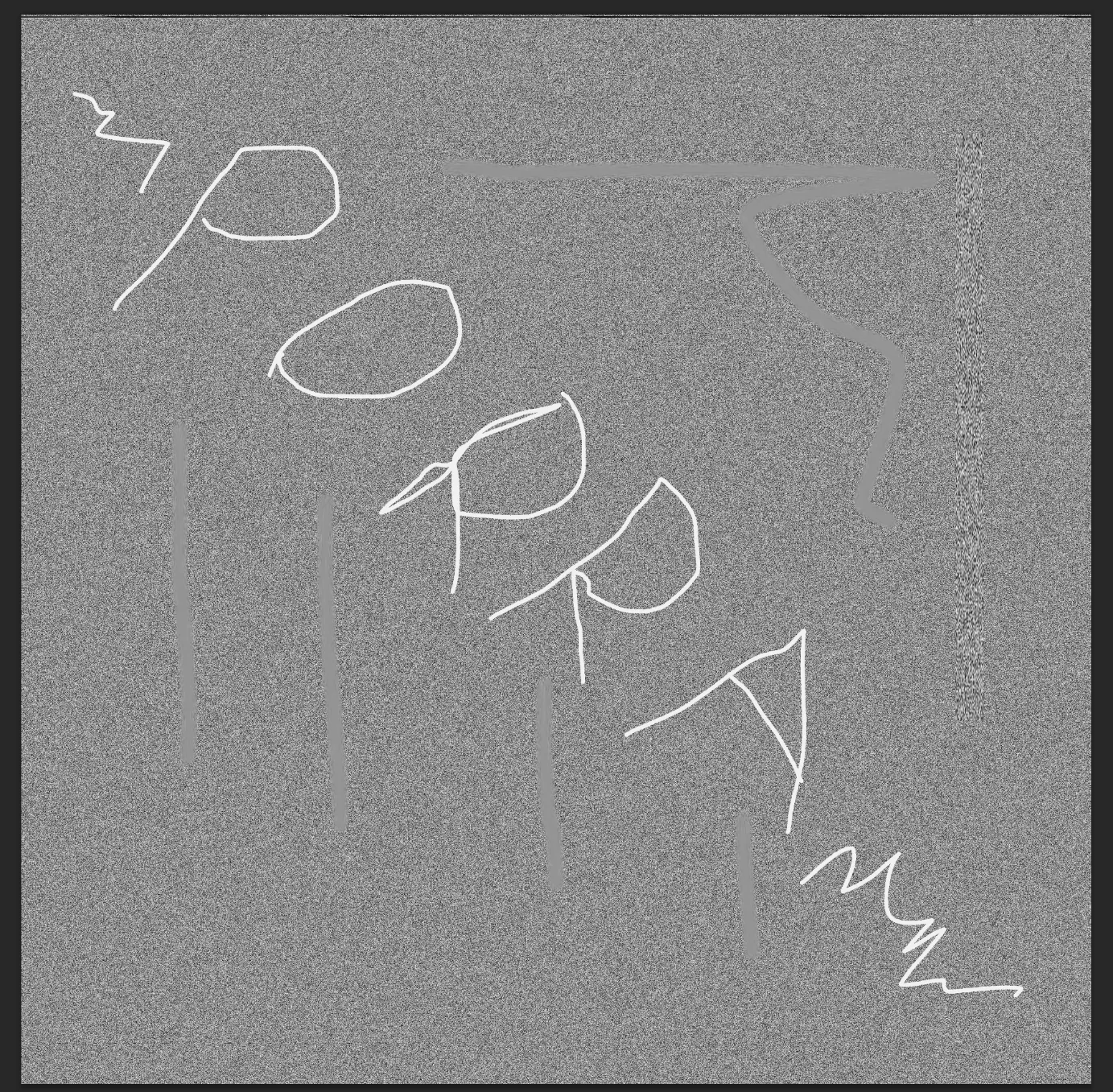
The artist Rodrigo Faustini catalogued television excerpts showing the Brazilian press illegally using personal recordings of former president Luiz Inácio Lula da Silva1, with the aim of compromising him judicially2. Through a politico-media gesture, Faustini transformed this video material by databending into an image in PNG format, on which he inscribed an improvised message (Figure 23) expressing an insult in Portuguese3. The still image thus altered was then (re)transcoded in the form of a video, giving rise to a short film entitled Dissimulados (2016)4. Here we find a notation, very simple to be sure, but radical, inscribed not on the temporality of the work itself (as could have been the case with Paul Sharits’s film T,O,U,C,H,I,N,G, among many others), but on a transcoded version of the work.
l0.5
Human inscriptions can be defined in another way by saying that they are images whose origin is the hand of the person who makes them. The hand can write, of course, but it can also simply choose. Writing itself can be understood as the permanent choice of a path (that of the pencil, of the pen) in a two-dimensional space5. This is not a choice among a limited number of possibilities, as is the case with the logic of selection which, in new media, would replace authentic creation according to Lev Manovich6. On the contrary, what is at stake here is a choice among virtually infinite possibilities, within a hyperdense and multidimensional domain generated by a system set up by the artist.
It is from this perspective that we can approach what constitutes notations for Barbara Lattanzi. Indeed, the artist produces moving and still images by means of algorithms that she designs and codes herself, but at certain moments, when the system rushes off in unknown directions, Lattanzi imposes a pause7. She then chooses images among those generated to create diptychs (Figure 24) or polyptychs that help her understand, take time, see the work from a new angle. These diptychs share their analytical role with Rose Lowder’s notations and with Bill Brand’s diagram for his film Moment. In Lattanzi’s words:
My use of notation is not a process of making marks on paper; it is not writing and it is not drawing. Rather, it is a process of screen-capturing. I make these screen-captures of the graphical output of my generative software in order to slow myself down, to distance myself from coding, and to reflect on the work in another way. More importantly, the screen-captures are assembled as juxtapositions within diptychs (or larger sets). These diptychs constitute a technique to help specify and focus on the interesting conceptual problems8.
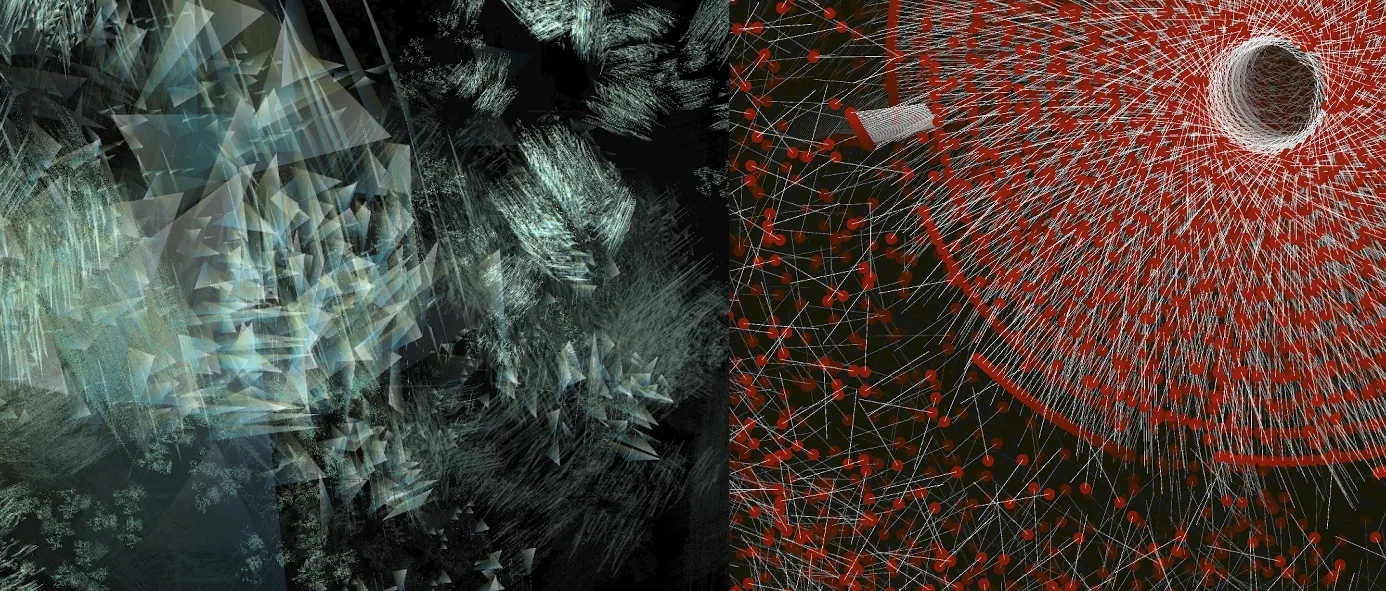
These notations by Lattanzi, produced by screen capture and the arrangement of images into diptychs, thus become detached from the work in progress; in this sense, the work itself can be considered their space of inscription.
Along the same lines, we can mention a proposal by Rosa Menkman, an artist whose images are traversed by multiple and diverse textual expressions (narrative, historical, analytical). In HOW NOT TO BE READ from 20159, Menkman proposes a protocol for encrypting a message inside an image, by diverting the principles of the compression process, notably the DCT (Discrete Cosine Transform). The notation, understood here as a human inscription, is produced by following a process that inscribes it “inside” an image, the message being legible only with the help of a decryption system.
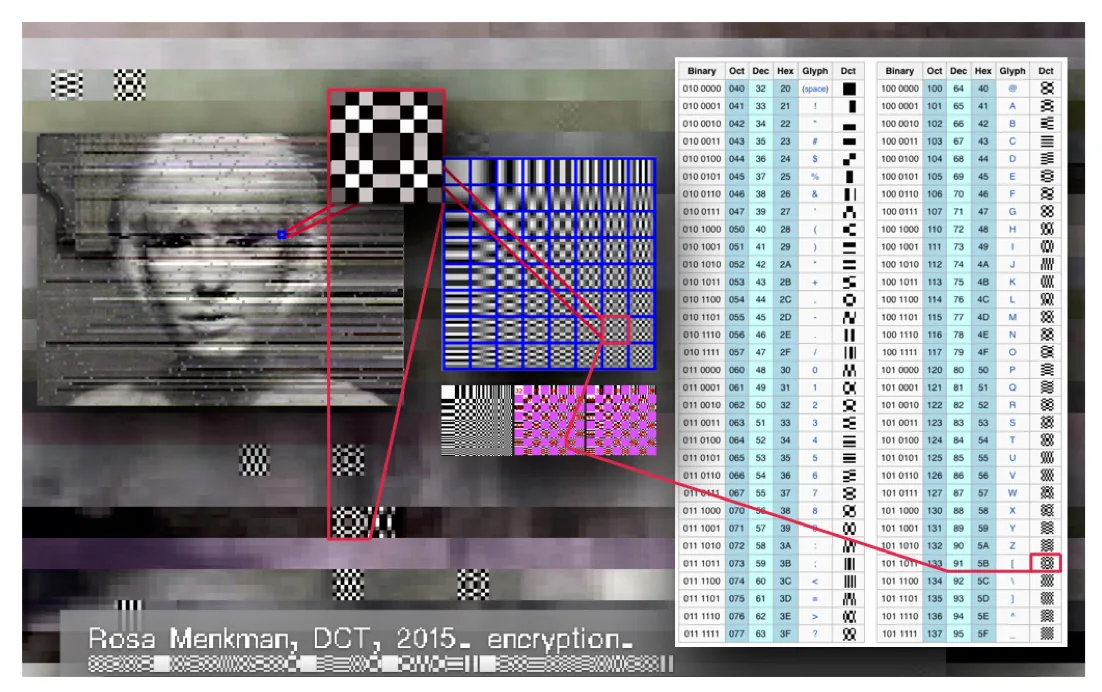
These approaches bear witness to the digital as a medium in which the times and spaces capable of hosting human inscriptions multiply: the transcoded work (Faustini), the work in progress (Lattanzi) or images capable of hosting encrypted inscriptions (Menkman). These inscriptions can follow an analytical logic (Lattanzi), give meaning to the work (Menkman) or act as a gesture that directly modulates the plasticity of the digital image (Faustini).
After two terms, from 2003 to 2010, Lula was re-elected president of Brazil in 2022 and took office on January 1, 2023.↩︎
This type of media operation, applied at the same time and according to the same mechanisms in several Latin American countries, has become known as lawfare.↩︎
The word in question is porra, a vulgar way of designating semen in Portuguese, also used as an expletive (“fuck!”), like the word “shit” in English.↩︎
https://vimeo.com/191670975 accessed 6 September 2024.↩︎
This evokes the Simondonian conception of movement, which is already image — here, in a very broad sense — before the emergence of perception and even before the appearance of consciousness. See on this subject Gilbert Simondon, Imagination et invention: 1965-1966. 1re édition. Paris : Presses Universitaires de France, 2014, p. XXVI and XXVII.↩︎
Lev Manovich, The language of new media, op. cit., p. 124.↩︎
In a vocabulary borrowed from Bernard Stiegler, which we will consider toward the end of the thesis, we can say here that, faced with her algorithm, which tends toward light-time, Lattanzi imposes, with her notation (which is a trace), a differing time.↩︎
This paragraph is an excerpt from exchanges with the artist in December 2020, reproduced here with the author’s permission, in the original English.↩︎
Which pays tribute to Hito Steyerl’s work How Not to Be Seen (2013).↩︎
Cite this pageCórdoba, Pablo-Martín. “New Territories”. In Making Digital Images in the Light of Experimental Cinema — Anthropological and Political Resonances of Algorithms in Contemporary Art, Doctoral thesis in visual arts and photography, Université Paris 8 Vincennes-Saint-Denis, Doctoral School EDESTA (no. 159), research unit AIAC, 2026. https://www.pablomcordoba.com/thesis/new-territories/