5.3.1
Breaking the Panopticon by Hand
Benjamin Gaulon ventured into an exploration of facial recognition algorithms in order to divert them in his project Face Glitch (2014). This project alters the functioning of digital cameras so that they provide images in which the filmed faces appear “glitched,” that is, covered by a rectangle inside which the colors of the pixels are altered, making any use of the image for facial recognition purposes impossible. A visionary project, Face Glitch anticipates the tensions between individuals eager to protect their anonymity and a political power that does everything to individualize them.
The concealment of the face carried out by Gaulon within digital images aimed to extend, on screens, the possibilities that individuals enjoyed during demonstrations in public space. Indeed, they could cover their faces with, for example, a scarf, notably to protect themselves from the effects of tear gas. Yet it is precisely this last freedom that was abolished in 2019, when concealing one’s face during demonstrations became an offense1. Not content with this, the control dispositif had, like Bentham’s panopticon, to articulate the total visibility of the “subjected” with the absolute invisibility of the agents of power. Thus, in 2020, the French government introduced the “global security” law (loi de sécurité globale), which extends the legal framework of surveillance while prohibiting the dissemination of images showing identifiable faces of police officers on duty2.
This in turn inspired Gaulon to develop the project Global Security (2020), which comprises a photographic series of images taken during the 2019 demonstrations in France, with the faces of the police officers “glitched.” By this means, the artist pretends, with humor3, to comply with a law that, in addition to running counter to freedom of expression, accentuates the imbalance between the repressive power of the government and popular power.
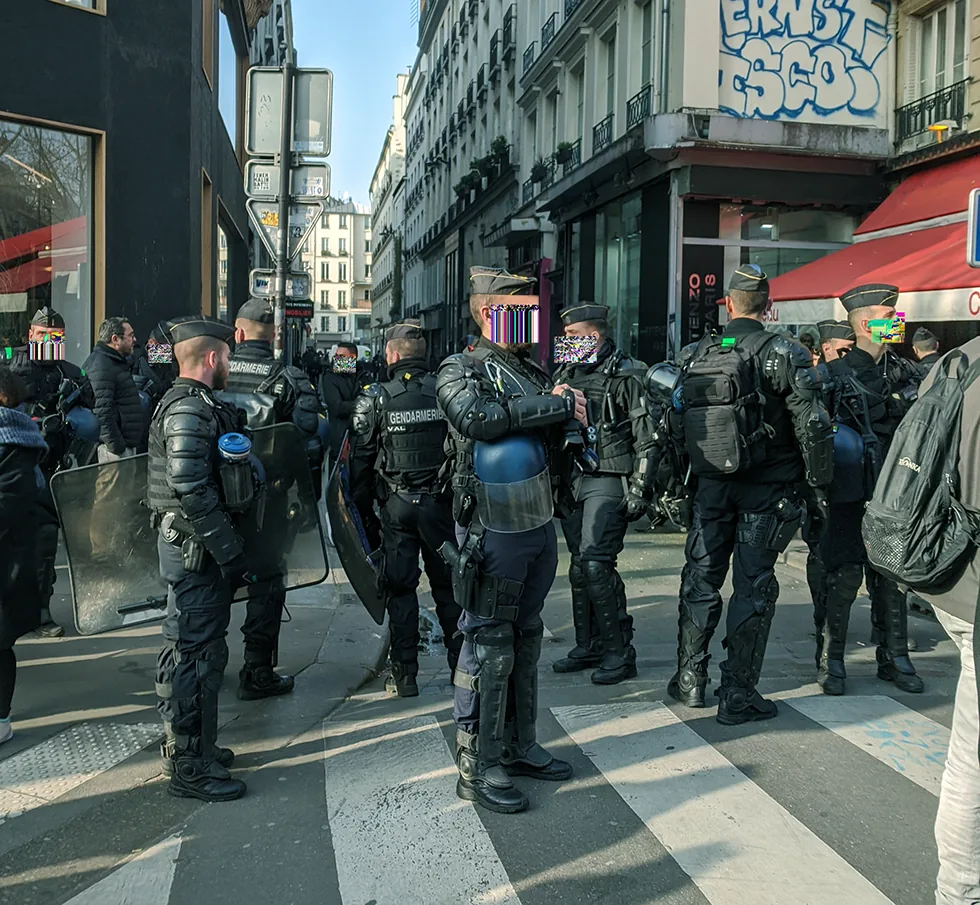
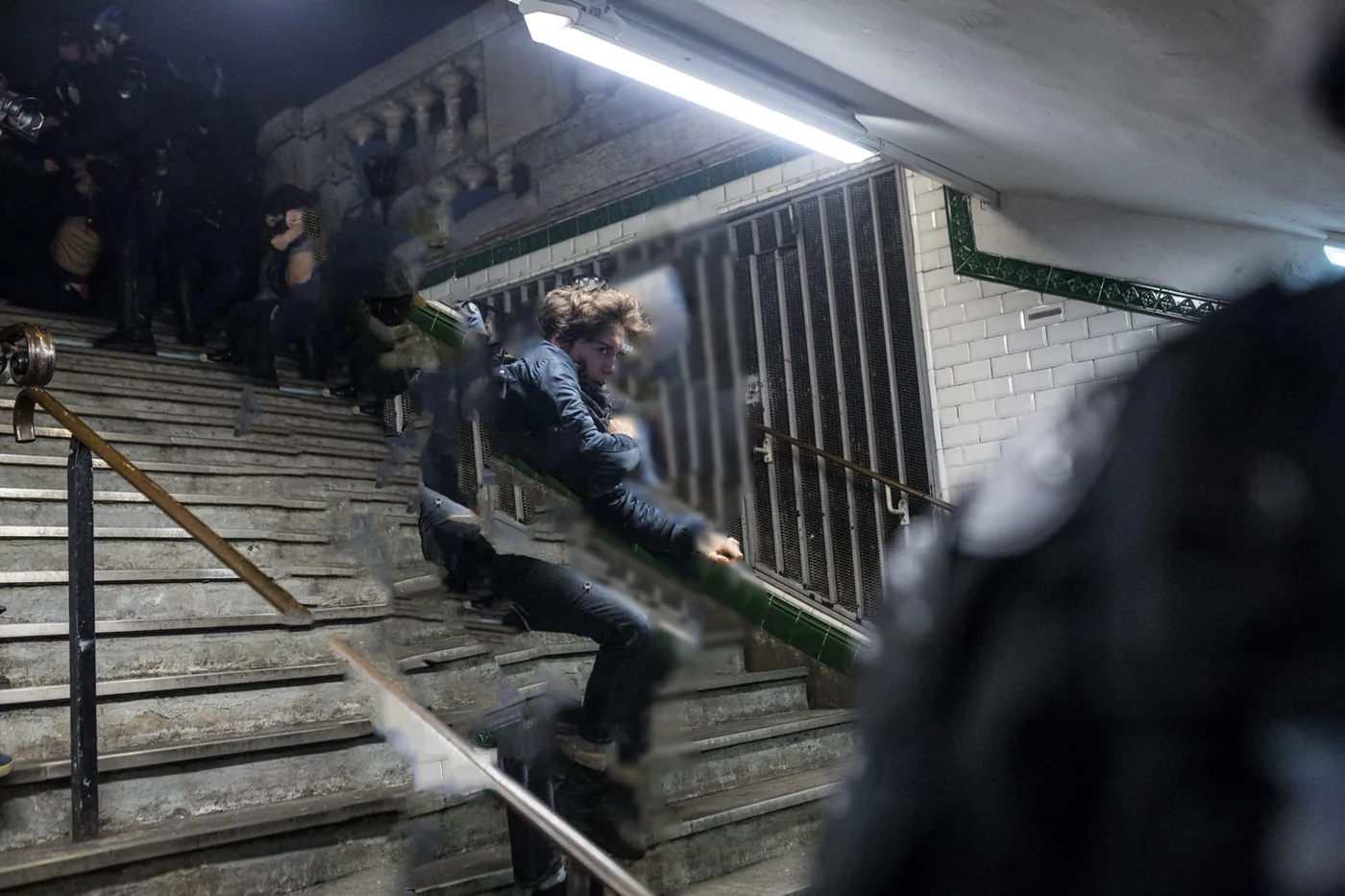
As in Face Glitch, Global Security rests on an appropriation of the algorithmic tool in order to inscribe it as a material means in a free approach, so as to divert it in the course of an open experimentation, in resonance with the artisanal aspect as it appears in Adorno. The project recalls that of Thierry Fournier, La Main invisible (2020), in which the bodies of officers involved in scenes of violence are completely erased from the images by manual digital retouching4. Often concealed in commercial digital imagery, the retouching is left absolutely evident in these images by Fournier, who does not seek to erase the traces of a gesture that, by remaining visible, loses none of its effectiveness.
Face Glitch, through artisanal algorithmic intervention, introduces a malfunction into one of the most disquieting mechanisms of surveillance, facial recognition, while Global Security and La Main invisible express a refusal of the disappearance of the image as a witness of the real, while evoking legitimate techniques of circumvention in the face of laws of doubtful relevance in a genuinely democratic framework. If, according to Foucault, a dispositif is defined as a resolutely heterogeneous and strategic ensemble5, aimed at “a certain manipulation of relations of forces6,” these works manage to reveal the undeniably heterogeneous and strategic character of the current biopolitical dispositif. The latter seeks to shift relations of force by associating a legislative push with technological developments, thanks to which new forms of repression are legitimized. Visible or not, the project of manipulation implemented by power, founded on the technological element, is unveiled through the prism of these works, thanks to strategic counter-manipulations that affect algorithms and images. All this in a DIY (do it yourself) atmosphere: these are low-tech manifestations within the high-tech, renewed expressions of contemporary craft.
Article 431-9-1 of law 2019-290, in force since April 12, 2019, https://www.legifrance.gouv.fr/codes/article_lc/LEGIARTI000038382669, accessed December 1, 2024.↩︎
This law legalizes the carrying of weapons off duty by police officers, makes possible the deployment of drones with on-board cameras (including during demonstrations) and facilitates the exploitation of surveillance images from body-worn cameras. URL: https://www.lemonde.fr/societe/article/2021/04/15/les-principaux-articles-de-la-loi-securite-globale-definitivement-adoptee-par-l-assemblee-nationale_6076884_3224.html, accessed December 1, 2024. The offense of inciting the identification of police officers or gendarmes was struck down by the Constitutional Council in May 2021.↩︎
In this, Gaulon’s project bears witness to a register different from that of Paolo Cirio, an Italian artist who staged, in his installation Capture (2020), images of the faces of police officers on duty, in a project that provoked an online reaction from Gérald Darmanin, then Minister of the Interior. See on this subject Jean-Paul Fourmentraux, «Œil pour œil : L’art contre la technopolice: Autour de Paolo Cirio, Capture, 2020 ». Appareil [en ligne]. 2023, vol. 25.↩︎
Understood in its opposition to automatic retouching.↩︎
Michel Foucault, Dits et écrits. Tome III : 1976–1979. vol. 3. Paris : Gallimard, 1994, p. 300-301.↩︎
Ibid., p. 300.↩︎
Cite this pageCórdoba, Pablo-Martín. “Breaking the Panopticon by Hand”. In Making Digital Images in the Light of Experimental Cinema — Anthropological and Political Resonances of Algorithms in Contemporary Art, Doctoral thesis in visual arts and photography, Université Paris 8 Vincennes-Saint-Denis, Doctoral School EDESTA (no. 159), research unit AIAC, 2026. https://www.pablomcordoba.com/thesis/breaking-the-panopticon-by-hand/