4.6
Glitch Capitalism
On three screens, placed side by side, we are confronted with sequences of images that follow one another abruptly. Behind the scenes, an algorithm automatically selects video streams from among the most pirated on the BitTorrent P2P protocol and sends them, without detour, successively to the screens. Since the image’s compression logic is not restored for each fragment, the transition between them takes place through tears and brutal freezes, resolved by strident glitches.
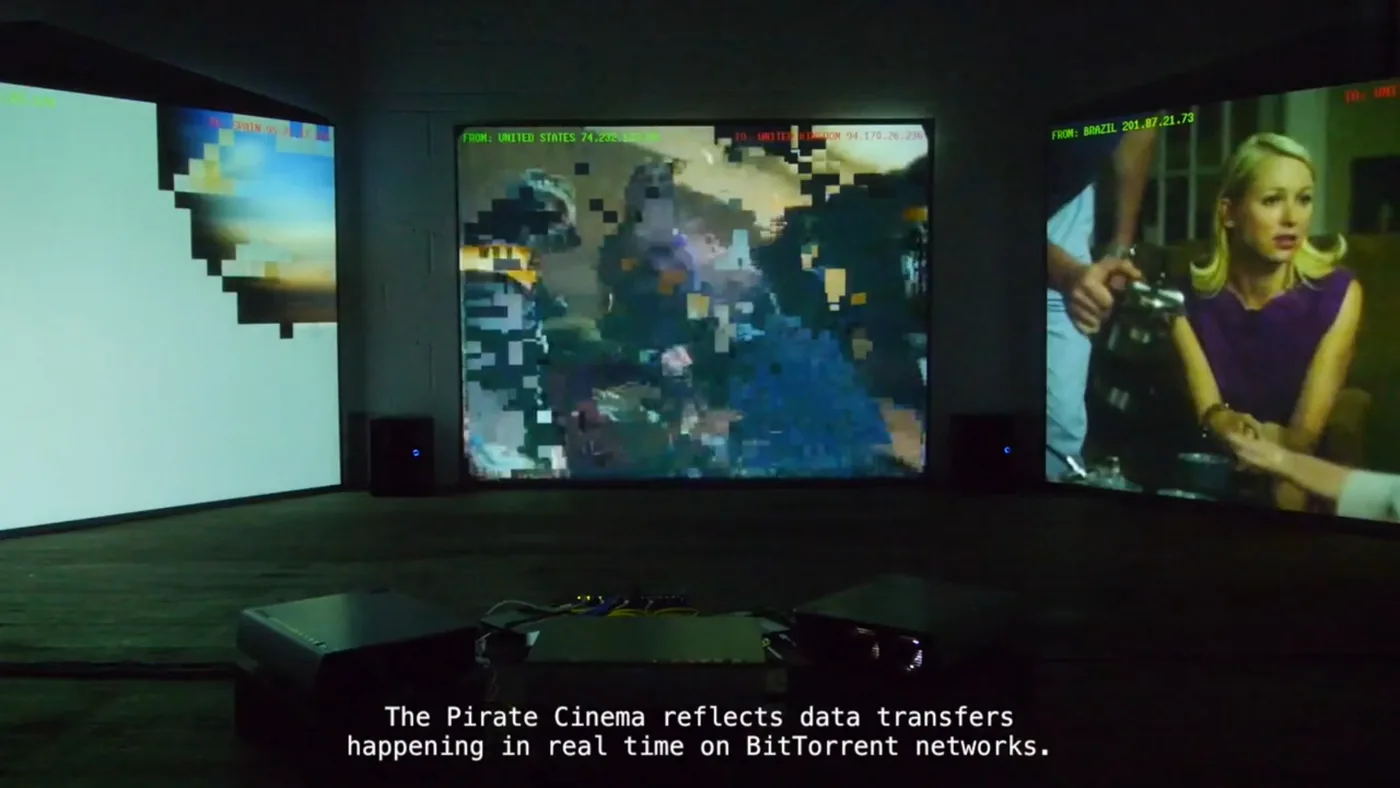
The dispositif brings together, at the site of the installation, shreds of video streams, pirated commodities of the entertainment industry: music videos, pornographic films, action films, thrillers, series, and other temporal objects intended for mass consumption. Torn from their narrative chain, these images reveal a form of fragile and calculated plasticity. Hollow – because highly compressed – prepared for transmission and not for rendering, these video fragments engender, within the installation, an audiovisual din from which a form of the sublime emanates. We sense the failing signal as it slides over the hypermaterial support, offering a glimpse of energy in its raw state, as if nature were managing to express itself through the many layers of technological mediation.
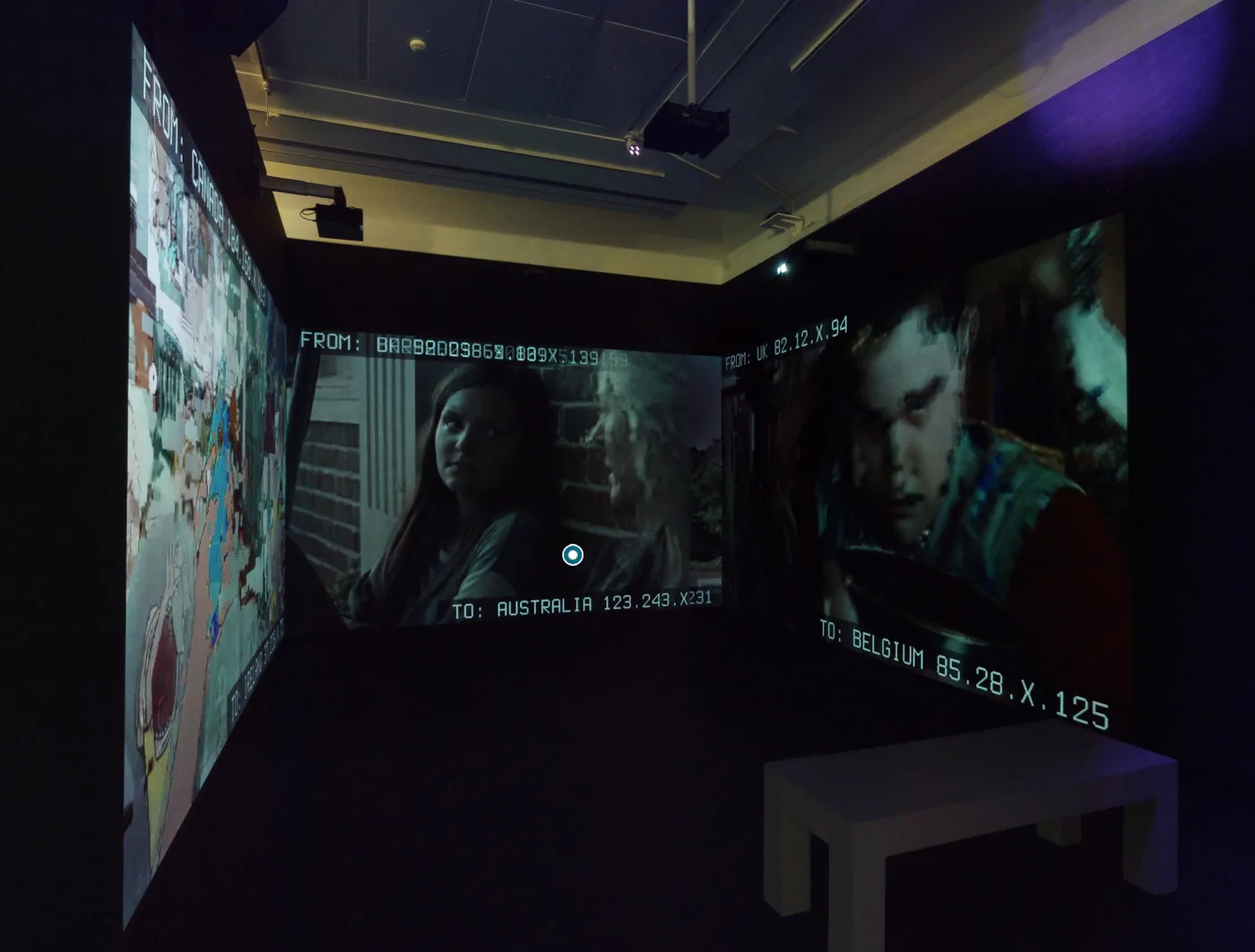
The disruptive staging at work in The Pirate Cinema makes perceptible the mode of existence of the technological element, in which digital streams are cut into pieces — chunks — in order to optimize sharing, transposing to the transmission process the fragmentation of data already effective at the level of the storage support1. This functioning is made possible by the random access that the computer allows. In this system, which pushes matter to its limits, failures of the signal and/or the support generate glitches whose effects overflow the surface of the screen, their repercussions spreading on the macro scale and disruptively affecting economic and social dynamics (glitch capitalism).
Lev Manovich had already proposed a form of transfer between the functioning of the computer and cultural dynamics. He distinguishes two layers: the computer layer, on the one hand, and the cultural layer, on the other. The first, the site of process, packets, operations, functions and variables, interacts with the cultural layer, a space of objects such as encyclopedias, stories and compositions2. The aesthetics of the database, like the notion of hypermedia, can be understood as cultural recontextualizations of the operating principle of computers (systematized data storage, the separation between algorithm and data, etc.)3. The Pirate Cinema seems, however, to deepen the description of this transfer – micro/macro, technics/culture – which, in Manovich, remains confined to the level of the symbolic layers.
Indeed, Disnovation.org’s work poses the question in more fundamental terms: how does the agency of the hypermaterial express itself in the world as we live it? These hypermaterial malfunctions, the logical counterparts of attempts at hyperoptimization pushed to their limits – temporal, spatial, material – lead to overloads that are resolved in uncontrollable ways. These seem to spread from the dynamics of digital supports to the very functioning of society, giving rise to what has been described as glitch capitalism4. Thus, the errors arising from algorithms, which overheat matter by forcing it, resonate with the disruptive action of certain contemporary actors who have learned to overload the system’s capacities to their advantage – whether in the judicial, penitentiary, financial5 or informational spheres – in a process that today threatens the very functioning of Western democracies6.
Fragmentation on HDDs, dispersion of blocks or optimized distribution of data on SSDs.↩︎
Lev Manovich, The language of new media, op. cit., p. 46.↩︎
Ibid., p. 47.↩︎
The notion was proposed by the investigative journalist Malcolm Harris in Malcolm Harris, Glitch Capitalism: How Cheating AIs Explain Our Stagnant Present [en ligne]. April 2018. disponible à l'adresse : https://nymag.com/intelligencer/2018/04/malcolm-harris-on-glitch-capitalism-and-ai-logic.html. Glitch capitalism was also the subject of a publication by Disnovation.org as part of the project Profiling The Profilers (2018-2019).↩︎
The very recent affair of the $LIBRA cryptocurrency appears as a glitch that lasted a few hours, during which a handful of individuals transgressively took some 300 million dollars from thousands of overly naive small investors.↩︎
See on this subject Martin Moore, Democracy hacked: How technology is destabilising global politics. Paperback edition. London, England : Oneworld, 2019.↩︎
Cite this pageCórdoba, Pablo-Martín. “Glitch Capitalism”. In Making Digital Images in the Light of Experimental Cinema — Anthropological and Political Resonances of Algorithms in Contemporary Art, Doctoral thesis in visual arts and photography, Université Paris 8 Vincennes-Saint-Denis, Doctoral School EDESTA (no. 159), research unit AIAC, 2026. https://www.pablomcordoba.com/thesis/glitch-capitalism/