2.2.9
A Narrative Plastic
When, in 2010, Jacques Perconte began work on his medium-length film Impressions (2012), the artist’s approach reached a stage of maturity that capitalized on 15 years of research1. Starting from an inquiry into the “digital body,” in which the human body resonated with a questioning of the materiality of digital images, the artist has always sought “ways of imprinting a physical trace on the work2.” By choosing the computer as his means of expression, Perconte set out to define his own style3 within the machine. To do so, he first had to outwit the standardized rigidity of the computer system by mistreating it:
When I started working with machines, I looked for ways of imprinting a physical trace on the work. I would twist the cables, cut them, bang on the machines in order to regain a possibility of working matter through gestures4.
It was through long experimentation that Perconte perfected his “toolbox,” which contains methods and algorithms that he exploits intensively, but from which he keeps a cautious distance: at the beginning of each project, for example, Perconte takes care to alter the structure of his algorithms5, including those that pose no operating problems. The aim is to escape “mastery” of the system, to prefigure a space capable of welcoming unexpected effects: “the pleasure comes from the fact that a little bug makes something appear – a bit of red or blue, which starts wandering around the shot thanks to the vibration of the image. Something magical then happens6.” The machine, in its capacity to generate images, is approached through its defects, which are sublimated, accentuated and controlled, one might say, in the terms of Bidhan Jacobs: “Jacques Perconte exploits and exacerbates what the industry calls the typical ‘defects’ of compression, and interprets them as degradations engendered by a succession of excessive compressions7.”
Thus, Perconte’s palette contains algorithmic tools that make it possible to affect the image in different ways:
First of all, “the block effect”: a structure recalling a square mosaic appears in certain places of the image. These are blocks of pixels that become visible because of very high compression rates. Also, “the halo effect”: fringes appear on the contours of objects, owing to an insufficient bit rate. Or again “the blurring effect”: details are less sharp, contours less marked, with trailing effects. The fourth is “quantization noise”: a snow effect arising from a local problem of analog/digital conversion contaminates the image non-uniformly. And finally, “the mosquito effect” (mosquito noise): noise appears on the transitions of moving elements, in the form of small points shimmering around shapes; it is due to quantization errors between neighboring pixels8.
Beyond the Fight Against the Machine
Although Perconte built his tools out of the errors of the image compression system, the artist himself sheds light on the nature of his approach, which can no longer be understood in terms of a “fight” within the images, or of the artist against the machine. Recently interviewed by Yves Citton, Perconte states:
It’s been more than ten years since I abandoned that language linked to destruction, to degradation, glitch, error… things that actually reduce, and that manifest forms of impossibility or insufficiency or powerlessness. On the contrary, I’ve now gone much more into stories of revelation, and for me I’m in the process of building something very positive […]9
Summarizing other fundamental remarks made by the artist during this conversation with Yves Citton, we can say that Perconte favors a relationship with his tools that goes through experimentation, outside of any pre-established knowledge. If there is a fight, it is not aimed at the machine as such, but at uses and attitudes toward computer tools. His work is situated at the level of the hic et nunc of concrete making, of an experimental manipulation that is always free, detached, and never on the plane of a reasoning that would calculate the effect of the action in terms of a predetermined result. In the artist’s words: “those tools, being used only for what they offer as a consequence [as a result], well, they cannot be creative, at any rate they cannot allow the person to create something10.”
This introspective look by Perconte at his practice illustrates and enriches one of the main questions of this research, and offers elements of an answer: can the computer system take part in artistic creation when it is used in its default modalities, without detour, without exploiting and/or introducing malfunctions into the system? Perconte does not seem to attribute an interesting creative potential to the computer unless the artist has first carried out a détournement of the logic proposed by the machine11.
What the Images Tell (Me)
In Impressions, however, the artist’s sharp critique of computer tools and their uses, like his algorithmic panoply under the sign of malfunction – compression codecs – seems to become naturalized, to dissolve behind the images of the film, which nevertheless bear its signature. The work unfolds in a timeless register, with diaphanous images that seem to struggle between the outside world and the interiority of consciousness, moving between a form of memory and immediate perception. Throughout the film we are carried by moments of tension that follow moments of calm, as volatile forms project meaning that deforms along with them.
The film remains in a prediscursive state, without this implying the absence of narrative elements: what results is a narrativity outside language, carried exclusively by the plasticity of the images, by their temporal evolution, by their sequencing. If the narration remains indeterminable in absolute linguistic terms, it nonetheless owes something to a presence and a coherence that make us think of a genuine work of plastic composition, as if it were a matter of music, but with images. These images, halfway between figuration and disfiguration, nevertheless remain far from abstraction: they seem to brush against linguistic explicitation while remaining exclusively on the sensible plane, so that each spectator lets their own subjective version of the story emerge from the images. The work gives off a narrative force that can only be illustrated, but never exhausted, in terms of language: such is the project to which the following paragraphs are devoted.
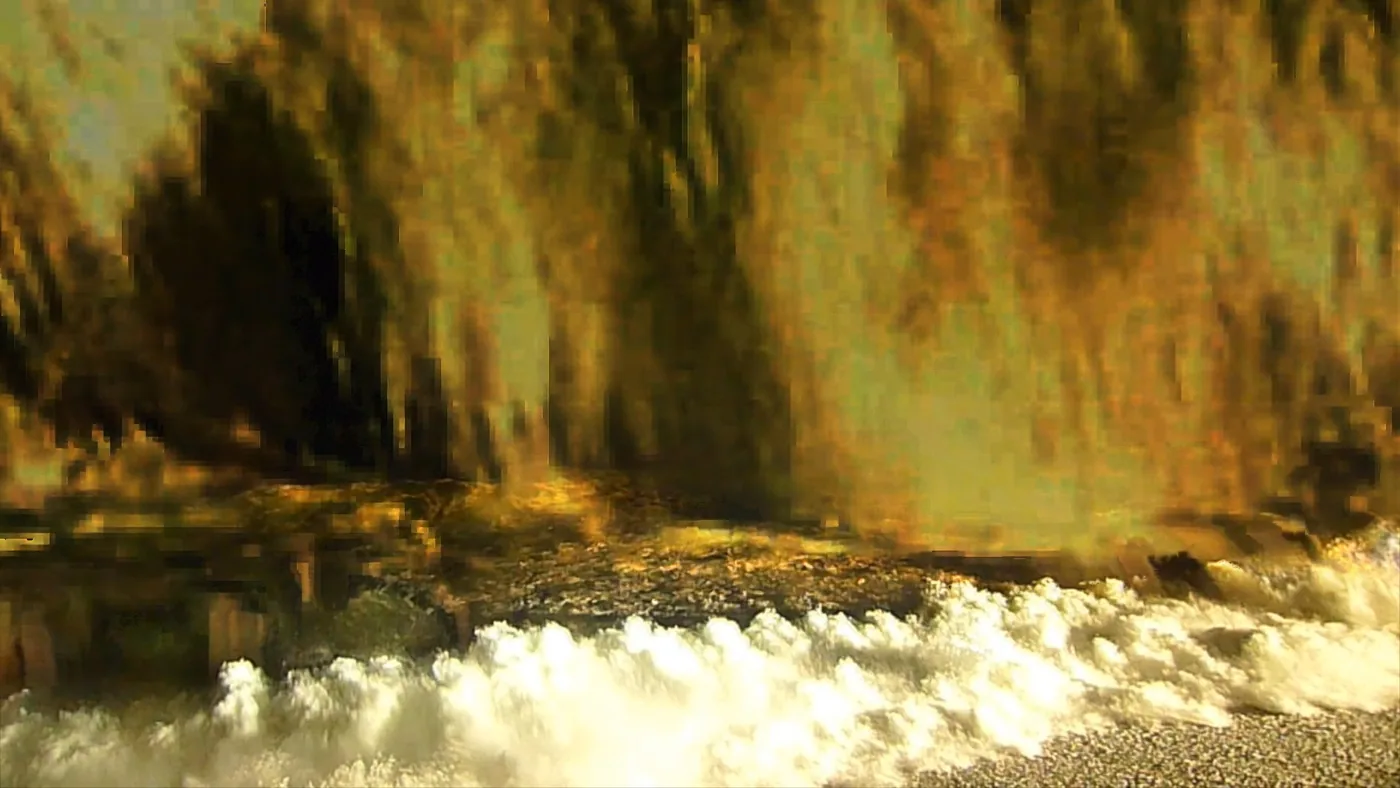
Night images of waves breaking on the beach introduce the film. These images are offered without the datamoshing manipulations characteristic of the artist, as if the dose of alteration possible on the image had been consumed at the level of the on-site staging, with an artificial lighting that deepens the black of the night. These “clean” images are accompanied at first by an ambient sound, which becomes more complex after the appearance of the title of this introductory chapter (Mystérieuse question, ~1m30s) with the addition of granular effects and instrumental sounds, while the image stages a series of zoom-ins that end up reaching the intimate structure of pixels that form the digital image. The freezing of the upper part of the image acts like a curtain suddenly closed on the waves, still in motion (~3m26s). The introduction ends with an image that freezes (~4m10s) and gives itself over to an undulating movement of pixels accompanied by the sound of an explosion, which seems to enact the collapse of perspectival representation, giving way to an image-surface made up of fluidified flat areas of pixels.
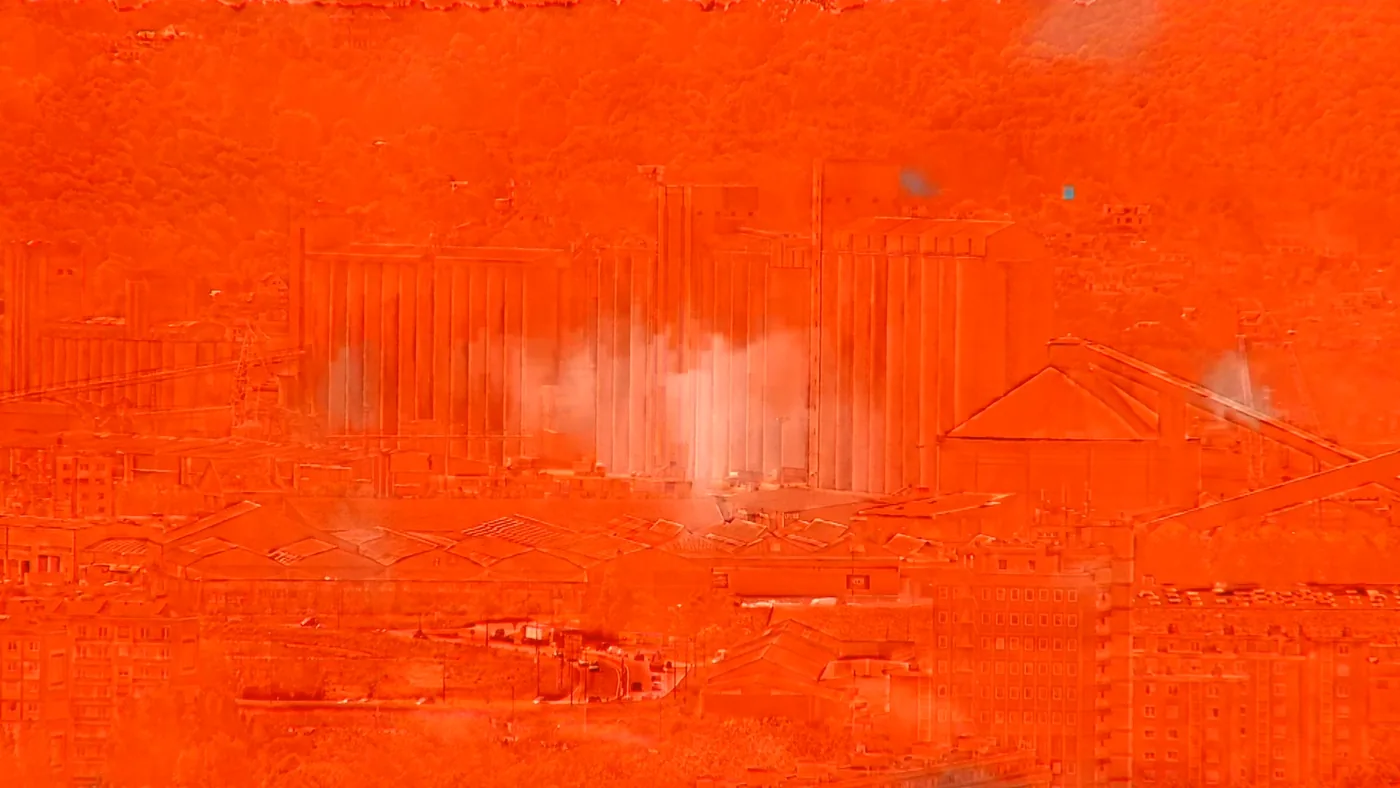
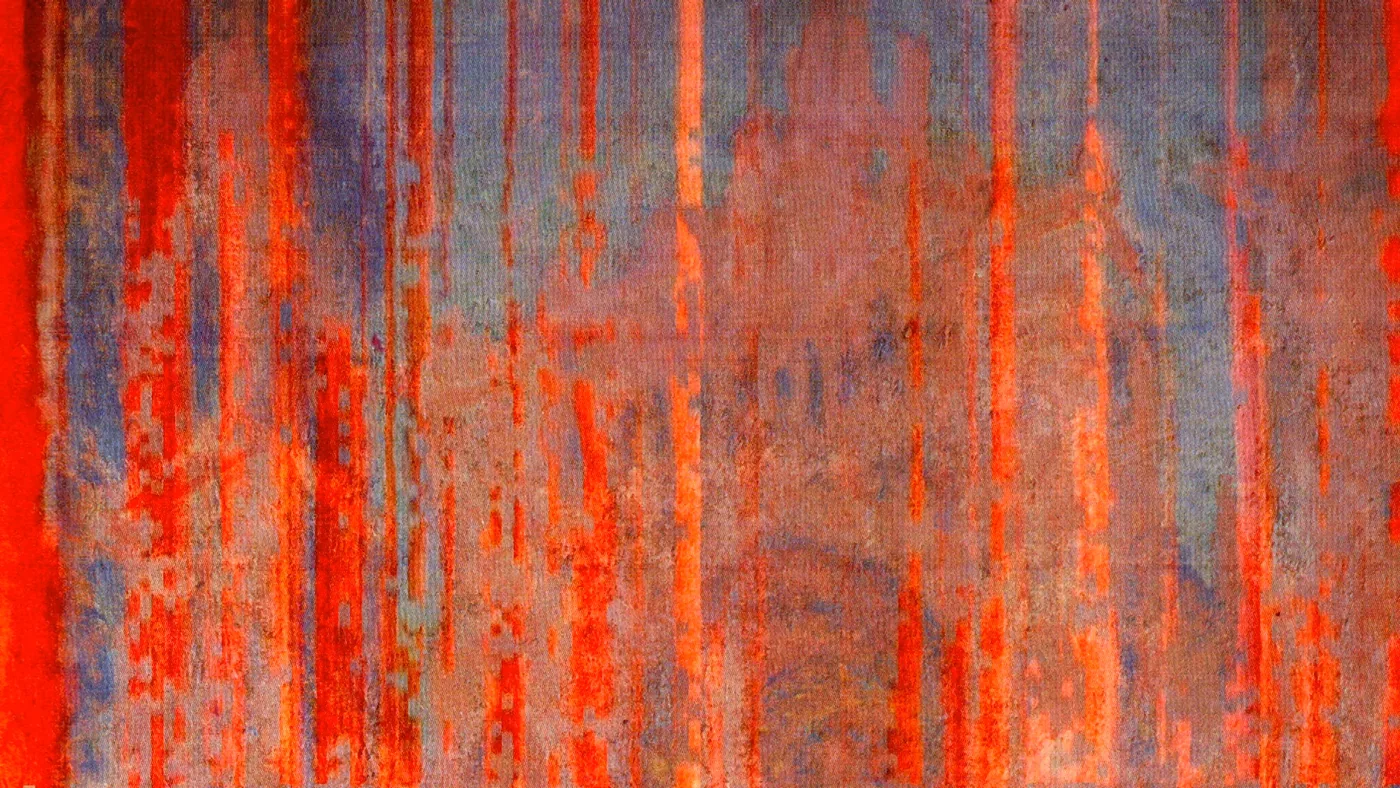
The second part of the work, entitled Médiance, introduces the dominant red color very present in the film, immersing here a periurban landscape in a fixed close shot (~6m). The image functions like a bas-relief whose fixity is altered by the slow movement of vehicles and by the smoke emitted from the factories located in the upper part of the frame (~6m40s). From a transition close to a dissolve, a close shot of a church emerges as the texture of the image evolves toward that of a canvas. The iconography here carries the visual experience toward that of Impressionist painting, recalling more precisely Monet’s studies of Rouen Cathedral, made by the painter between 1892 and 1894 while exploring the rendering of light on the walls of the building. The film’s pictorial filiation is made explicit at this moment by the straightforward appearance of one of these canvases by Monet (~8m20s), like a knowing wink to the spectator who might have guessed it. The machinic image now presents itself as a collage dominated by red, in which forms that seem hand-painted blossom, locally affected by the delicate, fluctuating movements of the pixelated flat areas.
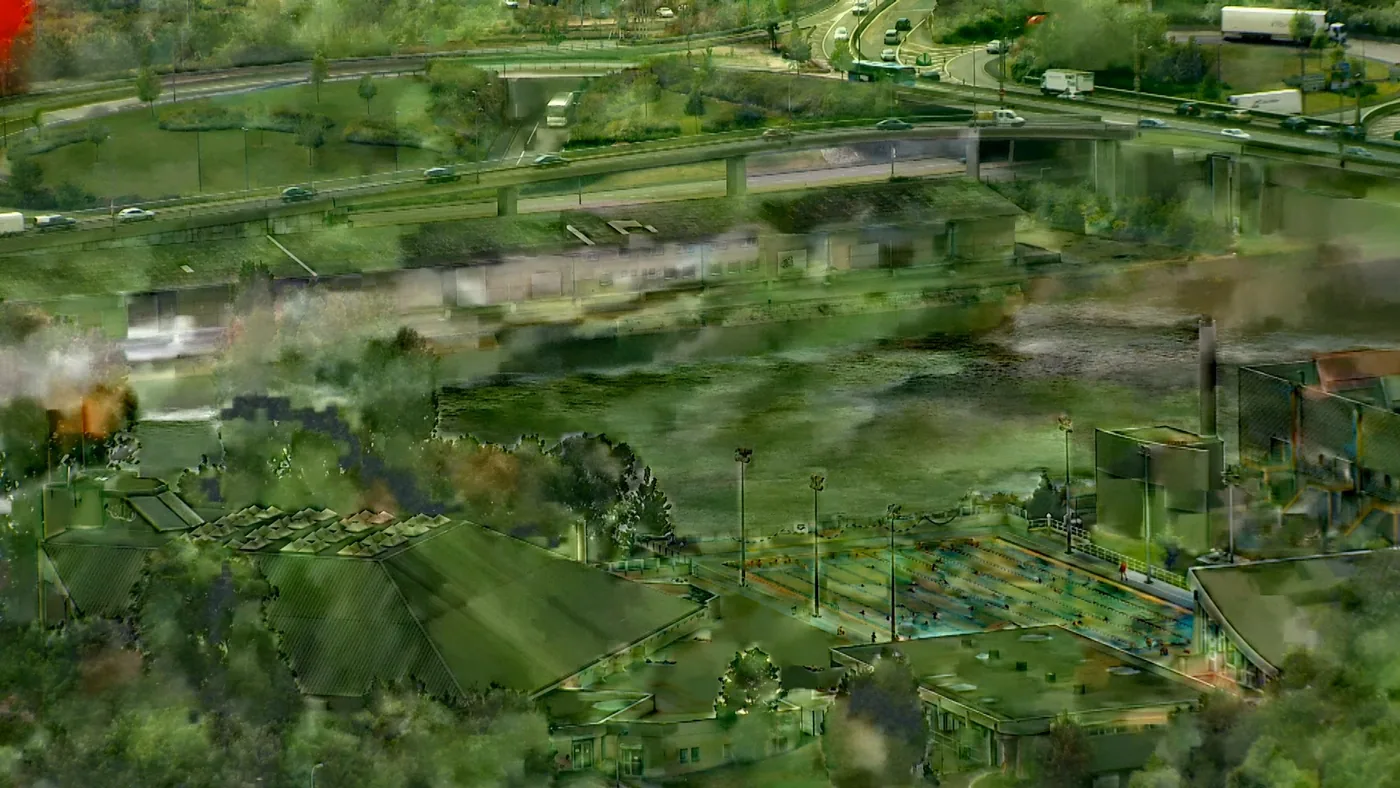
During the tenth minute, it is the dominant green that takes over, brought in by the swaying of foliage in the wind. At this point in the film, a fundamental element of Perconte’s style becomes clear, with moving elements leaving more or less lasting traces on a fixed, or almost fixed, background. Here, it is the movement of cars passing through an interchange that engraves gray traces on the fluctuating green background of the image. On the sound level, woodwinds introduce notes of an exoticism quickly shattered by the movement of the city. It should be stressed that in Perconte’s work the visual landscape is always in dialogue with very elaborate soundscapes, the latter being composed from the images by musicians working in close collaboration with the artist. In Impressions, the sound creation was provided by the Italian composer Simonluca Laitempergher, who at this point in the film (~13m20s) accompanies the introduction of the metallic blue of the sea’s surface with a delicate but anxiety-inducing sound, heralding a new cracking of the image to come (~13m50s). This image will in turn be transformed into an undulating surface of pixels, passing through the dreamlike vision of a coastal urban landscape (~14m), to welcome a little later (while the referent, the sea, is itself set in motion) the aerial traces of the flight of birds (~15m), followed by the appearance of cloud-islands in an unreal landscape, at once sea and sky, which no longer needs a horizon.
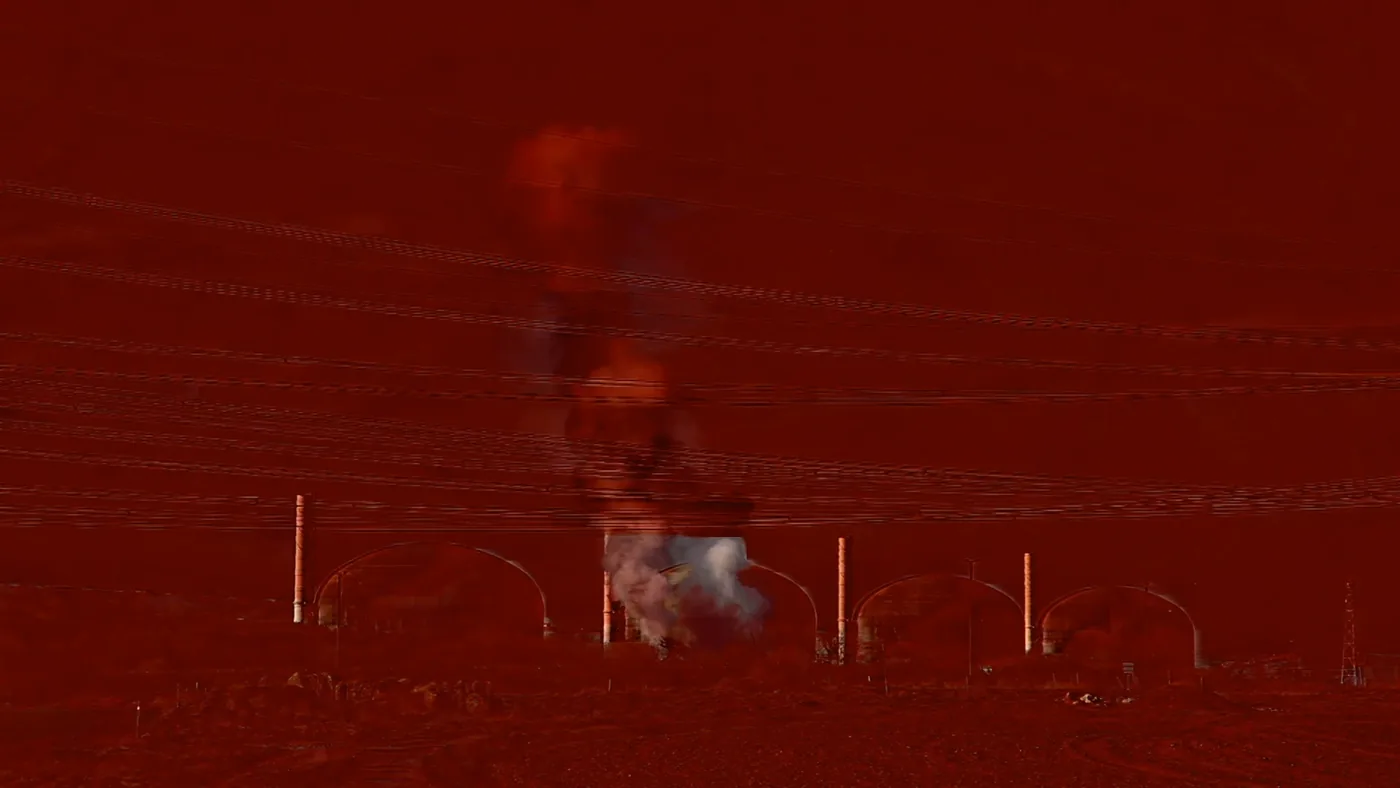
The first image of the third part of the film – Infinie fièvre de feu – reinstates a red-dominated bas-relief, whose almost total fixity is altered by the movement of a plume of smoke rising from the center of the image. This is not an urban landscape here, but a fixed shot of a nuclear power plant12. The collage depicts the plant in flames, suggesting an ecological axis of reading13 that coexists with the film’s main register, the latter less referential and sustained mainly by multiple dialectics (fixity/mobility, figuration/disfiguration…) always structured on the basis of the singular plasticity of these digital images. A new fluctuation of pixels once again invades the whole frame (~16m50s) in harmony with an animated view of the sea, the image’s new referent.
In addition to the dialogue between image and sound, both very elaborate, the tension between the image and its referent is certainly one of the central elements of the artist’s strategy. Indeed, a constant play of agreements and disagreements is proposed between what the image is and what it represents. The image in itself, more or less manipulated, more or less window, more or less surface, remains an explicit presence throughout the film, sustaining from its surface a dialogue of mobilities and fixities with its referent (natural landscape, urban landscape).
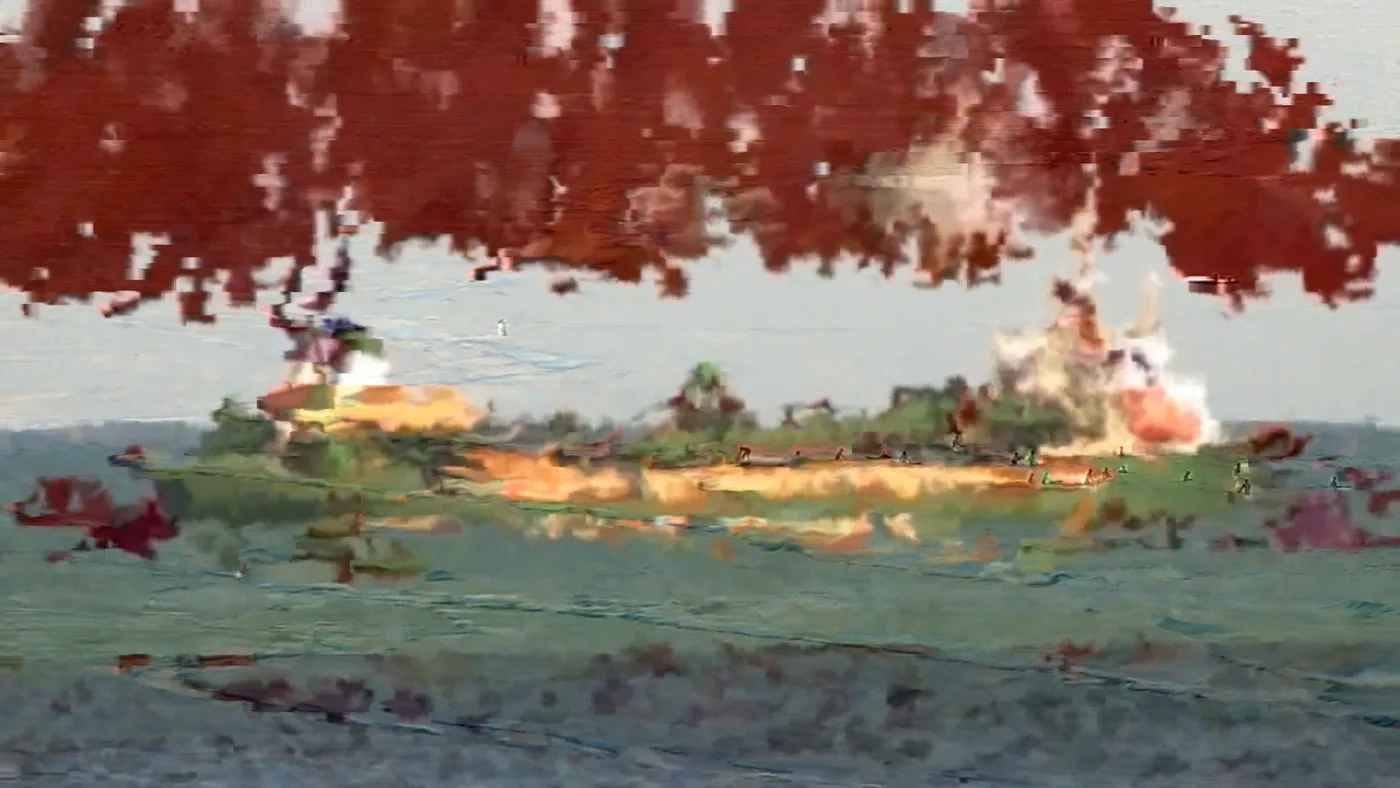
Around the seventeenth minute, roughly halfway through the film, a pared-down landscape appears before us, accompanied by a soft and delicate sound, allowing a calm but mysterious atmosphere to settle in. This atmosphere is shattered – and with it, the image – by the sudden and menacing irruption of a tanker, itself disintegrated in turn by the swarming of a small army of surfers who reintroduce into the frame a blue now punctuated by yellowish tones. At this stage Perconte’s intention to compose an epic narrativity out of the images becomes evident, one of formidable effectiveness, for it solicits both the visual and the auditory in a perfectly sensible register, of an intensity that is, as we indicated, prelinguistic.
A pixelated vibration in the eighteenth minute erases the traces of the action and leads us to a half-fixed, half-animated desert dominated by a colored oscillation. This timeless calm is in turn jolted by an image showing an individual standing at the edge of the beach, head lowered at first, who then looks up and stares at the horizon. This contributes to a sort of splitting of the spectator, who identifies with the central character without ultimately knowing to whom these dreamlike images belong (who is the one dreaming?), images that have absorbed the spectator in a constant and multiple movement between representation and image presence, between sensation carried by immediate perception and memorial signification: in the nineteenth minute, a swimmer, in whom the spectator and the character previously seen on the shore symbolically converge, struggles in a rough sea, getting out of it only after a great effort.
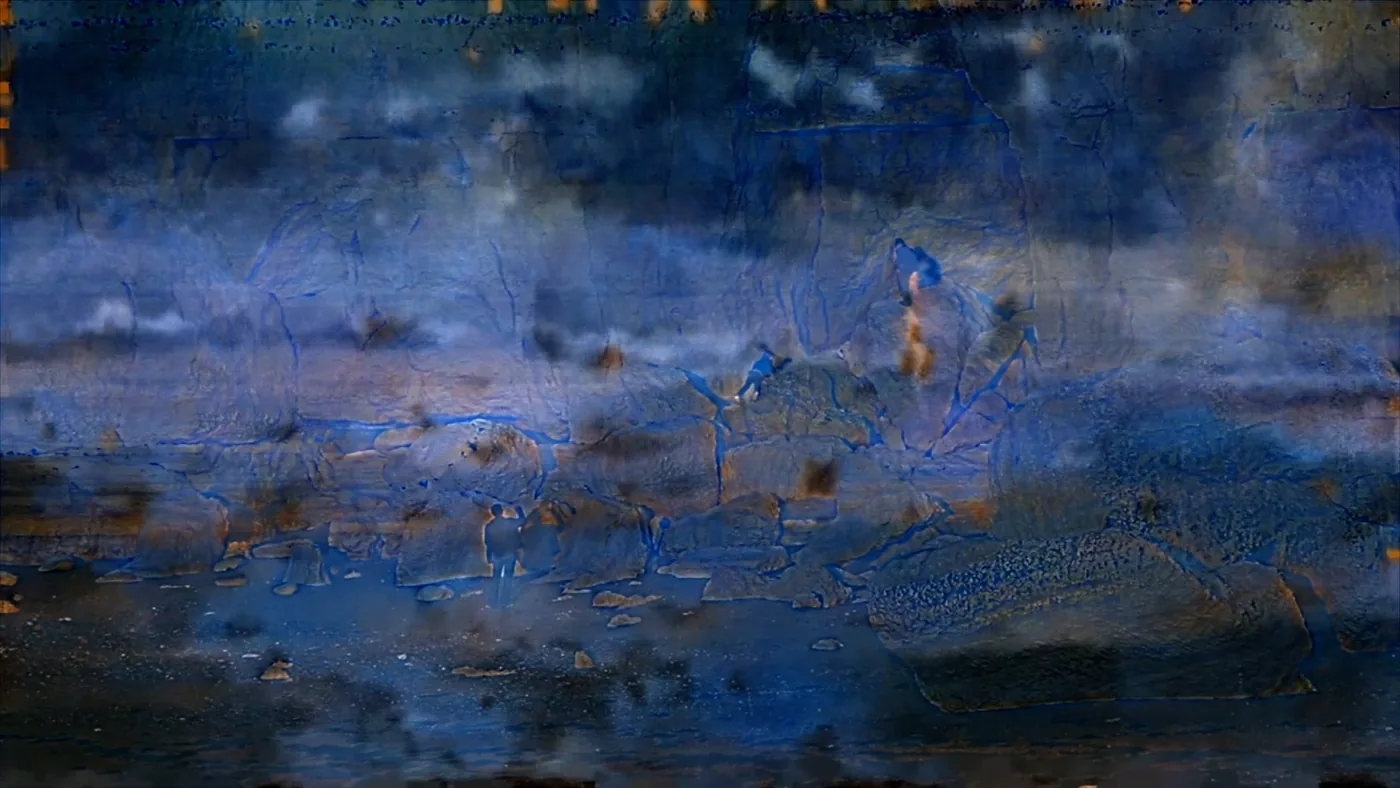
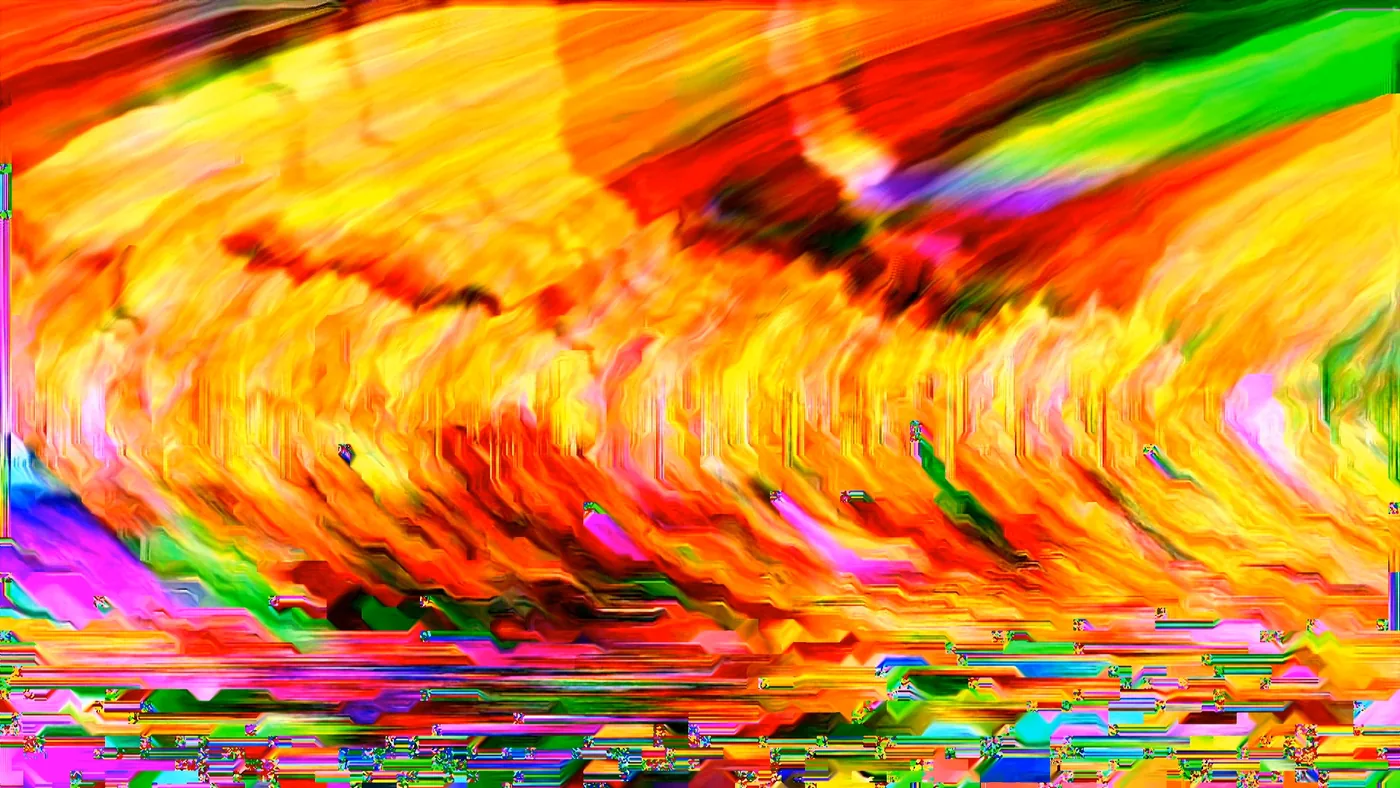
After this moment of tension, the sea-image becomes calm, habitable and inhabited by a multitude of bathers, only to stiffen again: it takes on the form and texture of a cliff face, of an unreal blue, torn by the traces left by birds, like brushes in their passage across the image: in Perconte, movement is trace. But immediately, the pictorial sketch freezes and gives way to a sort of improvised dance by a seagull in the middle of the image. This comic moment, as we know, offers a release that prepares the ground for a new irruption of the dramatic. The latter will stage characters in their smallness (~22m20s), trapped in a cyclical time, in a vain attempt to climb the cliff. An intention that refers symbolically to the ambition to overcome the mortal condition: either toward the heights of knowledge (Icarus, Prometheus), or the will to equal the divine (Babel)… projects doomed to punishment by pain and/or by fire. Just as in the film, where the image saturates and becomes magmatic, as if it sought to tell us its true face, to unveil its true body, far from a referent represented by central perspective, far too from surface effects on a screen that acts as a mask: the digital image is an incandescent, electric magmatic flow, circulating through integrated circuits whose structure ends up showing through on the screen (~23m50).
Then, once again, the sea erases the frame and does justice to the ruins of a story that nevertheless does not stop. If it was a matter of chastisement, it is now the turn of redemption, with hiker-pilgrims who cross the image to the sound of church bells, only to merge into it. Will they reach their destination? Does their movement designate a form of transcendence, or are they simply prolonging the habits of cattle (~25m30s)? In Perconte, the sumptuousness of the images is correlated with a temporal density, a high-frequency rhythm of events that offers diverse territories in which the spectator’s imagination and sensibility blossom vertiginously.
We then gradually witness the birth of a dreamed sea (~25m50s), formed by flat areas of fluctuating pixels, crossed by the traces left by sailboats as they pass. This scene is followed by the more realistic image of a “zoomed” maritime horizon, furrowed by a boat moving from the left to the far right of the frame. The image fades to black, seeming to indicate the end of an initiatory journey, leading us very slowly toward the fourth part of the film, entitled Sentiment océanique (~29m20s). This notion of an “oceanic feeling” had been suggested to Freud by Romain Rolland in the 1920s, on the hypothesis that this feeling would be at the origin of all religiosity. In Impressions this makes sense when one considers a certain sense of the mystical that had already manifested itself in the allusion to Monet’s cathedral, and that combines with what we have understood as a form of narrativity: the prelinguistic is thus articulated with the prereligious.
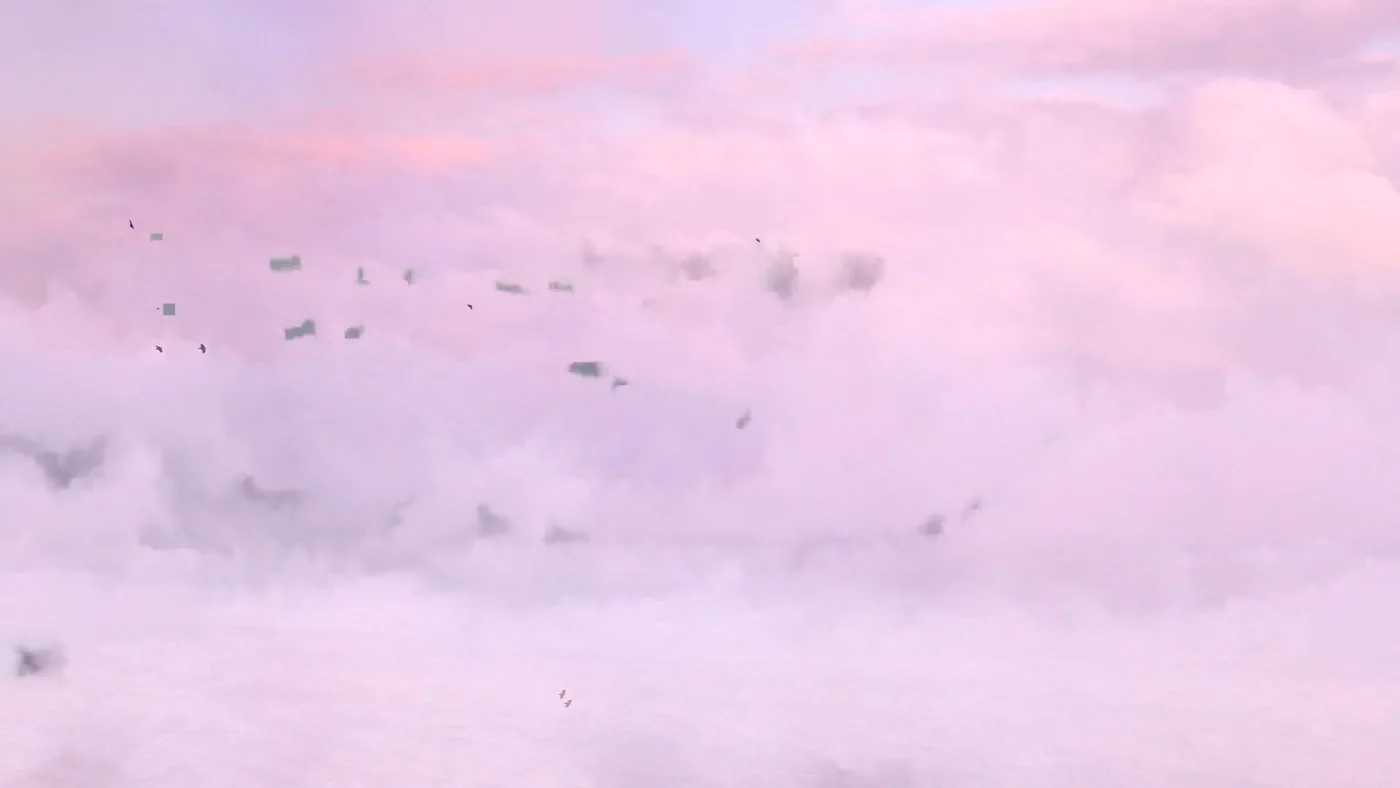
It is nonetheless important to keep a distance between religion and religiosity, as can be deduced from the exchanges between Freud and Rolland. If a form of religiosity is sublimated on the sensible plane at this moment of the film, the reference to religion in Perconte is accompanied by a definite critical side. Freud describes14 the oceanic feeling in spatiotemporal terms: dilation of time to the point of eternity, homogenization of elements, disappearance of boundaries. The image goes in this direction: almost monochrome, with a bas-relief look that is present but very nuanced, the figures barely standing out from the pinkish-white background. The frequency of changes in the image decreases, time stretches, taking the form of mist or pixelated clouds. The meditation is gradually interrupted by a new choreography of birds, still leaving their traces (~33m50s). Their intervention intensifies to the point of producing a form of asemic writing. Then the image evolves gently: the pinkish tone gradually dissolves, giving way to the real colors of an aerial view of the undulating surface of the sea.
The flight of a bird in an image now sharp carries us away (~38m25s). We have left the sky without setting foot on the earth. The journey could have ended in this nirvana where everything merges, but the artist refuses to abandon the physicality of the world and, more concretely, the earthly expression of love. These video recordings would not have done full justice to the Normandy landscapes without restoring the presence of farm animals: the artist is right to express love through cattle, living beings unjustly dispossessed of all spirituality by the exploitative mentality of man, who sees nature only as a resource. There follows a sort of sublimation of the colors, which evaporate, taking the form of a colorful fresco – except a digital and multilayered one. The texture of the colors becomes fluid again; the image moves away, showing us a second time its true electromagmatic face.
Digital Image, Narrative Paste
In the films of Jacques Perconte, of which Impressions is the emblematic example, a myriad of sensations emerges from the succession of images. From it emerges, let us say it once again, a form of narrativity carried by the plastic modulation of the images. The artist constructs the spatiality and temporality of the film through the permanent re-actualization of a balance played out on several registers: between image presence15 and referential reach16, between fixity and movement17, between perception and memory; a multiple balance affected by the resemanticization of the image through collages combining diverse elements, but also quite simply by the modulation of the chromatic register or the kneading of glitched forms…
These modulations are orchestrated by the artist with great coherence, without which the narrative register we have mentioned could not emerge on the sensible plane, and on the basis of plastic elements – a register that provokes in the spectator a variety of states of mind comparable to the sensations experienced in the face of an unfolding of events (of a story, a narrative). In Perconte, however, this narrativity will always remain prelinguistic, but of an intensity that constitutes the artist’s strength and that expresses itself outside of any discourse. This, and it is our hypothesis, stems from a will to compose, though not in the sense of traditional cinema by way of a script, but rather from a work of organization carried out in the making, by letting oneself be surprised, by making choices, by reworking the suggestive images, by letting oneself be carried away by intuition, with a very thorough retrospective look at the images already produced, which in turn condition the following sequences.
These complex images, veritable “fiction factories,” cannot escape comparison with conceptual schemes that have tried to reflect on narrativity, not by taking the image as a representation of a prior discourse – of which the image acts as a metaphor – but as a plastic assemblage on the basis of which narrativity is constructed. Such is the case of the taxonomy of images through which Gilles Deleuze set out to understand the functioning of cinema and its evolution during the twentieth century18. Although confronting Perconte’s complex images with Deleuze’s highly convoluted typology of images is beyond the scope of our research, bringing these two universes into resonance, which will remain at the stage of a sketch, yields elements of interpretation capable of enriching the apprehension of Perconte’s images.
A Plastic Time-Image
Deleuze distinguishes what he calls movement-images and time-images. The former, which are in turn divided into perception-images, affection-images and action-images, aim to grasp realist and narrative cinema – narrative-illustrative cinema – such as can be found in an overwhelming majority of Hollywood films. These movement-images account for a sensory-motor type of progression: characters who perceive, who let themselves be affected by what they have perceived, and who act accordingly. For movement-images, the reaction – of the characters – takes place immediately once the perception (action) has been received.
Time-images, on the contrary, present a situation in which there is a delay between perception and action19, which does not exclude the suspension of all possibility of action. With time-images, Deleuze attempts to characterize the new forms of cinema that appeared after the war, such as Italian neorealism. Largely inspired by Bergson in Matière et mémoire, Deleuze associates time-images with a form of duration, a sort of “Whole” specific to each film. Movement-images can be understood as cuts taken from the time-image that breathes in the background of the film, except that while the latter is the singular site of a gap, of freedom and of indeterminacy, movement-images have something mechanical about them (Deleuze uses the word “machinic”). Indeed, the model of movement-images and time-images that Deleuze develops while reflecting on cinema has its roots at a more general level, these images being conceived as fundamental concepts for describing the totality of the real. Thus the universe, including ourselves, would be made up of images, its movement-images at the level of the inorganic, and time-images, at the level of the living, representing “centers of indetermination.”
In cinema, according to Deleuzian logic, the level of time-images is expressed through optical images and sound images. These provoke a dislocation between perception, affection and action: “in an optical situation what is fundamentally cut is the perception-movement, perception-action articulation20.” Through time-images, we would be able to move beyond “the duality between an abstract cinema and a narrative-illustrative cinema,” extremes between which Perconte’s images oscillate21. These images have a referential origin: at the outset, they are recordings of the real, often panoramic views of natural or urban landscapes shot from above. Yet as they evolve, they are “called into doubt” as they are constructed22. Because of their uncertain and fluctuating functioning, they seem to collide with their own referent, which gradually loses its consistency. They seem to evoke a description (which remains on a plane of “total subjectivity”), but it is a – optical – description that ends up erasing the object (the referent of the image): “[…] when the description comes to an end, one realizes that it (the image) has left nothing standing behind it23.”
These time-images, indebted to Bergsonian duration, are constituted as structures that aim to take the living into account, and to that end they possess properties on the basis of which one could attribute to time-images perceptual capacities, even forms of freedom of action: “These three kinetic terms that make it possible to define the special image (the time-image) are: first: to subtract / select; second: to divide; third: to choose24.” Everything happens as if the time-images to which Deleuze refers were indebted to a form of “life,” and in this sense they resonate with the images that seem to breathe in Impressions.
Perconte’s plastic time-image breathes through superimpositions, through slowdowns and suspensions of movement, as well as through crackings often associated with artifacts resulting from the derangement of compression codecs. It is a multiple image, with an enlarged temporal and spatial thickness. Perconte’s films, like the time-images described by Deleuze, are images “with volume.” They are actualized as a form of memory would be, in which memories affected by immediate perception fluctuate, and vice versa. They result from the action on the image of a form of sheet-memory, which “contracts several moments into a present perception25,” associated with the expression of a contraction-memory, which “actualizes a sheet of memories in a present perception26.” Perconte’s time-image is constructed by very particular technical means, put at the service of a composition based on the plastic elements of the image, deployed intuitively in a – variable, subjective – temporality of the movement-images imagined by the spectator on the basis of the time-image understood as the manifestation of a form of duration.
Bringing Perconte’s images into tension with Deleuzian conceptual schemes thus appears promising, although an in-depth examination of this comparison, as we anticipated, is beyond the ambitions of this research. We nevertheless retain the vision of a time-image as the core from which movement-images are released, capable of bringing forth a narrativity out of their plasticity. But only, let us add, when this organization is tied together by the artist/composer, over the course of a process built through manipulations of a digital image that expresses its materiality.
Admittedly, Deleuze did not seem particularly optimistic about the artistic potential of digital technologies, probably because he saw in the digital the expression of a disembodied form of information, a vector of the word of power, incapable of establishing links between the human and the world27. However, a more materialist approach to digital technologies, consistent with an embodied conception of the notion of information28, leads us to consider a digital image in its links with the signal but also with the trace, the material support: a digital image that does not exclude the affective aspect that resides in matter. In this framework, the digital image resonates with the triad proposed by Bergson, for whom, according to Michel Guérin29, the image is movement, and movement is image, both expressing matter and being its expression.
From drawing during his visual arts studies in Bordeaux in the mid-1990s (when he first came into contact with “computer graphics”), to the increasingly advanced personal artistic experiments of the 2000s, by way of a participation spread over four years in a CNRS laboratory. See in this regard the interview of the artist by Raphaël Nieuwjaer, published under the title Jacques Perconte, Traversées on 6 June 2015 in the journal Débordements: https://www.debordements.fr/Jacques_Perconte-365 accessed 18 September 2022.↩︎
In the interview of the artist by Raphaël Nieuwjaer, Jacques Perconte, op. cit., web link: https://www.debordements.fr/Jacques_Perconte-365 accessed 18 September 2022.↩︎
Traditionally considered foreign to the digital, the notion of style associated with this technology is beginning to arouse interest in France. The journal Proteus, for example, devoted its September 2023 issue to it, “L’Ère numérique du style” (website http://www.revue-proteus.com/Proteus20.pdf accessed 9 October 2024).↩︎
Ibid.↩︎
Remarks made by Perconte during an exchange in December 2020.↩︎
Interview of the artist by Raphaël Nieuwjaer, journal Débordements, op. cit.↩︎
Bidhan Jacobs, «Traitement des signaux numériques et abstraction ». Débordements. Revue de Cinéma [en ligne]. March 2013. disponible à l'adresse : https://www.debordements.fr/Traitement-des-signaux-numeriques-et-abstraction.↩︎
Bidhan Jacobs, « Traitement des signaux numériques et abstraction ». Débordements. Revue de Cinéma, op. cit.↩︎
Conversation between Jacques Perconte and Yves Citton, as part of the Centre Pompidou’s online festival Hors Pistes 2021, L’écologie des images. https://www.centrepompidou.fr/fr/ressources/media/4iiEE72 accessed 19 September 2022.↩︎
Ibid.↩︎
Some works in this corpus, as we have seen, allow these remarks to be nuanced.↩︎
Very probably the Paluel nuclear power plant (CNPE), located on the Normandy coast, 20 km north of Fécamp.↩︎
A hypothesis supported by the appearance, a little later, of an oil tanker, and of wind turbines around the thirtieth minute of the film.↩︎
Sigmund Freud, Le malaise dans la culture. Paris : Flammarion, 2019.↩︎
To indicate the expression of the image at the level of its own surface, through texture effects, through the bringing into play of compression artifacts, in a dynamic that is accentuated by effects of fixity and movement.↩︎
To indicate the moments when the image acts as a window that sends us back to what it shows, to its referent.↩︎
Fixity and movement that may be partial, that is, without affecting the whole frame.↩︎
Regarding his taxonomy of images, Deleuze states: “It was all the more tempting to see whether cinema did not bring a moving matter that would require a new understanding of images and signs,” Gilles Deleuze, Pourparlers 1972-1990, op. cit., p. 68.↩︎
“the action undergone is not immediately prolonged into reaction,” Deleuze’s course on cinema, université Vincennes - Saint-Denis, 5/01/1982.↩︎
Deleuze’s course on cinema, université Vincennes - Saint-Denis, 18/05/1982.↩︎
Very different, it should be stressed, from the images Deleuze had in mind when he problematized time-images, namely the images of Italian neorealism, with Roberto Rossellini’s film Rome, Open City (1945) as the emblematic example, Perconte’s images seem to us to give form to a highly plastic version of Deleuzian time-images.↩︎
Deleuze’s course on cinema, université Vincennes - Saint-Denis, 18/05/1982.↩︎
Ibid.↩︎
Deleuze’s course on cinema, université Vincennes - Saint-Denis, 5/01/1982.↩︎
Deleuze’s course on cinema, université Vincennes - Saint-Denis, 18/05/1982.↩︎
Ibid.↩︎
The philosopher refers to the electronic image in Gilles Deleuze, L’image-temps. Paris : Editions de Minuit, 1985, in Gilles Deleuze, Le pli: Leibniz et le Baroque. Paris : Editions de Minuit, 1988, in Gilles Deleuze, Deux régimes de fous: textes et entretiens 1975 - 1995. Paris : Éd. de Minuit, 2003, and in Gilles Deleuze, Pourparlers 1972-1990, op. cit.↩︎
See for example Mathieu Triclot, «Information et entropie : Un double jeu avec les probabilités ». Electronic Journal for History of Probability and Statistics - Journal Electronique d’Histoire des Probabilités et de la Statistique [en ligne]. Ecole des Hautes Etudes en Sciences Sociales, December 2007, vol. 3, n° 2, p. 1–24. disponible à l'adresse : https://shs.hal.science/halshs-00514054.↩︎
Comment fonctionne une œuvre d’art ? (1/4) : L’art du geste, interview with Michel Guérin, op. cit.↩︎
Cite this pageCórdoba, Pablo-Martín. “A Narrative Plastic”. In Making Digital Images in the Light of Experimental Cinema — Anthropological and Political Resonances of Algorithms in Contemporary Art, Doctoral thesis in visual arts and photography, Université Paris 8 Vincennes-Saint-Denis, Doctoral School EDESTA (no. 159), research unit AIAC, 2026. https://www.pablomcordoba.com/thesis/a-narrative-plastic/