2.1.3
The Destructured Image
Among our artificial images1, the digital image is undoubtedly the most fluid that humans have known. However, in an apparent paradox, the plasticity of this image is built upon an extremely rigid structure.
Indeed, it may seem problematic to think of a structured fluid. Yet this is exactly what microelectronics does with the electrical flow. Anticipating one of the main results of this research, let us say that this notion of a “structured fluid” is already an expression of what will appear as the behavior of the digital image – but also of the digital as such – as both flow and trace, an ambivalence that we will see overflowing the medium to invade our entire era.
Let us say for now that, despite the effects of flow, the spatial organization of digital images is invariably ensured by a regular matrix of pixels, made up of a fixed number of rows and columns. When a digital image is captured, light passes through the optical system of the apparatus – video or still camera – is transformed into electricity, is encoded, is discretized, and its effect can be translated, for each pixel, as the additive synthesis of three color values that can vary between 0 and 255. As for the moving image, it should be noted that, just as with the classical cinematographic dispositif, digital images produce the illusion of movement through a rapid succession of still images at a constant speed (for example, 25 images per second): each frame contains pixels belonging to the same temporal instant. It is by disrupting the spatiotemporal structure of the digital image that Samuel Bianchini finds the principle at the heart of his interactive installation Sniper (1999), in a gesture that thwarts the intrinsic rigidity of this type of image.
The work presents a video sequence showing the fall of a woman shot down by a sniper as she was running with a red bucket full of water2. On the projection screen, Bianchini fragments the original sequence into a grid of 5 rows and 5 columns, thus creating 25 rectangles. Each rectangle shows, according to its position, the corresponding portion of the original sequence, except that the latter has been broken down into 30 still images3.
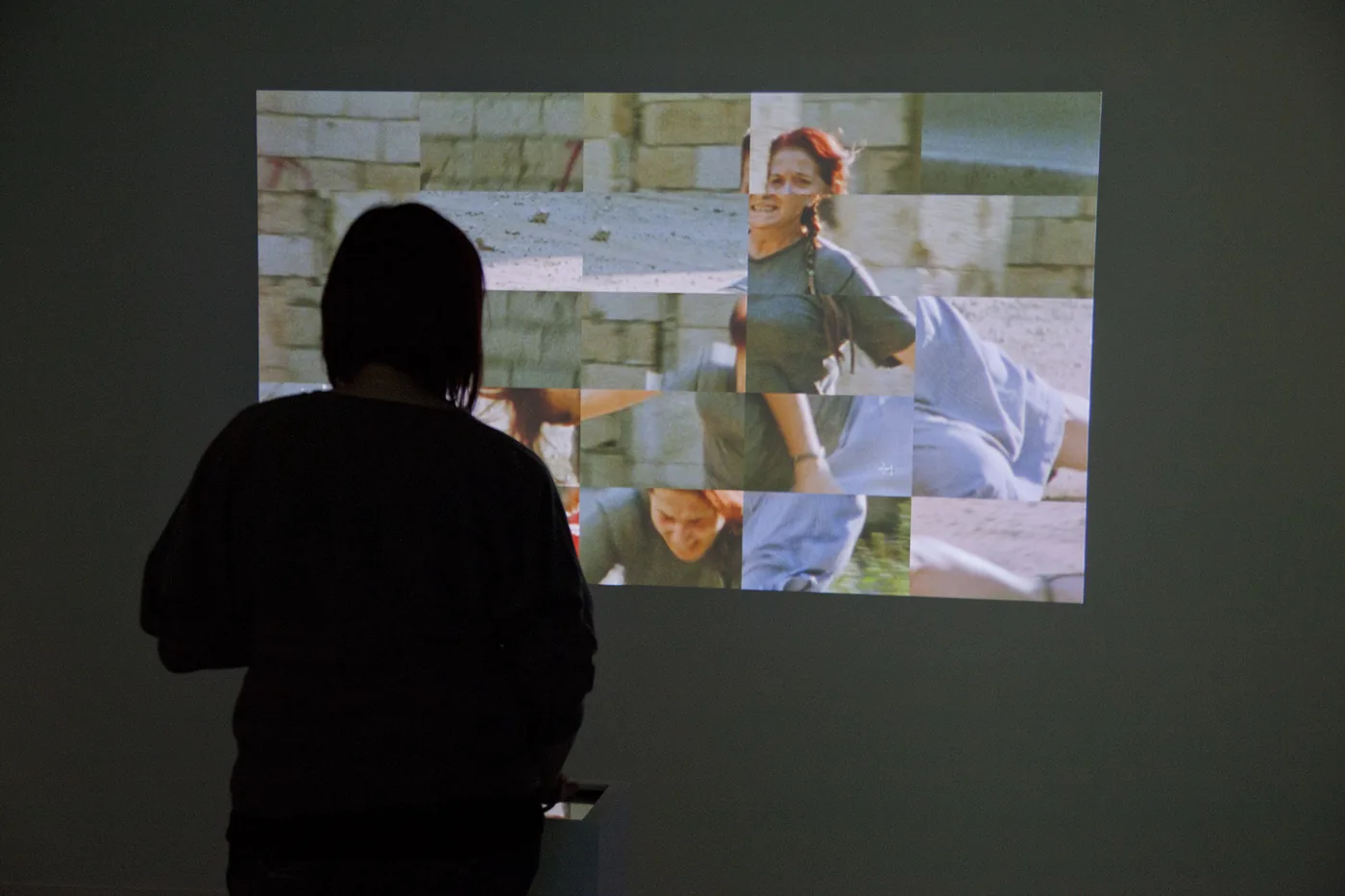
Within each of the 25 blocks that make up this rearranged image, temporality is managed independently. It is up to the spectator to trigger the advance of time in each fragment of the image, by moving across the blocks with a cursor provided for that purpose4. In his interactive installation, Bianchini introduced a form of irreversibility into the management of time. Indeed, within each block, the time of the image can only move forward, with no possibility of going back. This constraint adds further tension to the work.
The interactive functioning of the installation thus takes as its object a destructured version of the original sequence, the whole orchestrated by algorithmic means.
Spectator-Actor
Facing the installation, the playful project that would prompt the spectator to reconstitute the coherence of the image – when all the blocks are synchronized at the same temporal instant – quickly runs up against the gravity of the referent. Each intervention by the spectator inevitably precipitates the woman’s fall, with no possibility of going back. The bursting apart of the image accentuates the disarticulation of the body shot down, and the spectator oscillates between the status quo and an intervention that only hastens the inevitable conclusion.
By introducing interactivity, the artist obliges the spectator to abandon the passivity of cinematographic reception and become responsible for the unfolding of the fragmented action taking place before their eyes. It is important, however, to understand interactivity within the work as an extension of the artist’s initial algorithmic gesture, through which he reorganizes the space-time of the original sequence. Moreover, as Pierre-Damien Huyghe points out, interactivity functions in this work as a “method of access to a visible that, without it, would not unveil itself5,” a remark that evokes a Heideggerian filiation, since, for Heidegger, technics – as such – contributes above all to an unveiling of the real6. Thus, within the work, it is through interactivity that the spectator takes part in a gesture of unveiling that becomes collective and multiple, since the destructuration of the image proposed by the artist is only activated in conjunction with the specific action of each spectator.
In what way, then, does the installation Sniper manage to unveil the real? As we will see, the work brings to light a fundamental aspect that illuminates not only the nature of digital images, but also their genealogy: images that cannot content themselves with a passive role; on the contrary, they assert themselves as instances of concrete action upon the real in which they are inscribed.
At the Origins of the Digital Image
In his video Eye/Machine (2001), Harun Farocki describes as operational images those whose aim is neither to entertain nor to inform7. Farocki refers mainly to images used to control machines – including war machines – as well as to images for the surveillance and monitoring of industrial machines. The parallels with Sniper are obvious. Indeed, because of the nature of the visual referent (the fall of a woman who has been shot), and despite the benevolence of their intentions, the spectator taking part in Bianchini’s installation adopts a role that evokes that of military operators using remote weapons in which the moving image serves as a sight8: these sequences often reach their climax in the form of a cloud of smoke, marking the neutralization of “targets,” whether civilian or military, involved in the conflict or not. We are confronted here with the operational image in its most tragic dimension, within an installation that can be understood as an “operative assemblage,” in the artist’s terms9. The original sequence, which shows the fall of the woman who has been shot, functions above all in a representational mode in its initial context (Heiner Stadler’s film). The passage from the original sequence to the installation is carried out through a transformation by which the artist appropriates the dynamic that governs the image in order to subvert it. By redefining the spatiotemporal program of this carefully chosen sequence and integrating interactivity into it, Bianchini manages first of all to expose the operational aspect that motivated – and financed – the postwar development of the digital: the capacity for rapid calculation making it possible to predict the trajectories of projectiles and flying craft10.
However, as we will see from Jodi’s work, all the digital images “made available” – given – on the Internet already take part in various types of operations: technical11, marketing, surveillance12… It is therefore important to realize that every digital image, including those intended to “entertain” or inform, is in part an operational image. Farocki’s proposal must therefore be reassessed, since the digital image, by its nature, contains an inherent operational dimension. Operationality should not be perceived as a category for classifying images as operational or not, but rather as a constitutive property of every digital image, which is expressed to varying degrees depending on the context.
The Image Pulled Apart
When users find themselves before a digital image that conceals its operational potential, it is legitimate to ask where intentionality lies: does it lie on the side of the user, or on the side of the image, understood here as the visible manifestation of a technics instrumentalized by instances of power13 that are increasingly concealed, yet omnipresent because of the digital? For, as staged by Bianchini, and despite the intention to “do good,” the user does nothing other than make possible the evolution of a system that escapes them, an evolution that follows a predefined trajectory. In other words, where operational images are concerned, is it man operating upon the real through an image, or instances of power operating upon the real via technics, the image, and the human being itself? Vilém Flusser’s metaphor, which saw in the figure of the naive photographer – in which we find all heedless users of technological dispositifs – that of a functionary14 in the service of the techno-economic-military complex, becomes more legible and concrete in the digital context.
Bianchini’s work functions as a metaphor for the human who, believing they are manipulating technics, is in reality manipulated through it. On the basis of the spatiotemporal destructuration of the digital image and the addition of a layer of interactivity, the installation triggers a dynamic that reveals the components of the system: the operational aspect of the networked image and the at once determining and determined role of the spectator-user. The latter, forced to abandon the naive comfort offered by the implementation of the technological system, sees their share of responsibility brought to light.
In Sniper we find a way beyond both technophile blindness and technophobic pessimism: although it evokes a techno-economic-military system operating upon the real via the image, the installation also suggests a form of fragility inherent in the operational capacity of digital images. This capacity can be suspended by a free gesture which, through a supplement of technicity, awakens a form of awareness that is at once visual and gestural, when the human negotiates with technics through images.
In this work, which admits various conditionings – an installation with a large-scale projection, but also an online version visible on a computer screen – what Bianchini thwarts is above all the topological structure of the image: its integrity according to the coordinates (I, J) and its temporal development (t). This derangement, carried out at a level still legible by humans, makes manifest the current mode of existence of the digital image. The latter is consistent with its genealogy, within a technology designed for prediction – of every type of trajectory – and for the manipulation of the entities of the real through their symbolic equivalent, just as calculi represented, for primitive humans, the number of individuals in their herd.
However, as will gradually appear through the works, the digital image must be apprehended, like the system that contains it – its medium –, as a stratified entity, made up of several superimposed levels of structuration. By penetrating further into the flesh of the image, the work of Takeshi Murata, which will be considered next, destructures the digital image at a finer scale. The result is an image that tears apart, revealing in all its breadth a form of plasticity that tends toward the organicity of nature.
A natural image occurs when we look at a scene of the real (a person, an object, a landscape…); when the image emanates from a painting, a photograph, cinema or television, it is an artificial image.↩︎
Sequence taken from the film Warshots (1996), by Heiner Stadler.↩︎
This is a one-second video sequence, with a frequency of 30 frames per second (fps).↩︎
A web version of the installation is available here: https://sniper.dispotheque.org/ accessed 30 August 2022.↩︎
Pierre-Damien Huyghe, Éloge de l’aspect: Éléments d’analyse critique et paradoxale de l’industrie comme divertissement. Paris : Mix, 2006, p. 78.↩︎
See in this sense La question de la technique, in Martin Heidegger, Essais et conférences. Paris : Gallimard, 1980.↩︎
Harun Farocki, «Phantom Images ». Public [en ligne]. January 2004, p. 12–22. disponible à l'adresse : https://public.journals.yorku.ca/index.php/public/article/view/30354, p.17.↩︎
A situation staged in chilling fashion by Éléonore Weber in her film Il n’y aura plus de nuit (2020).↩︎
See in this sense the artist’s interview with Dominique Moulon, https://moocdigital.paris/cours/arts-dispositifs/art-dispositifs link accessed 30 August 2022.↩︎
For a historical description of developments related to the digital as a weapon of war, see Pierre Barboza, Du photographique au numérique : La parenthèse indicielle dans l’histoire des images. Paris ; Montréal : L’Harmattan, 1996.↩︎
We have been powerless witnesses to the use of all our images in training generative neural networks.↩︎
See on this subject Shoshana Zuboff, L’âge du capitalisme de surveillance, op. cit.↩︎
This research does not approach technics within a Heideggerian framework, that is, as an entity having an essence that would need to be grasped and become conscious of. On the contrary, from artistic practice emerges an apprehension of technics as an entity devoid of essence. Its action and its effects will therefore depend on the way it is mobilized by the human being.↩︎
Vilém Flusser, Pour une philosophie de la photographie. Belval : Circé, 2004, p.52.↩︎
Cite this pageCórdoba, Pablo-Martín. “The Destructured Image”. In Making Digital Images in the Light of Experimental Cinema — Anthropological and Political Resonances of Algorithms in Contemporary Art, Doctoral thesis in visual arts and photography, Université Paris 8 Vincennes-Saint-Denis, Doctoral School EDESTA (no. 159), research unit AIAC, 2026. https://www.pablomcordoba.com/thesis/the-destructured-image/