3.6.1
A Space Defined by "Strategies" and "Levels"
The artistic corpus addressed in the central chapter, as we have seen, was divided according to three strategies: destructurations, structurations and assemblages. These, as noted at the time, are to be understood as dominant tonalities, and not as rigid or self-sufficient categories, for they can coexist within certain practices1.
Furthermore, the domain that can be invested by the creative process was divided into three levels: an algorithmic core, surrounded by an analog periphery, with an intermediate protocol zone. These levels, as we have seen, are affected by uncertainties of different natures, associated with the analog virtual (for the analog periphery and also for the protocol zone) and with the algorithmic virtual (for the algorithmic core and the protocol zone).
It is from the works themselves that the relevance of these categories emerges, as capable of delimiting a place for the artistic gesture when it expresses itself within the digital medium. Indeed, the strategies (destructurations, structurations, assemblages) seek to account for the fact that, in their functioning, the works in the central corpus seemed to respond to different logics. The levels (algorithmic core, protocol zone, analog periphery), for their part, were grasped from the personal work, because the gestures at the origin of these works – known through a relationship of intimacy – emerged at different points of the creative process.
The strategies (destructurations, structurations and assemblages), when combined with the levels (algorithmic core, protocol zone, analog periphery), define a form of spatiality for the digital creative process, proposing a territory on which the artistic gesture of each work can be mapped.
The distinction between levels (algorithmic core, protocol zone, and analog periphery) and gestures goes without saying, since these are elements of different natures. The distinction between strategies and gesture, on the other hand, is less obvious. Indeed, the strategies refer to the nature (destructuring, structuring, assembling) of the organization of the work, to the conception of a “plan,” more or less intelligible and systematic, oriented toward an objective: the creation of the forms that will compose the work. The artistic gesture, for its part, as gesture, is essentially inchoative: it takes part in the initiation of certain actions, from which it is sometimes difficult to distinguish2.
Finally, one last clarification is needed, concerning the strategies that seemed to us to be at work in the creative processes considered in the central part. In the case of destructurations, and to a lesser extent of assemblages, the algorithm can be so far removed from its design framework that effects of the “analog virtual” can occur even at the level of the algorithmic core. This is undoubtedly the case with glitch, databending and datamoshing, at work in Rosa Menkman’s A Vernacular of File Formats, in Takeshi Murata’s Monster Movie and in Disnovation.org’s The Pirate Cinema. It is certainly also what happens when jodi.org disseminates various forms of malfunction across the most widespread web services.
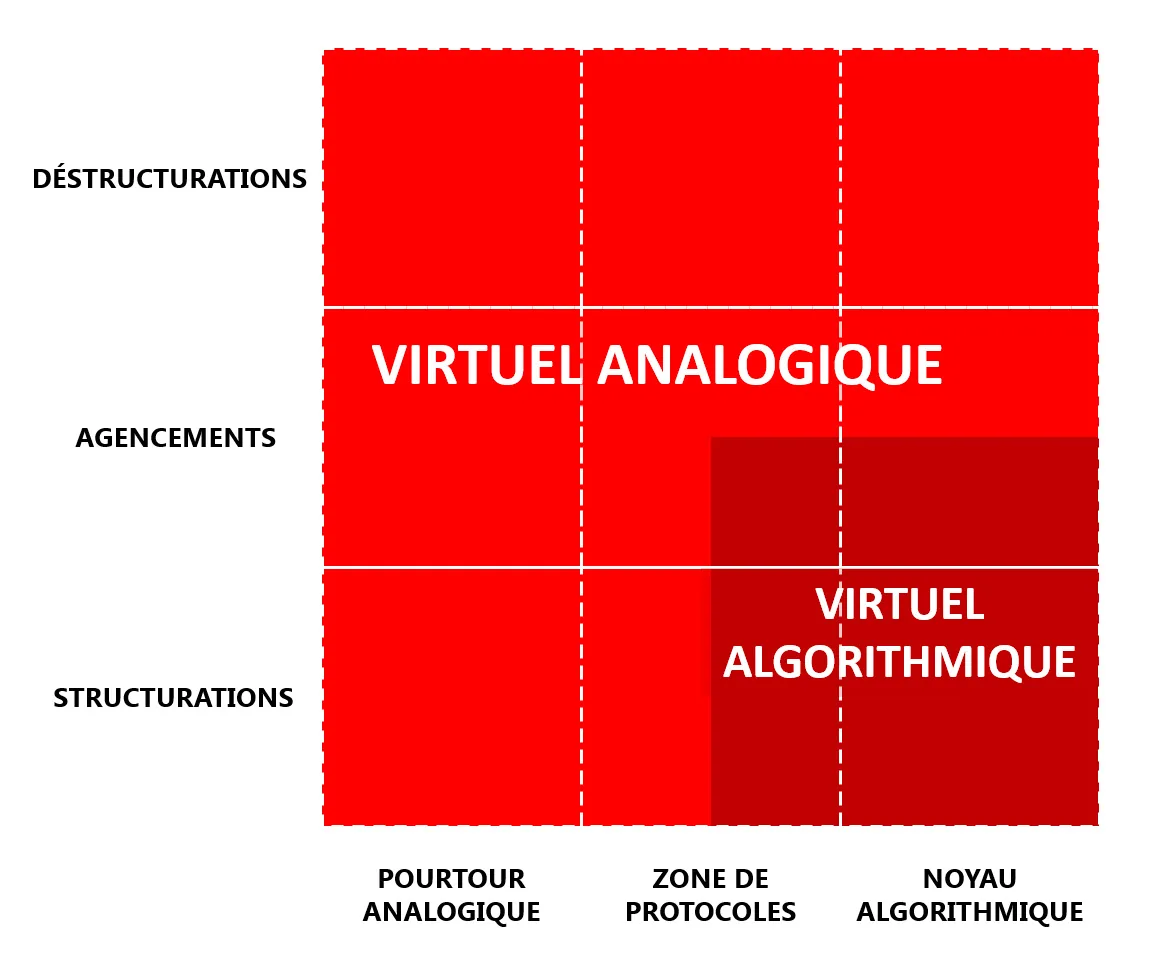
The aim will therefore be to try to grasp, in each of the works making up the personal work, the shape of the spatial unfolding of the gesture within a space thus defined.
That of Jacques Perconte, for example, predominantly structuring, also mobilizes tools drawn from destructurations, such as disrupting the functioning of the compression codecs of digital images. Moreover, as already mentioned, the category of assemblages, which refers to the personal work, can be understood as a hybrid between structurations and destructurations.↩︎
This inchoative nature of gesture makes it difficult to grasp, which would explain, according to Michel Guérin, the little interest that gesture has aroused among philosophers. Michel Guérin (dir.), Le geste: entre émergence et apparence ; éthologie, éthique, esthétique. Aix-en-Provence : Presses Universitaires de Provence, 2014, p. 7.↩︎
Cite this pageCórdoba, Pablo-Martín. “A Space Defined by "Strategies" and "Levels"”. In Making Digital Images in the Light of Experimental Cinema — Anthropological and Political Resonances of Algorithms in Contemporary Art, Doctoral thesis in visual arts and photography, Université Paris 8 Vincennes-Saint-Denis, Doctoral School EDESTA (no. 159), research unit AIAC, 2026. https://www.pablomcordoba.com/thesis/a-space-defined-by-strategies-and-levels/