4.4
Unfaithful Matter
When it comes to identifying the concrete configuration that the hypermaterial takes on as the support of digital images, we are confronted with a complexity that is nonetheless very familiar to us. The material management of the digital image – in capture, processing, rendering and storage – relies on the joint functioning of several types of supports of inscription, whether permanent or volatile: the magnetic platters of hard disk drives (HDDs), the NAND chips of flash memory supports (such as SSDs, USB sticks or SD cards), DRAM chips for random-access memory (RAM) and VRAM for the graphics card. There is therefore no self-sufficient digital hypermaterial, but a plurality of “hypermaterials” that function together, depending on whether the image is managed as trace or as flow. Hence there would be neither a “hypermatter” in its natural state – one we would be able to modify as needed at the microscale – nor a “hyper-material” (hypermatériau), elaborated from matter, capable on its own of meeting the requirements of the digital image1.
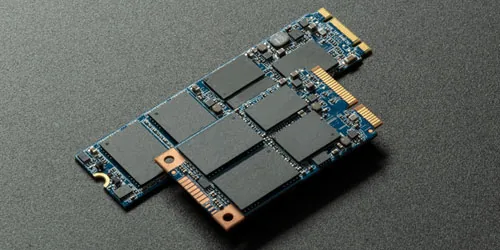
It thus becomes clear that there is no “immaterial” (immatériau) that humans would have designed according to the “needs of the project,” thanks to operative calculation or to a mobilization of codes drawn from science2. Lyotardian Platonism runs up against the resistance of an unfaithful matter3. Indeed, the development of digital supports has relied less on the intelligible principles of science than on the experimental tinkering carried out by engineers4.
Let us also stress that the inadequacy of individual concepts – the Deleuzian time-image, the Derridean trace – which seemed obvious to us when it came to characterizing the digital image from a theoretical point of view, finds its equivalent on the plane of matter, where no single material can manage the digital image on its own and where a multiplicity of materials must be mobilized.
In terms of materials, the integral trace-flow management of the digital image relies on the coordinated action of magnetizable alloys based on cobalt, nickel and iron – which make up the platters of hard disk drives (HDDs) – and of the various forms of purified or doped silicon – at the basis of NAND chips (SSDs, USB sticks, SD cards), DRAM and VRAM.↩︎
See on this subject Jean-François Lyotard, Les Immatériaux. 2: Album et inventaire. Paris : Centre Georges Pompidou / CCI (Centre de Création Industrielle), 1985.↩︎
A notion evoked by Gilbert Simondon. See on this subject LESSARD Clémentine « La matière infidèle. Penser l’activité de la matière d’Aristote à Simondon », in Guillaume Coissard and Arnaud Pelletier, L’activité de la matière. Paris : Librairie philosophique J. Vrin, 2024, p. 141-162.↩︎
We could say as much of the development of generative neural networks.↩︎
Cite this pageCórdoba, Pablo-Martín. “Unfaithful Matter”. In Making Digital Images in the Light of Experimental Cinema — Anthropological and Political Resonances of Algorithms in Contemporary Art, Doctoral thesis in visual arts and photography, Université Paris 8 Vincennes-Saint-Denis, Doctoral School EDESTA (no. 159), research unit AIAC, 2026. https://www.pablomcordoba.com/thesis/unfaithful-matter/