2.3.4
Gare Paris-Saint-Lazare, 10 avril 2017, 12h03-12h07 (2017)
I grew up in more or less peripheral areas, within a country that is itself peripheral: Argentina. During my childhood, I mostly knew sparsely populated urban neighborhoods on the outskirts of the large conurbations of the province of Buenos Aires. During my adolescence, I lived in medium-sized towns enclosed within the Patagonian desert.
Although I have now been living for more than twenty years in one of the densest conurbations on the planet, I long felt a sense of astonishment at the urban spectacle of a developed country like France, where the flows of material means and of individuals intertwine at high frequency, according to complex processes and structures.
The impersonal and expressionless attitude of individuals on their daily journeys – an anonymity in which I now feel very much at ease – was for a long time a source of troubling wonder for me. I could not help seeing something profoundly mechanical in it, in those quick and resolute gestures, in those women and men who seemed to know exactly what they were doing, even though they all appeared to be doing the same thing. The feeling of exteriority with which I mingled with this human mass was then total.
With reminiscences of this feeling still present in my consciousness, and at a time when I was still experimenting with the potential of processing the digital image at the level of the pixel, I made, in April 2017, a video capture in an indoor urban space: the underground interchange of the Saint-Lazare station in Paris. It is a set of stairs and escalators that carry the public from the surface down to the depths of the metro, and vice versa. These stairs, which become escalators as they rise, run along the walls of a vast cylindrical underground hall and describe a wide spiral. The hall is topped, at the surface, by a glass bubble – which serves as a metro entrance – a contemporary reinterpretation of the Guimard style1. At the base of this hall stands a monumental clock, almost invisible so integrated is it into the space, past which thousands of people file every day.
Although at the time I had not yet exhausted my desire to create assemblages of forms (of traces, of matter) between images, I did not know exactly what I was going to do with the sequence filmed in this space. The enormous cylindrical hall was lit by natural sunlight, which entered the interior space through the glass bubble – at once geometric and organic – located at the surface. During the video capture, an event occurred, banal in itself, but which played out remarkably in the scene. Whereas at the beginning of the recording the light was diffuse – from underground one could make out an overcast sky – halfway through, the sun’s rays must have forced their way between the layers of cloud to imbue the scene with a direct, hard light. This light, passing through the glass bubble, projected the image of its structure onto the wall of the hall, facing the camera, in a position that not only did not spoil the composition of the image but, on the contrary, seemed to sublimate it.
In order to process the captured video algorithmically at the scale of the pixel, it was broken down into a set of still images. Let us say, in passing, that like the analog cinematographic dispositif, digital video can also be reduced to a rapid succession of still images, even when the video stream is heavily compressed2. The ffmpeg software, run from the command line and serving as the internal engine of several graphical-interface programs for video processing, makes this transformation of the video stream into a sequence of still images possible. By readapting the algorithm used in El túnel, a new algorithm was designed that made it possible to extract, for certain frames of the video, the information relating to the moving entities, in order to add them to a “cumulative image” that merges with the video, adhering, as it gradually grows, to the moving image initially captured.
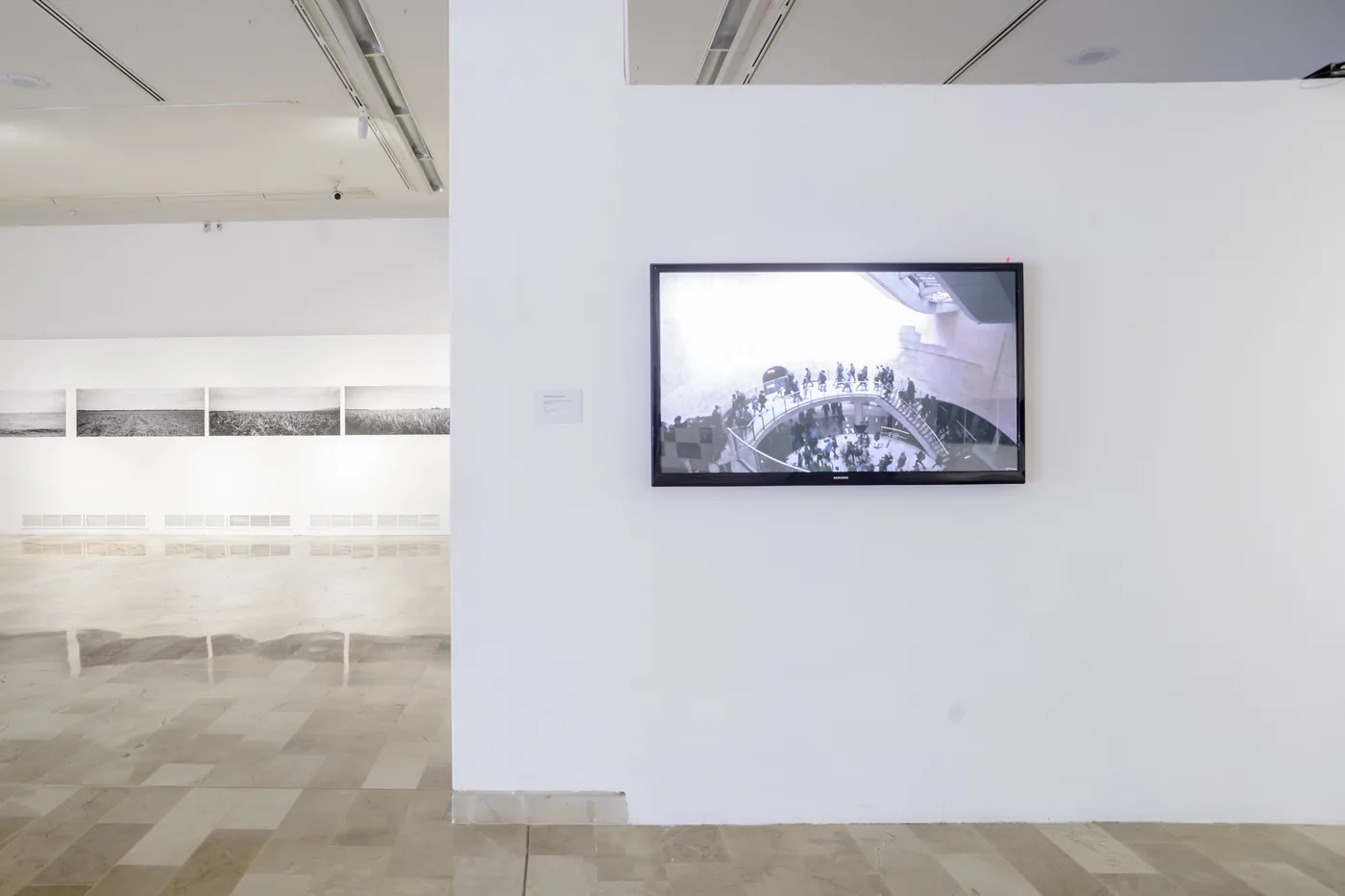
At the beginning of the work, in its final version, the image presents itself as a faithful view of reality, but very quickly the traces of the passersby begin to settle on the moving image, which continues on its course. These silhouettes, thus “fixed,” appear at first scattered, isolated; they retain their own bearing, without collectively forming a new figure or a unified structure. At this stage, one can observe how each moving passerby “leaves” behind several imprints of their silhouette — so many traces that inscribe their trajectory and show these travelers, at the very moment of their appearance, as if they were abandoning a part of themselves along the way. In a dualist reading, one might see in this bodies continuing on their way “alone,” their “minds” having stayed behind3.
A little later, when the silhouette-traces begin to saturate the space, they end up drawing a structure. Formed by the accumulation of bodies, this structure evokes the shape a sculpture would take if one imagined that the architecture acted as a mold. The relatively rapid filling of the whole space that the architecture makes available for the passersby’s movements bears witness both to the diversity of individual trajectories and to the normalizing capacity of the architecture, which makes these movements possible while conditioning them. It seems to me that the work manages to make perceptible an effect of “pressure” exerted by the human group — through the diversity and energy of the individuals who compose it — on the material infrastructure. This dialectic between individuals and infrastructure is reinforced by the oppressive appearance of the immense cylindrical hall, bathed in natural light, as if a panoptic will to “see everything” were at work there. This atmosphere derives from the architectural style of the station’s interior spaces and evokes, through its mechanical organicity, the universe of Hans Ruedi Giger.
Toward the middle of the video, when the shadow of the glass bubble is imprinted on the wall of the hall, there is a moment of calm: the soundtrack – created from recordings of plastic foam being torn – recedes, and the light on the wall signals a form of redemption, as if it signified a transcendental legitimation, a validation of the state of things, in short, the naturalization of a form of domination, a fatality. The video continues; as the form becomes denser, the image desaturates. It becomes monochrome – at the same time as it tends toward fixity – thereby managing to accentuate its structure.
This piece aroused a certain interest at various artistic events in very different countries. It must therefore have made sense despite the cultural diversity of the contexts in which it was received. This is probably due to the fact that, being generated algorithmically, the work finds its referent in the somewhat machinic aspect of our contemporary societies, hyper-accelerated – just like our algorithms – and in which the expression of the human tends to fade.
On the occasion of the 2019 Traverse Vidéo festival, Valentin Labatout wrote a text4 that echoes what I feel about the work. It does so, first of all, through its characterization of the station: a cold, panoptic architecture; but also, and above all, through the link the text draws with video surveillance – my camera here “mimics” surveillance cameras – whose project of “seeing everything” would be reversed, within the image, by the structure of amalgamated silhouettes, which helps to conceal each new passerby. I also recognize myself in the reference Labatout makes to the – political – potential of encounters (which do not take place), as well as in the reflection he suggests on the status of the image, not as a reflection of reality, but as a support of traces. If the instances of power are so eager to accumulate these traces – so I told myself at the time – it is because they must have learned to read them. The notion of surveillance capitalism – which I would discover much later in the course of the research – a system based on the exploitation of personal and behavioral data5, offers interesting theoretical echoes to these sensations worked through the sensible.
Designed by Arte Charpentier Architectes in 2003, this structure offers a present-day version of the famous Art Nouveau entrances designed by Hector Guimard at the beginning of the 20th century.↩︎
A compressed video corresponds to a succession of “p” frames, which are “deduced” by the codec from the information in the “i” or “p” frames that precede them (the “b” frames being deduced also from those that follow them), these “i” frames containing the color data for all of their pixels.↩︎
Taken to the extreme, this image evokes Patrick Bateman’s famous monologue in American Psycho (2000), directed by Mary Harron, in which, after describing his daily routine in meticulous detail — body care, exercise, etc. — the young trader declares that the only problem in his life is that, quite simply, he is not there. Monologue transcribed at this link: https://www.reddit.com/r/copypasta/comments/ykq0fz/my_name_is_patrick_bateman/?rdt=59153, accessed 10 December 2024.↩︎
Available in the event’s catalogue, page 79. Web link: https://traverse-video.org/catalogue_2019/Catalogue-livre_Rencontres%20Traverse%202019_L%27Exp%C3%A9rimental-recherche-art.html#p=79. Accessed 12 December 2024.↩︎
See in this regard Shoshana Zuboff, L’âge du capitalisme de surveillance, op. cit.↩︎
Cite this pageCórdoba, Pablo-Martín. “Gare Paris-Saint-Lazare, 10 avril 2017, 12h03-12h07 (2017)”. In Making Digital Images in the Light of Experimental Cinema — Anthropological and Political Resonances of Algorithms in Contemporary Art, Doctoral thesis in visual arts and photography, Université Paris 8 Vincennes-Saint-Denis, Doctoral School EDESTA (no. 159), research unit AIAC, 2026. https://www.pablomcordoba.com/thesis/gare-paris-saint-lazare-10-avril-2017-12h03-12h07-2017/