4.3
Images and Their Body
In Impressions, for 47 minutes, we are carried along by the variations of an image that expresses itself through collages, tears, slowdowns, stoppages and fluidifications. This complex image oscillates between fixity and movement, memory and perception, tension and release, suspense and meditation… It is – and is this one of the genuine novelties of the digital? – at once signal and support, flow and trace. The raw material of this film consists of panoramic shots taken from a slightly high angle – natural and urban landscapes – but also of images from handheld camera movements. This camera is the object of a first gesture by the artist1, under whose hold it struggles, in turn, between fixity and movement.
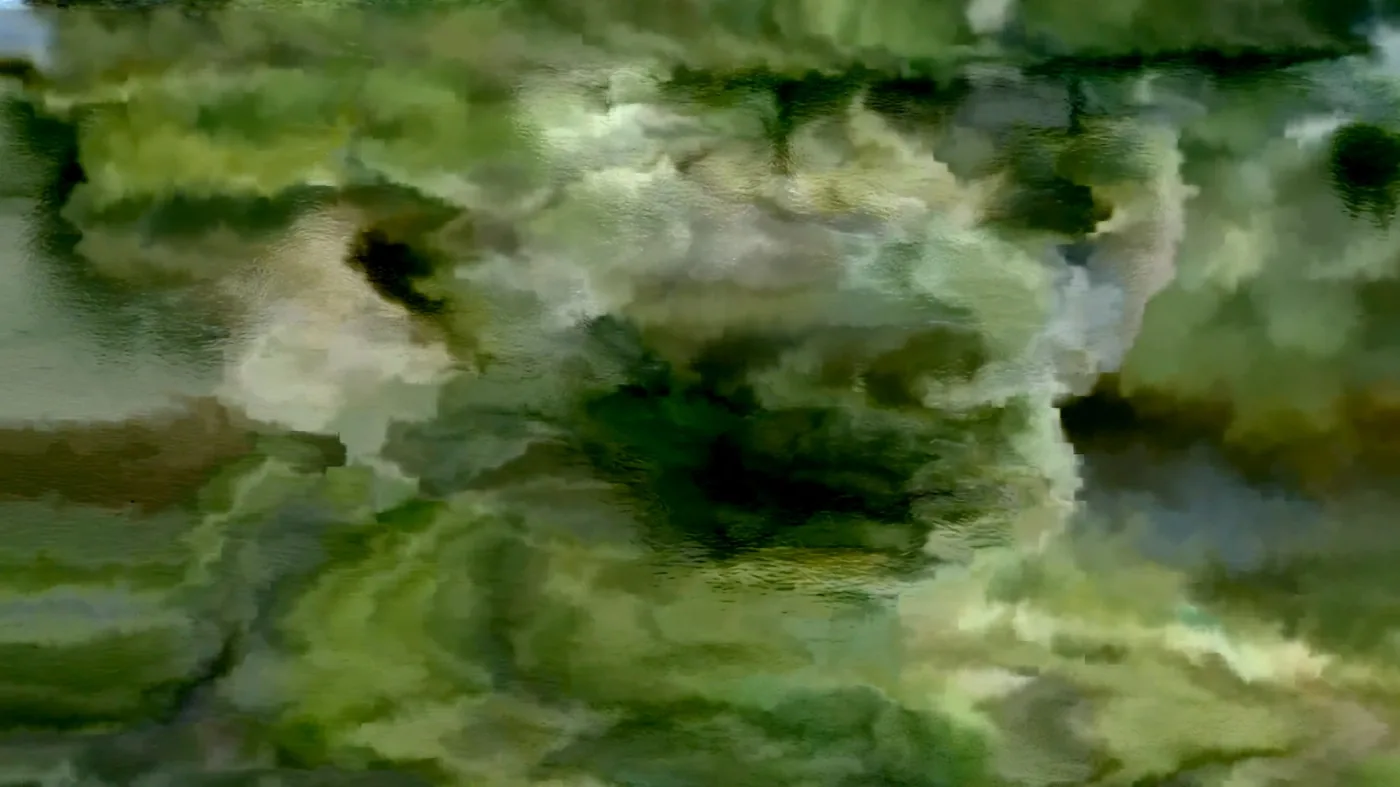
These images become disfigured, mix before our eyes, freeze, crack, tear, without ever losing their fluctuating attachment to their referents. The viewer, if they wish, can engage in a “reading” aimed at grasping a sequence of events from the image breathing before them. They will no doubt manage to extract a story from it, their own story, subjective, which they may – again, if they wish – put into words. But this story will then be only one variation, among an infinity of possible ones, of the inflections of an image of strange plasticity, in which a prediscursive narrativity throbs2.
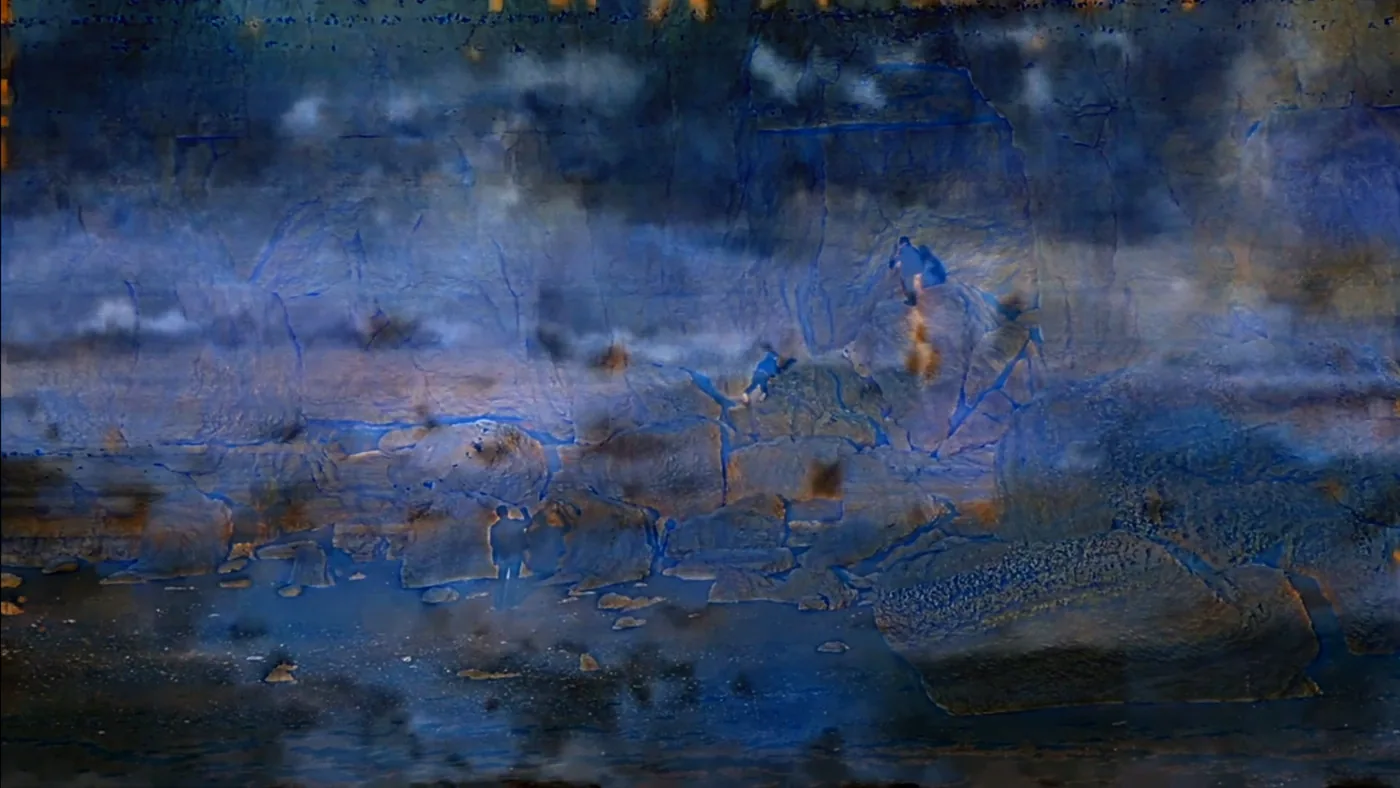
In Deleuze, we find a thought that seeks to describe the emergence of a narration from the curvatures of a moving matter3. Inspired by his famous taxonomy of images4 we might think that the story the viewer “makes up” in front of Impressions belongs to the movement-image, understood as a punctual cut from a time-image5 that is constantly transforming6. The movement-image, a story that can be made explicit in words, links together a sensory-motor eventfulness, whereas the time-image, more complex and more fundamental, admits effects of delay between the disturbances that affect it and the reactions they provoke. Whereas the movement-image mechanically triggers the series perception-image, affection-image and action-image, the time-image evolves according to an internal dynamic marked by a multiple fluidity: foreign to mere displacement, it metamorphoses continuously. This seems appropriate to describe what is at play in Impressions, except that the Deleuzian time-image rests on an irreducible fluidity, inherited from Bergsonian duration. Yet this omnipresent fluidity proves inoperative when it comes to accounting for the moments when Impressions – and, more broadly, the mode of existence of the digital in our societies – reveals something of the order of the trace: a permanence of forms that refers to the stability of the solid state7.
Even in its most static variant, that of the crystal-image, the time-image never ceases to redouble itself under the gaze that passes through it, revealing, in a play of reflections and diffractions, the shifting indiscernibility of past and present, of the actual and the virtual, coexisting in a single image8. In Perconte, by contrast, the fixity of the image marks a contrast that refers to ruins: there will be neither reactivation nor play of mirrors; only erosion and dissolution will set the stage for the advent of a new image. The Deleuzian-Bergsonian model resonates with the functioning of Impressions, but this comparison has its limits.
One might then think that the dynamic at work in Impressions would be better described by the fluctuating functioning of the trace in Jacques Derrida9. Yet this is a fluidity that manifests itself at the moment of the production of meaning, an interpretation in constant evolution, owing to an ever-changing context of reading, whereas in Perconte there is also a form of plasticity that directly affects the materiality of the image, provided that we assimilate the latter to the sign.
While the Deleuzian time-image struggles to account for the fixity of the image in Impressions, the trace in Derrida is, for its part, linked to a certain inalterability10, to a lack of fluidity in its material constitution. These two notions combined, the Deleuzian time-image and the Derridean trace, help us grasp the entire spectrum – between flow and trace, between signal and support – in which the digital image expresses itself, but neither, taken in isolation, manages to describe it in its full scope.
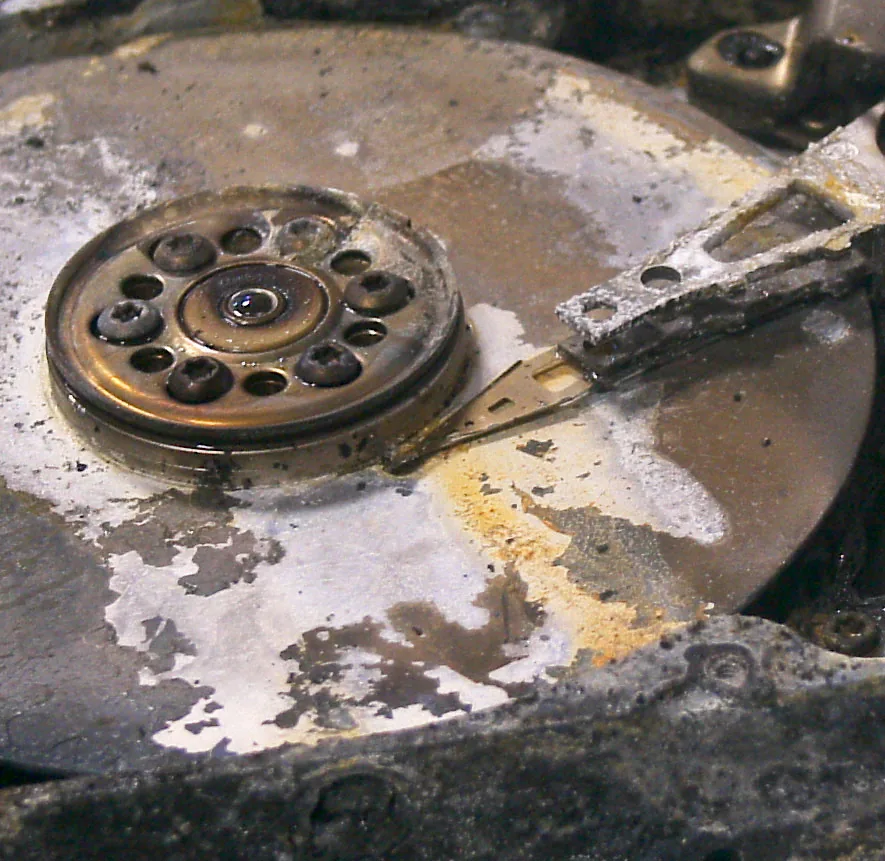
The notion of the hypermaterial, proposed by Bernard Stiegler, can lead us out of this impasse. The hypermaterial designates a material that can be modified by algorithmic processes, on the scale of the nanosecond and the nanometer. As the concrete material conditioning of the digital in the philosopher’s thought, the hypermaterial constitutes the support both of what Stiegler calls “orthothetic recording” – the exact and determined inscription of an aspect of the past – and of what he problematizes in the form of the “temporal object,” which is constituted as a flow. Orthothetic recording, heir both to the Derridean trace and to the that-has-been that Roland Barthes proposes for silver-based photography11, fixes the past in a stable inscription while opening it to indetermination, for the “lasting fixation of the now” is not to be confused with the “determination of the end associable with calculation12.”
Thus, from the lasting fixity of the trace, and without requiring any movement, we have with Stiegler the foundations for understanding how programs can produce indetermination13. Indeed, the trace, lasting and stable, remains determined as long as it is decontextualized. Taking context into account, at the moment of interpretation, opens the trace to indetermination14. However, the hypermaterial is also the support of the temporal object, which includes the musical flow and the video flow: indivisible flows whose reading by the human is affected by an interplay of primary retentions (memory of the immediate past, produced during perception), secondary retentions (recollections) and protentions (expectations), concepts the philosopher borrows from Husserl’s phenomenology. To this schema, Stiegler adds the notion of tertiary retentions to designate any technological inscription, on any support, understood as an exteriorization of memory, as its material prosthesis.
Vincent Sorrel, «”L’alpiniste est un homme qui conduit son corps là où, un jour ses yeux ont regardé” : Les longues focales de Jacques Perconte ». Le Cahier Louis Lumière [en ligne]. ENSLL, June 2019, n° 12. disponible à l'adresse : https://hal.univ-grenoble-alpes.fr/hal-01991642.↩︎
We considered this aspect of the image in Perconte’s work, which resonates with Deleuzian time-images, toward the end of chapter 2.↩︎
Gilles Deleuze, Pourparlers 1972-1990, op. cit., p. 68.↩︎
Let us note that Deleuze, who died in 1995, did not really have time to weigh the possibilities of the digital image. His vision remains anchored in an era when the digital was perceived as an information-processing machine, negatively connoted for the philosopher as a vehicle of the order of power. See, for example, his considerations on what he calls the silicon regime in Gilles Deleuze, Deux régimes de fous, op. cit.↩︎
It would then be, admittedly, a “plastic” version of the time-image, formally different – on the plane of representation, which is secondary here – from those of Italian neorealism that inspired Deleuze.↩︎
See in this regard Gilles Deleuze’s lecture at Vincennes-St. Denis, Bergson, propositions sur le cinéma, May 18, 1982. Website: https://www.webdeleuze.com/textes/74, accessed February 21, 2025.↩︎
The company Convar, Matthew G. Kirschenbaum reminds us in Mechanisms: New Media and the Forensic Imagination (2012)., commissioned by the FBI, managed to extract data from hard drives recovered from the rubble of the World Trade Center in 2001.↩︎
See on this subject Gilles Deleuze, L’image-temps, op. cit., p. 91.↩︎
The connection between this notion – which mainly concerns processes of writing – and the technical image is not new. Derrida himself reflects on photography on the basis of his notion of the trace in Jacques Derrida Hubertus von Amelunxen Michael Wetzel et al. (dir.), Copy, archive, signature: A conversation on photography. Stanford, Calif : Stanford University Press, 2010. For Matthew G. Kirschenbaum, the Derridean trace is central to his problematization of the digital support (Matthew G. Kirschenbaum, Mechanisms: New media and the forensic imagination. First MIT Press paperback edition. Cambridge, Massachusetts London, England : The MIT Press, 2012.)↩︎
“It is there that différance as writing could no longer (be) an (ontological) modification of presence. My ‘written communication’ must, if you will, remain legible despite the absolute disappearance of every addressee.” In Jacques Derrida, «Signature, événement, contexte ». dans : Communication au Congrès international des Sociétés de philosophie de langue française. Montréal, Canada, August 1971.↩︎
See Roland Barthes, La chambre claire: Note sur la photographie. Paris : Gallimard, 1980. The analog rigidity that affects the Barthesian that-has-been relaxes in the digital, without our being able to deny all indexical capacity to the digital image. See in this regard André Gunthert, «L’empreinte digitale. Théorie et pratique de la photographie à l’ère numérique ». dans : L’image partagée. La photographie numérique. Paris : Éditions Textuel, 2015, p. 17–30 and Louise Merzeau, «Du signe à la trace ». dans : BOUGNOUX, Daniel (dir.), Empreintes de roland barthes. [s. l.] : Éditions Cécile Defaut, 2009, p. 125–144.↩︎
Bernard Stiegler, La technique et le temps, op. cit., p. 376. In this, Stiegler departs from Heidegger, on the basis of whom he also reflects.↩︎
Ibid.↩︎
Machinic interpretation at the level of the program – in its normal functioning, without bugs – admits no indetermination: any unresolved ambiguity causes the system to halt, the error. But as soon as the material assemblage becomes more complex, unpredictable behaviors can manifest themselves, and, a fortiori, as soon as the human intervenes as an instance of interpretation, the overall behavior of the system becomes unpredictable and indeterminable: we evoked this, in other words, in the previous chapter, when we described the modalities that this research proposes for the process of actualization of the algorithmic virtual, which opens itself to indetermination when the computed images become the object of the artist’s sensible, perceptual and affective attention.↩︎
Cite this pageCórdoba, Pablo-Martín. “Images and Their Body”. In Making Digital Images in the Light of Experimental Cinema — Anthropological and Political Resonances of Algorithms in Contemporary Art, Doctoral thesis in visual arts and photography, Université Paris 8 Vincennes-Saint-Denis, Doctoral School EDESTA (no. 159), research unit AIAC, 2026. https://www.pablomcordoba.com/thesis/images-and-their-body/