3.7.2
From the Artistic Gesture to Ancestral Gestures
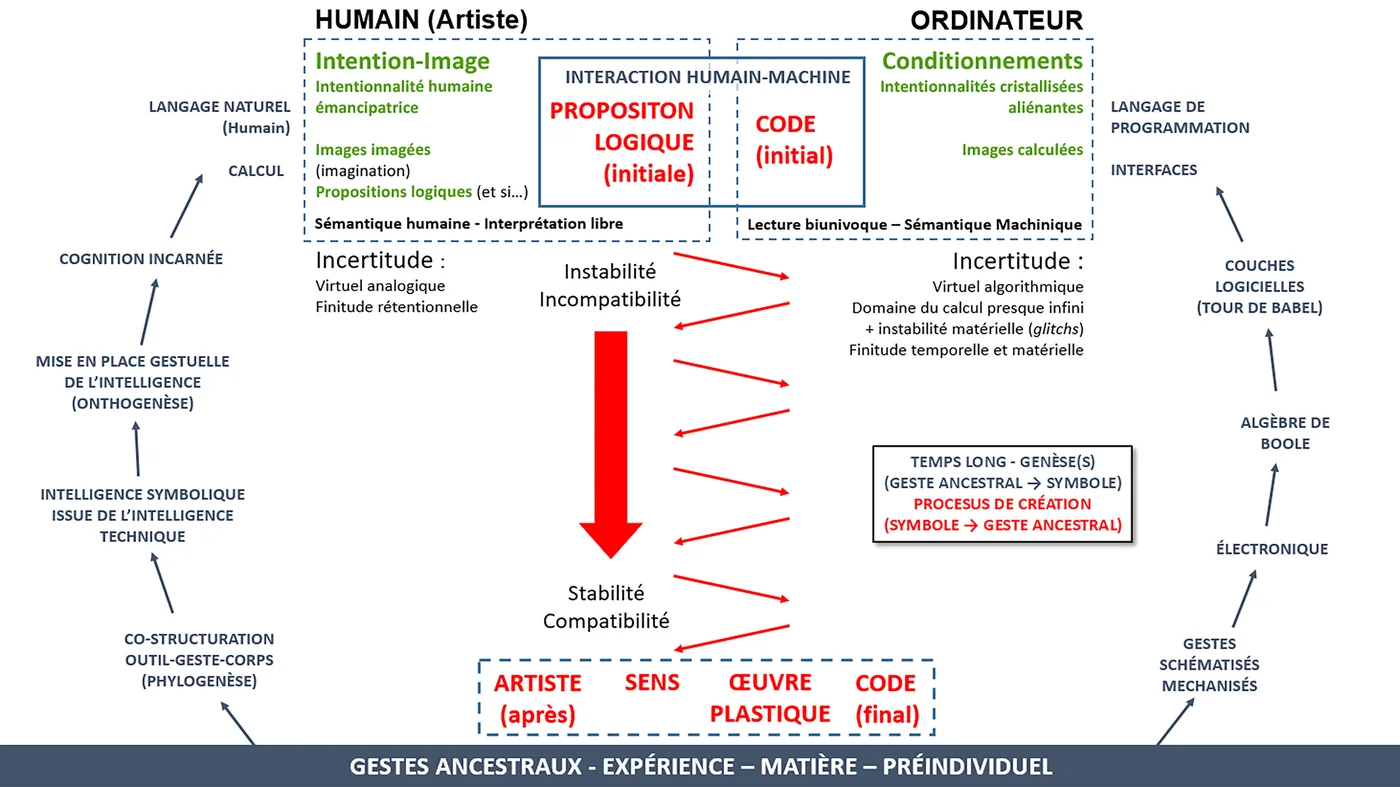
The second diagram widens the field, while unfolding the temporality of the creative process vertically, from top to bottom. Here, the human (on the left) interacts with the machine (on the right).
Let us recall once again that a gestural genesis was sketched out for these two entities in the preceding paragraphs, at the beginning of this chapter: both the human and the machine reach the symbolic on the basis of an experiential and material link with the world, in a dynamic inhabited by technical gesture. These movements – from below (gesture) and upward (symbol) – have been integrated into the diagram, at the far left and far right, for the human and the machine respectively.
During the creative process, as the work takes shape, the two entities, human and machine1, as well as the plastic component – the images – increasingly enter into resonance with their original gestural stock. Indeed, in the course of the back-and-forth between human and machine, these three main instances of the creative process (artist, images, machine) evolve in a way that recalls the process of individuation proposed by Gilbert Simondon, which takes the name of concretization when he describes the evolution of the technical element2.
Without going into technicalities, or into considerations that would exceed the objectives of this research, we will not attempt here to describe the – rich and complex – rootedness of Simondon’s work in the classical philosophical tradition3, in a reflection that mobilizes the major scientific advances of the twentieth century (thermodynamics, quantum physics), while drawing on Merleau-Ponty in several respects – among others, the phenomenologist’s reflection on the preindividual4. Nevertheless, a few considerations will help us better understand the notion of individuation developed by Simondon, within a thought structured around this notion.
During the digital creative process, the machine evolves through the algorithm, as the latter is progressively modified.↩︎
From the industrial machine onward, and a fortiori in the case of the computing machine, Simondon speaks of the technical individual, affected by an individuation that echoes (by analogy) that of the living, which the machine progressively approaches, but asymptotically, for in Simondon’s view – and we share this feeling – the machine will never attain the status of the living. See in this regard Gilbert Simondon, Du mode d’existence des objets techniques, op. cit.↩︎
In which Simondon is situated (as Jacques Garelli indicates in the preface to the book that presents Simondon’s thesis) – “paradoxically at the confluence of a meditation inspired by the Ionian physiologists on the notion of Physis, Anaximander’s thought of the boundless […] that of Plato on the One and the indefinite dyad of the Great and the Small, as this principle appears […] [in] Aristotle’s Metaphysics, the critique of the Aristotelian hylomorphic principle and of the substantialist atomism of Leucippus and Democritus.” Gilbert Simondon, L’individuation à la lumière des notions de forme et d’information. Nouvelle éd. Grenoble : Millon, 2017, p. 9↩︎
Ibid.↩︎
Cite this pageCórdoba, Pablo-Martín. “From the Artistic Gesture to Ancestral Gestures”. In Making Digital Images in the Light of Experimental Cinema — Anthropological and Political Resonances of Algorithms in Contemporary Art, Doctoral thesis in visual arts and photography, Université Paris 8 Vincennes-Saint-Denis, Doctoral School EDESTA (no. 159), research unit AIAC, 2026. https://www.pablomcordoba.com/thesis/from-the-artistic-gesture-to-ancestral-gestures/