4.1
The Persistence of the Trace
The sense of fluidity characteristic of our era is very real; the contemporary world is continuously accelerating its transformation. This observation, however, deserves to be qualified in the direction of a degradation: despite the resistance of everything that is truly alive, our natural, social and geopolitical milieus seem today to be rushing toward maximum entropy1. Humanity sometimes seems to be liquefying under the weight of processes shaken up by new technologies, on a local as well as a global scale. The diagnosis issued by Gilles Deleuze, terrifying as it is, proves in no way illusory: Foucauldian disciplinary societies – with their factories, the bodies of their workers and their minted currencies – seem to be giving way to societies of control, composed of corporations with undefined contours, undulatory individuals and floating exchanges2. How can forms of resistance be anchored in a reality that has been irreducibly fluidified, algorithmically hypercontrolled by the Web giants?
A certain persistence of forms, however, manifests itself and poses a problem. It calls for nuancing the conception of an entirely fluid world. It can be observed both at the level of our personal data and in the products of our creations, lengthily “read” remotely during the training of generative neural networks, through which private actors seek to storm both the symbolic and the sensible. Moreover, while one cannot extract a portion, at a time “t,” from a completely fluid entity – such as a musical flow – the survival of forms to which our era still bears witness makes it possible to obtain “frames,” within reach of some: Cambridge Analytica thus obtained, from 87 million Facebook accounts, a detailed portrait of the psychological and behavioral profiles of voters, which allowed it to hijack the 2016 US elections and the Brexit referendum through hypertargeted communication campaigns. Finally, a structural endurance is associated with the material needs of the digital – data centers, cabling, small-cell antennas for 5G, satellites, etc. – which never cease to grow exponentially3.
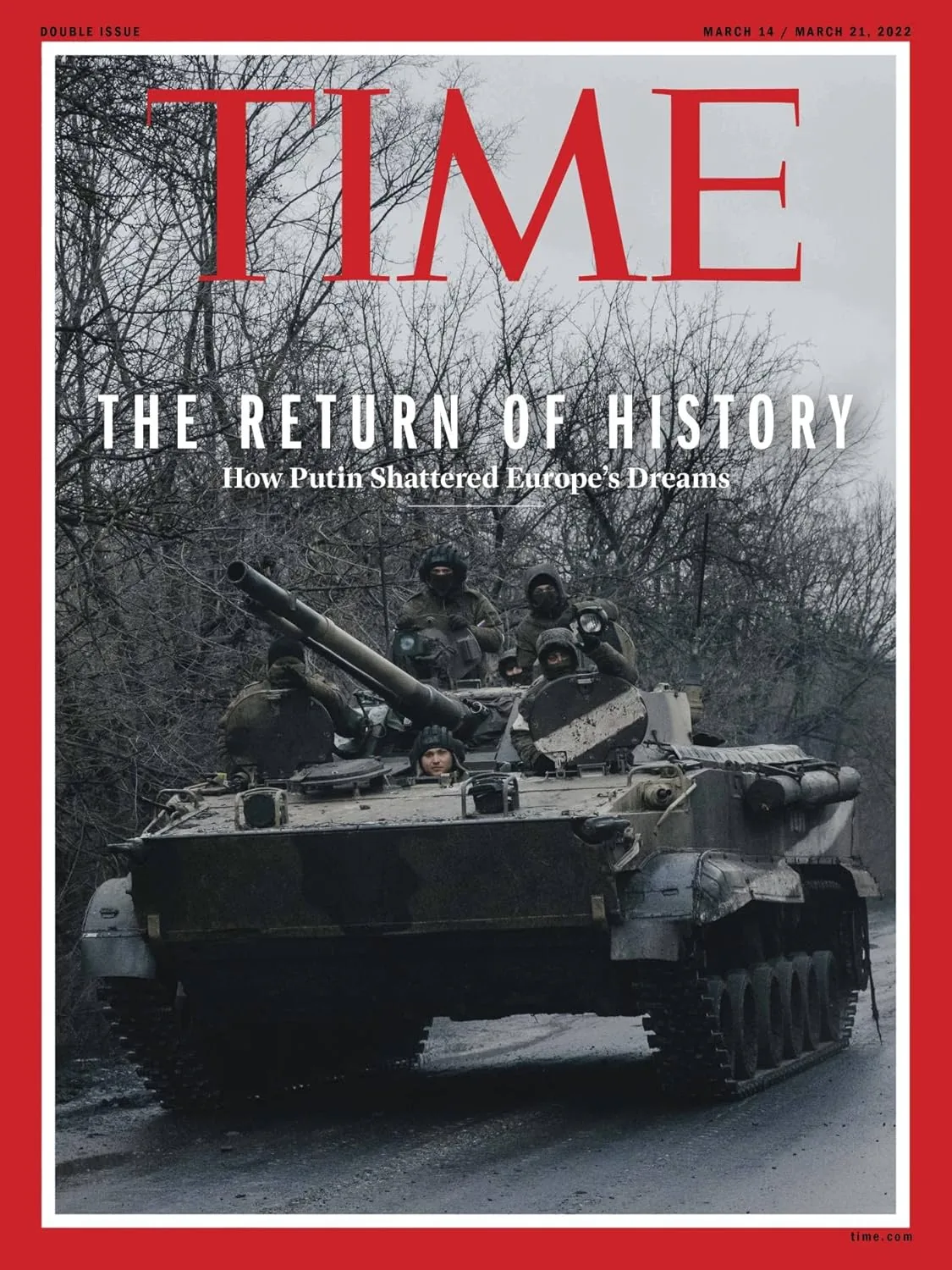
The postmodern sense of confusion4, founded on the alleged collapse of the grand narratives – whereas the capitalist narrative has never ceased to reconfigure and expand itself – and which led some to proclaim the end of historical dynamics5, is ridiculed by the cover of Time magazine, which ironically underlines the “return of history” when Russian tanks cross the Ukrainian border in February 2022. Does this really signal the return of big “hardware,” or rather the suspension of its invisibility6?
r0.5
Without seeking to downplay the fluid aspect of our world, which manifests itself forcefully in everyday life, would it not be appropriate to preserve, in our conception of the real, a dimension pertaining to the trace? The question arises from the very heart of communicational dynamics, in which the digital image is a fundamental element, serving to knead disruptive and entropic imaginaries. Can we, starting from art, reassess the mode of existence of our images without essentializing them, by seeking to identify their current becoming, in the hope that they will, in return, shed light on our era? Taking as its basis three works that could be understood as expressions of digital experimental cinema, this reflection aims to restore the balance between the fluidity of the signal and the stability of the support, by mobilizing the notion of the hypermaterial proposed by Bernard Stiegler.
Donald Trump’s statements on Gaza have crossed a threshold in indifference to human fate. A region with a pleasant climate, according to Trump, the Gaza Strip would be ideal for building a new Côte d’Azur, without the Palestinians, because, among other things, “most of them are dead, anyway.” https://web.archive.org/web/20250213194603/https://edition.cnn.com/politics/live-news/trump-inauguration-01-2025 ↩︎
Gilles Deleuze, Pourparlers 1972-1990, op. cit., p. 244.↩︎
Thus, in La Courneuve, the construction of the Paris Digital Park – the largest data center in France, 250 m in diameter – is discreetly continuing, out of sight.↩︎
Staged by Lyotard in the famous exhibition Les Immatériaux, which he curated at the Centre Pompidou in 1985.↩︎
Francis Fukuyama, La fin de l’histoire et le dernier homme. Paris : Flammarion, 2008.↩︎
As early as 1991, Friedrich Kittler observed the reappearance of hardware during the Gulf War. Faced with this unveiling, he explains, a discursive effort was needed to breathe back into the digital its “spiritual” appearance, threatened by the evidence of its material anchoring. Kittler places this process within what he calls the postmodern strategies of appearance. Friedrich A. Kittler, Mode protégé, op. cit. p. 53.↩︎
Cite this pageCórdoba, Pablo-Martín. “The Persistence of the Trace”. In Making Digital Images in the Light of Experimental Cinema — Anthropological and Political Resonances of Algorithms in Contemporary Art, Doctoral thesis in visual arts and photography, Université Paris 8 Vincennes-Saint-Denis, Doctoral School EDESTA (no. 159), research unit AIAC, 2026. https://www.pablomcordoba.com/thesis/the-persistence-of-the-trace/