3.7.1
Human Temporality, Machinic Temporality, Hybrid Temporality
The first diagram, a close-up view at the heart of the creative process, unfolds its temporality horizontally, and seeks to account for its eventful potential. The artistic gesture may appear in the course of the exchanges between the human and the machine, in connection with images in the making, we might say, as forms of the virtual – analog virtual, algorithmic virtual – seek to actualize themselves. In the image, different temporalities, one human and the other machinic, advance from left to right.
As it progresses, the process sees the artist interact with the computer by sending it logical sentences (algorithm), which the machine transforms into images. These are received by the artist, become the object of their perceptual attention, and are then adjusted through modifications made to the logical statements, that is, to the algorithm, which is itself evolving.
A multitude of unexpected events can occur: system errors, unforeseen behaviors, the appearance of surprising images. Choices will then have to be made. In the course of the creative process, phenomena of transfer may arise between theoretical considerations — research, readings, reflections carried out by the artist — and the ongoing practice. At some point it may prove necessary to step back, to let the project settle. The process may fail at any moment: irremediable technical error, plastic incoherence, loss of meaning. It may, for example, prove necessary to put the project on hold, while waiting for an element that will unblock a dynamic that has become poor or rigid. Sometimes, prematurely, the work may simply turn out to be finished, having reached earlier than expected a form of consistency that no longer admits modifications.
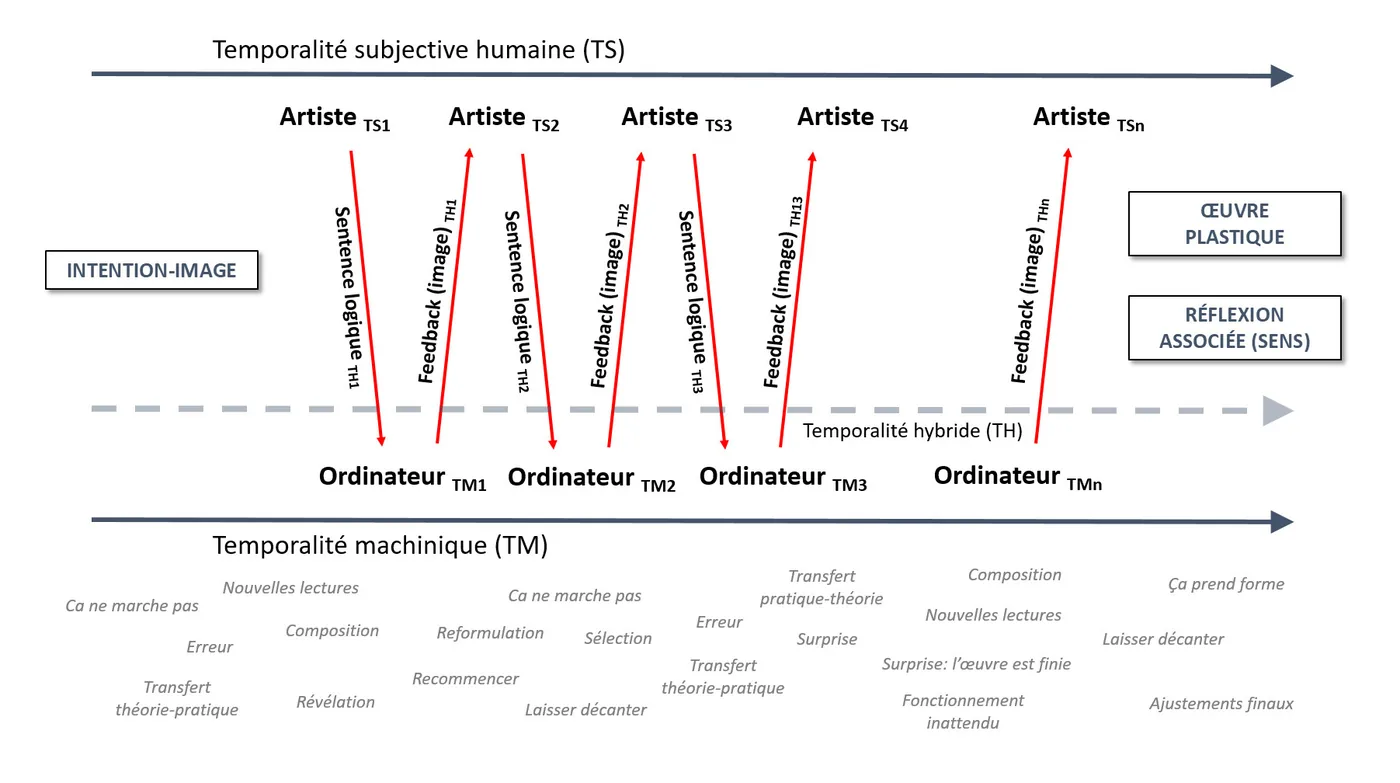
As it advances, the creative process sees its components — algorithm, images, meaning — evolve in a dynamic that does not spare the artist. In the diagram shown, the computing machine is modified by the algorithm as the latter evolves (ComputerTM1, TM2, ..., TMn), while the artist also evolves, even if subtly, throughout the creative process: the artist is no longer the same before and after the execution of the work.
As the starting point of the process, there is no Platonic “Idea” imposing itself on a passive matter, but rather a humbler intention-image: an artistic impetus aimed at the creation of the work, proposed here in resonance with the process of invention as apprehended by Gilbert Simondon, which we considered in the preceding paragraphs. The intention-image, a human intentionality that constitutes the origin and the true engine of the creative process, is endowed with a certain plasticity. It is carried by the artist, who will negotiate the plastic component of the work with the machine, while trying to grasp intelligible elements that make it possible to initiate a reflection, to draw meaning from it. In the course of the process, the artist’s intentionality may come up against other forms of human intentionality (the machine being incapable of having intentions) crystallized within the very material structures of the means of creation.
When the process unfolds felicitously, and the work progressively takes shape, human temporality merges with machinic temporality, giving rise to the expression of a hybrid temporality.
Cite this pageCórdoba, Pablo-Martín. “Human Temporality, Machinic Temporality, Hybrid Temporality”. In Making Digital Images in the Light of Experimental Cinema — Anthropological and Political Resonances of Algorithms in Contemporary Art, Doctoral thesis in visual arts and photography, Université Paris 8 Vincennes-Saint-Denis, Doctoral School EDESTA (no. 159), research unit AIAC, 2026. https://www.pablomcordoba.com/thesis/human-temporality-machinic-temporality-hybrid-temporality/