1.4.4
Generative Notations
In analog avant-garde cinema, we have identified graphic, geometric or mathematical structures which, more or less autonomously, “generate” certain aspects of the architecture of the images and/or sequences that will make up the film. In this respect, as already pointed out, the paper notations we have considered prefigure certain aspects of what is known in the digital realm as generative art. Such is the case of the notation for Paul Sharits’s T,O,U,C,H,I,N,G (1972), in which the chromatic evolution of the images (found in the notation) is determined on the basis of a mandala. One also thinks of the pyramidal structure created by Ladislav Galeta, from which the duration of the sequences of the film PiRâMidas (1972-1984) is derived, and finally of the combinatorial principles that function as the generating core of images — internally partitioned into vertical bands — in Christian Lebrat’s Trama (1980).
The possibilities offered to image-generation systems multiply in the digital, to the benefit of works that orchestrate unprecedented formal structures.
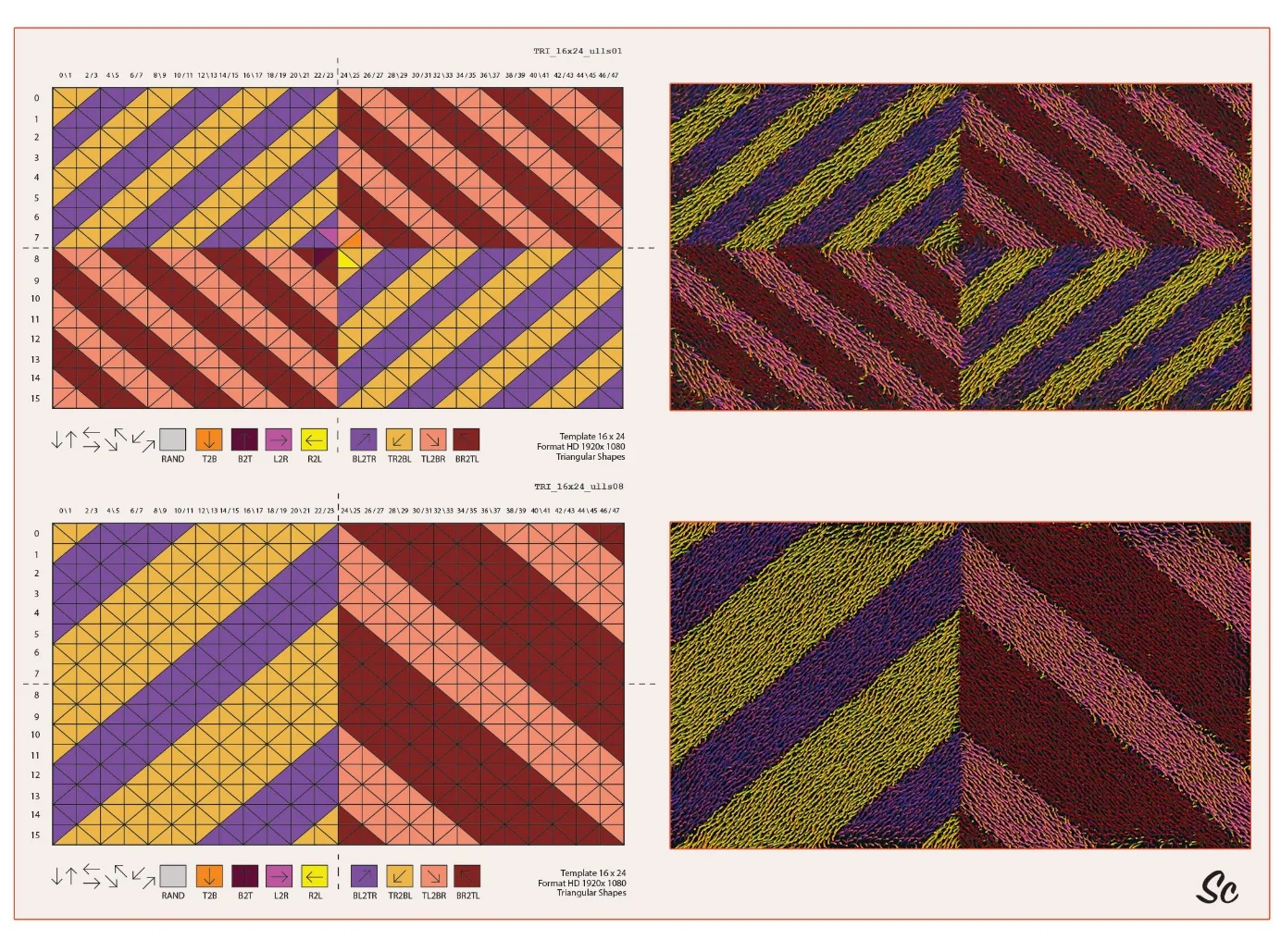
The Spanish artist Toni Mitjanit, for example, generates the sequences of his film AAAC (An Autonomous Agent Choreo) (2016) by having thousands of autonomous agents coexist within the frame of the image, each responding to simple (coded) rules of behavior aimed at simulating natural entities (in this case, sea anemones). The collective behavior of this swarm of agents, unpredictable, generates forms and textures of great complexity. The artist plans the parameterization of his code with the help of notations, which he calls templates (Figure 26), in a creative process that unfolds during coding, but that depends on a long phase of observation and experimentation during which the relevant sequences are chosen1.
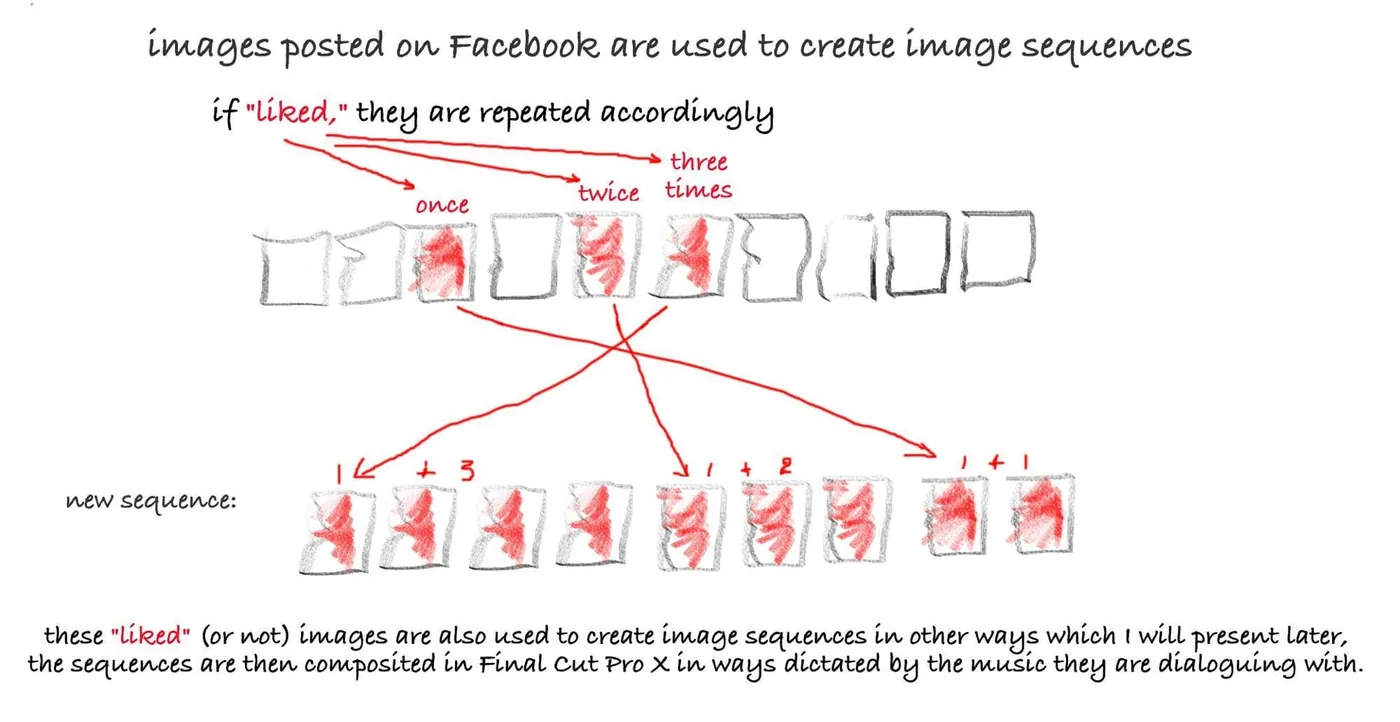
For his part, the Canadian artist Jean Detheux develops a register in which the digital resonates with both painting and music, while taking advantage of the most advanced possibilities offered by the medium. Indeed, in one of his latest projects, still in progress2, the artist shares on Facebook still images taken from his films, with the aim of re-editing the film by favoring the images in proportion to their number of “likes,” that is, by considering the level of approval each image has received within the social network. The participation of the network’s users also generates, according to the protocol pre-established by the artist (Figure 27), a new order for the succession of images in what can be considered a collective montage. In this context, the artist clarifies his method through drawings and also uses numerous working notations to keep track of the most “liked” images — as well as of the operations to be carried out on them —, all of which defines an environment in which Facebook “likes,” rigid but unpredictable, constitute a form of collective generative notation.
We will return in the following chapter to this work, which seemed to us highly telling with regard to the processes of emergence associated with works belonging to the category — the “strategy” — of structurations.↩︎
It is in fact a “metaproject,” so to speak, with the artist’s works as base material, set to evolve according to the public’s choices. This process is presented in a Vimeo collection entitled With Facebook, available at this link https://vimeo.com/showcase/5641128, last accessed in September 2025.↩︎
Cite this pageCórdoba, Pablo-Martín. “Generative Notations”. In Making Digital Images in the Light of Experimental Cinema — Anthropological and Political Resonances of Algorithms in Contemporary Art, Doctoral thesis in visual arts and photography, Université Paris 8 Vincennes-Saint-Denis, Doctoral School EDESTA (no. 159), research unit AIAC, 2026. https://www.pablomcordoba.com/thesis/generative-notations/