2.3.5
Paysage d'hiver (2019)
For various reasons, my visits to Argentina have become increasingly rare, the second-to-last dating back to September 2018. On that occasion, with part of my family, we had taken a short trip into the interior of the province of Neuquén, in Patagonia — where my parents live. In this region of the world, when one travels westward, one crosses a territory that rises gradually at first, then more steeply as one approaches the Andes, while the Patagonian desert gives way to a forest of araucarias.
We were at a small ski resort, at the foot of the mountains, where a little snow still remained at the end of the southern winter, just enough for the children to have fun with their sleds. For my part, I set the camera on a tripod and filmed a sequence of a few minutes, simply capturing people sliding with their sleds down a very gently sloping hillside.
These images remained on a hard drive for several months, until the day I told myself I would try to make something of them. On viewing them, I felt a kind of insufficiency in these sequences in their raw state. So, like a raw material that needs to be prepared, the videos were processed with a radical increase in contrast, accentuating the “graphic” tendency that the images, backlit, already possessed.
An algorithm was designed by means of which the base sequences would be progressively integrated into a composition: offset in time, alternately flipped horizontally, and progressively reduced in size so as to line up one after the other toward the top of the frame. A great number of trials, adjusting the algorithm’s parameters, were needed before a suitable formula was found.
An illusion was thus constructed: that of a landscape of uncertain geometry, since the ground is invisible, in which multiple, incompatible movements take place. In this landscape, which unfolds toward the horizon, the silhouettes slide or walk along descending or ascending diagonals. At this point in the creative process, between the desire — not yet completely satisfied — to see something “take form” and the uncertainty of not knowing whether this would finally happen, I was reassured to see that the image echoed, albeit vaguely, certain “human” landscapes by Bruegel. Moreover, the very concrete echoes that manifested themselves within the video, between versions of the same sequence offset in time and space — like a weaving of space-time — seemed to me to offer points of purchase for the gaze.
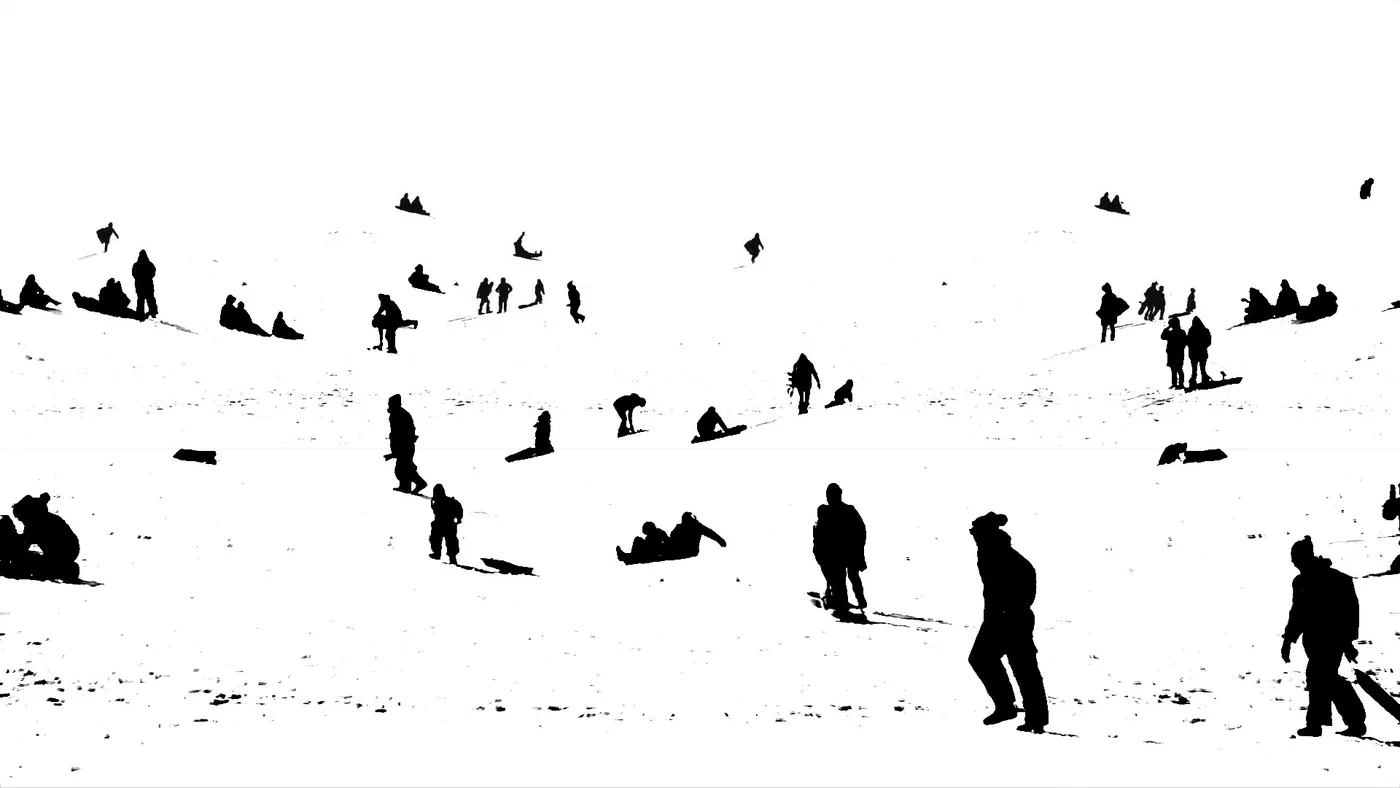
I could not help perceiving, in the image, the confrontation of two temporalities: one machinic — evident through the geometric structure of the composition — and the other more human, expressed in the free movements of bodies and their interactions. The screen became the site of a dialogue between a linear, regular, machinic and fleeting temporality, and another, multiple, irregular one, admitting stopping points, fixations — traces: human temporality.
In a second part of the video, once the landscape has fully unfolded, doublings gradually appear, like local echoes affecting each of the countless silhouettes moving in the image. This new transformation accentuates a process already at work, modulating the interaction between the forms of flow and the manifestations of traces, the latter motionless, giving rise to points of origin and termination for the flows. As if the human were seeking to become wave-like, without ever quite succeeding, unable to detach itself from the affective aspect that resides in its body — liable to be affected by another body, to become a support of traces, and to leave its imprint.
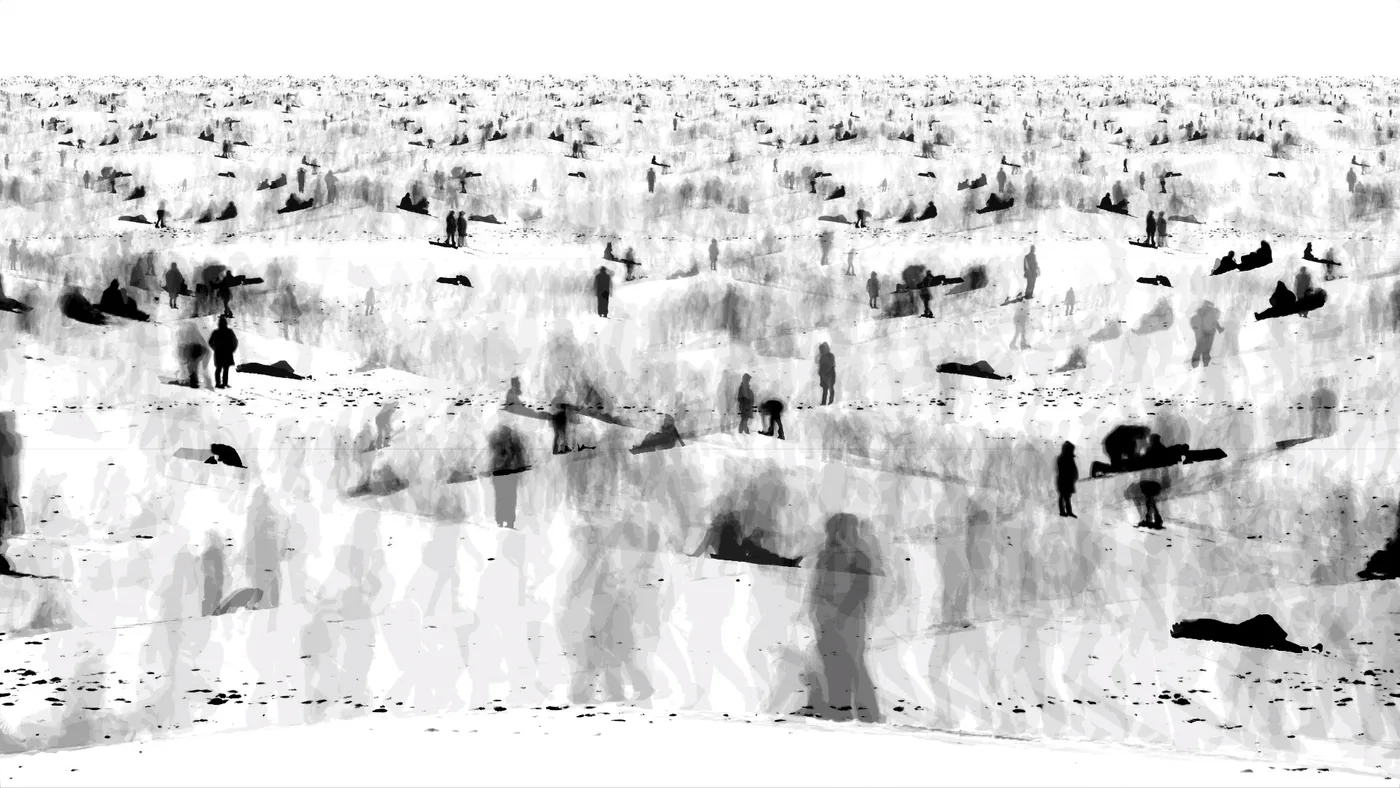
If Gare Paris-Saint-Lazare, 10 avril 2017, 12h03-12h07 evokes a somewhat dystopian vision of a society “channeled” by power through a structure that rigidifies space, Paysage d’hiver offers a glimpse of an environment at once natural and artificial, which can be traversed by free bodies in all directions. These bodies, without paradox, give rise to an undifferentiated human mass while retaining their individual figure and subjectivity, whereas the digital image expresses its dual nature: flow and trace, signal and support1.
An aspect that will be problematized in chapter 4.↩︎
Cite this pageCórdoba, Pablo-Martín. “Paysage d'hiver (2019)”. In Making Digital Images in the Light of Experimental Cinema — Anthropological and Political Resonances of Algorithms in Contemporary Art, Doctoral thesis in visual arts and photography, Université Paris 8 Vincennes-Saint-Denis, Doctoral School EDESTA (no. 159), research unit AIAC, 2026. https://www.pablomcordoba.com/thesis/paysage-d-hiver-2019/