3.2.4
From the Gesture of Moving to the Gesture of Placing
The gesture of manually moving beads, at work when calculating with an abacus, appears in the Pascaline as a rotation of the input wheel, the operator using a stylus to turn the wheel, while the internal gears took care of the carries (when, for a given order of units, one goes beyond ten). This rotating gesture – completely exteriorized in Babbage’s machine in 1837 – was at the heart of small mechanical dispositifs for personal calculation, often used by shopkeepers until the twentieth century (such as the Addiator, patented in France in 1889).
Over the course of the technical genesis that would lead to the computer, the gesture of moving (linear or circular), which modulated a calculating matter, was transformed into a gesture of placing, when mechanics was replaced – by way of electromechanics (Harvard Mark I) – by electronics (with the ENIAC, for example, whose calculations were carried out using vacuum tubes, a decimal machine not yet relying on Boole’s binary logic). This gesture of placing – which Michel Guérin problematizes as the gesture of setting down (poser) – consists in positioning elements in a specific way, so as to direct the signal (here electricity) in one direction or another during the execution of the program, to combine or interrupt currents, blocking their circulation in one direction to allow it in the other, etc. This is what is done on the ENIAC by means of diodes and triodes, a configuration that was restructured as needed – as already mentioned – by rewiring.
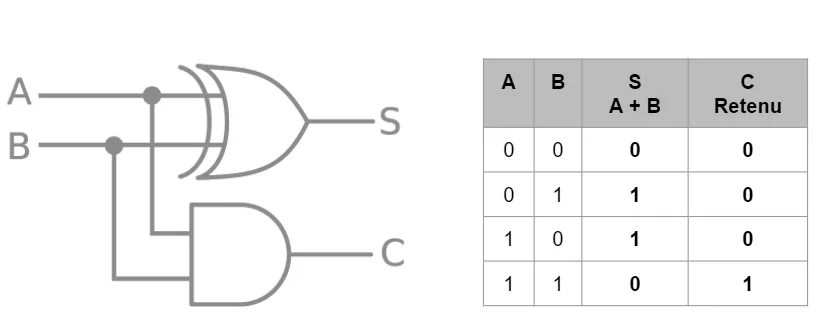
These diodes and triodes physically constitute what are called logic gates: through their morphology, these transform the input signal into a specific output signal. The behavior of these logic gates, depending on different input signals, can be described using what are called truth tables. Thus, the so-called NOT logic gate inverts the signal received – if it receives a 1, it returns a 0, and vice versa – while the AND logic gate receives two values and returns 1 if both values received are 1 (otherwise, it returns 0). For its part, the OR logic gate returns 1 if at least one of the two values received is 1, and the XOR gate returns 1 if, and only if, exactly one of the two values received is 1.
We had imagined – at the beginning of these paragraphs – an installation by the side of a hiking trail where, by means of physical operations performed on white rocks and black rocks, one could increment by one unit an initial number, indicated by a particular configuration of rocks placed on a grid on the ground. We could have imagined a more complex installation, capable of adding two numbers symbolized by two sequences of rocks (the description of how it worked would have been too long). This type of operation can be crystallized in a particular arrangement of logic gates. This is what is called an adder, or a full adder if carries are taken into account (like the carries of an abacus). If we consider only one bit, the adder (with no carry input) is composed of an XOR gate and an AND gate, as the diagram shows.
Over the course of the process of exteriorization of the human calculating gesture, the machinic gesture, once linked to the displacement of matter, becomes a gesture of setting down: one sets down the structure of a logic gate or of a network of interconnected gates, awaiting a signal that will trigger its specific activation. The algorithm, in the form of a program, is also set down in memory. When it is executed, this program materializes as sequences of control signals that organize the electrical flows within the processor, defining the logical state of the transistors. The circuit thus configured is capable of processing the data in the required way.
Cite this pageCórdoba, Pablo-Martín. “From the Gesture of Moving to the Gesture of Placing”. In Making Digital Images in the Light of Experimental Cinema — Anthropological and Political Resonances of Algorithms in Contemporary Art, Doctoral thesis in visual arts and photography, Université Paris 8 Vincennes-Saint-Denis, Doctoral School EDESTA (no. 159), research unit AIAC, 2026. https://www.pablomcordoba.com/thesis/from-the-gesture-of-moving-to-the-gesture-of-placing/