3.4.1
Algorithmic Core, Protocol Zone, Analog Periphery
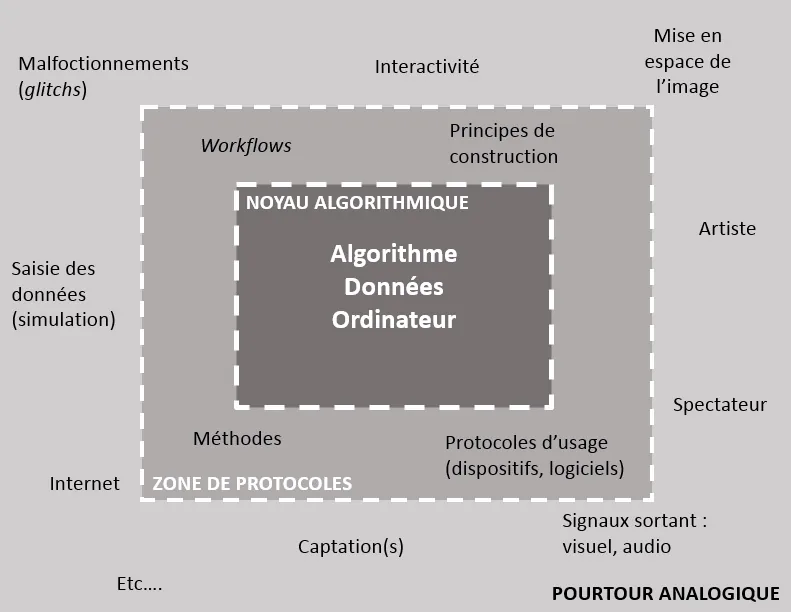
Whatever the intensity with which the creative process “calls” the artistic gesture to manifest itself, the gesture will appear only on condition that forms of uncertainty inherent in the medium persist, ready to be activated. These are distributed across the spatiality and temporality of the creative process, where creation unfolds through countless back-and-forths between the human and the machine, and where the artist’s affective investment plays a fundamental role. It is in this to-and-fro that forms are generated and, with them, the meaning of the work, its symbolic radiance. Around the functioning of the algorithm, to be grasped as the “algorithmic core” of the creative process, are scattered elements obeying analog dynamics (non-discretized, continuous, where energy and matter are transformed while keeping an analogous bearing), within a zone that we will agree to call the “analog periphery”:
- images captured from the real (from a real that emits only analog signals, such as sound and light) by means of cameras (photography, video);
- malfunctions of the system such as the glitch, understood as a material failure;
- recordings and/or samplings of the real providing, over the long term, data intended to adjust simulation models (the notion of capture (saisie) problematized by Jean-Louis Boissier);
- visual or sound signals reaching our senses, which is always analog;
- aspects related to the spatial staging of the work (size of screens, projections, lighting, formats, etc.);
- various traces, of analog origin, that the algorithm can capture and mobilize from the Internet (necessarily digital in their structure, but coming, for example, from captures taken from the real);
- etc.
These non-digital components interact with the digital through the multiple openings it offers. The artist thus finds the computing machine wrapped in a thick analog layer from which emanate uncertainties that irrigate the creative process. These uncertainties are of the same nature as those at work in the real1: thanks to this analog periphery, digital creation benefits from the share of indeterminacy that has always made the various artistic expressions possible.
An intermediate zone must be considered, within the digital creative process, between the analog periphery and the algorithmic core: the zone of protocols. To be placed in this zone are all the systematic approaches set up by the artist during his formal quest, the workflows and technical procedures, the creative strategies following one another in stages of action, in short, any operational stratagem implemented by the artist for a heuristic purpose. This zone, just like the algorithmic core, can call on instructions, on operations that follow one another, some of them probably applied conditionally. Yet by its nature the protocol zone remains analog: it unfolds over a non-discretized, indeed non-machinic, continuity. The presence of this zone may be more or less significant depending on the specificities of each creative process.
They will, however, be specified below, associated with an analog virtual.↩︎
Cite this pageCórdoba, Pablo-Martín. “Algorithmic Core, Protocol Zone, Analog Periphery”. In Making Digital Images in the Light of Experimental Cinema — Anthropological and Political Resonances of Algorithms in Contemporary Art, Doctoral thesis in visual arts and photography, Université Paris 8 Vincennes-Saint-Denis, Doctoral School EDESTA (no. 159), research unit AIAC, 2026. https://www.pablomcordoba.com/thesis/algorithmic-core-protocol-zone-analog-periphery/