2.1.5
Unbinding Code
From the work of Jodi, a duo of artists formed by the Dutch Joan Heemskerk and the Belgian Dirk Paesmans – emblematic figures of online art – the notion of deconstruction naturally emerges, in its simplest conception. It manifests itself on several levels, beginning with the contours and the packaging of the artwork itself. Their work OSS/**** (1999-2005), for example, which offered a diverted operating system and was once distributed on CD-ROM1, was reworked and integrated into a new, larger online work. This work encompasses the whole of Jodi’s output while serving as the website – a very peculiar one, admittedly – of this artist duo: jodi.org. Always in a phase of (de)construction, this site articulates, in a fluctuating way, a growing constellation of websites, each offering varied experiences of disruption of the elements that make up the manifestation of the Internet on the screen.
Built mainly from pieces of code found on the web2, jodi.org forms a vast collage of Internet objects modified by the artists who, curiously, declare that they do not know how to code:
We’re not able to write code ourselves, so we pick it up elsewhere – there’s always a piece of code somewhere that looks like the one we’d like to write – and most of the time, we modify it by simplifying it3.
Jodi destructures its flagship work on the basis of non-mastery, bearing witness to a professed indiscipline. Changing by nature, the work evolves, affected by digital randomness, but also over the long term under the effect of the artists’ interventions, as they frequently modify the underlying code. However, these interventions are not the only source of instability. The very functioning of the jodi.org site adds a further layer of chaos: each visit redirects randomly to one of the many websites that make up the work. Added to this are the evolutions of web protocols and coding layers, which generate “natural” malfunctions superimposed on the intentional détournements. All of this makes jodi.org a fundamentally unstable work, in constant mutation, impossible to delimit.
The Experience of Malfunction
In 2012, an anonymous user, by directly consulting the HTML code at the root of the site, undertook a systematic navigation of jodi.org. They explored, one by one, the 30 redirection links in place at the time, recording their path in a video posted on YouTube4. This kind of controlled navigation is impossible today: the artists have blocked access to the HTML code at the root, probably in response to this kind of methodical exploration. From now on, each visit to the URL https://jodi.org is necessarily an unpredictable experience. The web user may find themselves facing an altered video game, a torn blog, a falsified geolocation application, or a chaotic heap of code characters, often animated and incomprehensible. Dysfunctional buttons, unexpected hyperlinks: the user is left disconcerted, clicking at random in a vain attempt to understand a system that eludes them.
Despite the variety of detours and disruptions introduced by the artists, one constant emerges: the normal link between the movements of the mouse, actions on the keyboard and the behavior of the screen is completely altered. Web navigation ends up turning into a drift – bordering on shipwreck – in an uncontrollable algorithmic sea, in which the user first of all becomes the powerless spectator of unpredictable actions that are triggered – or that they trigger – on the screen. Sometimes, if they wish to pursue the experience, they must close a multitude of pop-up windows displayed by their antivirus software, alerted by the abnormal behavior of this strange website. At times, certain pages opened by jodi.org display maps or networks, suggesting the possibility of some orientation. However, the random behavior of these maps leaves the web user facing a dynamic tangle of diverted and changing forms that blend together, ultimately preventing them from knowing where they come from, and where they are going.
In this vast work, the artists do not limit themselves to generating visual forms from diverted web applications or to the graphic use of ASCII characters. They also appropriate 3D imagery by diverting video game engines. For example, one may come across a naked female 3D avatar performing back flips one after another, totally disconnected from the game’s scenario, or a shooter in an FPS (First Person Shooter) game trying to move around in a confined space, while the confusion is accentuated by the placement of the point of view, inside the character’s very body5. Jodi.org may just as well redirect us to a page on blogspot.com6, where the classic elements of the blog’s structure – titles, table of contents, archives, etc. – are diverted, exposing their usually invisible lines of code. The choices of font and color transform these elements into graphic objects rather than readable information.
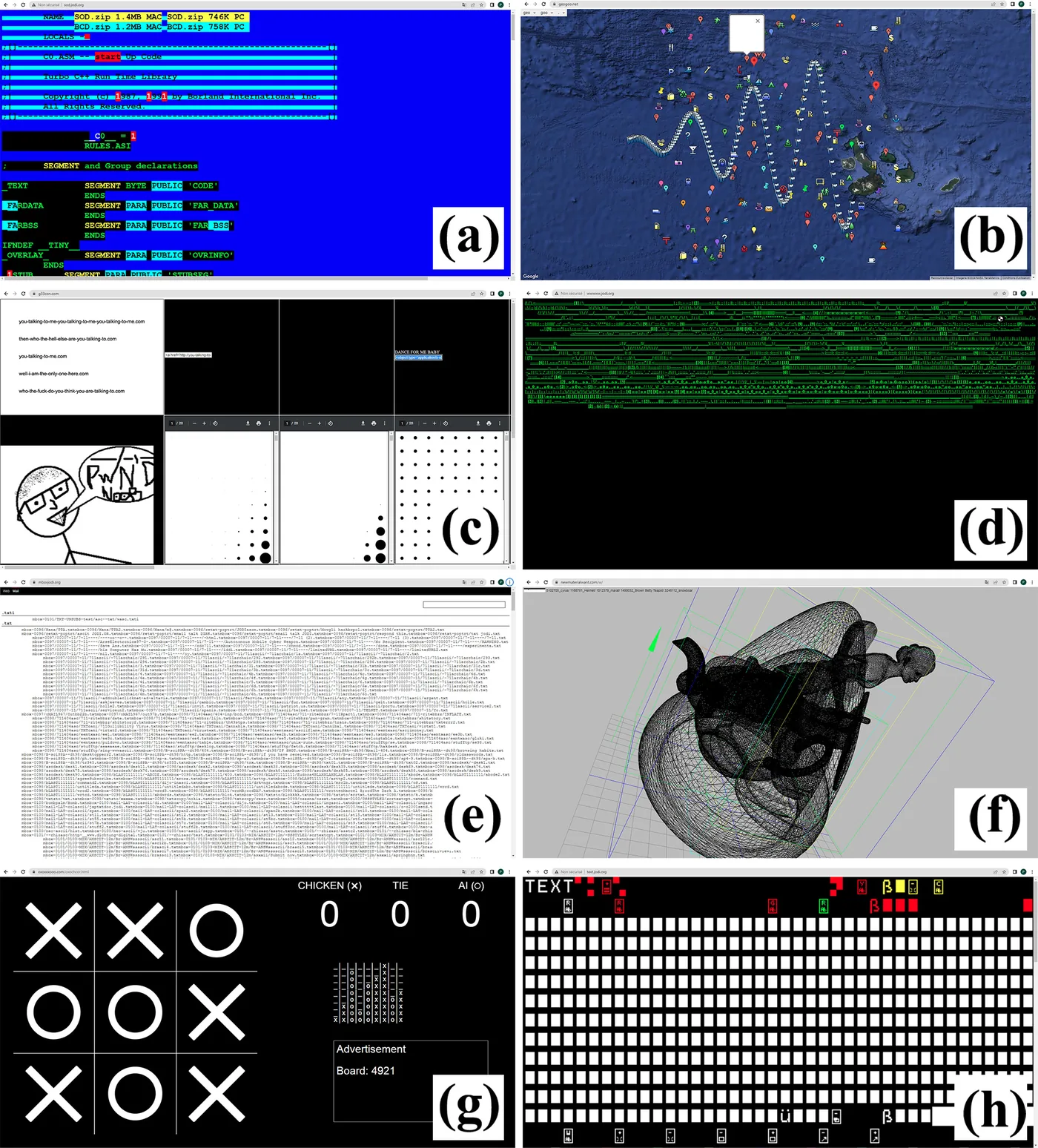
The web user may also land on a web page imitating Google Maps. But whereas Google Maps makes it possible to search for or annotate places of interest – parking lots, subway stations, stores, etc. – or to place pins indicating GPS positions and photos, the map offered by Jodi seems to represent a strange planet, dotted with craters. The places of interest, placed randomly and devoid of real referents, gradually form, with their colored icons, a geometric drawing detached from any functional meaning.
Jodi.org also mobilizes textual elements, as shown by the link leading to the page you-talking-to-me.com. This site presents a succession of pages without content, but whose URLs reproduce the famous dialogue from the film Taxi Driver (1976), in which Robert De Niro, gun in hand, addresses his reflection in a mirror, challenging an imaginary interlocutor7.
When Code Becomes Image
A rare form of contemplative attention ends up prevailing in the user – now a spectator – at the climax of this complex and unstable work, born of the reinvestment of the elements of the Internet, visible or not, in order to make them image. More precisely, if we accept that everything the Internet displays on a screen is first and foremost an image – whether it shows text to be read, playful applications, or contains other images – its organization of buttons, hyperlinks, sliders, etc., makes it an operational image8: by interacting with it, operations are triggered. By breaking the causal links between buttons and the expected operations, by diverting visual codes and establishing random connections between predefined elements, Jodi suspends the usual roles of web elements (textual, playful, communicational). This gesture of disconnection materializes on the screen a profusion of visual scraps that persist, brought back to their primary nature as images.
At times, thanks to the diverted use of characters, which become colored bricks, one has the impression of facing genuine graphic compositions, evoking pictorial experiments from the modernist tradition (Cubism, geometric abstraction…). It is therefore not surprising that the reflection of this artist duo is anchored in art history, traversed by pictorial references9. It is clear, however, that their work cannot be reduced to a mere extrapolation of the artistic tradition. Even if their classical culture shows through behind these machinic images, their approach is above all nourished by “hacker culture10.” This filiation is illustrated by the curatorial choice made for an exhibition held in 2012 at the Sodobna Umetnost contemporary art center, in Slovenia, where snapshots taken from Jodi.org were presented alongside works by other net.art artists. All this in a room described as baroque, where images extracted from the web, set in carved gilt frames, contrasted with walls of a pompous cream red. In a humorous wink, a label read:
Golden frames are an easy and effective thing to do if you want to canonize net.art. This method was first used by Per Platou in Oslo in 2003. You only see the look of things and they are nice11.
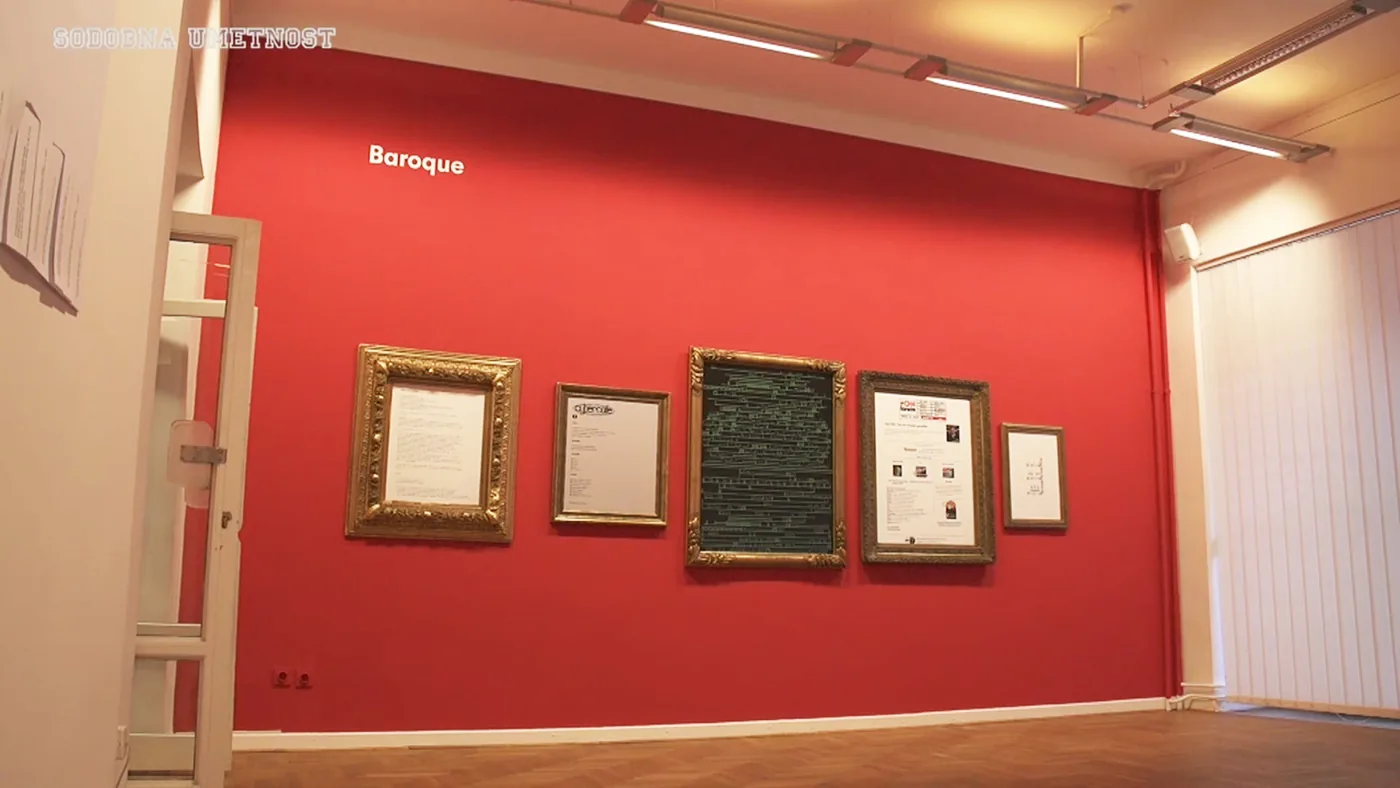
This comment suggests that the continuity between net.art and tradition does not lie in the unchanged conventions of classical reflection on art, but in a common horizon that could not integrate classical aesthetics without subjecting it to reinterpretation.
While a direct comparison between Jodi’s work and the classical artistic tradition – even the pictorial one – is not conceivable, their interest in the articulations between code and image, sometimes explicitly displayed, is undeniable:
[…] in BASIC, the little graphic blocks used to draw images were visible in the code, like little Legos. In the code, you see the program in action, it’s very beautiful. Code is like an image, and when you look at the image, you’re very close to the code, you can understand what’s going on12.
Moreover, it is through a reflection on media that the artists, far removed from the modernist tradition as understood by Clement Greenberg13, recognize the specificity proper to computers:
That’s a specificity of the computer: there are layers. That’s what distinguishes it from video, photography or other media that don’t have hidden levels you can enter […]. There are layers in a painting, but they aren’t active layers. On a computer, what is on the surface is generated by something located at a lower level: the code14.
Figure/Ground Reversals
The becoming-image of code, linked to a form of technical malfunction, can be understood as the emergence of an underlying technical layer, usually invisible, but acting behind the scenes. If code is interpreted as the technical background hidden behind the image (figure) visible on the screen, Gilbert Simondon’s reflection on the failure of the technical gesture resonates particularly with Jodi’s work:
The failure of the technical gesture dephases the technical act into two opposed realities: a figural reality, made of schemas of action, habits, structured gestures learned by man as means, and a reality of ground, the qualities, the dimensions, the powers of the world to which the technical gesture is applied. This reality of ground that underlies the technical gesture is the dynamism of things, that by which they are productive, that which gives them a fecundity, an efficacy, a usable energy15.
The normalized image of the Internet is apprehended, through the prism of Jodi’s work and in light of the Simondonian schema, as the expression of a figural reality directly linked to the standard behavior of the user, accustomed to the schemas of action that the digital image, thus instrumentalized, offers them. But the “dynamism of things” can also be glimpsed, that which makes matter active, the expression of a “preindividual” state dear to Simondon, which will become important in the framework of this research, as we will see. It is by disrupting the usual cause/effect links of Internet navigation that Jodi makes code emerge into the domain of the sensible. This upsurge upends the image, conferring a new status on it: freed from its role as an instrument, it is enriched by a “reality of ground” that opens it to aesthetic experience.
The works considered so far respond to gestures that act on the upper levels of digital images: the topological structure in Samuel Bianchini’s Sniper, the texture of pixels with Takeshi Murata and his Monster Movie, and, below, the symbolic level of code with the duo Jodi. Before these works, we discussed, with Rosa Menkman’s A Vernacular of File Formats, the derangement of the reading process of digital images, a gesture that operates outside the data structure of the digital image. These interventions, even when they are exercised on the upper layers of the image – or directly outside it – make the digital image react on the basis of its most intimate nature, unveiling its hidden secrets.
However, the plastic level of the image – the one seen on the screen or projected – and the symbolic level – code – are in turn erected on a material base. This seems obvious, and yet it is surprising to note that reflection on the digital has largely dispensed with the role of the physical surface of inscription. Far from being a passive and transparent milieu, this surface has specificities that manifest themselves all the way up into the upper layers, and beyond the image. The work of the collective Disnovation.org, which will hold our attention next, sheds light on the nature of this often neglected element, the digital storage support. This largely invisibilized domain carries not only the flows associated with the visible practices of the Internet, but also those pertaining to illegality and piracy.
The digital art collection of the Espace multimédia Gantner in Burgundy (France) holds a CD-ROM version of this work, in its state at the time.↩︎
Can we speak of “found code,” as a digital equivalent of “found footage” in experimental cinema?↩︎
Interview with Jodi by Camille Paloque-Berges, Sophie Daste and Jean-Noël Lafargue, in the journal Amusement, No. 8, April 2012.↩︎
This is the user under the pseudonym NishtyakNishtjacovij, in a video titled Review Jodi.org, https://www.youtube.com/watch?v=Vbs3r-vg92Y, accessed 18 December 2022.↩︎
A dialogue is established between this variation of jodi.org and certain passages of Harun Farocki’s series Parallel (2012-2014). Website: https://www.harunfarocki.de/installations/2010s/2012/parallel.html accessed 1 October 2023.↩︎
Now blogger.com.↩︎
you-talking-to-me.com / well-i-am-the-only-one-here.com / who-the-fuck-do-you-thing-you-are-talking-to.com / you-talking-to-me-you-talking-to-me-you-talking-to-me.com / then-who-the-hell-else-are-you-talking-to.com.↩︎
We have already discussed this notion, as understood by the artist and theorist Harun Farocki, through the prism of Samuel Bianchini’s work Sniper (1999).↩︎
Interview with Jodi, Amusement magazine, op. cit.↩︎
Ibid.↩︎
Original English quote, in the video of the exhibition, web link: https://www.youtube.com/watch?v=LIBYm377Dzw accessed 2 October 2024.↩︎
Interview with Jodi, Amusement magazine, op. cit.↩︎
A tradition within which each medium had the aim of finding its own specificity.↩︎
Interview with Jodi, Amusement magazine, op. cit.↩︎
Gilbert Simondon, Du mode d’existence des objets techniques. Nouvelle éd. revue et corrigée. Paris : Aubier, 2012, p.278.↩︎
Cite this pageCórdoba, Pablo-Martín. “Unbinding Code”. In Making Digital Images in the Light of Experimental Cinema — Anthropological and Political Resonances of Algorithms in Contemporary Art, Doctoral thesis in visual arts and photography, Université Paris 8 Vincennes-Saint-Denis, Doctoral School EDESTA (no. 159), research unit AIAC, 2026. https://www.pablomcordoba.com/thesis/unbinding-code/