2.2.1
Introduction
It is relatively easy to find historical antecedents to creative approaches based on the creation of new structures, since these approaches correspond to the traditionally accepted conception of the making of art. The generation of forms often rests on a pre-existing system of construction, which may take the form of specific know-how, working methods, craft tools or, in the case of the so-called apparatus-based arts, apparatuses and dispositifs for capturing, processing and rendering images.
r0.5
Without aiming at any form of exhaustiveness, and to illustrate our point schematically, we may recall that central perspective – formalized by Leon Battista Alberti in De pictura (1435) – constitutes a system allowing artists to structure the space of pictorial representation. This system of graphic construction – which survives inside our technical dispositifs for capturing, generating and rendering images – makes it possible to determine, for each element represented, its size on the canvas according to its real size, while the representation of its volume is governed by vanishing lines that all converge toward a single point on the surface of the image. Atmospheric perspective, for its part, described by Leonardo da Vinci in his notebooks, serves to assign tonalities and levels of definition to the objects represented, according to their proximity to or distance from the point of view.
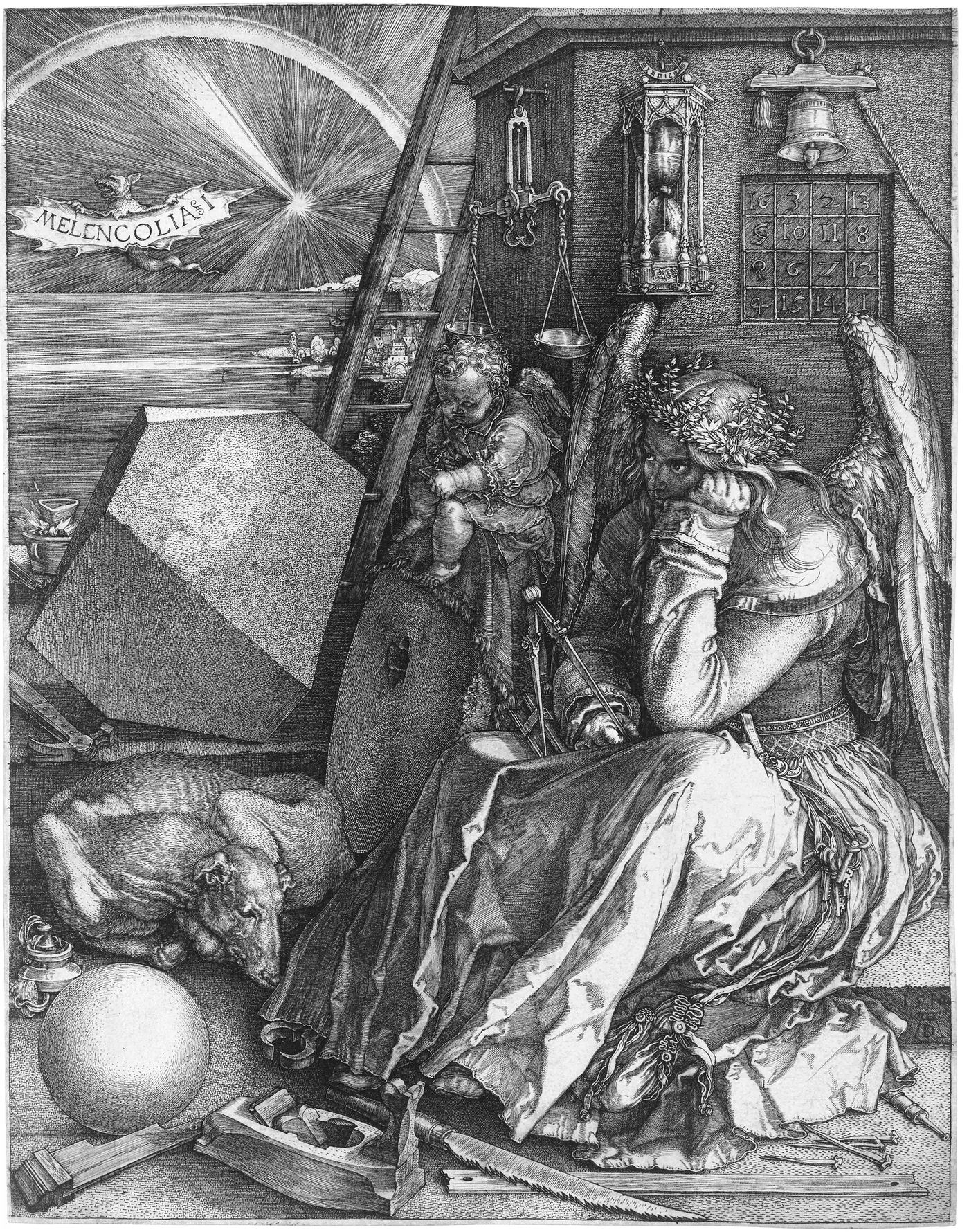
During the Renaissance, some artists proceeded by transcribing the perceived image of the real onto a pictorial plane previously discretized into regular rectangles. They did so by using the grid composition device known as the perspectograph. In his treatise Instruction sur la mesure avec le compas et la règle (1525), Albrecht Dürer illustrates the implementation of this method through numerous engravings. His famous Melencolia I (1514), whose symbolic richness can only be evoked here, stages a panoply of tools available at the time for structuring and materializing the representation of space: implements of geometric construction (compass, ruler), tools of material execution (saw, hammer, nails), as well as associated measuring instruments.
In sculpture, the “pointing” method makes it possible not to generate but to transpose the spatial structure modeled in clay – the object of the sculptor’s fundamental gesture – into marble or limestone. The introduction of this method made possible the remarkable evolution from archaic sculpture to the classical sculpture of Greek Antiquity, of which the sculptor Praxiteles was one of the tutelary figures. This technical innovation made possible a more supple and dynamic representation of the human body, with increasingly accentuated contraposti and torsions, at the antipodes of the frontal rigidity of the archaic Kouroi and Korai, the latter being produced by direct carving in the final material (marble or stone).
Long before classical Greece, and for millennia, formal production in ancient Egypt obeyed the strict application of ancestral canons, invariable – or nearly invariable – models that regulated the representation of bodies very precisely. When correctly applied, these canons ensured the “efficacy” of the representation – menekh – by favoring the return, after death, of the king to the divine world from which he had come.
In every period, the tradition of the so-called minor arts has also offered modular methods of formal generation through the repetition of predefined patterns. Such is the case of molds in ancient and medieval sculpture, as well as of matrices in weaving. Medieval illumination in Europe, like metalwork, is marked by the presence of structures resulting from the repetition of basic elements, such as interlace made up of highly complex sequences of animal and/or plant motifs – meshes which, in the arts of Islam, took on more geometric and abstract forms known as arabesques.
On the Ruins of Central Perspective
The pictorial experiments of the avant-gardes, described earlier as adventures in the deconstruction of central perspective, each undertook, on its ruins, structuring projects that aspired – with the probable exception of cubism – to establish themselves as new hegemonic paradigms for the representation of the real world, as the many manifestos written by these groups of artists attest.
Each avant-garde claimed its own vision of the world and its own way of representing it, in the face of a real that, since the invention of photography in 1827, no longer belonged to the domain of classical – academic – representation, and that, in the postwar period of the twentieth century, often became an object of mistrust or contempt.
From the multiplication and recombination of points of view, the cubist proposal was born, a project that sought, outside of illusionism, a representation of the real more faithful to perceptual experience. The cubists experimented while structuring their method, which evolved over the course of the intense research1 of Pablo Picasso and Georges Braque, soon joined by Juan Gris: from their “Cézannian” beginnings, through an analytical phase, the structural complexification of the representation ended up impairing its clarity, which led the artists, during a phase known as “synthetic2,” to add textual elements to their canvases in order to make up for the loss of legibility due to figurative fragmentation.
For their part, and during the same period, the futurists, obsessed with technical progress and the acceleration of the world, favored speed as the supreme expression of a real that was thereby transformed. From a fixed point of view, their method aimed to structure the representation through the juxtaposition of successive fragments, drawn from contiguous temporalities, in order to represent the real in its moving quintessence.
A little later, surrealism developed a series of dispositifs – automatic writing, the paranoiac-critical method, etc. – aimed at generating forms from the liberation of the unconscious. Their strategy of the exquisite corpse, a collective work based on individual contributions without any artist exercising control over the composition as a whole – in literature, in music or in drawing – constitutes a clear antecedent that prefigures the phenomenon of emergence – of forms, and of meaning – that will interest us in connection with structuring digital creation.
As for the various forms of pictorial abstraction – lyrical, geometric, suprematist, etc. – each claimed its own method, its own forms and the meanings associated with them, as so many means of structuring a representation deemed pertinent to the foundations of the real.
Thus, the first avant-gardes can be understood as movements which, by way of the destructuring of central perspective3 constituted themselves as projects aiming to grasp the real more faithfully, outside of all illusionism, on the basis of different strategies of representation structured by methods of construction, echoing the diverse – and not always compatible – visions of the world that drove these powerful artistic movements of the early twentieth century.
Apparatus-Based Structurations
With technical dispositifs for capturing images, beginning with photography, the principles of form generation became further materialized. The photographic camera can be understood as the convergence of a photosensitive support capable of fixing an image and a camera obscura, the latter materializing the principle of central perspective.
While a whole branch of photographic practice, known as experimental, was built on unconventional uses of the camera, other proposals, without resorting to détournements of the dispositif, managed to explore sensible territories and to establish themselves as legitimate art forms.
Such is the case of photographic currents that artistically sublimate so-called “documentary” imagery, as expressed in various events in the postwar United States4, in what is known as French humanist photography – with Robert Doisneau, Henri Cartier-Bresson and Willy Ronis, among others –, in the German New Objectivity, or again in the Düsseldorf School initiated by the Bechers (Hilla and Bernd). The latter bear particular witness to the force of a working protocol capable of inscribing images within a rigorous systematicity, thereby introducing a new layer of meaning5.
The application of a protocol in the creation of photographic forms structures the approach of countless artists, among them Sophie Calle (Filatures parisiennes (1978–1979), Suite Vénitienne (1980)) and Edward Ruscha (Twentysix Gasoline Stations (1963), Every Building on the Sunset Strip (1966)). In fortunate cases, this protocol-based implementation lets forms emerge that the artist finds interesting and integrates into the work – a principle that echoes that of emergence, which will be addressed in the digital context.
In cinema, outside experimental cinema – structural film will be discussed more specifically below –, there are films that owe their depth, at least in part, to the application of rigorous protocols. Chantal Akerman’s film Jeanne Dielman, 23, quai du Commerce, 1080 Bruxelles (1975) can be approached from this angle. Indeed, in a dilated temporality, the film’s images follow one another according to a protocol so strict that, in a new scene, because of a slight delay, Jeanne is forced to sit for several minutes at the right-hand edge of the imposed frame: her favorite table in her usual café, always filmed with the same framing, was already occupied by an anonymous character.
Video art has also given rise to works built on the “standard” functioning of capture and processing dispositifs, their use being guided by protocols thanks to which new forms can emerge. Thus it is through a sequence of instructions on the use of various kitchen utensils – presented in alphabetical order and filmed in a frontal and sober mise-en-scène6 – that Martha Rosler, in Semiotics of the Kitchen (1975), progressively structures a dynamic of revolt against the oppression of women in patriarchal society. For his part, in Around & About (1980), Gary Hill puts a text into images through a simple but rigorous protocol: a still image appears on screen for each syllable spoken. The artist, who describes this dispositif as a “What if” type of scenario, thus manages to bring forth a coherent audiovisual form from minimal but strictly followed rules.
“A” Structural Film
In the framework of this research, the essence of what is called “structural film” is understood as a cinematic tendency in which the sensible plastic manifestation – moving image, sound – is articulated with a formal principle that can be stated intelligibly. Thus, in Michael Snow’s words, we clearly find the formal principle of his film Wavelength (1967), unanimously recognized as an emblematic work of structural film:
The film is a continuous zoom which takes 45 minutes to go from its widest field to its smallest and final field. It was shot with a fixed camera from one end of an 80 foot loft […]. The room (and the zoom) are interrupted by four human events including a death. The sound on these occasions is sync sound, music and speech, occurring simultaneously with an electronic sound, a sine-wave, which, in forty minutes, goes from its lowest note (50 cycles per second) to its highest (12,000 cycles per second)7
The field of reflections and practices associated with structural film is of particular interest in the framework of this research, since setting in tension, on the one hand, the formal – even generative – principle of the works of analog structural film and, on the other, the use of the algorithm in digital works makes it possible to clarify the mode of existence of these two regimes, while making explicit certain issues related to the transition from the analog to the digital within experimental cinema. Work of this kind was carried out in the previous chapter (chapter 1), by analyzing works of experimental cinema associated with notations on paper8. For these works, the formal principle is materialized in the notations on paper, which – as we have seen – do not serve only to analyze the film, but also function as tools of concrete construction, notably when these notations serve to guide the manipulations, sometimes artisanal, of the celluloid.
The aim, then, is to inscribe the tradition of structural film as an analog antecedent of the digital works that will be addressed next: works which, by means of algorithms and interfaces, generate new structures without disrupting pre-existing ones. To do so, however, it is first necessary to take a position with respect to the debates and controversies that have surrounded the notion of structural film since its formulation by P. Adams Sitney in 1969 in the famous journal Film Culture, founded by the brothers Adolfas and Jonas Mekas in 1954.
According to P. Adams Sitney, who reformulated his own definition of structural film in 1974, when Visionary Film. The American Avant-Garde was published9:
[Structural film is] a cinema of structure in which the shape of the whole film is predetermined and simplified, and it is that shape which is the primal impression of the film. The structural film insists on its shape, and what content it has is minimal and subsidiary to the outline10.
An understanding of structural film likely to resonate with our research must necessarily qualify Sitney’s proposal on several levels. Certainly, the overall shape of so-called “structural” films may be simplified, but this does not mean that they are simple forms. To cite just one example, the notation for Paul Sharits’s film T,O,U,C,H,I,N,G (1972) – which we studied in chapter 1 – displays a high level of complexity, deployed on several levels – image, sound, text – in a notation that is intelligible overall, but that also contains enigmatic segments.
The predetermined aspect of the overall shape of the structural film, as Sitney conceives it, is also problematic. Indeed, almost all the inscriptions on paper addressed in chapter 1 — comparable to the overall shape to which Sitney refers — are punctuated with notes, additions and corrections. These marks bear witness to the fact that these notations, in their initial state, undergo reworkings, modifications, adjustments, even complete overhauls, in a constant back-and-forth between the notation — an intelligible formal principle — and the sensible result.
The initial notation cannot therefore be grasped as a pure Platonic “Idea,” simply inscribed onto the — passive — matter of the film11. Indeed, as understood here, notations on paper trigger the creative process and guide it, while themselves being transformed in the course of it. As the materialization of the intentionality that guides the construction of the film, these notations involve a form of plasticity that echoes the one Michel Guérin associates with artistic intention12.
Thus the notation on paper, understood as a guiding proposal, is reassessed — often upward — according to partial results, according to what the artist perceives in their film under construction.
A particular case, which allows us to qualify by other means the completely predetermined character of the intelligible structure of the structural film — as Sitney suggests — is that of Rose Lowder. Indeed, as we have seen, the artist builds the notation at the same time as the film, the latter being made frame by frame, edited as it is shot, literally woven in the 16 mm Bolex camera. Through its mechanical design, this apparatus allows frame-by-frame capture on any frame of the reel, thanks to a mechanism that allows the film to be advanced or rewound before recording. Martin Arnold’s films, for their part, are accompanied by extensive notations, resulting from long experimentation. Thus, regarding the construction of Pièce Touchée (1989), the artist states:
At the beginning, I experimented with certain forward and backward movements. Naturally, most of the material produced was worthless, but I repeatedly corrected and developed the most promising passages. In this way, I was able to advance step by step toward a final product13.
In light of these creative processes, Sitney’s tendency to overestimate the weight of the intelligible, to the detriment of the sensible, in his conception of structural film becomes clear. For him, structural film “is a cinema of the mind rather than the eye14.”
Nothing seems more foreign to the approach favored in the framework of this research, which sees in structural film — and in experimental cinema in general — a practice anchored in the materiality of perception. This does not exclude, of course, the participation of intelligible elements — which will come to be articulated with the sensible —, comparable to what Sitney designates as the activity of the “mind15.” Indeed, structural film concerns first of all the perception of the artist, essential in the construction of the film over the course of its creative process. Subsequently, the film will in turn solicit the perception of the spectator facing the work. Sitney thus appears too oriented toward the importance of language, from which follows his conception of the primacy of narration, aspects that will be considered at the end of this chapter.
Structural-Materialist Experiments
Filmmakers such as Malcolm Le Grice and Peter Gidal defend an apprehension of structural film that comes closer to our intuitions. It goes by the name of structural-materialist film16, and approaches practices from the standpoint of their creative process, which carries a depth that cannot be dispensed with.
Michael Snow, a sculptor of time, seems close to this conception of experimental cinema defended by Le Grice and Gidal; he himself distances himself from Sitney. Indeed, in an interview, when an attempt is made to liken his work to that of Andy Warhol — the latter being considered by Sitney as the great precursor of structural film — Snow declares:
I don’t think there are many affinities [between his work and Warhol’s]. Although some of Warhol’s films have something “theatrical” about them, they are essentially documentaries, whereas my films are constructions17.
The act of constructing — like that of deconstructing — stems here from a making that unfolds along a creative process, subject to adjustments and reformulations aimed at modulating the effect of contingencies — fortunate or not — that manifest themselves on the plane of experience, and that are apprehended by the artist through the sensible, in a permanent negotiation with matter.
Let us say, by way of synthesis, that the works traditionally associated either with structural film, or with the so-called formalist current that precedes it, and/or with the post-structural current that succeeds it18, appear as expressions that prefigure the “structuring” practices that work images through algorithms. This holds provided that these analog films are approached as experiments in construction, whose experiential aspect cannot be neglected, and whose formal aspect — like any symbolic resonances — is elaborated from an initial proposal that triggers the process but evolves, always articulated with the fundamentally sensible component of the work: the film projected or perceived on screen.
The works making up this second part of the central corpus will be addressed with these more or less distant antecedents in the background, while taking into account other references that will emerge. As mentioned earlier, these will be works that do not rest on the malfunctions of the technological system, but that are shaped by the generation of new structures without affecting pre-existing structures — a process intensified in the digital environment thanks to the action of algorithms and interfaces, which multiply, as never before, the possibilities of manipulating the support of inscription.
The exploration of these approaches will be followed by general considerations aimed at problematizing the works as a whole. It has been possible, not without difficulty, to grasp certain conceptual elements, some of which evoke passages — from the virtual to the actual, from the possible to the real — likely to contribute to a better apprehension of these transformations. The latter seem to fit into the pre-existing theoretical landscape while also departing from it. Indeed, these artistic approaches point to human19 and machinic finitudes — which find expression at the heart of the process, stemming from the limits of matter and from a time that emerges from it — while also calling for recognition of the role of the sensible within every creative process. Hence the need to qualify the almost systematic equivalence that has been established, on the philosophical plane, between the possible and the real. These structuring works cannot be thought independently of the temporality of their creative process, conceived as a back-and-forth between human and machine. These reflections will be initiated here, then developed further in chapter 3.
Finally, the aim will be to grasp how, like the Destructurations, these works that “structure” also propose an overall movement from the outside of the digital image toward its inside, reaching the symbolic layer located beneath the sensible plane, in resonance with the physical foundation that constitutes the support of the image. This movement traces the contours of the body of the digital image, structured on the materiality of the medium, an aspect that will be specified in chapter 4.
Which lasted seven years in all, from Picasso’s founding act with Les Demoiselles d’Avignon (1907) to the culminations of synthetic cubism around 1914.↩︎
This periodization and its meaning, notably in the passage from analytical to synthetic cubism, were in reality complex and marked by specificities proper to each artist. See in this regard John Golding, Le cubisme. [s. l.] : Julliard, 1962.↩︎
As far as surrealism is concerned, this is true above all of the exquisite corpse. Indeed, as is well known, most surrealist painters individually continued to make use of central perspective. Their destructuring then occurred not through the form but through the content of the representation: the latter, marking a departure from the real, aimed to describe the dream world and to express the activity of the unconscious.↩︎
Notably the exhibition The Family of Man (1955), curated by Edward Steichen, and New Documents (1967), presenting the work of Diane Arbus, Lee Friedlander and Garry Winogrand. These events followed the first monographic photography exhibition at MoMA, American Photographs (1938), devoted to the images of Walker Evans, notably those bearing witness to the Great Depression.↩︎
If, in photography, these approaches are not associated with what is called experimental photography, this does not mean that they are devoid of experimentation – the latter simply lies outside the technological means used.↩︎
In a register reminiscent of certain kitchen scenes in the Akerman film mentioned.↩︎
P. Adams Sitney, Le cinéma visionnaire, op. cit., p.334.↩︎
These works can be considered centered on structural film, although some – like Kubelka’s work – belong more precisely to the formalist current, which, according to P. Adams Sitney, prefigures structural film while differing from it. Others – such as those of Martin Arnold, Rose Lowder or Christian Lebrat – more often belong to what is called a “post-structural” current.↩︎
Translated into French by Paris Expérimental: P. Adams Sitney, Le cinéma visionnaire, op. cit.↩︎
Ibid. p.329.↩︎
With the exception of the film PIRAMîdas (1972–1984), by the Croatian experimental filmmaker Ladislav Galeta (1947–2014), in which a kind of strong idea seems to find expression through a highly coherent notation, seeking unreservedly to impose itself on the matter of the film, which, in our view, inhibits any emergent expression in this work.↩︎
In Michel Guérin, “Qu’est-ce qu’un médium artistique ?”, in Appareil, op. cit.↩︎
Martin Arnold and Scott MacDonald, «Sp... Sp... Spaces of Inscription: An Interview with Martin Arnold ». Film Quarterly [en ligne]. October 1994, vol. 48, n° 1, p. 2–11.↩︎
P. Adams Sitney, Le cinéma visionnaire, op. cit., p. 330.↩︎
And which it would be better to apprehend within a more immanent framework.↩︎
See in this regard Peter Gidal, Materialist film. London : Routledge, 2014.↩︎
Remes, Justin. « Sculpting Time: An Interview with Michael Snow », Oakland University, 2012.↩︎
Despite the varying levels of relevance that the literature attributes to these three categories, as well as the heterogeneous relations between the films attached to them — inspiration, extension of research, opposition, reactions. See Christian Lebrat, Entre les images, op. cit., p. 85, for a definition of post-structural film.↩︎
An essential aspect of the use of the digital, largely ignored in the literature — with the exception of Bernard Stiegler, who makes it a central element of the bond between the human and technics.↩︎
Cite this pageCórdoba, Pablo-Martín. “Introduction”. In Making Digital Images in the Light of Experimental Cinema — Anthropological and Political Resonances of Algorithms in Contemporary Art, Doctoral thesis in visual arts and photography, Université Paris 8 Vincennes-Saint-Denis, Doctoral School EDESTA (no. 159), research unit AIAC, 2026. https://www.pablomcordoba.com/thesis/structurations-introduction/